
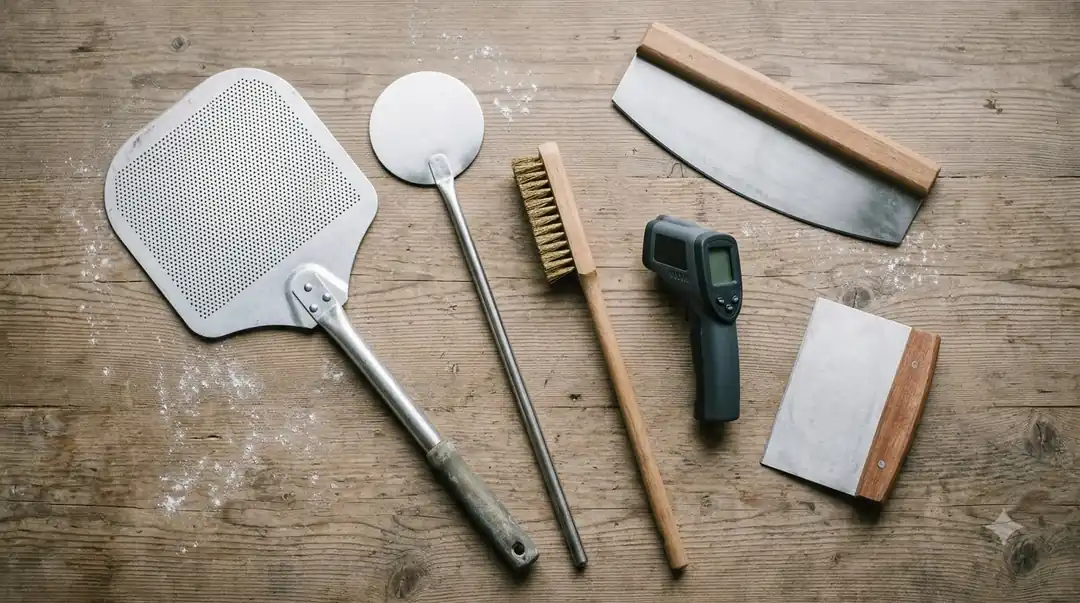

Knowing how to stretch pizza dough by hand comes down to relaxing the dough, then pressing it into a thin round. Press air from the center toward the edge to form the crust, then enlarge the base with a hand technique. You do not need to toss it in the air.
A relaxed dough, a light dusting of flour or semolina, and patience matter more than strength. If the dough springs back, let it rest before you push again.
What You Need Before You Start
To learn how to stretch pizza dough, start with a dough ball that has rested at room temperature, a light dusting of flour or semolina, and a clean, cool work surface.
Gozney suggests flour, semolina, or a 50/50 mix of the two for dusting, and notes that semolina is more forgiving for beginners. Flour your hands lightly, then toss the ball in the dusting mix before you lift it off the counter.
Remove watches, rings, and other jewelry first. Ooni’s guide says jewelry can cause tears in the dough, and Gozney adds fake nails to that list. Stretching takes practice, so expect the first base to be rough.
- Flour or semolina for dusting
- A clean, cool, debris-free work surface
- A dough ball that has rested but is not limp
- Bare hands, free of rings, watches, and jewelry
How Long Pizza Dough Should Rest Before Stretching
Dough usually needs about 2 to 4 hours at room temperature before it stretches easily, and up to 8 hours in a cooler kitchen, according to Gozney’s pizza dough guide.
Under-resting is the most common reason dough fights back when you try to stretch pizza dough. Gozney warns that dough which has not relaxed enough will spring back when you stretch it.
Use a quick poke test. Press a dough ball gently with one finger. If it springs back straight away, the gluten is still tight. If the dimple holds for a moment, the dough is ready to stretch.
If the dough still resists, King Arthur Baking suggests walking away and letting it rest for 15 minutes, or longer if necessary. Cover it with an upside-down bowl, a damp towel, or reusable food wrap so the surface does not dry out.
For a slower schedule, King Arthur also suggests refrigerating preshaped dough overnight and shaping it the next day, which lets the gluten relax fully.
How to Stretch Pizza Dough Step by Step
To stretch pizza dough by hand, press the middle three fingers of each hand from the center toward the edge to form a thick outer crust before you widen the base.
Gozney’s method builds the crust first and the size second. Ooni’s guide uses a similar order, starting with a finger press that flattens the ball and pushes your hands outward.
- Flour your hand lightly, then toss the dough ball thoroughly in the dusting mix, as Gozney describes.
- Set the ball in front of you and press with the middle three fingers of each hand, moving air from the center toward the edge.
- Stop when the crust is about 1 to 1½ inches wide, the target Gozney gives for the rim.
- Enlarge the base with one of the hand techniques in the table below, keeping the shape as circular as possible, as Ooni advises.
- Hold the base up to the light to check thinness, and pinch any small holes shut.
- If the dough snaps back at any step, stop and rest it, as covered in the rest section above.
Brands differ on the rim. Gozney aims for a crust of 1 to 1½ inches, while Ooni’s guide leaves about 1 cm (roughly 0.4 inch) of dough untouched at the edge. Pick the rim size that suits your oven and taste, then keep it consistent from pizza to pizza. If you are still choosing a recipe, the Neapolitan pizza dough recipe makes a dough that suits this method.
Comparing Hand Techniques for Enlarging the Base
When you stretch pizza dough, Gozney describes three hand techniques for enlarging the base, the knuckle duster, the steering wheel, and wax on/wax off, and suggests combining them when needed.
| Technique | How it works | Notes from the source |
|---|---|---|
| Knuckle duster | Drape the base over your knuckles, lift it to eye level, then move your hands apart while rotating. | Gozney |
| Steering wheel | Hold the dough by its edge without gripping the crust, and pass it hand to hand so gravity stretches it. | Gozney says it suits less relaxed dough |
| Wax on/wax off | Put both hands inside the crust with the surface well floured, rotate, and pull your hands apart. | Gozney |
| DJ deck | Place both hands flat on the disc, rotate it, and pull your hands in opposite directions to flatten lumps. | Ooni |
The steering wheel relies on gravity. Ooni says you can pinch right from the edge or handle a wider part of the base closer to the center, depending on how big you want the base. Your grip also changes the crust height.
Ooni also describes a parachute step for the final thinning. Curl your hands as if holding a mug, drape the dough over them, then lift and move your hands outward. Use it on thick spots, and pinch any tears back together. For more detail, see Ooni’s stretching steps.
Why Pizza Dough Snaps Back or Tears
Dough that snaps back when you stretch it is usually under-rested, because kneading and shaping tighten the gluten and it needs time to relax.
King Arthur Baking explains that kneading, folding, and shaping tighten the gluten, so dough resists stretching. Its fix is to rest the dough and press outward rather than pull on it, as laid out in King Arthur’s pizza dough guide.
Tears have a few common causes. Gozney lists jewelry and fake nails, and advises a cool, clean surface free of debris. Ooni notes the dough is unlikely to rip at the steering wheel step unless it is paper thin when you start that step.
Relaxation involves a trade-off. Wetter doughs are softer and behave differently, as the guide to high hydration pizza dough explains. Gozney notes that a very relaxed dough opens easily but is harder to handle, so a less relaxed dough gives beginners more control and fewer tears.
These habits cause most failed stretches:
- Stretching the dough straight after shaping, before it has rested
- Pulling at the edges instead of pressing outward
- Working on a dirty or cluttered surface
- Wearing rings or watches while handling the dough
Pan Pizza Versus Round Pizza
Pan pizza dough should skip the round preshape, because a round shape makes it harder to stretch into a rectangular or square pan, according to King Arthur Baking.
The same article advises pressing and pushing the dough outward rather than pulling it. That motion works for free-form rounds as well as pan styles, so one technique covers both.
This guide on how to stretch pizza dough covers hand stretching only. For a thinner finished base, see this thin crust pizza dough recipe, and for the full workflow from dough to oven, read how to make pizza at home. If you use a pasta machine or a rolling pin, treat that as a different method with its own rules.
Frequently Asked Questions
Do I need to toss pizza dough in the air?
No. The hand methods in this guide press, drape, and rotate the dough, and none of them require tossing. Ooni’s steps show how a base can be enlarged without throwing it. Start with the finger press and build from there.
Should I use a rolling pin on pizza dough?
This guide does not use one. King Arthur Baking recommends pushing and pressing the dough outward rather than pulling it, a motion that works for both free-form rounds and pan pizza. Master that motion first, then compare other tools.
How thin should the base be before topping?
Ooni suggests holding the base up to light to check its thinness, and for a Neapolitan style, a lot of light should show through. Thin the base gradually, since according to Ooni the dough is unlikely to rip at the steering wheel stage unless it is paper thin when you start.
What if my dough keeps springing back?
Rest it longer. Gozney’s poke test shows whether the gluten is still tight. King Arthur Baking suggests a 15 minute rest, or longer if necessary, covered so the surface does not dry out.
What should I dust the dough with?
Gozney recommends flour, semolina, or a 50/50 mix of the two. The brand says semolina is more forgiving for beginners, so it is a sensible first choice. Dust your hands and the work surface before you stretch.
Is a less relaxed dough easier for beginners?
Gozney says beginners may prefer a less relaxed dough because it offers more control and fewer tears. A very relaxed dough opens easily but is harder to handle. Move to a more relaxed dough once your hand motion feels steady.
Learning how to stretch pizza dough takes practice, so work on one dough ball before you stretch a full batch. Start with a well-rested, less relaxed dough and the finger press, then add the steering wheel once the rim forms evenly. Keep the dough cool and clean, and stop whenever it snaps back. Once the base is ready, check the pizza oven temperature guide for baking.