
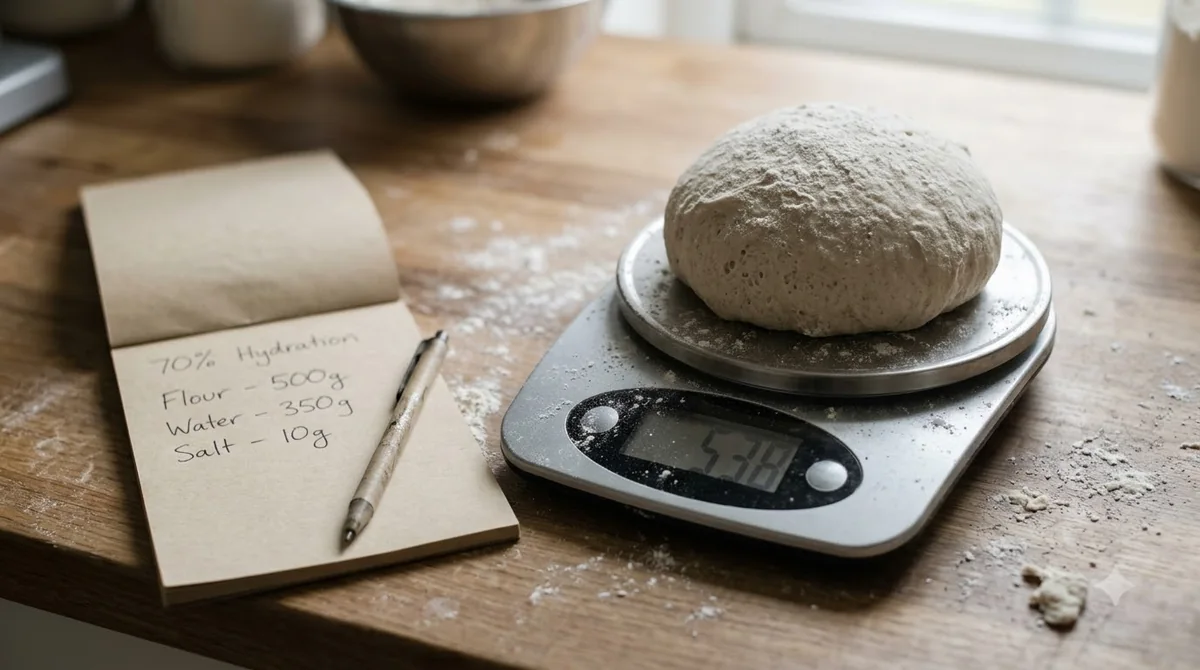

The neapolitan pizza dough recipe uses only flour, water, salt and yeast, with no oil or sugar. The AVPN standard for Verace Pizza Napoletana sets the ratios and a total fermentation time of 12 to 24 hours. Following those figures gives you a dough that matches the traditional method at home.
The figures below come from the AVPN 2024 regulations, so you can copy the same ratios in your own kitchen. Oven heat and baking time are covered separately (see pizza oven temperature), so this guide stays on the dough.
Neapolitan Pizza Dough Recipe Ingredients and Ratios
The AVPN ratio for one liter of water is 1,600 to 1,800 grams of flour, 40 to 60 grams of salt and 0.1 to 3 grams of fresh yeast. Every amount in this neapolitan pizza dough recipe starts from the water, so weigh the water first and scale the rest from it.
The flour range works out to about 55.6 to 62.5 percent hydration, which matches the AVPN absorption range of 55 to 62 percent. The table shows the full ratio and a smaller batch built on 500 ml of water, which is easier to handle in a home bowl.
| Ingredient | Per 1 liter of water | Scaled to 500 ml of water |
|---|---|---|
| Water | 1 liter (1,000 g) | 500 g |
| Flour, type 00 | 1,600 to 1,800 g | 800 to 900 g |
| Salt | 40 to 60 g | 20 to 30 g |
| Fresh brewer’s yeast | 0.1 to 3 g | 0.05 to 1.5 g |
| Dry brewer’s yeast | One third of the fresh amount | One third of the fresh amount |
| Natural sourdough | Under 10% of the flour weight | Under 80 to 90 g |
The regulation allows fresh brewer’s yeast, dry brewer’s yeast and natural sourdough. It does not allow chemical dry yeast with added improvers. Weigh every ingredient on a digital scale, because a cup of flour can vary with how it was packed, while grams give the same dough each time.
Choosing Flour for Neapolitan Dough
Type 00 flour (see what is 00 flour) is the base of any neapolitan pizza dough recipe that follows AVPN, and the standard allows a small share of type 1 flour, between 5 and 20 percent of the blend. The regulation sets these specifications for the 00 flour in a Neapolitan dough:
- Strength (W): 250 to 320
- P/L ratio: 0.50 to 0.70, with 0.6 as the ideal
- Water absorption: 55 to 62 percent
- Protein: 11.5 to 13.5 grams per 100 grams
- Ash: below 0.55
Strength tells you how the flour holds up during a long rise, and protein sets how much gluten the dough can build. The full table of values sits in the AVPN 2024 international regulations, which is the primary reference for this ratio.
Not every neapolitan pizza dough recipe uses the same hydration, and Polselli 00 flour is one example of a flour sold for pizza. Modernist Cuisine’s version runs at 62.3 percent and uses instant dry yeast in place of fresh yeast, while its proportions stay close to Naples. The same guide notes that AVPN now permits variations beyond 00 flour and sourdough starters.
Mixing Order and Kneading Time
Start with the water, add the salt and yeast next, then add the flour gradually. This order keeps salt and yeast from touching for more than 5 minutes, which the regulation says would damage the yeast cells. Every neapolitan pizza dough recipe built on the AVPN method uses this order.
The dough can be mixed by hand or in a fork, spiral or plunger-arm mixer, and the order stays the same for each neapolitan pizza dough recipe. Follow these steps for the mixing stage:
- Pour all the water into the bowl.
- Dilute the salt and yeast directly in the water, adding them one after the other.
- Add the flour gradually to avoid lumps. This stage takes about 10 minutes to reach the dough point.
- Knead for no more than 20 more minutes, depending on the mixer.
- Stop when the dough is moist but not sticky, and it comes away cleanly from the bowl.
The regulation also warns about overworking. Extra mixing heats the dough and organizes the gluten into fibers, a process the AVPN calls stringing. Stringing damages the elasticity of the dough and starts oxidation, so a neapolitan pizza dough recipe should stop once the dough feels right.
How Long Neapolitan Dough Should Ferment
The AVPN sets total fermentation at a minimum of 12 hours and a maximum of 24 hours, depending on the flour, temperature and humidity. A neapolitan pizza dough recipe rested in a warm kitchen will reach the end of its window sooner than one kept in a cool room. Plan the rise around your baking day so the dough lands inside the 12 to 24 hour window.
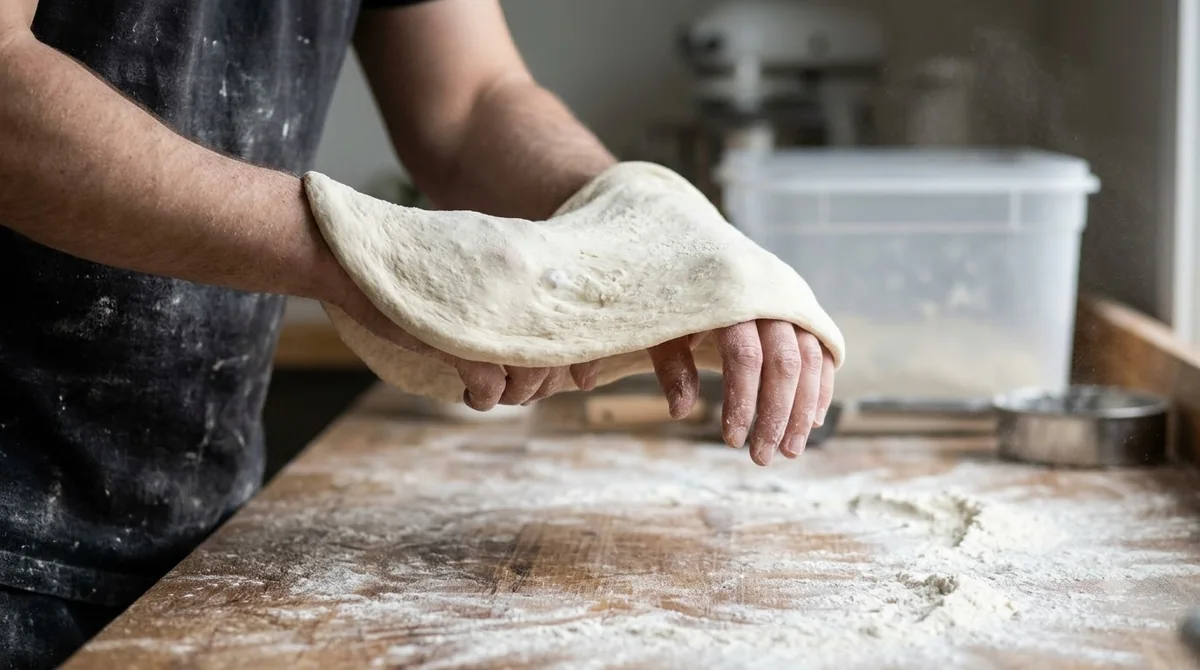
After mixing, the dough rests on the bench covered with a damp cloth. The cloth stops a hard skin from forming as water evaporates from the surface, which lets the dough settle before you cut it into portions.
After portioning, the balls go into covered food boxes for a second fermentation. The regulation’s ideal proofing box holds 18 to 20 °C with 60 to 70 percent humidity. Maturation during this stage breaks proteins and starches into simpler parts, which the AVPN says makes the dough more extensible and easier to digest.
Modernist Cuisine describes a longer schedule, with a bulk fermentation of 20 to 24 hours at room temperature, followed by about 3 hours of balling and proofing. That total can go past the AVPN 24-hour maximum, so treat it as another method rather than the same standard.
Dividing, Shaping and Resting the Dough Balls
Divide the dough into 200 gram balls for a 22 to 24 cm pizza, or 280 gram balls for a 28 to 35 cm pizza. The AVPN sets the ball weight in proportion to the diameter, so a larger pie needs more dough. The same ball sizes apply to any neapolitan pizza dough recipe that follows the AVPN ratios.
| Dough ball weight | Finished pizza diameter |
|---|---|
| 200 g | 22 to 24 cm |
| 280 g | 28 to 35 cm |
Cut each portion with a spatula and shape it into a ball by hand, using a method close to mozzarella making. Dust the ball lightly with flour just before you stretch it, so the dough does not absorb too much flour from the surface.
Press outward from the center with your fingers until the disc is about the size of your hand, then stretch the edges. The AVPN notes that this movement pushes air toward the rim, which forms the cornicione. The rim should stand 1 to 2 cm high after baking, and the center should be 0.25 to 0.30 cm thick, with a tolerance of plus or minus 10 percent. These are finished pizza measurements, so the disc will look thicker before it goes into the oven.
Common Dough Mistakes to Avoid
Four errors can throw off the balance of any neapolitan pizza dough recipe: adding fat or sugar, using chemical yeast with improvers, overworking, and cutting the rise short. Each one has a clear rule behind it.
- Adding oil or sugar. The AVPN says never add any fat or sugar to the dough.
- Using chemical dry yeast with improvers. The regulation does not allow it, so stick to brewer’s yeast or sourdough.
- Overworking the dough. Extra kneading heats it and damages the gluten network.
- Shortening the rise. A fermentation under 12 hours falls below the AVPN minimum.
Frequently Asked Questions
Can I use bread flour in a neapolitan pizza dough recipe?
The AVPN standard is built on type 00 flour and allows up to 20 percent type 1 flour in the blend. A plain bread flour dough, such as pizza dough with bread flour, is an adaptation rather than the standard, so expect a different texture. Compare the flour’s protein and absorption with the AVPN ranges before you start.
Is sugar or olive oil allowed in neapolitan pizza dough?
No. The AVPN regulation says never to add any fat or sugar to the dough. Many home versions of a neapolitan pizza dough recipe include oil, but the standard leaves it out, so omit it if you want to follow the traditional method.
Can I use instant dry yeast?
The AVPN allows dry brewer’s yeast at one third of the fresh amount, and chemical dry yeast with improvers is not allowed. Modernist Cuisine uses instant dry yeast in its own version, so check the label to confirm the product is plain yeast.
Is sourdough allowed in neapolitan pizza dough?
Yes. The AVPN allows natural sourdough at under 10 percent of the flour weight, so a sourdough version of a neapolitan pizza dough recipe is still within scope.
Can I ferment the dough for less than 12 hours?
You can, but a shorter rise for a neapolitan pizza dough recipe falls outside the AVPN minimum of 12 hours. The dough will still bake, yet it will not match the regulation’s timing or its texture goals.
Use the AVPN figures as a starting point for any neapolitan pizza dough recipe, then adjust the water slightly for your flour and kitchen temperature. Write each batch’s weights in a notebook, so you can repeat the good batches and fix the rest. When the dough is ready, a classic margherita pizza with fresh basil and mozzarella is the simplest way to test it.