
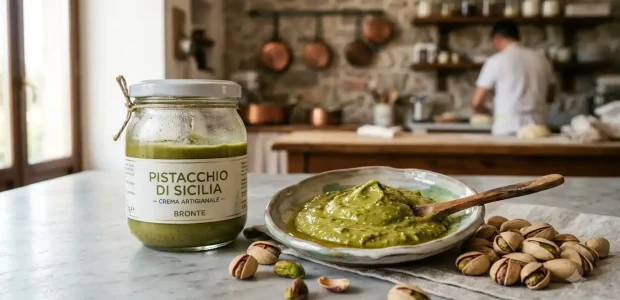

Pistachio paste is concentrated ground pistachios with little or nothing added, while pistachio cream is a sweet, spreadable product that blends pistachios with sugar, oil, and often milk. That gap is the whole pistachio cream vs pistachio paste difference in practice: it decides whether a jar belongs on your toast or inside your gelato base, and the word on the front won’t always tell you which one you’re holding.
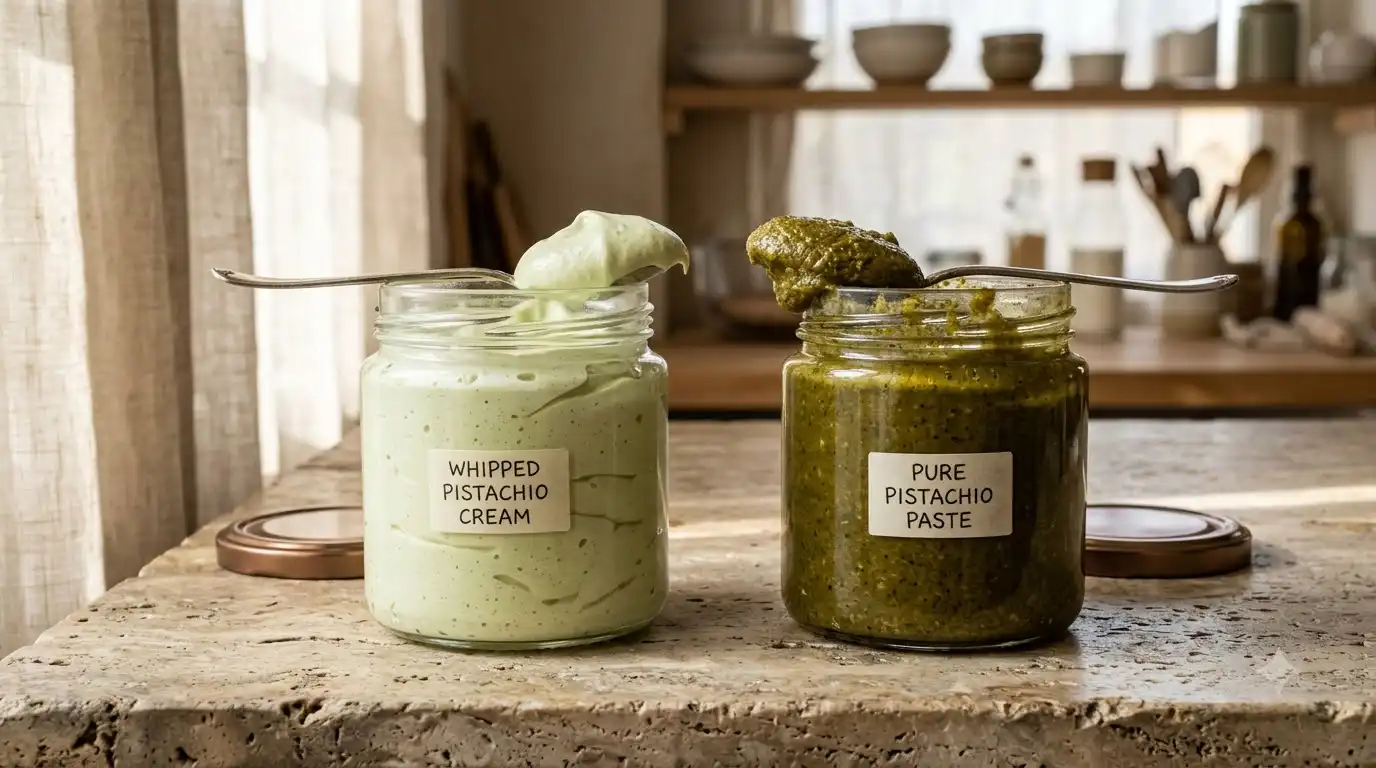
Pistachio Cream vs Pistachio Paste: The Side-by-Side Difference
The real difference comes down to dilution: paste is almost all nut, while cream stretches the nuts with sugar, fat, and sometimes dairy so it spreads straight from the jar.
Where brands publish numbers, the gap is wide, and the guides don’t fully agree on how wide. Délice Pistachios, a Malaysian paste supplier, puts pure paste at 90% to 100% pistachio and cream at roughly 30% to 60%, depending on the brand. Arvione, a Philippine pistachio cream brand, gives a lower 15% to 30% for premium creams and says paste typically runs 65% to 100% pistachio. Treat those ranges as ballpark figures from sellers rather than an industry standard. The percentage printed on your specific jar is the only number that matters.
| Feature | Pistachio paste | Pistachio cream |
|---|---|---|
| What it is | A concentrated ingredient | A finished, ready-to-eat spread |
| Pistachio share | Very high, often close to 100% | Noticeably lower, varies by brand |
| Sweetness | Unsweetened or barely sweet | Pre-sweetened |
| Typical add-ins | None, or a little oil | Sugar, vegetable oil, emulsifier, often milk powder |
| Texture | Thick and dense, oil may separate | Smooth, glossy, spreadable |
| Eat it straight? | Not really, it’s built to be mixed in | Yes, that’s the point |
| Who controls the sugar | You | The manufacturer |
The trade-off is control versus convenience. Délice frames paste as the version that leaves decisions to the cook and cream as the one that has already made them for you. Paste makes you do the sweetening and balancing, but nothing in the jar fights your recipe. Cream skips that step, but it locks in a sugar and fat level you can’t remove later.
Why the Labels Are So Easy to Mix Up
Product names in this category aren’t standardized, so the ingredient list tells you far more than the word “cream,” “paste,” or “butter” on the front.
Khoshbin Group, an Iranian pistachio supplier, points out that paste and pistachio butter are both pure pistachio with different textures, and that manufacturers sometimes sell one under the other’s name. It gets messier with hybrid names. Wholesale Italian Food carries a Gusto Etna product called Sicilian Pistachio Butter Cream, and the retailer’s own FAQ explains that it is a sweet cream rather than a 100% pistachio paste, and that it is made with pistachios and milk ingredients. A shopper who reads “butter” as a sign of a pure product would pick up the wrong jar.
There’s a quality trap as well. Khoshbin warns that some products sold as pistachio paste or butter are really made from bitter almond paste plus green coloring, which delivers the color without the pistachio taste.
A quick label check before you buy
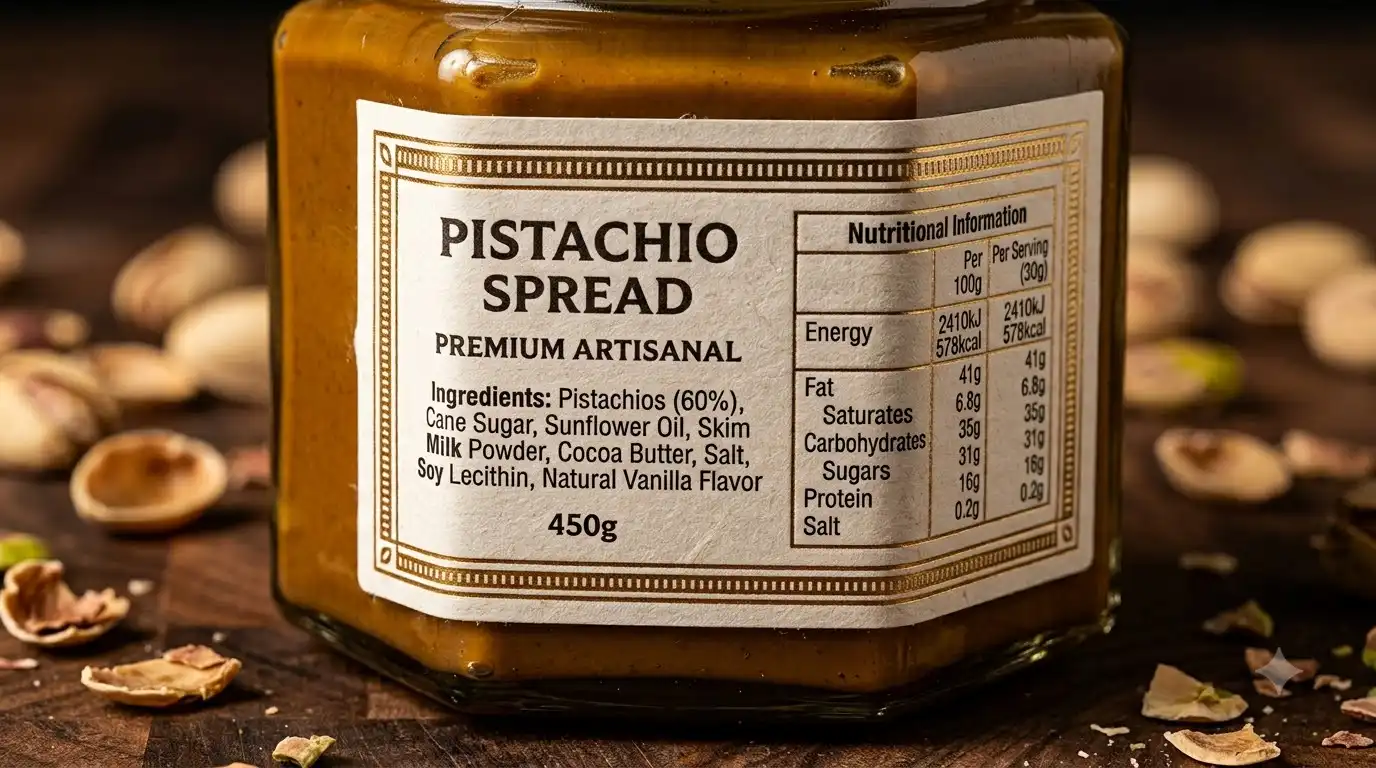
- Count the ingredients. Délice’s rule of thumb is that a true paste lists no more than three ingredients, while a cream usually lists five or more.
- Find the pistachio percentage. If a jar doesn’t declare one, compare it against a jar that does before you pay a premium for it.
- Check where sugar lands. According to Délice, a “paste” with sugar as its second ingredient is effectively a cream.
- Scan for milk. Paste made only from pistachios has no dairy, but many creams add milk powder, which matters if anyone you’re feeding has a milk allergy.
- Watch for added green. Délice treats colorants such as chlorophyllin or synthetic greens in a paste as a sign the nuts weren’t vivid enough on their own.
Which One Works Better in Baking, Gelato, and Drinks
Use paste whenever the recipe sets its own sugar and fat, and use cream when the product goes straight onto the food with no further mixing.
| Use | Better pick | Why |
|---|---|---|
| Gelato and ice cream base | Paste | Keeps color and flavor intense after churning |
| Buttercream, frangipane, croissant filling | Paste | Cream’s extra oil and emulsifiers can destabilize the mix |
| Toast, pancakes, waffles | Cream | Already sweet and smooth, zero prep |
| Dubai-style chocolate bar filling | Cream | Sold as a ready filling to mix with kataifi |
| Pistachio latte | Either | Cream blends in as is; paste needs sweetener and liquid first |
| Savory sauces and dressings | Paste | Unsweetened base won’t add sugar |
For frozen desserts, Délice notes that the dairy and sugar in cream can fade a bright green gelato into a dull grey-green, while pure paste holds its color through freezing. Saveur’s pistachio gelato recipe goes further, advising readers to skip anything labeled “pistachio cream” because that name signals nut content cut with sugars and stabilizers. In baking, Délice reports that cream can make pistachio buttercream split or turn grainy, and can cause baked frangipane to weep liquid into a tart shell.
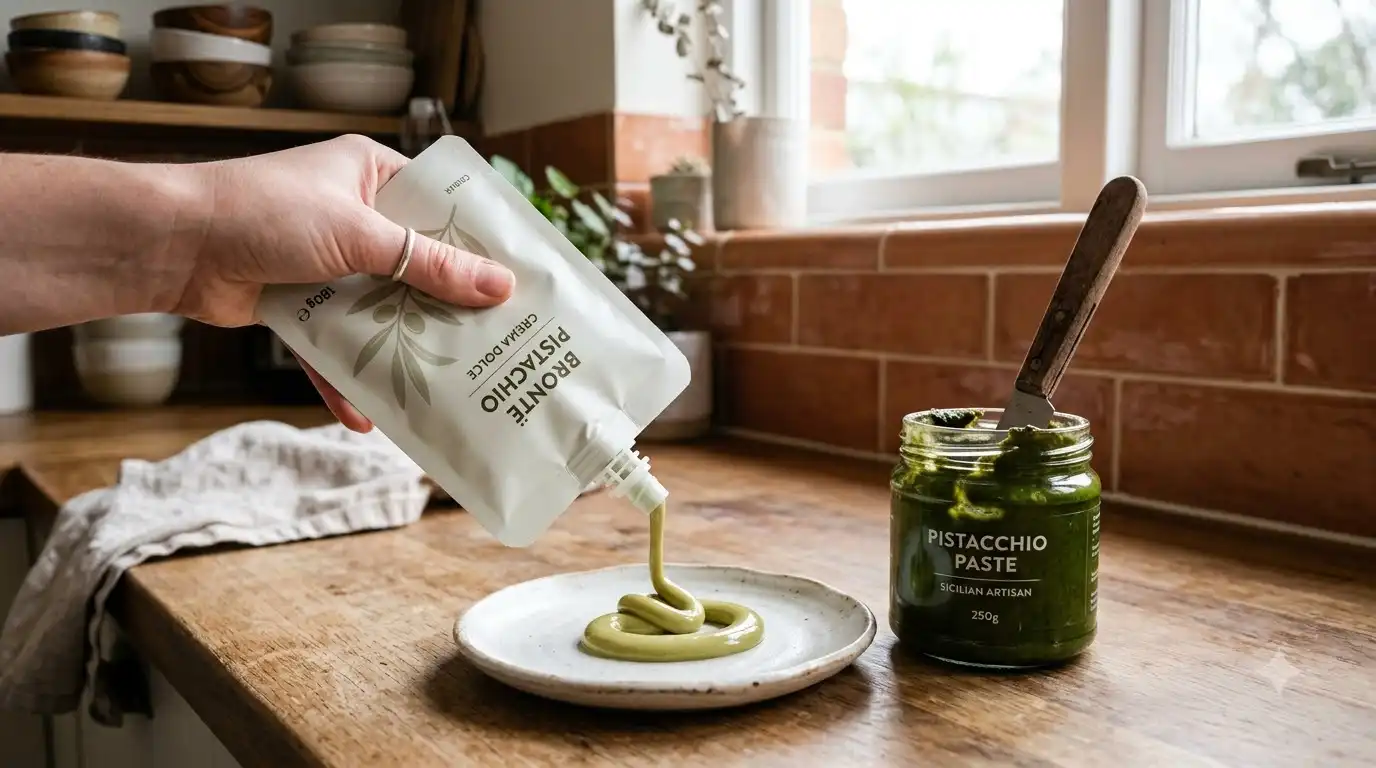
Drinks are the one place both work well. Wholesale Italian Food says its Gusto Etna cream pouch mixes smoothly into cold or warm milk for lattes, while its 100% paste has to be blended with a sweetener and a liquid such as syrup or milk first, since it isn’t a ready flavoring.
For a home cook who wants a pistachio fix a few times a month, cream covers most needs. Paste earns its higher price when you bake often, make gelato, or care about exact sweetness and color.
Can you swap one for the other?
Only in one direction. Délice says cream is not a reliable substitute for paste because its added sugar and fat throw off a recipe, especially in baking, but paste can be turned into cream. If you have paste and want a spread:
- Stir the jar well, since natural oil separation is expected in pure paste.
- Blend the paste with powdered sugar.
- Loosen it with a neutral oil such as sunflower.
- Taste and adjust. Délice suggests about 60% paste, 25% powdered sugar, and 15% oil as a starting ratio for a toast spread.
If a recipe calls for paste and cream is all you have, Délice recommends cutting the recipe’s other sweeteners and fats significantly and expecting a less precise result.
What the Price Gap Looks Like at Wholesale Italian Food
Per gram, pure paste costs more than twice as much as sweet cream, which tracks once you remember that cream is stretched with cheaper ingredients.
As checked on September 17, 2026, Wholesale Italian Food lists the Gusto Etna 100% Sicilian Pistachio Paste in a 172g jar at $12.30, and the Gusto Etna Sicilian Pistachio Butter Cream in a 400g squeeze pouch at $11.00. The per-100g figures below are simple math on those single-unit prices.
| Product | Type | Size | Single-unit price | Approx. cost per 100g |
|---|---|---|---|---|
| Gusto Etna 100% Pistachio Paste | Unsweetened paste | 172g jar | $12.30 | $7.15 |
| Gusto Etna Pistachio Butter Cream | Sweet cream, contains milk | 400g pouch | $11.00 | $2.75 |
Buying in volume narrows the cost on both. The paste drops to $10.33 per jar at 240 or more units, and the pouch falls to $9.46 each at 320 or more units. The retailer also advertises free shipping on orders of $99, applied automatically at checkout, and offers a 3kg paste format for high-volume kitchens.
The sticker gap can be less painful than it looks. Arvione describes paste as intense and designed to be diluted into recipes rather than eaten on its own, so a small jar may stretch further in baking than its price per gram suggests. Prices and tiers on this kind of catalog change, so confirm the numbers in your cart. Before you check out, look at Couponaro’s Wholesale Italian Food page for a working code; when a store has no offer that passed testing, the page says so instead of listing a dead code.
Quick Answers Before You Buy
Is pistachio butter the same as pistachio paste?
Usually close, but not identical. Arvione describes pistachio butter as unsweetened ground pistachios, often roasted, with a texture that ranges from coarse to smooth depending on grind time, while paste is typically ground finer for pastry work. Just avoid anything labeled “butter cream,” which may be a sweet cream.
Does pistachio cream contain dairy?
Often, yes. Arvione lists skimmed milk powder among typical ingredients in dairy versions of pistachio cream, and the Gusto Etna pouch sold by Wholesale Italian Food contains milk ingredients. Always read the allergen line rather than assuming.
Why is pistachio paste so expensive?
It’s close to pure nut with no cheaper fillers. Arvione notes that a 1kg jar of paste needs roughly 1kg of raw pistachios, and premium varieties from Gaziantep or Bronte are costly even at wholesale.
If all you want is pistachio on toast, pancakes, or a homemade Dubai-style bar, sweet cream is the cheaper and faster buy. If you bake, churn gelato, cook savory dishes, or need to control sugar, pay the extra for paste, and treat any jar whose ingredient list leads with sugar as a cream, whatever the front label calls it.
Last updated: September 18, 2026

Elliot Long spent seven years buying paid search and social traffic for e-commerce brands before starting Couponaro. That work taught him how much of the coupon web runs on codes that expired years ago. He runs this site on his own, dates every page he updates, and would rather tell you a brand has no working code than waste your time at checkout.