


The Journal 18 Track Pad Pro is the top choice if your goal is diagnosing why you shoot 84 instead of 78, because it tracks technical metrics beyond raw strokes.
Written by the Couponaro Golf Gear Team. All product specifications, prices, and dimensions are verified directly against manufacturer technical documentation as of September 2026.Couponaro is reader-supported. When you purchase through links on our site, we may earn an affiliate commission at no extra cost to you.
1. Which Journal 18 Model Tracks Scores Best?
While traditional scorecard tracking records only gross score and total putts, Journal 18 designs dedicated physical notebooks that isolate miss patterns, club yardages, and recovery percentages. Deciding between their three core notebooks comes down to how much detail you want to write down during play:
Choose The Track Pad Pro ($79.00)
You want comprehensive round metrics, shot dispersion plots, smartphone scanning support, and wipe-clean pages that last multiple seasons.
Choose The Performance Journal ($54.00)
You care about mental preparation, post-round reflection, and swing thoughts on archival Tomoe River paper without needing to erase past rounds.
Choose The Track Pad Lite ($40.00)
You prefer a thin, minimalist companion that slips right behind your golf club scorecard to note basic fairways and putts without slowing down pace of play.
2. Journal 18 Model Breakdown: Specs, Pricing, and Scoring Layout
Each Journal 18 notebook addresses a specific type of golfer, varying widely in page materials, physical bulk, and data tracking capability.
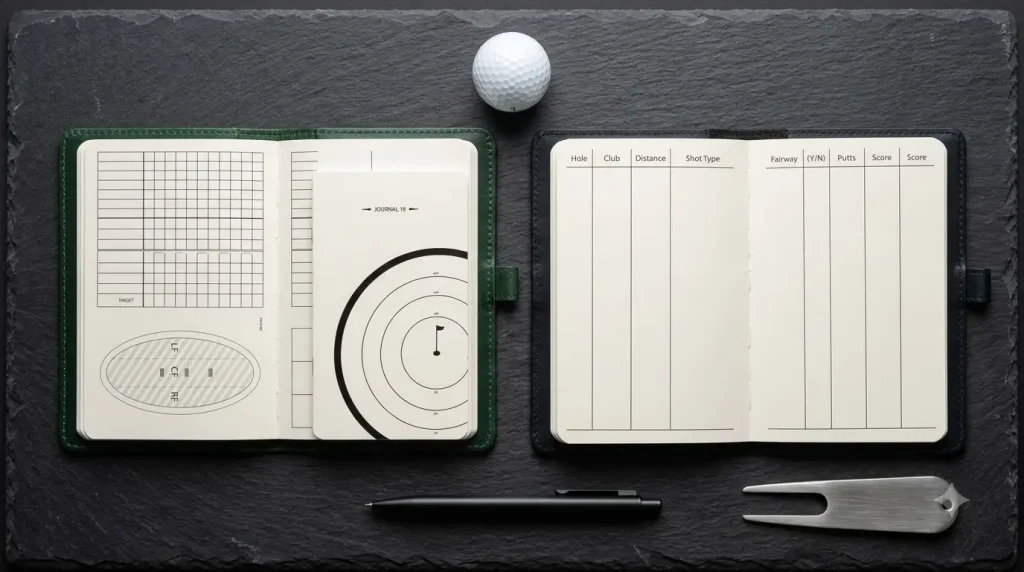
Prices on direct orders from Journal 18 remain consistent throughout the season, though optional cover personalization adds $10.00 to any book. Before buying, shoppers often check available Journal 18 discount codes and promotional offers to offset shipping charges or accessory add-ons like extra thermal pens.
Here is how the core specifications align across the current catalog as of September 2026:
The Track Pad Pro
Priced at $79.00. Dimensions measure 6.0 inches high, 3.5 inches wide, and 0.5 inches thick. It features synthetic waterproof pages, reusable thermal ink compatibility, and shot dispersion grids.
The Performance Journal
Priced at $54.00. Dimensions measure 6.0 inches high, 3.5 inches wide, and 0.6 inches thick. It features 140 pages of 52gsm cream Tomoe River paper, a dimpled golf ball hardcover, and ribbon page marker.
The Track Pad Lite
Priced at $40.00. Dimensions measure 5.8 inches high, 3.4 inches wide, and 0.25 inches thick. It features slim staple-bound uncoated cardstock, focusing strictly on basic stat tracking alongside course scorecards.
3. The Track Pad Pro: The Best Pick for Serious Stat Tracking
The Track Pad Pro is designed for golfers who want tour-level performance tracking without looking at a phone screen during their round.
The core strength of the Pro lies in its structured hole layout. Rather than blank lines, every hole provides designated input blocks for club selection off the tee, fairway accuracy (left, fair, right), approach shot distance, green in regulation status, up-and-down conversion, sand saves, and putt counts. This structure ensures you capture the exact data points that determine strokes gained.
In addition to tables, the Pro includes visual target grids for driving and approach shots. By marking where your ball lands relative to the center of the fairway or green, you immediately spot directional misses. If seven out of nine missed approach shots leak right, you have concrete proof of a push-fade bias rather than guessing after eighteen holes.
The primary trade-off with the Track Pad Pro is writing speed. Filling out the shot map and seven stat fields requires five to ten seconds before walking off each green. Golfers who rush between shots or dislike methodical record keeping may find the layout too dense. However, the waterproof synthetic pages solve the problem of sweat or rain destroying your notes, and the included thermal erasable pen allows you to clear completed rounds with heat or a moist towel once you record your totals.
4. The Performance Journal: Best for Mental Game and Reflection
The Performance Journal focuses on golf psychology, pre-shot routines, and round reflection rather than strict numeric stat tracking.
Bound in a tactile white hardcover patterned after golf ball dimples, this model uses Japanese Tomoe River paper. This premium, fountain-pen friendly paper holds ink without feathering or bleed-through, creating a permanent keepsake of your golf season. If you treat golf as a craft and enjoy reviewing entries from three years ago, this journal delivers an unmatched physical feel.

The internal pages allocate generous room for pre-round planning: course conditions, target scores, strategic goals, and swing keys. During the round, scoring entries are simpler than the Pro, emphasizing mindset notes, key recovery shots, and lessons learned. At the conclusion of eighteen holes, you complete a structured self-audit examining emotional discipline, course management mistakes, and practice priorities for your next range session.
The downside of the Performance Journal for stat purists is the lack of standardized data tables. You will not find designated check-boxes for approach yardages or sand save percentages. It operates as a structured diary. If you struggle with anger on the course, lose focus on the back nine, or work with a golf instructor who asks for lesson reflections, this is the superior option.
5. The Track Pad Lite: Best Pocket Companion for Basic Scorecards
The Track Pad Lite is built for players who want basic statistical confirmation without carrying a bulky notebook or spending seventy dollars.
Measuring barely a quarter-inch in thickness, the Lite sits flat inside your back pocket alongside the standard course-provided paper scorecard. You do not need to unzip golf bags or dig into console compartments to reach it. It weighs almost nothing and folds open instantly.
The scoring fields on the Lite strip away the complex diagrams found in the Pro. You get basic tracking lines per hole: Fairways Hit, Green in Regulation, Number of Putts, and Penalties. It provides just enough structure to tell you whether your 82 was caused by erratic driving or three-putts, without demanding that you plot ball flight coordinates while your playing partners wait on the next tee box.
The limitation of the Lite is longevity. The pages are paper-based rather than synthetic, meaning heavy downpours or pocket moisture can cause edges to curl. It also contains fewer total rounds per book and lacks reusable erase capabilities. Once you fill the pages, you must purchase a replacement.
6. Feature Comparison: Pro vs Performance vs Lite
Comparing the three journals across functional categories shows clear separation between mechanical stat collection, mindset journaling, and casual scorekeeping.
| Feature | The Track Pad Pro | The Performance Journal | The Track Pad Lite |
|---|---|---|---|
| Retail Price | $79.00 | $54.00 | $40.00 |
| Cover Type | Durable vegan leather / synthetic | Golf ball dimpled hardcover | Flexible textured cardstock |
| Paper Material | Reusable waterproof synthetic | 140-page cream Tomoe River paper | Standard uncoated paper |
| Scoring Detail | Advanced (FIR, GIR, Putts, Yardage, Up/Down) | Moderate (Score, Putts, Strategy, Notes) | Basic (FIR, GIR, Putts, Penalties) |
| Shot Dispersion Maps | Yes (Tee and green dispersion grids) | No (Open notes space) | No |
| Reusability | Yes (Wipe clean or heat erase) | No (Permanent archive) | No (Single-use pages) |
| App Scanning Compatible | Yes (Digital sync ready) | No | No |
| Best For | Low handicappers and data tracking | Mindset, lessons, and reflection | Fast play and minimal pocket weight |
7. On-Course Durability, Paper Quality, and Weather Resistance
Weather resistance represents the single biggest practical difference between Journal 18 models during actual golf course use.
Playing in summer heat leads to moisture buildup inside golf pockets. Standard scorecard paper absorbs perspiration, resulting in smudged pencil marks and torn corners by the twelfth hole. The Track Pad Lite is susceptible to this issue if kept directly against your body on humid days, making it better suited for placement on a golf cart clip or in a pushcart console.
The Performance Journal resists bending thanks to its rigid hardcover shell, but its delicate Tomoe River interior pages require caution in wet weather. While Tomoe River paper handles ink beautifully, rainwater drops will wrinkle the sheets and cause standard fountain pen ink to smear.
The Track Pad Pro is the only model completely impervious to moisture. Its synthetic sheets do not absorb water, sweat, or spilled drinks. If mud splashes onto the page, you can rinse it with water without degrading the paper fibers. However, keep in mind that the included thermal pen ink responds to temperature extremes: leaving the notebook in a hot car trunk over 140 degrees Fahrenheit can cause written ink to temporarily disappear until cooled in a freezer.
8. How to Choose the Right Journal 18 for Your Game
Select your journal based on your handicap goals, your current pace of play, and whether you prefer digital or analog records.
1. Evaluate your data commitment
If you never review post-round stats and only want to count putts, buying the $79.00 Track Pad Pro is unnecessary. Get the Track Pad Lite. If you actively study your miss patterns to guide practice sessions, the Pro pays for itself in targeted range time.
2. Assess your round routine
If you already feel rushed on the golf course, plotting dispersion grids on the Pro may add stress. The Lite or Performance Journal allows quick notes without feeling like an administrative task.
3. Decide on archiving
If you want a shelf of completed golf journals representing decades of rounds, choose the Performance Journal. If you hate clutter and prefer digitizing data before wiping the book clean for Saturday morning, choose the Track Pad Pro.
9. Frequently Asked Questions About Journal 18 Score Tracking
Is the Journal 18 Track Pad Pro reusable?
Yes, the Track Pad Pro features waterproof synthetic pages that work with the included thermal erasable pen. You can wipe entries clean with a damp cloth or erase them with heat, allowing you to reuse the journal across seasons.
Does Journal 18 require a smartphone app to track scores?
No, all Journal 18 journals function as standalone physical notebooks for distraction-free play. While the Track Pad Pro supports optional page scanning with companion tracking apps to digitize stats, the journal does not require an app or phone on the course.
What is the difference between the Track Pad Pro and the Track Pad Lite?
The Track Pad Pro costs $79.00, offers reusable erasable pages, full shot dispersion mapping grids, and app scanning integration. The Track Pad Lite costs $40.00, uses traditional paper pages, and is designed as a slimmer notebook meant to sit directly behind a standard paper scorecard.
Can the Performance Journal fit into a standard back pocket?
Yes, the Performance Journal measures approximately 3.5 inches wide by 6 inches tall, allowing it to slide comfortably into the back pocket of golf trousers or shorts during a round.
Last updated: September 10, 2026

Elliot Long spent seven years buying paid search and social traffic for e-commerce brands before starting Couponaro. That work taught him how much of the coupon web runs on codes that expired years ago. He runs this site on his own, dates every page he updates, and would rather tell you a brand has no working code than waste your time at checkout.