


A golf journal for lowering scores works when it forces you to spot repeating patterns after each round, not just record numbers. Most golfers buy one, fill in a few holes, then let it sit in a bag pocket until it’s forgotten.
Does Writing Down Your Round Actually Lower Your Score?
A golf journal lowers your score only when you use it to catch a pattern, not just fill in boxes during the round. The writing itself doesn’t fix anything. What fixes things is looking back at the last three or four rounds and noticing the same miss showing up again and again, then doing something about it before your next tee time. Skip that review step and a journal is just an expensive scorecard. It also won’t replace lessons or practice; it only tells you where to point them.

What to Track If You Want the Journal to Do Real Work
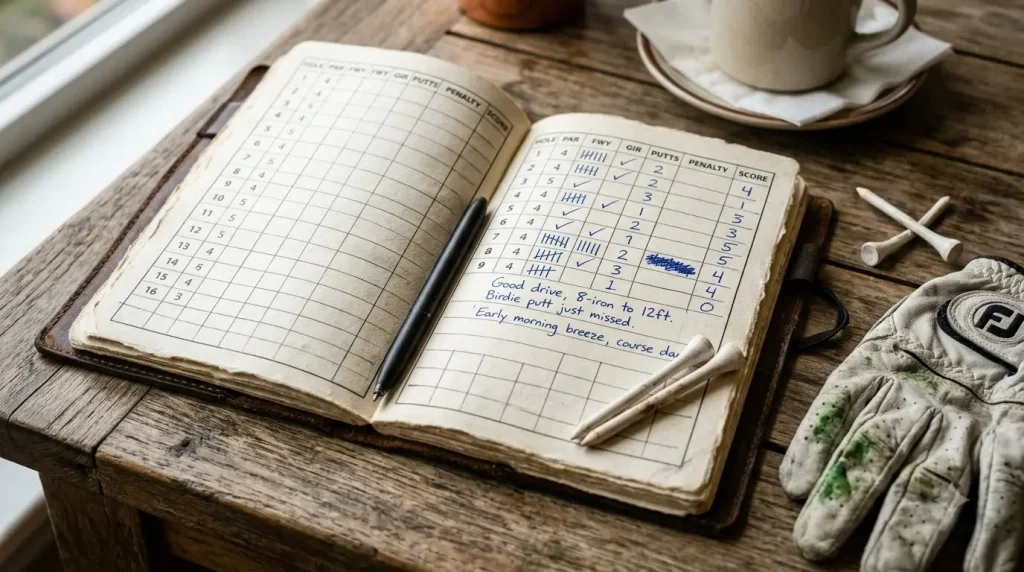
Four or five numbers are enough to work with. Trying to log every yardage and every club choice is the fastest way to quit by round three.
- Fairways hit
- Greens in regulation
- Putts per hole
- Up-and-down conversion rate
- One line on a decision you’d make differently
That short list is small enough to fill in walking off the green, and specific enough to actually show a trend after a handful of rounds.
Where Journal 18 Fits Into This
Journal 18 makes a line of pocket-sized paper journals built specifically for this kind of round-by-round tracking, not general-purpose journaling. According to buyer reviews collected on the brand’s own review page, golfers carry it like a yardage book in a back pocket or glove pocket, using pre-round pages to set a focus, in-round pages to log fairways, greens, and putts, and post-round pages to review the round afterward.
The lineup includes The Performance Journal and the Track Pad Lite and Pro versions, plus a personalization add-on for golfers who want it. A review from The 2nd Cut newsletter described the same layout: pre- and post-round sections built around a scorecard, plus a separate practice-log section at the back for structuring range time instead of hitting balls at random.

Who This Journal Suits and Who Should Skip It
This fits golfers who already walk with a paper scorecard, play at least weekly, and want a fixed layout that tells them exactly what to fill in. It’s also a natural fit if you take lessons and want physical data to hand your coach instead of describing a round from memory.
It’s a weaker fit if you play only a handful of rounds a year, since a few scattered entries won’t show a real pattern. It’s also not the right tool if you already track everything through a GPS app with automatic stats and have no interest in writing anything by hand, since the format depends entirely on you filling it in.
How to Start Without Turning It Into a Chore
- Pick three or four stats tied to your actual miss pattern, such as fairways hit, three-putts, and up-and-down rate, rather than copying someone else’s list.
- Write one line before you tee off: today’s single focus.
- Fill in the round pages during or right after the round, not from memory a week later.
- Spend five minutes at home comparing this round against your last three.
- Adjust one practice priority based on whatever keeps repeating.
Don’t rebuild your swing off one bad round. A single 95 doesn’t mean anything on its own; the same miss showing up across three or five rounds does.

If you already forget to write down the back nine, a paper journal won’t fix that habit gap on its own. But if you’re willing to spend two minutes before and after each round, a fixed layout like Journal 18’s does more than a blank notebook would, mainly because it tells you exactly what to fill in, which is what actually keeps a scoring journal in use past the second week. Pick the version that matches how you play, and check Couponaro for a current Journal 18 offer before you order.
Last updated: September 11, 2026

Elliot Long spent seven years buying paid search and social traffic for e-commerce brands before starting Couponaro. That work taught him how much of the coupon web runs on codes that expired years ago. He runs this site on his own, dates every page he updates, and would rather tell you a brand has no working code than waste your time at checkout.