
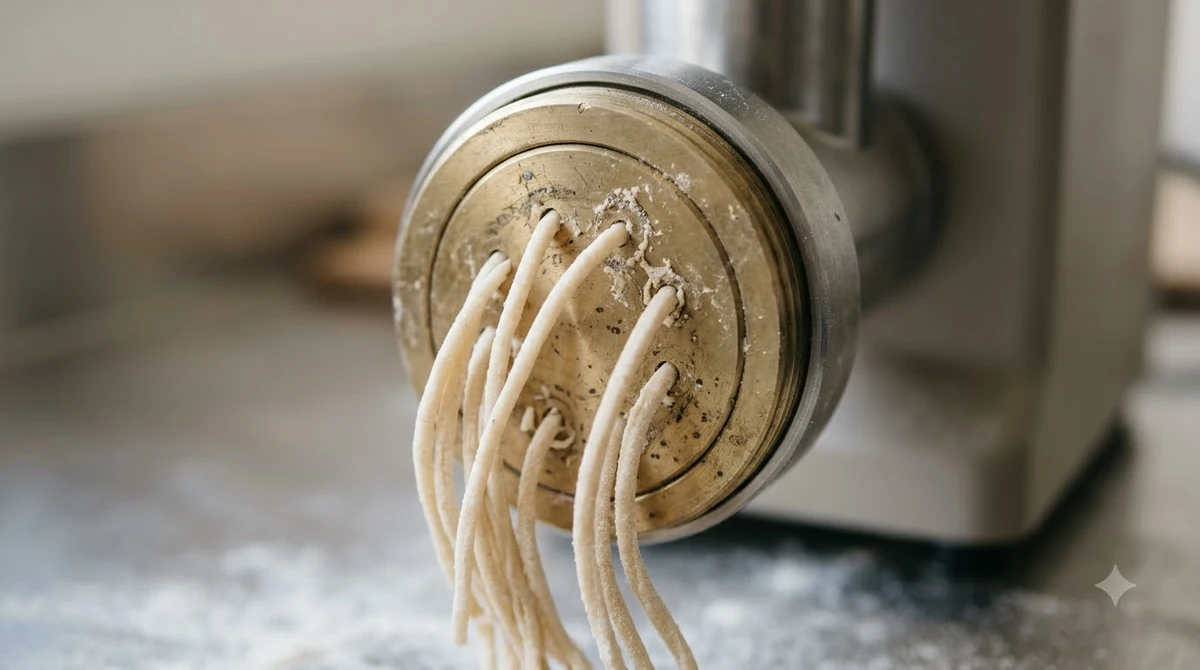

The KitchenAid pasta extruder manual shows you how to assemble the press, attach it to a stand mixer and extrude dough at the right speed. The booklet covers six pasta plates, a basic egg dough and a cleaning routine that protects the press.
Read the plate chart in the KitchenAid pasta extruder manual before your first batch, because each plate has its own mixer speed and cut length. Keep the cleaning steps in mind too, since the housing must never be immersed in water. For more ideas once the press is running, browse KitchenAid pasta extruder recipes.
KitchenAid Pasta Extruder Manual: What the Kit Includes
The kit described in the KitchenAid pasta extruder manual includes a press housing, a cutter, an auger, a pasta ring, a combo tool, a cleaning brush, a storage case and six pasta plates. Each plate sets the shape of the pasta, so swapping plates is how you change from spaghetti to fusilli.
- Housing: the body that the plates, auger and ring attach to.
- Auger: a screw that pushes the dough toward the plate.
- Pasta ring: holds the chosen plate in place.
- Cutter: a swing-arm wire that trims the pasta as it exits.
- Combo tool: a flat end to push dough, a wrench for the ring and a hook for the auger.
- Plates: spaghetti, bucatini, rigatoni, fusilli, large macaroni and small macaroni.
How to Assemble the Pasta Press
The KitchenAid pasta extruder manual says to assemble the press starting with the auger, then the plate, then the pasta ring, and to finish by locking the cutter in place.
- Insert the auger into the housing, cross-shaped peg first.
- Set one pasta plate over the opening, matching its tabs with the notches in the housing.
- Place the pasta ring over the plate and turn it by hand until it is finger tight. Do not over tighten it.
- Push the cutter in and turn it to the right to lock it.
How to Attach the Pasta Press to Your Stand Mixer
Turn the mixer to OFF and unplug it before you attach the press, then tighten the accessory knob clockwise until the press is fully secured. The KitchenAid pasta extruder manual asks for this every time you attach the press, and the KitchenAid UK assembly FAQ gives the same first step.
Before attaching the press, detach the storage case from the top of the housing. Then follow these steps.
- Turn the speed control to OFF and unplug the stand mixer.
- Loosen the accessory knob by turning it counterclockwise.
- Remove the accessory hub cover, or flip it up.
- Insert the accessory shaft housing into the hub so the power shaft fits the square socket. Rotate the press back and forth if it does not seat.
- When the pin on the housing sits in the notch on the hub rim, tighten the accessory knob clockwise until the press is secure.
Speeds and Lengths From the KitchenAid Pasta Extruder Manual
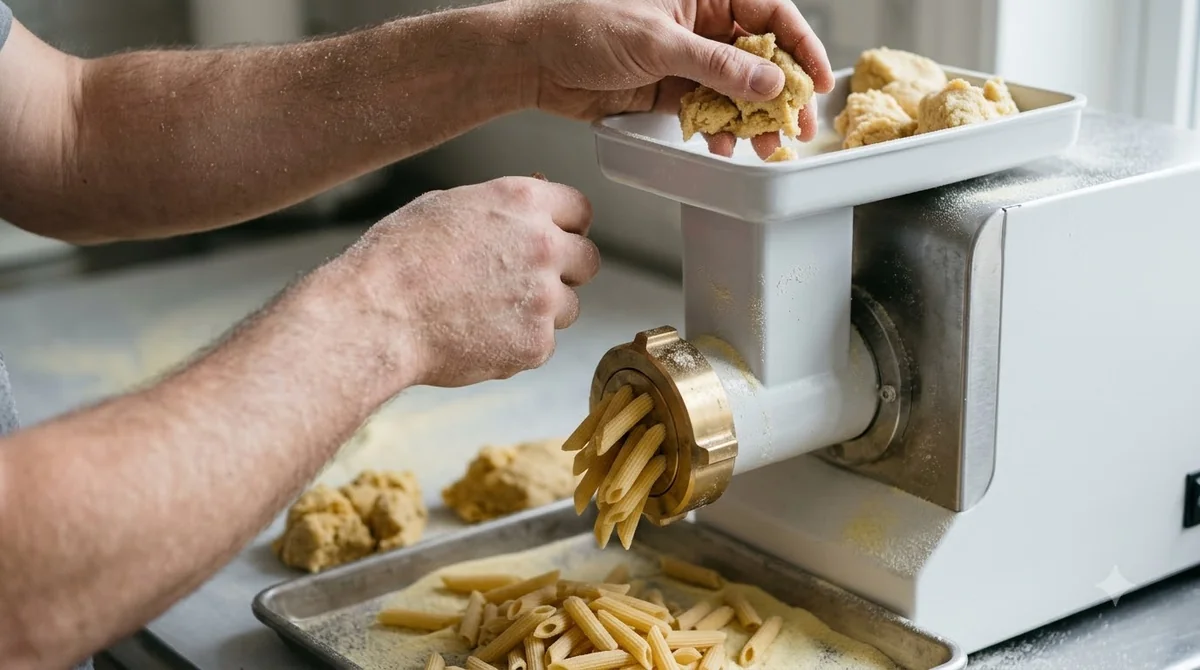
The KitchenAid pasta extruder manual recommends mixer speed 10 for spaghetti and bucatini, speed 6 for rigatoni and both macaroni plates, and speed 2 to 4 for fusilli. Cut each pasta to the length the booklet lists for its plate.
| Plate | Recommended mixer speed | Extrusion length |
|---|---|---|
| Spaghetti | 10 | About 9½ in (24.0 cm) |
| Bucatini | 10 | About 9½ in (24.0 cm) |
| Rigatoni | 6 | About 1½ in (4.0 cm) |
| Fusilli | 2 to 4 | Traditional 9½ in (24.0 cm) or short 1½ in (4.0 cm) |
| Large macaroni | 6 | Up to 2 in (5.0 cm) |
| Small macaroni | 6 | Up to 1½ in (4.0 cm) |
The KitchenAid pasta extruder manual’s text adds that fusilli should be extruded at a maximum speed of 6 for best results, and that slower speeds suit very short pasta. For the general rule, set the speed between 6 and 10 according to the pasta type and your preference.
Following the KitchenAid pasta extruder manual, feed walnut-size pieces of dough into the hopper and let the dough self-feed. Use the combo tool to push dough only when it gets caught and stops feeding.
Cut the pasta with the swing-arm wire cutter as it leaves the press, as the KitchenAid pasta extruder manual describes.
To change plates, turn the mixer to OFF, unplug it, remove the press, then take out the cutter, pasta ring and auger. Clean the dough out of the housing and reassemble the press in the assembly order above. For general upkeep of other machines, see how to clean a pasta machine.
Basic Egg Dough From the Manual
The KitchenAid pasta extruder manual’s basic egg dough uses 4 large eggs, 3½ cups of sifted all-purpose flour, 1 tablespoon of water and 1 teaspoon of salt, and yields about 1¼ pounds (579 g). This is the booklet’s basic dough for the press.
- 4 large eggs.
- 3½ cups (830 mL) sifted all-purpose flour.
- 1 tablespoon (15 mL) water.
- 1 teaspoon (2 mL) salt.
- Mix the flour and salt, then add the eggs and water gradually with the flat beater.
- Switch to the dough hook and knead until the dough comes together.
- Finish by hand until the dough is smooth and holds together in a ball.
- Form walnut-size pieces and extrude them through the plate you want.
In the KitchenAid pasta extruder manual, a good dough should stay together when you pinch a small amount, without sticking to your fingers. If it is too moist to extrude, dust it with flour or pat flour into the dough before it goes into the press.
Sift the flour before measuring, because the quantities in the KitchenAid pasta extruder manual assume sifted flour. For a dough made without the press, see this fresh pasta dough recipe.
The KitchenAid pasta extruder manual says the mixer must rest at least 1 hour after you extrude two consecutive pasta dough batches. Plan that break between big batches.
How to Clean the Pasta Press Without Damaging It
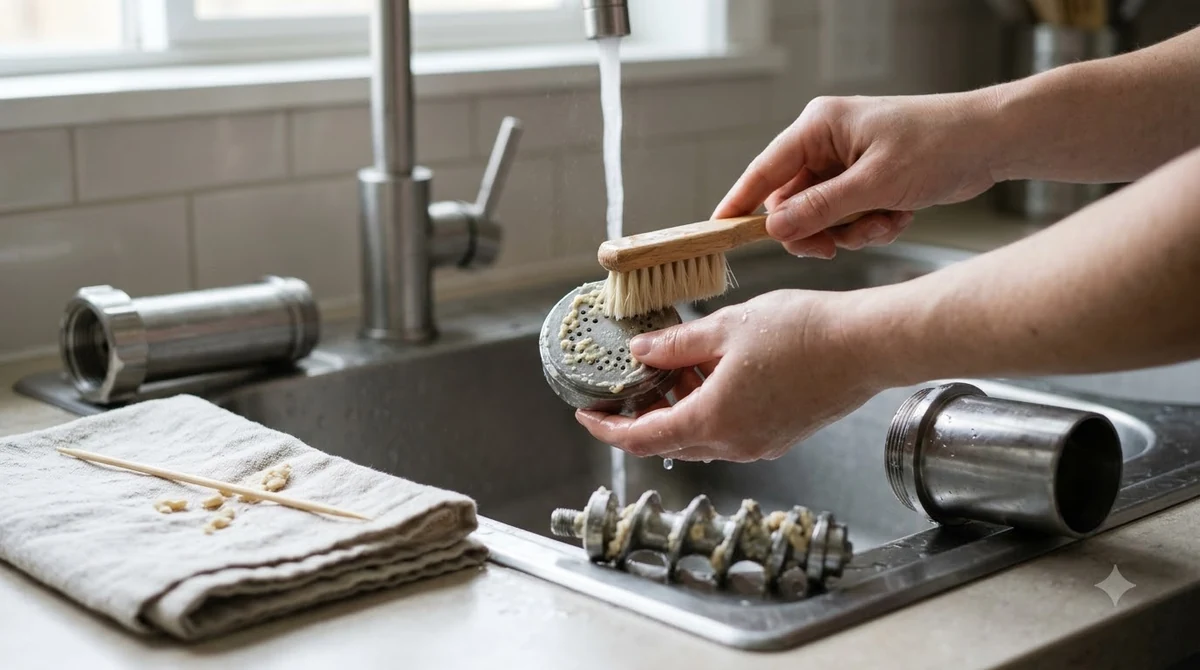
The KitchenAid pasta extruder manual says to turn the mixer off, unplug it, disassemble the press completely and let leftover dough dry overnight before you brush it out.
- Turn the speed control to OFF and unplug the mixer.
- Remove the cutter, pasta ring, auger and plate. Use the wrench end of the combo tool to loosen a tight ring, then use the hook to pry out the auger.
- Let leftover dough on the plates dry overnight before separating it.
- Brush dried dough off with the cleaning brush, and use a wooden skewer or toothpick for anything left in the holes. Do not use metal objects.
KitchenAid’s product help page on disassembling the pasta press follows the same sequence, from turning the mixer off through removing the auger.
- Auger, pasta ring, combo tool and storage case: dishwasher safe.
- Cutter and pasta plates: hand wash in warm sudsy water, then dry thoroughly.
- Press housing: never put it in the dishwasher or immerse it in water or other liquids.
Storing, Drying and Cooking Your Pasta
The KitchenAid pasta extruder manual says fresh pasta can be air dried for 1 hour, then refrigerated for up to 5 days, and it cooks in 2 to 5 minutes depending on thickness.
- Refrigerate fresh pasta in an airtight plastic bag for up to 5 days after its 1-hour air dry.
- Freeze fresh pasta double wrapped for up to 4 months, and cook it straight from the freezer without thawing.
- Let long noodles air dry on a rack or a towel before you bag them.
The KitchenAid pasta extruder manual cooks pasta in 6 quarts (5.7 L) of boiling water with 2 teaspoons (10 mL) of salt. Dry pasta takes about 7 minutes, and fresh pasta takes 2 to 5 minutes.
Frequently Asked Questions
Where can I find the KitchenAid pasta extruder manual online?
The manual used for this guide is the KPEXTA pasta press booklet, and KitchenAid’s product help site has step pages for some tasks, such as disassembly. Check that the model number on your accessory matches the booklet before you follow its steps.
Which mixer speed should I use for spaghetti?
Use speed 10 for spaghetti, according to the KitchenAid pasta extruder manual’s plate chart. Cut the pasta at about 9½ inches (24.0 cm), and cut it with the wire cutter as it leaves the press to keep the length consistent.
Why does my dough stick inside the press?
Dough that is too moist can stick and become hard to extrude. The KitchenAid pasta extruder manual says to dust it with flour or pat flour into the dough before loading the press, and to check the pinch test before you start.
Can I wash the press housing in the dishwasher?
No. The KitchenAid pasta extruder manual says not to wash the press housing in the dishwasher or immerse it in water or other liquids. Wash the auger, pasta ring, combo tool and storage case in the dishwasher, and hand wash the cutter and plates.
How long should the mixer rest after making pasta?
The KitchenAid pasta extruder manual says the mixer must rest at least 1 hour after extruding two consecutive pasta dough recipes. Plan that rest between big batches so you do not run the mixer through a long session without a break.
Who do I call if I need help with the press?
The booklet lists KitchenAid service lines of 1-800-541-6390 in the United States and 1-800-807-6777 in Canada. Have your model number and proof of purchase ready when you call.
Read the mixer rest rule and cleaning steps in the KitchenAid pasta extruder manual before your first batch, since they protect both the mixer and the press. If you own a different KitchenAid accessory, check the booklet that came with it, because plates and speeds can differ between models.