
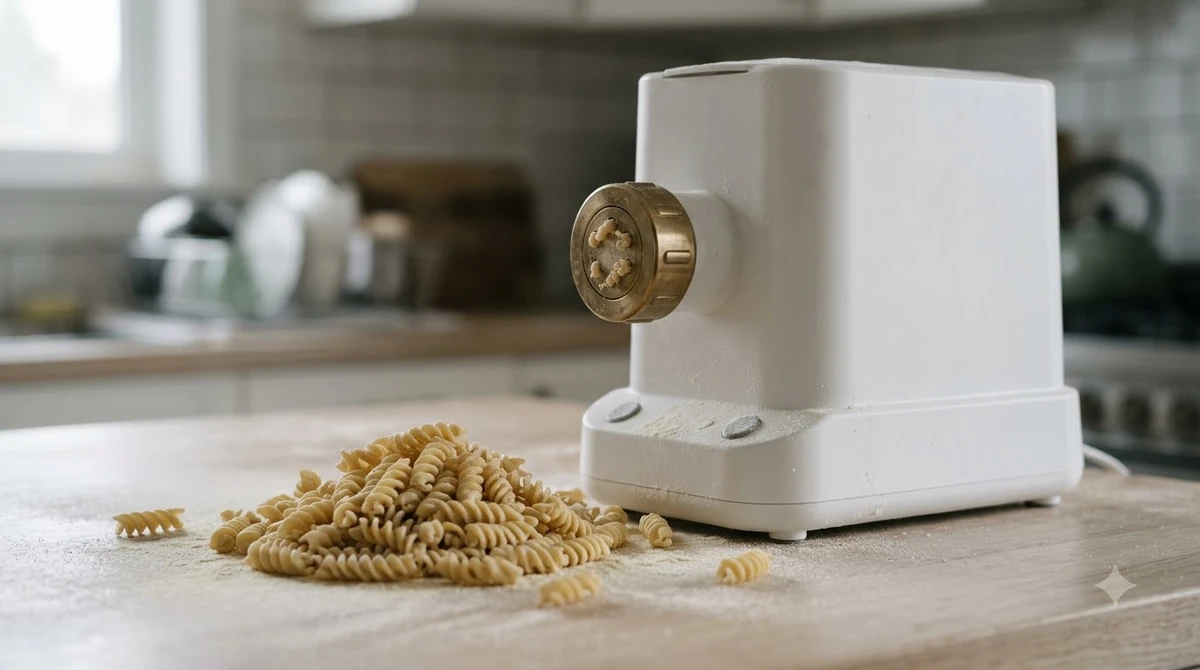

The best kitchenaid pasta extruder recipes start with a firm egg dough of 4 large eggs, 3½ cups all-purpose flour, 1 tbs water and 1 tsp salt, as given in the KitchenAid manual for the pasta press attachment. The batch makes about 1¼ pounds of dough. Mixer speed matters as much as the dough, so set it by pasta shape and fix the consistency before you extrude.
The Basic Egg Dough in KitchenAid Pasta Extruder Recipes
The basic dough for kitchenaid pasta extruder recipes is 4 large eggs, 3½ cups sifted all-purpose flour, 1 tbs water and 1 tsp salt, and it yields about 1¼ pounds (579 g). Learn the feel of this dough first, because the other variations change it.
- Break the eggs into a glass measuring cup. They should measure 7/8 cup (207 mL). If they fall short, add water 1 tsp at a time until you reach that amount.
- Place the sifted flour and salt in the stand mixer bowl. Attach the bowl and flat beater, then mix on Speed 2 while you add the eggs and 1 tbs water gradually, for 30 seconds.
- Swap the flat beater for the dough hook. Knead on Speed 2 for 2 minutes.
- Remove the dough and hand knead it for 30 seconds to 1 minute, until it is smooth, pliable and holds together in a ball.
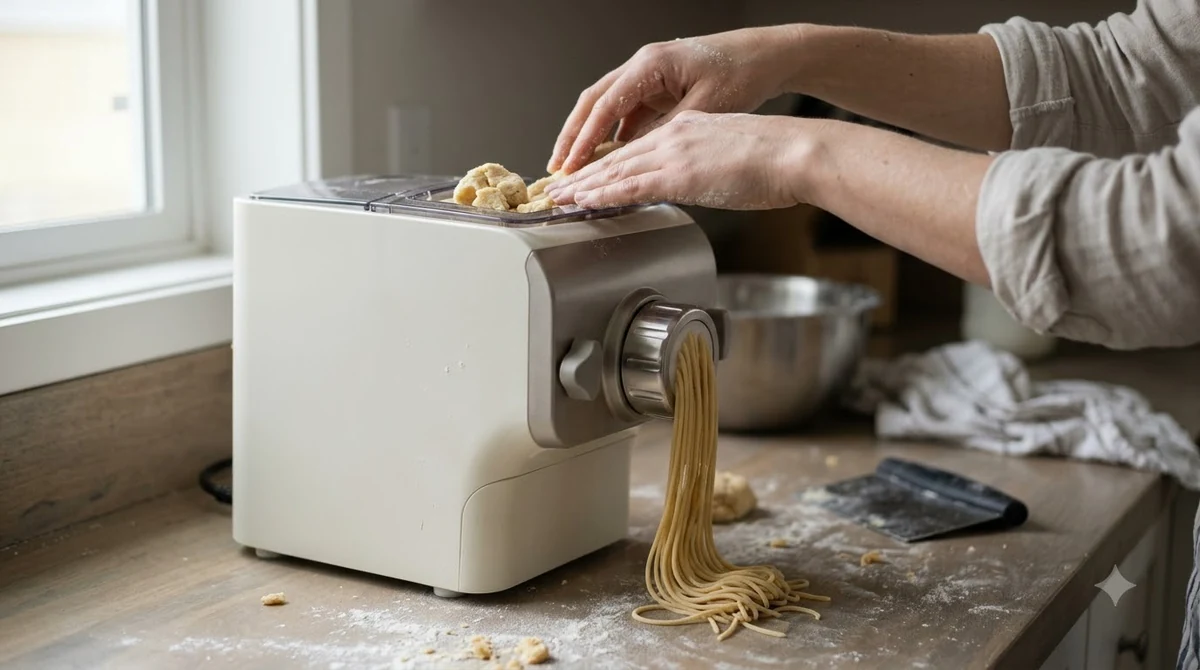
- Form walnut-size pieces. Place them in the hopper and let the dough self-feed. Use the combo tool to push dough only if it catches, and never push it with your fingers.
When you run kitchenaid pasta extruder recipes, the auger should be visible before you add the next piece. Crumbly dough at the start is normal, because the kneading and hand kneading firm it up. That is why the first walnut-size pieces matter: they show you whether the dough is right before you commit a whole batch to the press. Cut the strands as they leave the press and lay them out right away so they do not stick together.
Mixer Speed and Plate Choice for Each Pasta Shape
In most kitchenaid pasta extruder recipes, set the stand mixer between speed 6 and 10 based on the pasta shape, and keep fusilli at a maximum of speed 6. Longer shapes can run faster, while very short pasta needs slower speeds. If you prefer flat ribbons such as fettuccine, those come from the separate roller and cutter attachments rather than from the extruder plates.
| Pasta plate | Speed guidance in the manual |
|---|---|
| Spaghetti and bucatini | Speed 6 to 10. Longer pasta may run at higher speeds. |
| Rigatoni | Speed 6 to 10, set by pasta type and your preference. |
| Fusilli | Maximum speed 6 for the best results. |
| Large and small macaroni | Speed 6 to 10. Slower speeds are recommended for very short pasta. |
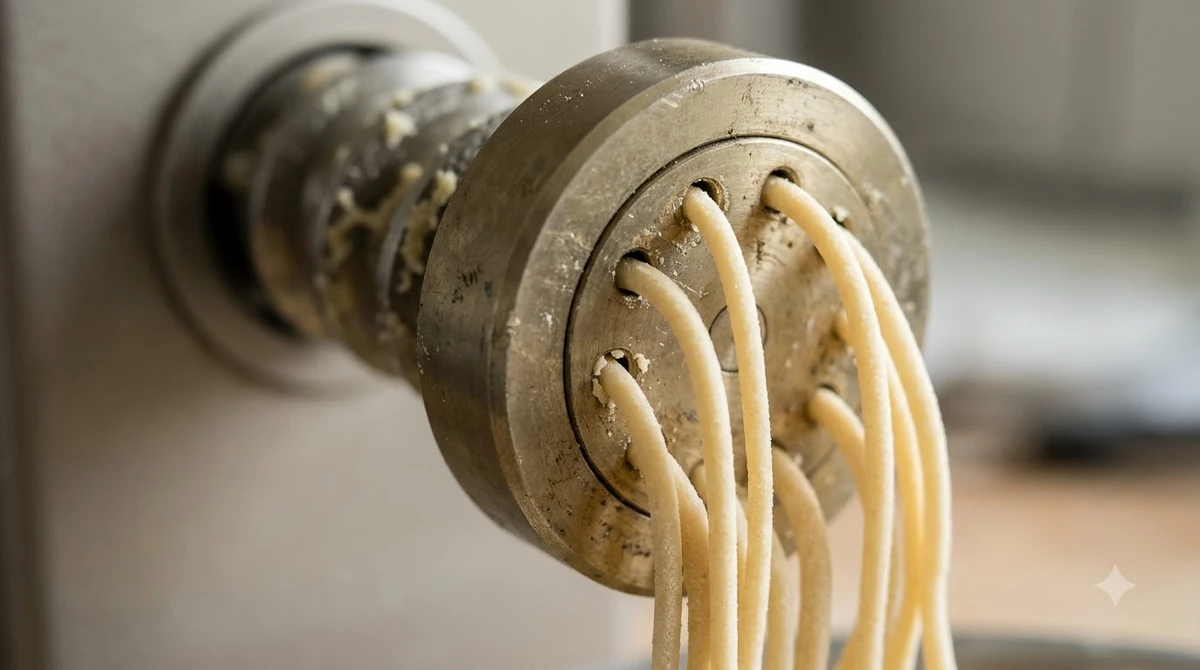
The press comes with six plates: spaghetti, bucatini, rigatoni, fusilli, large macaroni and small macaroni. To change plates, turn the mixer off, unplug it, remove the cutter, pasta ring and auger, then reassemble with the new plate. Cut the strands with the swing-arm wire cutter as they exit the press.
Spinach and Whole Wheat Variations for Extruder Dough
Spinach dough adds 10 oz of frozen spinach to 4 eggs and 4 cups flour, while whole wheat dough uses 3½ cups whole wheat flour with 2 tbs water. Both are variations of the kitchenaid pasta extruder recipes above.
- Spinach: thaw 10 oz frozen spinach, wring it dry in a towel and chop it finely. Mix it with 1 tbs water, 4 large eggs and 4 cups sifted all-purpose flour. Yield is about 1½ pounds (680 g).
- Light wheat: 2½ cups sifted whole wheat flour, 1 cup sifted bread or unbleached flour, 4 large eggs, 2 tbs water and ½ tsp salt. Yield is about 1¼ pounds (565 g).
- Whole wheat: 3½ cups whole wheat flour, 4 large eggs, 2 tbs water and ½ tsp salt. Yield is about 1¼ pounds (565 g).
For kitchenaid pasta extruder recipes made with whole wheat, the manual warns that dried pasta should not be kept for more than 1 month, because it may turn rancid. Store it in an airtight container in a cool, dark place.
Fixing Dough Consistency in a KitchenAid Pasta Extruder Dough Recipe
If dough from kitchenaid pasta extruder recipes is too moist to extrude, dust it with flour. If it is too dry or crumbly, add a small amount of water or flour. Humidity, flour brand and egg size all change how the dough behaves, which is why the same kitchenaid pasta extruder recipes can feel different from one kitchen to the next.
- In humid weather, start mixing with only the flour and eggs, as the manual suggests.
- Pinch a small amount after the flat beater step. It should hold together without sticking to your fingers.
- If it is too dry, add a little water one small amount at a time. If it is too sticky to extrude, pat flour into it or dust it before it goes into the extruder.
Between batches of kitchenaid pasta extruder recipes, give the mixer a rest of at least 1 hour after you extrude two consecutive pasta dough recipes.
Drying, Cooking and Storing Extruded Pasta
Dry the pasta from your kitchenaid pasta extruder recipes in a single layer on a towel, cook fresh pasta for 2 to 5 minutes, and refrigerate it for up to 5 days. Long strands can hang on a KitchenAid Drying Rack (KPDR) instead of lying flat.
- Drying: separate the strands right after extrusion and lay them on a towel. Let them air dry for about 1 hour before you bag them.
- Cooking: boil 6 qt water with 2 tsp salt and, if you like, 1 tbs oil. Fresh pasta usually takes 2 to 5 minutes, depending on thickness.
- Storing: keep fresh pasta in an airtight bag in the fridge for up to 5 days, or freeze it double wrapped for up to 4 months.
Frozen pasta from kitchenaid pasta extruder recipes goes straight from the freezer into boiling water, without thawing. The manual also says not to leave perishable eggs, dairy or meat unrefrigerated for more than one hour.
Deluxe Macaroni and Cheese Made with Extruded Macaroni
One of the kitchenaid pasta extruder recipes in the booklet is Deluxe Macaroni and Cheese. It uses one batch of basic egg noodle dough, extruded into short-cut large macaroni, and bakes at 350°F (180°C). The sauce uses 3 tbs butter, 2 tbs minced onion, 2 tbs flour, 3 cups milk, 4 oz extra sharp Cheddar and 4 oz Fontina, plus seasoning. For more on the shape itself, see macaroni pasta explained.
- Cook and drain the extruded macaroni in boiling salted water, following the basic cooking steps above.
- Melt the butter in a large saucepan over medium heat. Cook the onion 4 to 5 minutes, until translucent.
- Add the flour and cook 1 minute. Whisk in the milk and cook until the mixture boils and thickens slightly.
- Lower the heat and stir in the Cheddar and Fontina until melted. Add 1 tsp Worcestershire sauce, ¼ tsp garlic salt, ⅛ tsp pepper and ⅛ tsp paprika, then remove from heat.
- Combine the sauce with the macaroni in a large bowl. Transfer to a greased 9 x 13 x 2 inch baking pan, cover tightly with foil and bake at 350°F for 25 to 30 minutes. Remove the foil and bake 10 minutes more to brown the top. The booklet yields 10 servings.
Frequently Asked Questions
Can I use a KitchenAid pasta extruder with a stand mixer from another brand?
The manual says the pasta press is approved for use with KitchenAid household stand mixers. It does not cover other brands, so check with that mixer’s maker before you try it.
Do I need to rest the mixer between pasta batches?
Yes. For kitchenaid pasta extruder recipes, the manual says the mixer must rest at least 1 hour after you extrude two consecutive pasta dough recipes.
Can I freeze extruded pasta?
Yes. Leftover kitchenaid pasta extruder recipes can be frozen, and the manual says to double wrap fresh pasta and keep it frozen for up to 4 months. Do not thaw it first. Cook it straight from the freezer in boiling water.
Why does my dough stick in the hopper?
When kitchenaid pasta extruder recipes stick, the dough is usually too moist. The manual says to dust it with flour or pat flour into it before it goes into the extruder. Humid weather, flour brand and egg size all change the dough, so adjust a small amount at a time.
What speed should I use for fusilli?
Extrude fusilli at a maximum speed of 6, according to the manual. Faster speeds suit longer shapes such as spaghetti. Slower speeds also suit very short pasta.
How do I clean dough from the pasta plates?
Let leftover dough dry overnight, then remove it with the cleaning brush. Use a wooden skewer or toothpick for stubborn bits and avoid metal tools. The booklet says the cutter and pasta plates should be hand washed in warm sudsy water and dried thoroughly. Its cleaning page lists the auger, pasta ring, combo tool and storage case as dishwasher safe, but not the press housing. KitchenAid’s Pasta Press product help page links to the manuals and cleaning guide. For the roller attachment, see our guide on how to clean a KitchenAid pasta roller.
Start with the basic egg dough from these kitchenaid pasta extruder recipes, then adjust with flour or water only when the dough needs it. Keep fusilli at speed 6 or lower, and give the mixer its one-hour rest after two batches.