
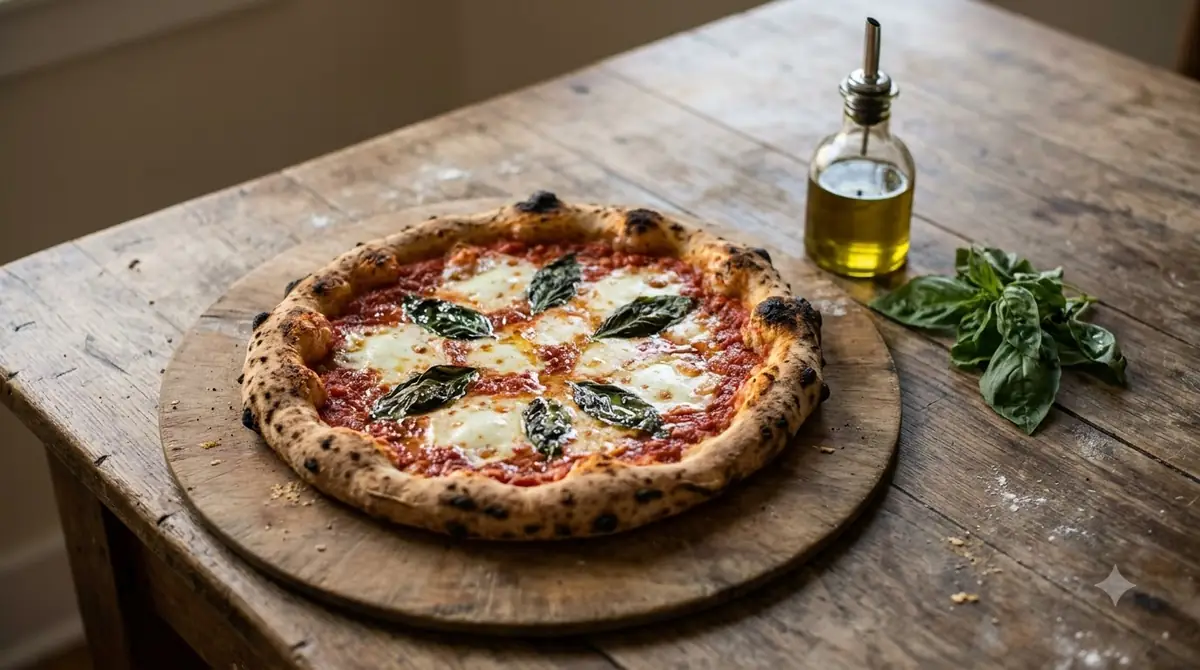

Knowing how to make pizza without a peel comes down to one job: moving the dough onto a hot surface with a flat, rigid, well-dusted transfer. Any surface that releases the dough will do, because a peel is only a tool for that step. Two methods work well in a home oven, and both depend on the same dusting and shake test.
Parchment is the simplest choice. A dusted sheet pan gives a more stone-like base when you bake on a stone or steel (see how to use a pizza stone and how to use a pizza steel). Your oven’s temperature limit decides which one is safe to use when you learn how to make pizza without a peel.
Why most no-peel pizzas stick
Pizza sticks when the surface under it is wet, unevenly dusted or too rough to let the dough move. Flour is a common dusting choice that backfires, because it is mostly starch and becomes very sticky once it gets wet. If a pizza still sticks, see pizza sticking to the peel.
Keep three habits in mind whenever you learn how to make pizza without a peel. Keep the surface dry and free of crumbs, dust it in a thin, even layer, and test the dough before it reaches the oven.
- Dust evenly across the whole surface, not in one spot.
- Wipe away flour, crumbs and oil before you lay down the dough.
- Shake the dough once before topping and again before it goes in.
How to make pizza without a peel on parchment paper
Parchment is the easiest route when you want to know how to make pizza without a peel, because the paper rides under the dough and goes into the oven with it. You stretch and top the pizza on the paper, then slide the whole sheet onto the hot surface.
Cut the paper to the size of the pie you plan to make, then stretch the dough slightly past the edge so no bare paper sits exposed. King Arthur Baking’s parchment guide suggests using heat-rated parchment and stretching the dough a little beyond the paper’s edge for this reason.
- Cut a round of parchment to your planned pie size.
- Stretch the dough on the paper and add sauce and toppings while it rests there.
- Shake the paper and pizza gently to confirm the dough moves freely.
- Slide the paper and pizza onto the hot stone, steel or pan.
The main limit is heat. King Arthur Baking says the maximum temperature rating for parchment is below 500°F, and that the edges begin to char between 450°F and 500°F. Watch the paper closely above 450°F, especially on an upper rack, and skip parchment entirely when you bake at very high temperatures.
Parchment is not a one-use item for every bake. The same guide says you can reuse it at least one more time, depending on your oven, so keep a clean sheet only when it still looks dry and unscorched.
Using a dusted sheet pan instead of a peel
A dusted sheet pan can stand in for a peel, and a dark pan transfers heat most efficiently for a thin crust, according to King Arthur Baking’s thin-crust guide. This is a second answer to how to make pizza without a peel: build the pizza on parchment, then move it from the back of a half-sheet pan onto a hot stone.
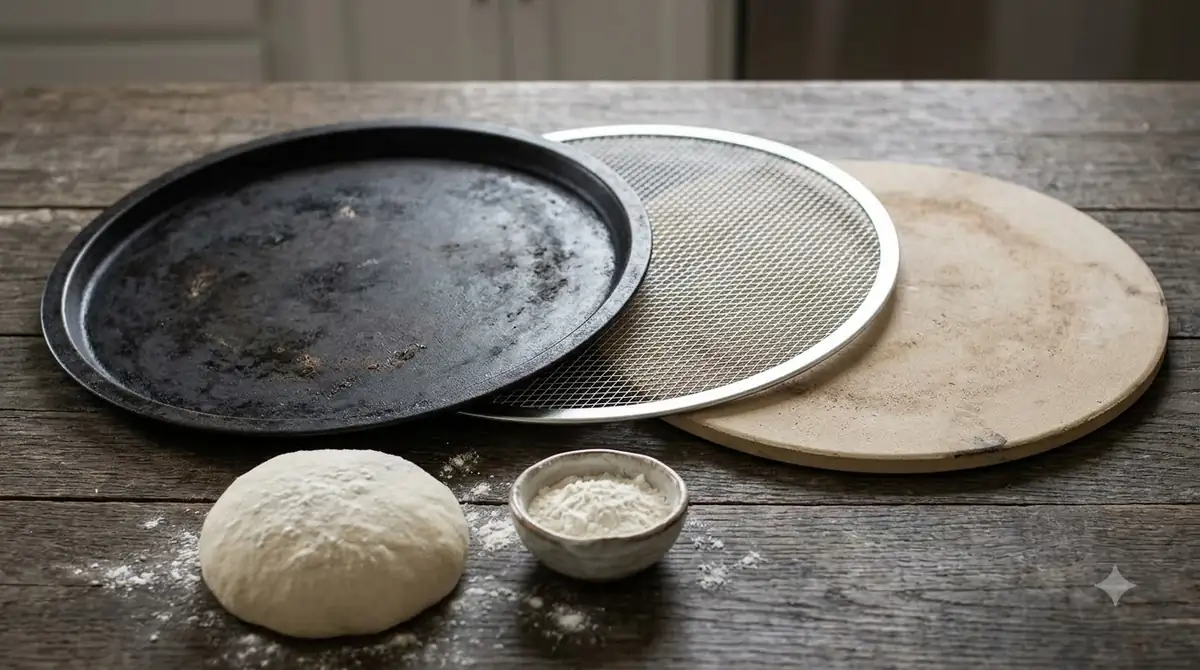
The guide describes this sequence: build the pizza on parchment, place it on the back of a half-sheet pan or large cookie sheet, level that pan with the stone, then slide the pizza onto the stone. The pan works as a flat launch surface, and the stone does the baking.
If you bake directly in the pan, grease it only when you want a fried-dough texture. The same guide suggests drizzling the pan with olive oil in that case, and notes that an oiled pan can produce a somewhat thicker crust.
Sauce quantity matters on a sheet pan too. For a freeform sheet pan pizza of about 12 by 15 inches, King Arthur Baking uses a scant 1/2 cup of sauce for that size.
Choosing a dusting material: semolina, cornmeal or flour
Semolina is the best dusting material when you are working out how to make pizza without a peel, because it burns less readily than cornmeal and can be spread very thinly. The semolina vs cornmeal comparison goes deeper. The dust works as a barrier, so the dough releases instead of grabbing the surface.
King Arthur Baking’s guide also prefers semolina for a peel-free transfer, and it advises using more of it while you are learning. Apply it evenly, because uneven dust leaves bare patches where the dough can stick.
Dust the surface once before the dough arrives, then add a light pinch after you stretch the dough, since stretching thins the coat. That second pinch is cheap insurance and keeps the transfer predictable at every stage of how to make pizza without a peel.
| Dusting material | How it behaves | Best use |
|---|---|---|
| Semolina | Burns less readily and spreads thinly | Default choice for any no-peel transfer |
| Cornmeal | Burns more readily than semolina | Backup when semolina is not on hand |
| Flour | Mostly starch, very sticky once wet | Avoid as the transfer dust |
The shake test before you slide
A short forward and back shake tells you whether the pizza will slide, and it is the core habit of how to make pizza without a peel. King Arthur Baking recommends running the jiggle test at three points: before topping, after topping and just before loading.
- Shake the bare dough on its dusted surface before you add anything.
- Repeat the shake after you add sauce and cheese, because the extra weight can change how it moves.
- Run one last shake just before the pizza goes into the oven (our how to launch a pizza guide shows the slide).
If a section sticks, lift it gently with a bench knife and add more semolina underneath. King Arthur Baking notes that a firmly stuck pizza may need to be transferred to parchment, or folded and baked as a calzone or stromboli.
Preheating your stone, steel or pan
For a stone or steel, King Arthur Baking advises preheating at 450°F for at least 30 minutes, and 45 to 60 minutes gives a better base. Those figures come from the thin-crust guide and apply to the stone or steel itself, which matters for any plan on how to make pizza without a peel.
The same source gives no verified time or temperature for a bare sheet pan. Follow your oven manual before you preheat a pan, and place the stone or pan in the oven before you turn the heat up so you are not moving a hot surface later.
Which no-peel method to choose
Parchment suits most home ovens, while a dusted sheet pan suits stone-style results when your oven runs hot enough to need a stone or steel. When you decide how to make pizza without a peel, pick by oven limit first and by crust style second.
| Method | Best for | Main limit |
|---|---|---|
| Parchment on a flat surface | Simplest transfer and easy cleanup | Rated below 500°F, edges char from 450°F |
| Dusted sheet pan with a stone or steel | Stone-style base, pizza built on paper | Needs a preheated stone or steel |
| Baking in a dark pan | Thin crust baked right in the pan | Grease only for a fried texture |

Frequently Asked Questions
Can you bake pizza on parchment paper in the oven?
Yes, but check the temperature first. King Arthur Baking says parchment is rated below 500°F and its edges begin to char between 450°F and 500°F, so use it below that range and skip it at very high heat.
Can you bake pizza directly on a baking sheet?
Yes. King Arthur Baking’s thin-crust guide says a dark pan transfers heat most efficiently. Grease the pan only if you want a fried-dough texture, and follow your oven manual for preheating a bare pan.
What is the best dusting material when you have no peel?
Semolina is the best choice. King Arthur Baking prefers it because it burns less readily than cornmeal and can be spread very thinly. Use more of it while you are learning, and avoid flour as the transfer dust.
Why does pizza stick when you slide it without a peel?
Sticking usually comes from a wet or unevenly dusted surface. Flour is mostly starch and turns very sticky when wet, so a thin layer of semolina and a quick shake test before loading prevent most sticking.
Do you need a pizza stone to make pizza without a peel?
No. King Arthur Baking says thin-crust pizza is baked either in a dark pan or on a hot stone or steel. A dark pan can replace the stone for a simpler bake, which makes it a practical route to how to make pizza without a peel, though a stone or steel gives a crisper base.
If you are learning how to make pizza without a peel and your oven stays below 450°F, start with parchment. If you want a crisper base, pair a dusted sheet pan with a preheated stone or steel. Run the shake test before every bake, because it takes seconds and saves the toppings.
 8 min readLearnPizza Al Taglio Recipe: Roman Sheet-Pan Pizza You Can Make at HomeUpdated Nov 10, 2026
 10 min readLearnSheet Pan Pizza Recipe: Three Doughs, Exact Amounts and Bake TimesUpdated Nov 11, 2026
 8 min readLearnHow to Launch a Pizza Without It Sticking to the PeelUpdated Nov 10, 2026
 7 min readLearnHow to Clean Wooden Pizza Peel Without Warping ItUpdated Nov 10, 2026
 6 min readLearnHow to Make Gnocchi Without Potato: Ricotta Method and TipsUpdated Nov 13, 2026
 8 min readLearnCan You Use Parchment Paper in a Pizza Oven?Updated Nov 10, 2026