
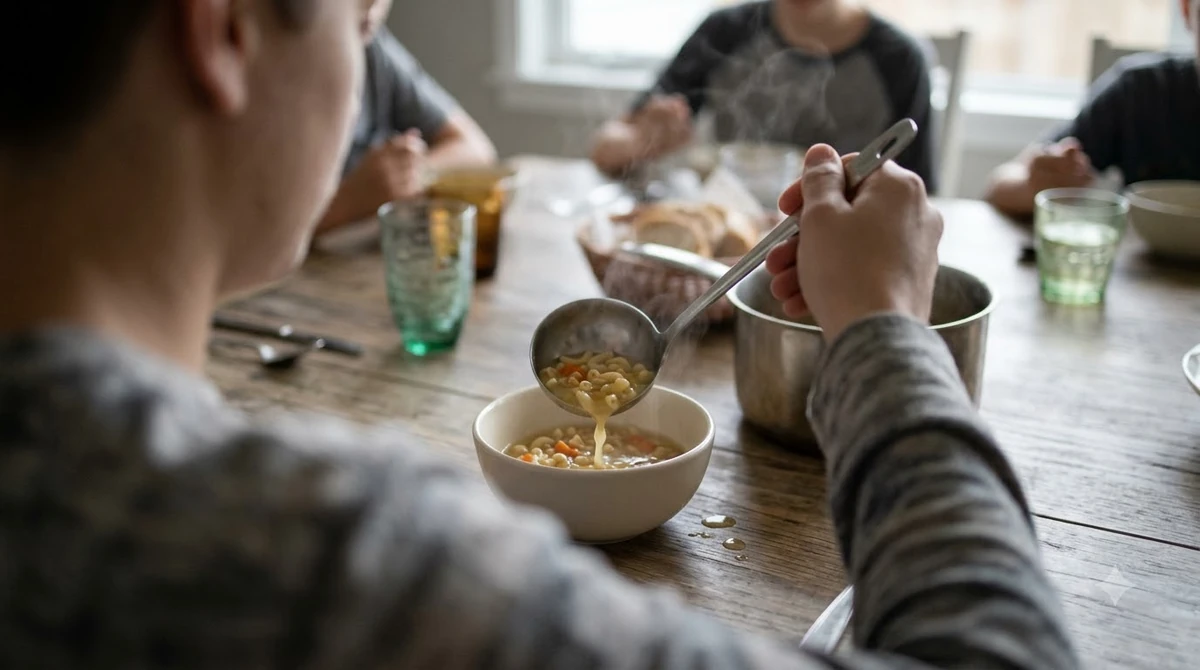

Passatelli pasta is a fresh, egg-based pasta from Romagna and parts of Marche, made by pressing a dough of breadcrumbs, Parmigiano and eggs through a perforated press. It is usually served in broth and can be made at home with a potato ricer.
The dough contains no flour, which sets it apart from most pasta. Sources also disagree on the exact quantities, so this guide shows two recipes side by side.
What Is Passatelli Pasta?
Passatelli pasta is a traditional Italian pasta made from breadcrumbs, grated Parmigiano and eggs, often flavored with nutmeg or lemon rind.
The Pasta Project notes that passatelli is not made with flour but is still classed as a pasta. The Pasta Project says to use normal white bread, well dried and finely grated, and the Emilia-Romagna guide says the dish began as a way to use up dry leftover bread.
Most sources agree on the core ingredients. A typical dough includes:
- Breadcrumbs, usually white bread crumbs
- Grated Parmigiano Reggiano (see Parmigiano Reggiano vs Parmesan)
- Eggs
- Nutmeg or lemon rind, which appears in some versions only
- A pinch of salt
The main details of passatelli pasta are summarized below, with the source for each value named where the sources differ.
| Detail | What the sources say |
|---|---|
| Flour | None, according to The Pasta Project |
| Shaping tool | Passatelli iron, or a potato ricer as the alternative |
| Rest before shaping | At least 2 hours, per The Pasta Project |
| Cooking time | About 5 minutes per The Pasta Project; a few minutes in boiling broth per the Emilia-Romagna guide |
| Usual broth | Chicken broth, or meat and vegetable broth |
Where Passatelli Pasta Comes From
Passatelli pasta comes from Romagna, in Emilia-Romagna, and is also traditional in parts of the Marche region.
The Emilia-Romagna tourism guide describes passatelli in broth as humble Romagna cooking, made with leftovers, especially bread. It is traditionally eaten with family at Easter or Christmas and on cold evenings.
Wikipedia places the dish in Romagna and in the Pesaro and Urbino and Ancona provinces of Marche, and says it appears in other regions such as Umbria. The Pasta Project adds Lazio, so the exact regional map depends on the source. For another Umbrian shape, see umbricelli pasta or stringozzi pasta.
The Emilia-Romagna guide’s version follows Pellegrino Artusi’s recipe no. 20 and lists 20 g of ox marrow as optional. Another stuffed pasta from the same region is tortellini pasta.
How Passatelli Pasta Is Made
Passatelli pasta is made by pressing a breadcrumb, Parmigiano and egg dough through a passatelli iron or potato ricer into boiling broth.
The Pasta Project recipe serves four and follows four steps. The dough rests at room temperature for at least 2 hours before shaping. The page lists 10 minutes of prep and about 5 minutes of cooking, not counting the rest.
- Mix the breadcrumbs, grated Parmigiano, eggs, salt and nutmeg or lemon rind into a dough.
- Rest the dough at room temperature for at least 2 hours.
- Press the dough through a passatelli iron or potato ricer into boiling broth.
- Cook for about 5 minutes, until the passatelli rise to the surface.
The quantities differ between the two sources. The Pasta Project uses equal weights of breadcrumbs and cheese, while the Artusi-based version on the Emilia-Romagna guide uses about two and a half times as much breadcrumbs as cheese.
| Ingredient | Recipe A: The Pasta Project (serves 4) | Recipe B: Artusi-based, Emilia-Romagna guide (serves 4) |
|---|---|---|
| Breadcrumbs | 120 g | 100 g |
| Grated Parmigiano | 120 g | 40 g |
| Eggs | 3 | 2 |
| Ox marrow | Not used | 20 g, optional |
Choose one recipe and keep its amounts together, because the two recipes do not share the same ratio. In the Pasta Project method, you knead the dough by hand until it is elastic and compact, add breadcrumbs if it is too wet or stock if it is too dry, then wrap it before the rest. The Emilia-Romagna guide says the ox marrow is fine to leave out. The Pasta Project calls the press a passatelli iron and compares it to a spaetzle maker or potato ricer, and it adds that the strands can be cut off with a knife and set on a floured surface until all are made.
Wikipedia notes that the dough is often passed through a potato ricer directly into boiling broth. According to a reply from the Pasta Project author to a reader, the ropes are about 1/2 cm wide and cut into pieces of 4 to 5 cm.
Cooking time is not stated the same way across sources. The Pasta Project gives about 5 minutes, until the strands rise to the surface, while the Emilia-Romagna guide says only that they boil in the broth for a few minutes so they hold together. Wikipedia gives no cooking time.
How to Serve Passatelli Pasta
Passatelli pasta is typically cooked in chicken or meat broth, and the classic serving is passatelli in brodo.
Wikipedia describes the usual preparation as cooking the pasta in chicken broth. The Emilia-Romagna guide says the pasta cooks briefly in boiling meat and vegetable broth so that it holds together.
Families in Romagna have traditionally eaten it on these occasions:
- At Easter
- At Christmas
- On cold evenings
The Pasta Project publishes a nutrition estimate for its recipe, which assumes one cup of homemade chicken broth per serving. Per serving it lists 283 kcal, 23 g of carbohydrates, 19 g of protein, 12 g of fat, 6 g of saturated fat, 143 mg of cholesterol, 757 mg of sodium, 429 mg of calcium and 2 mg of iron. The broth you choose will change the sodium and calorie figures, so treat these numbers as an estimate for that recipe only.
Because the pasta cooks directly in the liquid, the broth is part of the dish rather than a side. Wikipedia says passatelli is typically cooked in chicken broth, so a clear, well-seasoned broth is the starting point for most home versions.
Tips for Cooking Passatelli Pasta at Home
To cook passatelli pasta at home, you need a press or potato ricer, a dough that rests at least 2 hours, and broth at a boil.
The rest time is a minimum in the Pasta Project recipe, so prepare the dough ahead rather than shaping it right away. The recipe lists the broth without a quantity, so check the amount and pot size before you start.
If you do not own a passatelli iron, a potato ricer is the alternative named in the Pasta Project recipe. Some readers report using a hand-crank meat grinder with a large-hole plate, though this is user experience rather than an established method.
Weigh the breadcrumbs and cheese rather than measuring by eye. Both recipes give these ingredients in grams, and the two versions differ by a wide margin, so a weighing scale is the most reliable way to keep the dough close to the printed proportions. When you change the batch size, convert both recipes to grams first so the proportions stay the same.
Frequently Asked Questions
Is passatelli pasta made with flour?
No. The Pasta Project states that passatelli is not made with flour, because the dough is built from breadcrumbs, grated Parmigiano and eggs. It is still classed as a pasta.
What is passatelli pasta served with?
Most often it is served as passatelli in brodo, cooked in chicken or meat broth. The pasta is pressed into the hot liquid and cooked briefly until it rises.
Which tool makes passatelli pasta?
A passatelli iron is the traditional press with holes. The Pasta Project lists a potato ricer as an alternative, and the Emilia-Romagna guide describes the traditional tool as similar to a potato masher.
Can you make passatelli pasta without a passatelli iron?
Yes. The Pasta Project names a potato ricer as the alternative, and some readers report a hand-crank meat grinder with a large-hole plate. Both give the same basic result of pressing the dough through holes into broth. If you want a flour-based dough instead, the fresh pasta dough recipe covers that.
How long does passatelli pasta take to cook?
The Pasta Project recipe cooks the passatelli for about 5 minutes after a rest of at least 2 hours. The Emilia-Romagna guide says only a few minutes in boiling broth, so check the strands as they rise. Prep takes about 10 minutes, and the rest is the longest step to plan around.
Where does passatelli pasta come from?
It comes from Romagna in Emilia-Romagna and is also associated with Marche. Some sources also name Umbria and Lazio, so the regional picture varies by source.
Why do passatelli recipes give different amounts?
Recipes vary. The Pasta Project uses 120 g of breadcrumbs, 120 g of Parmigiano and 3 eggs for four servings, while the Artusi-based version uses 100 g, 40 g and 2 eggs.
If you own a potato ricer, passatelli pasta is a practical dough to try at home. Start with one recipe’s quantities, rest the dough for at least 2 hours, and serve it in hot broth.