
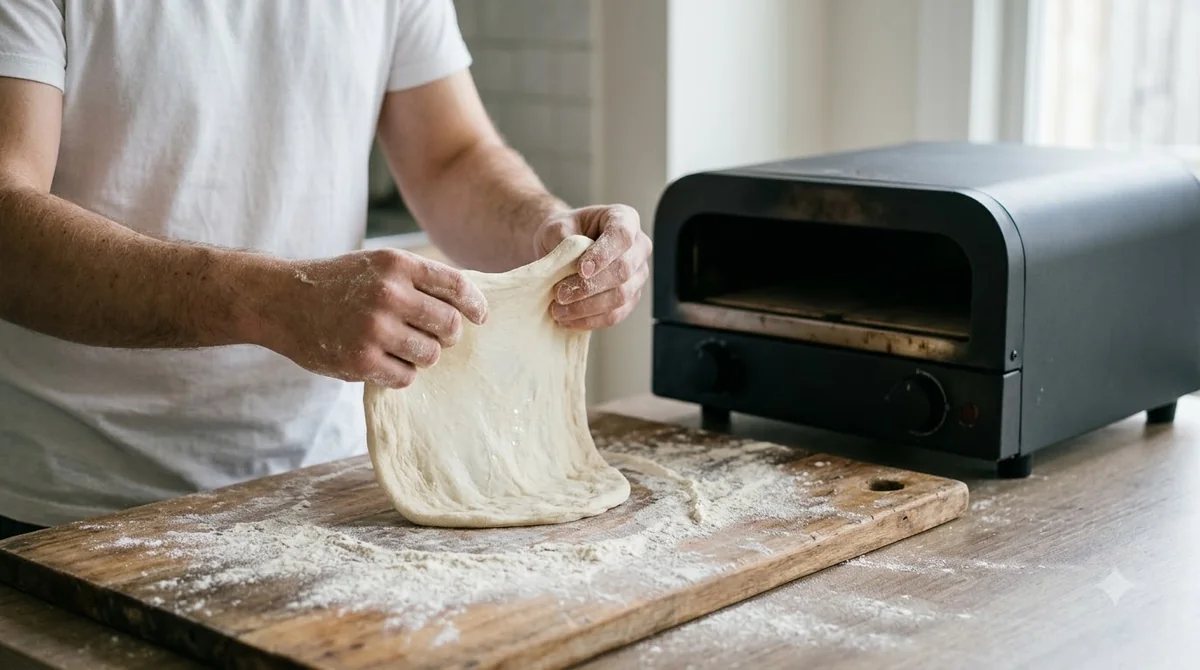

The charcoal for pizza oven that most owners choose is lump charcoal, since it lights quickly, runs hot and burns down to a small amount of ash. Ooni’s guides for its multi-fuel ovens recommend good-quality lump charcoal and say briquettes should not be used.
Your oven’s manual still decides which fuels are allowed, so check it first. This guide compares fuel types, explains how to choose and covers the mistakes that cut airflow and heat.
Why Lump Charcoal Is the Usual Choice
Lump charcoal is the usual choice because Ooni’s Karu guide recommends good-quality, sustainably sourced lump charcoal and says it burns down to a small amount of ash.
The Ooni Karu Essentials Guide describes lump charcoal as an easy choice for low and slow cooking because it offers a wide range of temperatures. It also reduces clean-up, since the fuel leaves only a small amount of ash behind, and the guide uses it for non-pizza dishes too, which makes it a flexible charcoal for pizza oven choice.
Ash has a practical effect on every charcoal for pizza oven cook. The Ooni Pro guide explains that the holes in its charcoal and wood burner increase airflow and let excess ash drop out of the burning area, so a fuel that leaves less ash is simpler to manage during a cook.
When you compare a charcoal for pizza oven, start with the standard Ooni sets in its own guidance: good-quality lump charcoal from a sustainably sourced supplier. Check the bag’s label for the fuel type before you buy, and read our explainer on using charcoal in a pizza oven for the basics.
Charcoal for Pizza Oven: Types Compared
Lump charcoal is the best-supported charcoal for pizza oven use, while briquettes are the wrong choice because they block the grate holes that carry air to the fire.
| Fuel type | How it behaves in a pizza oven | What the maker guidance says |
|---|---|---|
| Lump charcoal | Offers a wide range of temperatures and burns down to a small amount of ash | Ooni’s Karu guide recommends good-quality, sustainably sourced lump charcoal |
| Briquettes | Compressed fuel that can block the holes in the grate and reduce airflow | Ooni’s Karu guide says do not use briquettes |
| Charcoal and wood together | Lump charcoal gives a steady base, and wood adds a burst of heat and wood-fired flavour | Both Ooni guides describe this combination for their multi-fuel ovens |
Instant-light charcoal is not covered by the maker guides we read, so this guide makes no claim about how it performs. If an instant-light product is on your list, check your oven’s manual and the product’s own fuel guidance before you buy.

Mr. Bar-B-Q All Natural Hardwood Lump Charcoal
Pros & ConsViewHide
Reasons to buy
- All-natural hardwood lump charcoal rather than compressed briquettes
- 8 lb bag is easy to store and enough to try for a few cooks
- Sold for grilling, so the pieces are widely available
Reasons to avoid
- Sold as a grilling charcoal, so check your oven manual before using it
- Pieces vary in size and may need breaking down for a small grate

Betterwood Products 3317 100% All Natural Hardwood
Pros & ConsViewHide
Reasons to buy
- 100% natural hardwood lump charcoal, not briquettes
- Larger bag lasts through many fires
- Listed for outdoor grills and smokers, so it is a familiar fuel type
Reasons to avoid
- Only a small number of Amazon ratings so far
- Large pieces may need breaking down for a small oven grate

Premium Lump Charcoal – Restaurant-Grade
Pros & ConsViewHide
Reasons to buy
- 100% natural hardwood lump charcoal, not briquettes
- Listing describes it as low ash and long burning
- Rated 4.6 stars, though from a modest number of ratings
Reasons to avoid
- Fewer ratings than the big grilling brands
- Higher price per bag than basic grilling charcoal
How We Chose the Charcoal in This Guide
This guide sets out the criteria for choosing a charcoal for pizza oven rather than ranking brands by hands-on tests, and each criterion below traces back to a maker guide we read.
- The maker allows the fuel. The Karu and Pro guides both list charcoal among the fuels their ovens accept.
- Low ash output. The Karu guide says lump charcoal burns down to a small amount of ash.
- Pieces that keep airflow open. Briquettes block the grate holes, so they fail this test.
- Sustainable sourcing. The Karu guide asks for sustainably sourced lump charcoal.
Brand names, bag sizes and prices for each charcoal for pizza oven change often, so they are left to the product section above. Check the current listing and the fuel note on the bag before you buy.
What to Check for Your Oven Type
A charcoal for pizza oven only belongs in an oven whose maker lists charcoal as a fuel, and Ooni’s Karu and Pro are multi-fuel models that accept wood and charcoal.
- Check the fuel list. The Karu, such as the Ooni Karu 12, is described as a wood- and charcoal-fired oven, and the Pro guide lists charcoal among its fuels.
- Check the temperature limit. The Karu guide says it is designed to run at up to 932°F (500°C), and the Pro guide gives the same 932°F ceiling for charcoal and wood.
- Check the space and airflow. The Karu guide asks for at least 3 feet (1 metre) of space around the oven when firing solid fuel, with the chimney cap removed and the door left on.
The Pro guide describes charcoal and wood together as its favourite fuel source, with the charcoal holding a steady base and the wood adding a burst of heat. Our guide to wood for pizza oven covers moisture and species. If your oven is not listed for charcoal, do not buy a charcoal for pizza oven just because it is cheap or close at hand.
Heat Targets and Fuel Management
Aim for at least 752°F (400°C) in the centre of the stone before you launch a pizza, and stop adding fuel well before the oven reaches its 932°F (500°C) design limit.
The Karu guide suggests checking the stone with an infrared thermometer and aiming for at least 752°F (400°C) in the centre before you launch. The guide also tells you to allow new fuel a couple of minutes to burn before you add food.
The Ooni Pro Essentials Guide gives a preheat of 20 to 30 minutes for charcoal and wood, with a top temperature of 932°F (500°C). It also says those figures are estimates that depend on weather and ambient temperature, so use the timing as a starting point rather than a fixed rule.
The Karu guide gives a simple ready signal. The oven is not ready while the charcoal is black and smoking, and it is ready when the charcoal glows white with a red centre. Follow this routine for each cook:
- Start with two or three pieces of charcoal in the grate and light them with natural firestarters.
- Wait until the charcoal glows white with a red centre before you cook.
- Top up little and often, and always leave room for air to move through the grate.
Flame size is the other thing to manage. The Karu guide notes that charcoal alone gives smaller flames, so adding a small piece of kindling two or three minutes before you bake helps raise the flame. For a Neapolitan-style pizza that cooks in about 60 seconds, the guide says you need real flame, which only forms after the fuel has burned through and air can reach the grate.
If the fuel tray looks unbalanced or the flame is weak, do not launch a pizza yet. Build the fire up gradually with smaller pieces of kindling, and give each new addition time to burn properly before you start cooking.
Common Mistakes That Cut Airflow and Heat
The biggest mistakes with any charcoal for pizza oven are using briquettes, cooking before the fire is ready and adding too much fuel at once, which either blocks airflow or pushes the oven too hot.
- Using briquettes. The Karu guide says they block the holes in the grate and reduce airflow.
- Cooking too early. The Karu guide says the oven is not ready while the charcoal is still black and smoking.
- Adding too much fuel at once. The Pro guide warns that the oven may overheat past 1,022°F (550°C) if too much fuel goes in at one time. Stop adding fuel and remove the hatch to let heat out.
- Blocking the air. Keep the grate open and the clearance around the oven, since the Karu needs room for airflow when firing with solid fuel.
The same care applies after every charcoal for pizza oven cook. Wait at least 1 hour after the fire goes out before you move or clean the oven, and never use water to cool or extinguish it. Store the oven only when it is completely cool and dry.
Frequently Asked Questions
Can I use briquettes in a pizza oven?
Ooni’s Karu guide says no, because briquettes block the holes in the grate and reduce airflow. Check your own oven’s manual before you choose a charcoal for pizza oven, since the maker sets the rules for its model.
How much charcoal should I start with?
The Karu guide suggests starting a charcoal for pizza oven fire with two or three pieces in the grate, lit with natural firestarters. Top up little and often rather than loading a full tray, which keeps the fire under control and leaves room for airflow.
Can I mix charcoal and wood?
Yes, for a charcoal for pizza oven whose maker lists both fuels. The Karu guide says lump charcoal gives a steady base, while wood adds a burst of heat and wood-fired flavour, so the two work well together. If your oven burns pellets instead, see our wood pellets for pizza oven guide.
How long does charcoal take to get ready?
The Ooni Pro guide gives a 20 to 30 minute preheat for charcoal and wood, and it says those times are estimates that depend on weather. Wait until the charcoal glows white with a red centre before you launch a pizza.
Is it safe to use charcoal indoors?
The Karu guide says the oven is designed for outdoor use only and should not be fired in high winds. It also asks that children and pets stay at a safe distance and are supervised whenever the oven is hot.
Do I need a thermometer?
A thermometer helps you check the heat of any charcoal for pizza oven fire instead of guessing. The Karu guide recommends an infrared thermometer and aims for at least 752°F (400°C) in the centre of the stone before you launch a pizza.
Before you buy a charcoal for pizza oven, check your oven’s manual for the fuels it accepts. If charcoal is on the list, choose good-quality lump charcoal, avoid briquettes and keep the fire small and topped up. That approach matches what Ooni’s own guides recommend for its multi-fuel ovens.
 9 min readGear & PantryBest Pizza Flour: How to Choose by Type, Style and OvenUpdated Nov 17, 2026
 7 min readGear & PantryPizza Oven Door: Types, Sizes and Materials for 2026Updated Nov 17, 2026
 9 min readGear & PantryBest Wood Pellets for Pizza Oven: Types and How to ChooseUpdated Nov 10, 2026
 9 min readGear & PantryPizza Oven Brush Guide: 4 Easy Bristle Types ComparedUpdated Nov 10, 2026
 6 min readGear & PantryBertello Outdoor Pizza Oven Pizza Peel: Size and Type GuideUpdated Nov 15, 2026
 8 min readGear & PantrySpiral Mixer for Pizza Dough: Best Types and Picks for 2026Updated Nov 10, 2026