
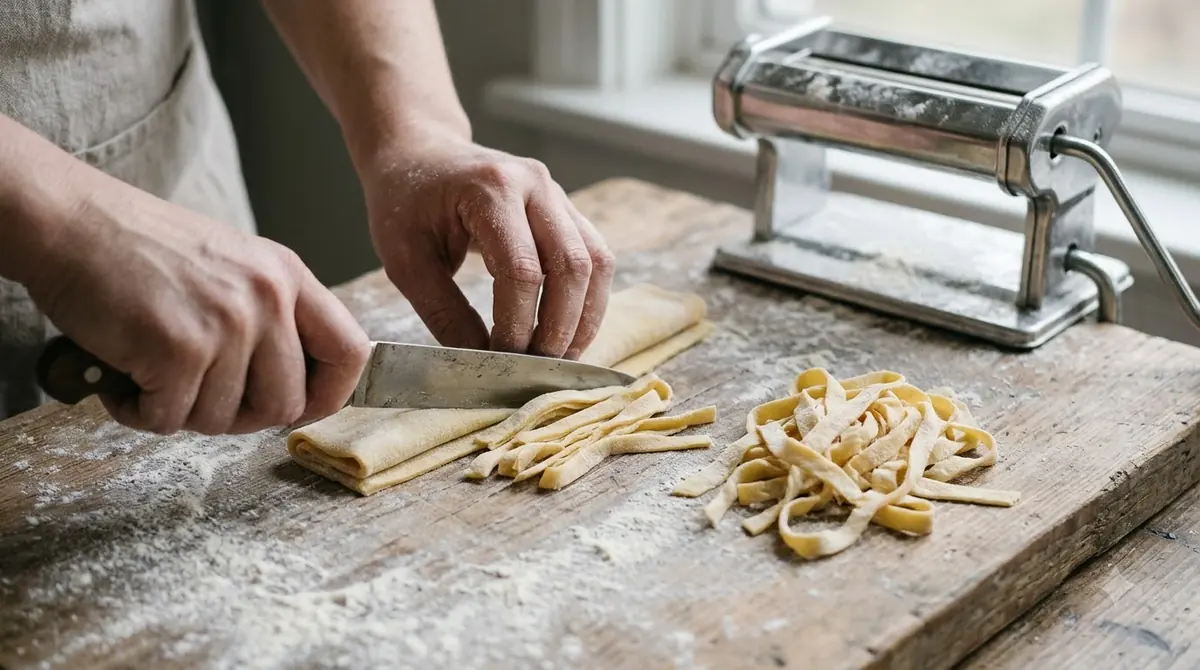

Tagliatelle pasta is a long, flat ribbon pasta from Emilia-Romagna, Italy. Traditional versions use durum wheat semolina and eggs, and the strands are wide enough to hold rich sauces. You can make it by hand at home or buy it dried.
Fresh tagliatelle cooks in a few minutes, while dried nests take longer. The sections below cover size, dough, sauces, cooking time and common mistakes, so you can cook tagliatelle pasta with confidence.
What Is Tagliatelle Pasta?
Tagliatelle pasta is a flat ribbon pasta traditionally made in Emilia-Romagna, Italy, and its name comes from the Italian word tagliare, meaning to cut.
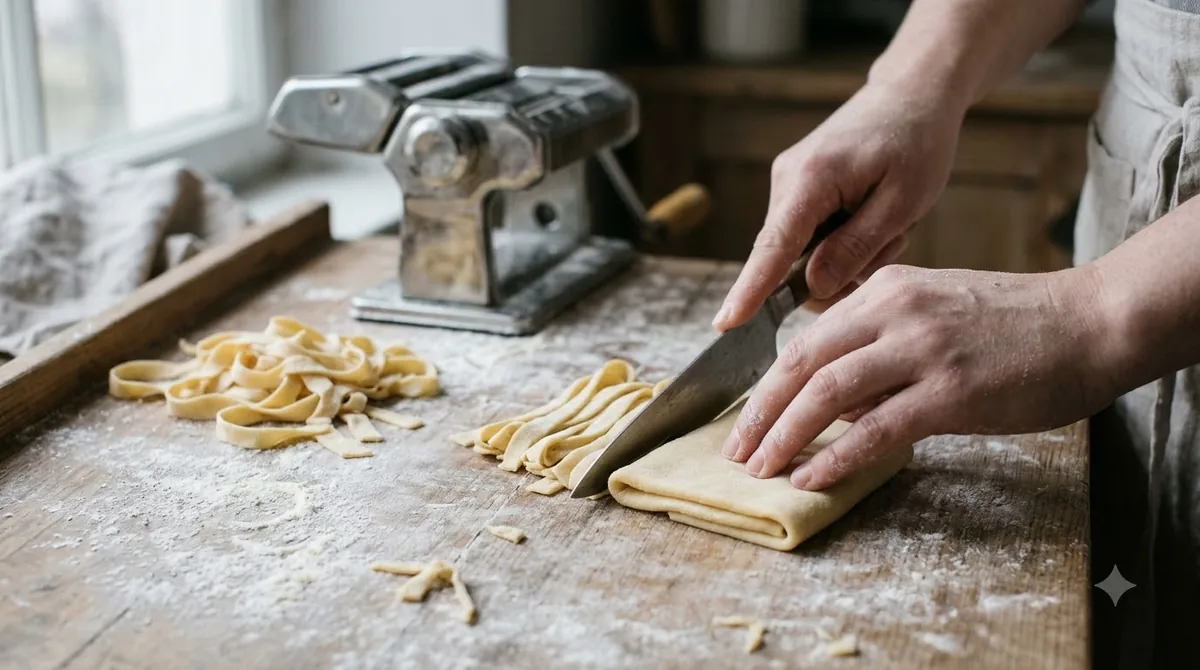
The egg version is made from durum wheat semolina and eggs, which gives it a golden color and a richer flavor. A simpler semolina version uses only durum wheat and water. Both forms are sold fresh or dried, and dried tagliatelle usually comes as small nests that are easy to portion.
The shape is long and flat. DeLallo’s guide to tagliatelle describes the strands as about 1 mm thick, which gives the pasta its broad, ribbon-like look on the plate.
Wikipedia lists the Marche region as an origin alongside Emilia-Romagna, so the history of tagliatelle is shared between two Italian regions.
Tagliatelle Width and Shape Compared with Fettuccine
Tagliatelle is usually 6 to 8 mm wide and about 1 mm thick, and it is very close in shape to fettuccine.
Sources give slightly different widths. DeLallo gives 6 to 7 mm before cooking and about 8 mm after cooking, while The Pasta Project gives a normal range of 6 to 8 mm.
| Measurement | Typical figure |
|---|---|
| Width before cooking | 6 to 7 mm |
| Width after cooking | About 8 mm |
| Thickness | About 1 mm |
Fettuccine is the closest comparison. Wikipedia describes the two shapes as similar, and DeLallo says tagliatelle is the thinner of the two, so the width is the main difference you will notice. The full fettuccine vs tagliatelle guide compares them side by side, and fettuccine pasta covers the other shape on its own. A narrower option is linguine, a flat-oval noodle about 4 mm wide, which suits the same light sauces.
How to Make Homemade Tagliatelle
Homemade tagliatelle uses about one large egg for every 100 grams of flour, kneaded into a smooth dough and rolled thin before cutting.
Most cooks use soft wheat “00” flour (see what 00 flour is), although all-purpose flour also works. The Pasta Project’s tagliatelle guide gives the ratio of one large egg per 100 grams (3.5 oz) of flour.
Follow these steps for a basic batch of tagliatelle pasta.
- Weigh the flour, make a well in the center, and add the eggs and a pinch of salt.
- Mix with a fork, then knead by hand until the dough is smooth.
- Wrap the dough and let it rest before rolling, so it is easier to stretch.
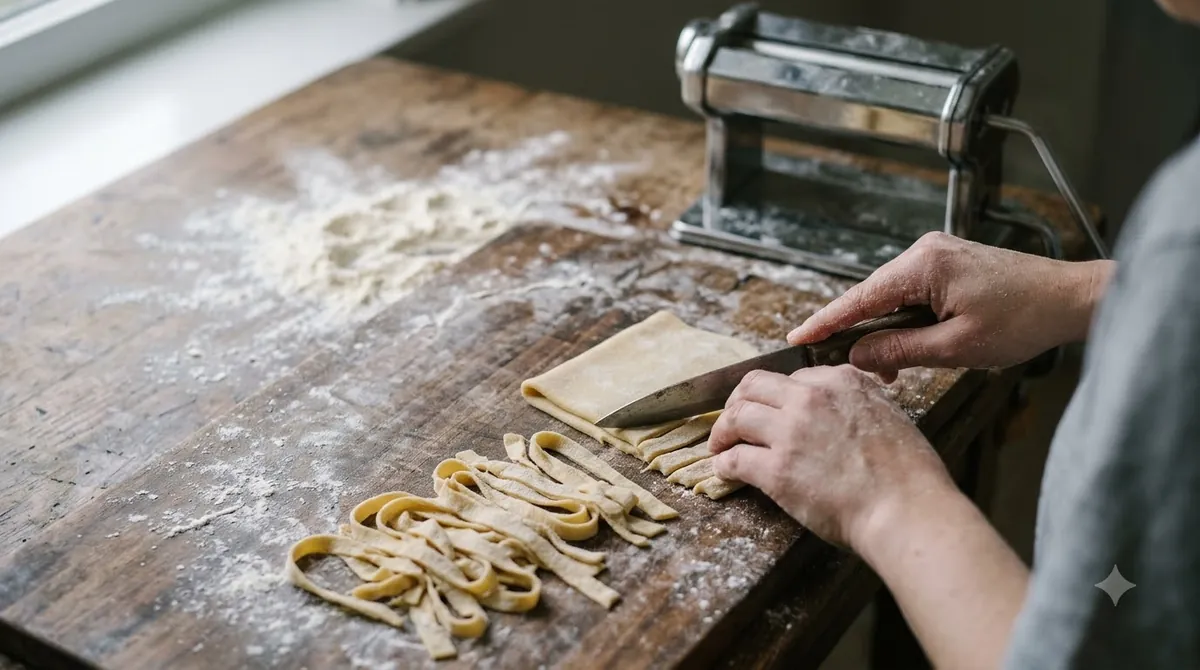
- Roll the dough into thin sheets by hand or with a pasta machine, such as the one in the Marcato Atlas 150 manual setup guide.
- Cut the sheets into ribbons with a sharp knife or a pasta cutter, then dust them lightly with flour.
The Pasta Project does not give set kneading or resting times, so judge by feel. The dough should look smooth and hold its shape without sticking to your hands. For a full egg dough with its own kneading and resting times, see our step-by-step egg pasta dough. If you use an electric machine instead, these Hamilton Beach pasta maker recipes include a simple egg pasta.
Best Sauces for Tagliatelle
Bolognese and other meat ragu are the classic pairing for tagliatelle, and the wide, flat strands also hold creamy, pesto and tomato sauces well.
The Pasta Project calls Bolognese the most famous pairing and notes that the wide, slightly rough surface suits thick, rich sauces. DeLallo lists a wider set of options, and the list below shows the most common matches for a tagliatelle pasta dish.
- Bolognese and other meat ragu
- Cream, butter or cheese sauces
- Pesto and fresh tomato sauces
- Mushroom sauces
Tagliatelle is not typically used in baked pasta or soup, so keep it for stovetop sauces that you can toss directly with the noodles.
A good rule for tagliatelle pasta is to match the sauce’s body to the ribbon. A wide, slightly rough surface grips a thick ragu or cream sauce, while a thin, watery sauce tends to pool at the bottom of the bowl. Spoon a little extra sauce over the top just before serving so every strand is coated.
How Long to Cook Tagliatelle
Fresh tagliatelle cooks in about 3 to 5 minutes, while dried nests take 7 to 10 minutes to reach al dente.
| Form | Cook time | Portion guide |
|---|---|---|
| Fresh tagliatelle | 3 to 5 minutes (DeLallo says 3 to 4) | No set weight in the sources |
| Dried nests | 7 to 10 minutes to al dente | About 50 g per nest; one nest as a side, two for a main |
Dried tagliatelle is usually sold as nests of about 50 g each. The Pasta Project suggests two nests (about 100 g) per person, while DeLallo recommends one nest per person as a side dish and at least two for a main course.
- Bring a large pot of salted water to a boil, then add the nests a couple at a time.
- Stir as the nests soften so the strands separate.
- Start checking fresh tagliatelle after 3 minutes, then every 30 seconds until it is firm to the bite.
- Before draining, scoop out some of the starchy pasta water.
- Add the hot pasta directly to the sauce with a splash of the pasta water, and toss until it is coated.
Taste one strand of tagliatelle pasta near the end of the cooking window. It is ready when it is firm to the bite, with no chalky center.
Common Mistakes with Tagliatelle
The most common mistakes are rinsing the cooked pasta, draining away all the pasta water that helps the sauce cling, and adding cold pasta to the sauce.
- Rinsing hot pasta, which stops it from absorbing the sauce. Rinse only if you cannot serve it right away.
- Adding cold or rinsed pasta to the sauce. Add the hot pasta straight from the pot instead.
- Draining without saving the starchy water you need to loosen a thick sauce.
These tips apply to both fresh and dried tagliatelle, although fresh pasta needs a much shorter cooking window.
Frequently Asked Questions
Is tagliatelle pasta the same as fettuccine?
Tagliatelle is very close to fettuccine in shape, and Wikipedia describes the two as similar. DeLallo says tagliatelle is thinner than fettuccine, so width is the main difference between them.
Can tagliatelle pasta be made without eggs?
Yes. According to DeLallo, the semolina version uses only durum wheat and water. Because the eggs add the golden color and richer flavor of the egg version, the semolina version tends to look paler and taste plainer.
How many nests of dried tagliatelle per person?
DeLallo suggests one nest per person as a side dish and at least two nests for a main course. A nest is about 50 g, so two nests come to roughly 100 g.
How long does tagliatelle pasta take to cook?
Fresh tagliatelle cooks in about 3 to 5 minutes, and dried nests take 7 to 10 minutes to reach al dente. Start tasting a minute before the shortest time in each range.
How wide is tagliatelle pasta?
Tagliatelle is normally 6 to 8 mm wide and about 1 mm thick. DeLallo gives 6 to 7 mm before cooking and about 8 mm after cooking. For a wider ribbon, see pappardelle pasta, and for a thinner egg ribbon, see tagliolini pasta, which is about 2 to 3 mm wide.
What is the best sauce for tagliatelle pasta?
Bolognese is the classic choice, because the wide, slightly rough surface grips thick sauces. Cream, butter, cheese, pesto, fresh tomato and mushroom sauces also suit it.
If you are buying tagliatelle pasta, choose dried nests for a quick weeknight dinner and fresh ribbons when you have more time. Start with a meat or cream sauce, since both suit the wide strands. Start tasting dried tagliatelle at 7 minutes, since the usual dried range is 7 to 10 minutes.