
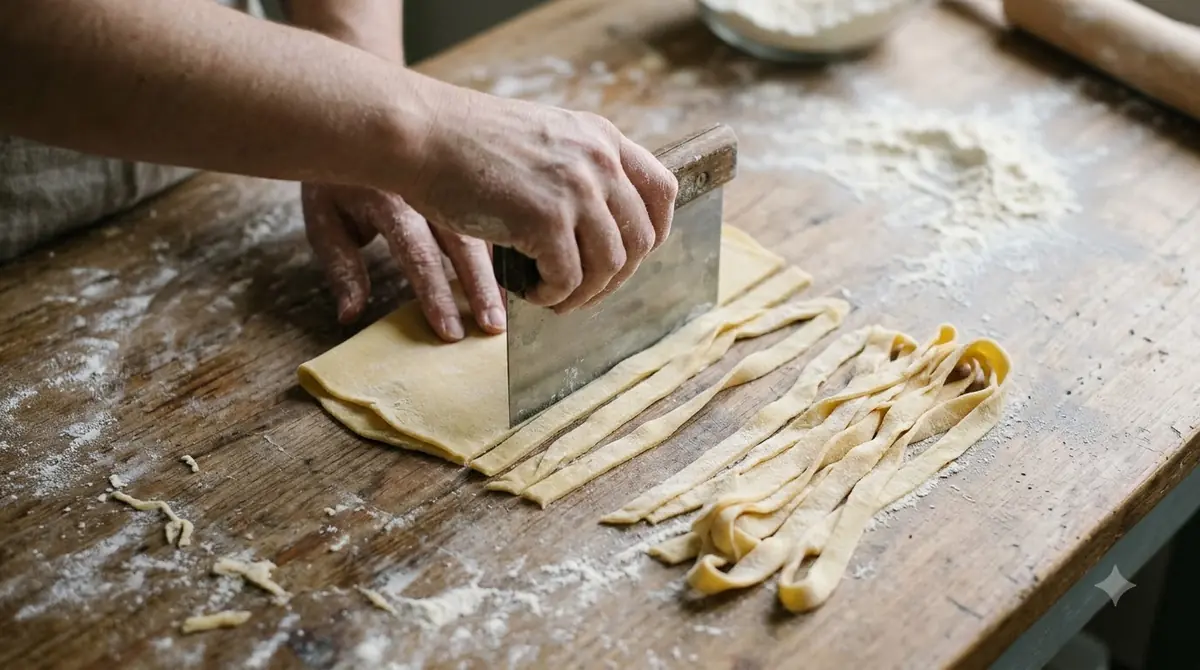

Lagane pasta is a rustic fresh pasta from Southern Italy that is usually thicker and wider than tagliatelle. It is traditionally made by hand from flour and water and served with legumes, especially chickpeas.
Parts of its history rest on food writers’ claims, but the homemade recipe is simple: 300 g of durum wheat flour and 150 ml of tepid water. Dried lagane pasta is rare, so most cooks make it fresh.
What Is Lagane Pasta?
Lagane is a wide, flat fresh pasta from Southern Italy, usually thicker and wider than tagliatelle but narrower than lasagna.
The Pasta Project describes the usual method for lagane pasta: roll the dough into a sheet about 2 mm thick, shaped as close to a rectangle as possible, then cut it into strips. The sheet is rolled up, cut into sections 2 to 3 cm wide, and then unrolled, so each piece opens into a flat ribbon.
Lagane pasta is made across Southern Italy, in the regions of Basilicata, Calabria, Campania and Puglia. In Puglia, particularly in Salento, some cooks fry the pieces in boiling oil until they swell and turn crunchy.
Very little lagane pasta reaches shops in dried form. The Pasta Project notes that few makers produce a dried version, and the author could not find one in supermarkets in Northern Italy. Most people who want lagane pasta make it by hand at home; for a plain base, see our fresh pasta dough recipe, and for how fresh differs from boxed, read fresh pasta vs dried pasta.
Where Lagane Pasta Comes From
Food writers describe lagane pasta as one of the oldest forms of pasta and the ancestor of lasagne, but these are claims rather than documented dates.
According to The Pasta Project’s lagane guide, lagane are believed to be the ancestors of today’s lasagne and the oldest form of pasta. The site also says the word comes from ancient Greece, where it described a pasta of flour and water cooked on a stone and then cut into strips.
The same guide credits the Roman poet Horace with writing about a soup of lagana and chickpeas that he ate in his home town of Venosa in Basilicata. It also says his writings are said to be the first written reference to pasta, and it mentions Cicero writing about the laganum. These are claims from one blog, so treat them as a starting point rather than settled history.
Wikipedia’s article on lagane e ceci does not mention Horace, so the link between the dish and his writing is not confirmed by that source.
How to Make Lagane Pasta at Home
To make lagane pasta at home, combine 300 g of durum wheat flour with 150 ml of tepid water, knead for about 15 minutes, rest the dough, roll it and cut it into strips 2 to 3 cm wide.
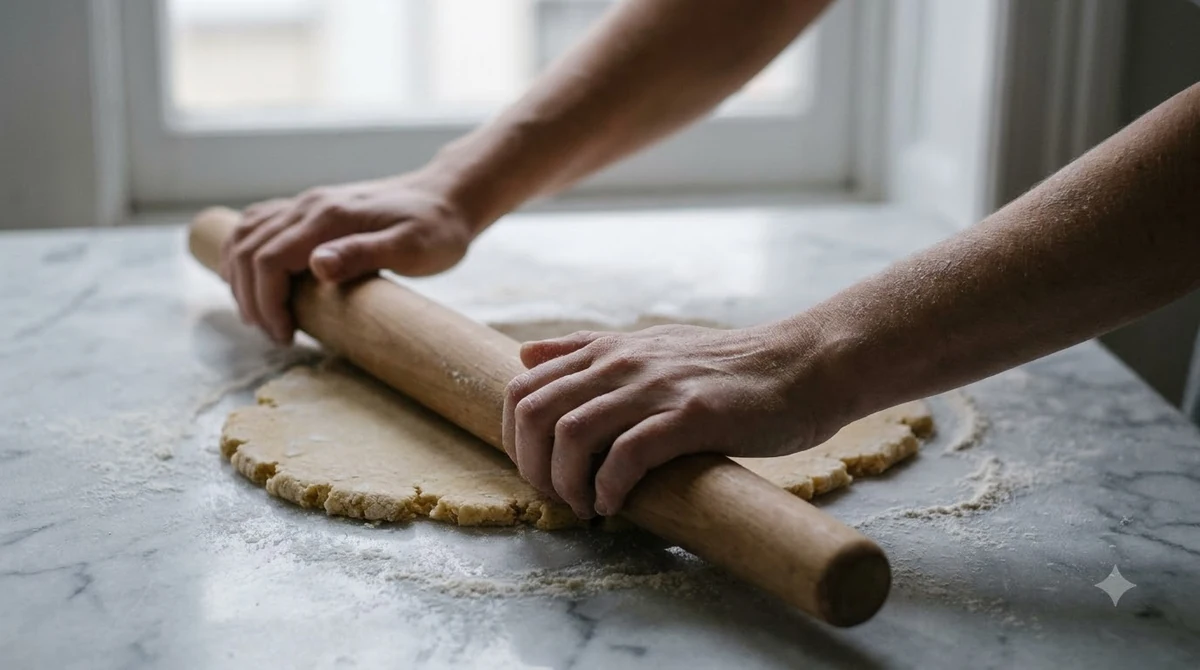
- Sift the flour into a mound on the counter, make a well in the center, and add the water a little at a time, mixing with a fork.
- Knead for about 15 minutes until the dough is smooth and elastic.
- Shape the dough into a ball, wrap it in plastic wrap, and rest it for half an hour at room temperature.
- Cut off about one third of the dough and roll it on a floured surface to roughly 2 mm thick, aiming for a rectangle.
- Roll the sheet up, cut it into sections 2 to 3 cm wide, then unroll each piece.
- Rest the cut pasta for about 20 minutes before cooking.
- Cook in boiling water until al dente, then toss with your sauce.
The lagane pasta recipe lists no salt in the dough and gives no cooking time. The author notes that fresh pasta cooks quickly and that the exact time depends on thickness, so start tasting early.
The author uses semola rimacinata, which she calls the most traditional flour for Southern Italian flour-and-water pasta. Because it is milled twice, it is finer than ordinary semolina. A commenter was told it has about 12% protein, and that other hard wheat flours should work with little difference.
| Element | Recipe figure |
|---|---|
| Flour | 300 g durum wheat flour |
| Water | 150 ml tepid water |
| Kneading | About 15 minutes |
| Dough rest | Half an hour, wrapped, at room temperature |
| Sheet thickness | About 2 mm |
| Cut width | 2 to 3 cm |
| Rest before cooking | About 20 minutes |
Lagane e Ceci: The Classic Chickpea Dish
Lagane e ceci is a first course from Calabria that pairs lagane with chickpeas, garlic and olive oil, and it is also known as pasta del brigante.
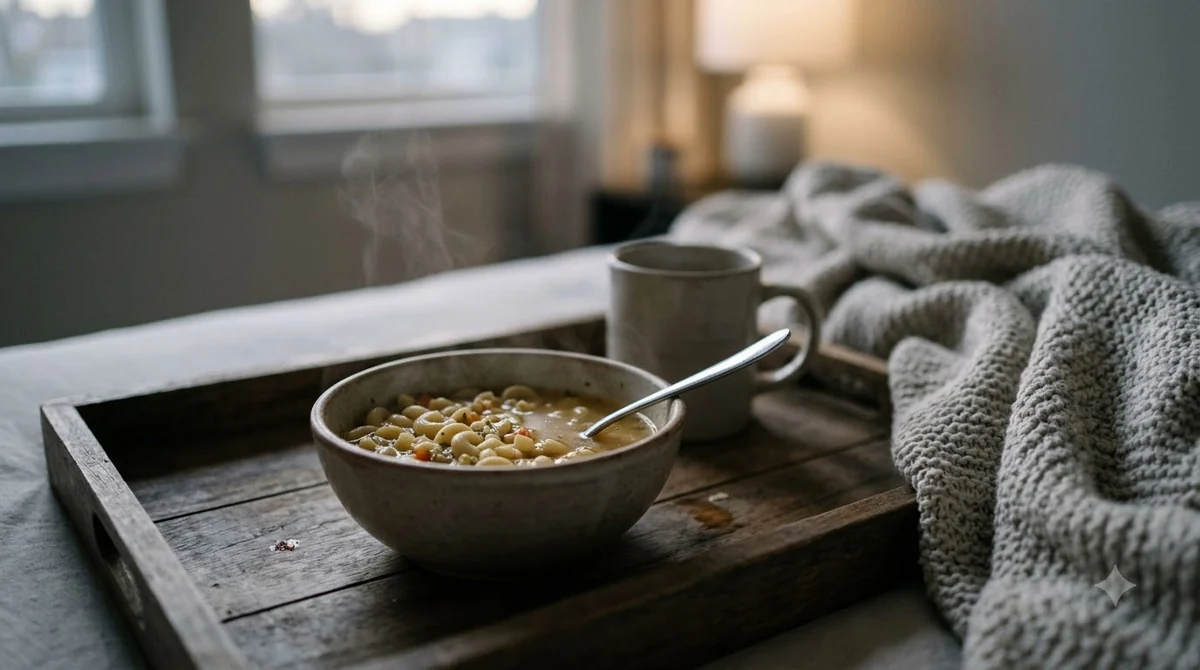
Wikipedia’s entry on lagane e ceci describes the dish as a lagane pasta dish from Calabria made with lagane, chickpeas, garlic and olive oil. The dish is tied to St Joseph’s Day on 19 March, when families and neighbors traditionally share it, served with pan-fried cod and zeppole.
The origin of that custom is uncertain. It may date to the 20th century, or it may have roots in Calabria’s medieval feudal society. The name pasta del brigante, or brigand’s pasta, is not explained in that source.
Ingredients for four servings
- 320 g lagane
- 200 g dried chickpeas
- 200 g cherry or datterini tomatoes, halved
- 2 garlic cloves, peeled
- 1 large rosemary sprig
- 1 fresh or dried chili, seeds removed
- 3 tablespoons extra virgin olive oil
Add salt and pepper to taste. Grated grana or pecorino and black pepper are optional at the table.
Method
- Soak the dried chickpeas in cold water for 12 hours, then drain and rinse them.
- Simmer them in salted water with a bay leaf for about 1 hour, until quite soft. Reserve a cupful of the cooking water before draining.
- Heat the olive oil in a large pan, then add the garlic, rosemary and chili. Cook until the garlic turns golden without burning.
- Add the tomatoes and a pinch of salt, and cook on low for about 20 minutes until soft.
- Remove the garlic cloves, stir in the chickpeas and half a cup of the reserved water, and cook for 5 more minutes, adding water if the sauce is dry.
- Cook the lagane until al dente, drain, add it to the sauce and toss well. Serve with cheese if you like, and black pepper.
Canned chickpeas can be used for a faster version, added at the sauce stage. The author prefers dried chickpeas for flavor and warns that canned ones may contain more sodium and BPA unless labeled BPA-free.
Recipes vary across the South, with or without tomatoes, bacon or lard, and as either a soup or a drier dish.
Can You Buy Lagane or Use Another Pasta?
Dried lagane pasta is hard to find, since the author could not find it in Northern Italian supermarkets, so most cooks make it fresh or use a similar ribbon pasta.
The Pasta Project’s chickpea recipe calls for 320 g of lagane “or other pasta”, so a similar wide pasta works. Ribbons such as pappardelle pasta or tagliatelle pasta are the simplest stand-ins when you cannot make lagane, and short cavatelli pasta is another Southern Italian option.
The homemade dough is only flour and water, so it contains no eggs. That makes the pasta naturally egg-free, although the optional grated cheese in the chickpea dish is not.
Common Mistakes When Making Lagane
Three points in the recipe matter most: keep the sheet near 2 mm, respect both rests, and check the pasta early because fresh lagane pasta cooks quickly.
- Rolling the lagane pasta sheet much thicker than about 2 mm, the thickness the recipe aims for.
- Skipping the half-hour dough rest or the 20-minute rest for the cut pasta.
- Cooking by the clock, when the recipe gives no time and fresh pasta cooks quickly.
- Skipping the 12-hour soak for dried chickpeas.
- Draining the chickpeas without reserving cooking water, which the recipe uses to loosen the sauce.
Frequently Asked Questions
What is lagane pasta made of?
The homemade lagane pasta recipe uses only durum wheat flour and tepid water, so it contains no eggs. The dough has no salt. The author uses semola rimacinata, which she calls the most traditional flour for this style of pasta.
Is lagane the same as lasagne?
No. According to The Pasta Project, lagane are believed to be the ancestors of today’s lasagne. Lagane are usually thicker and wider than tagliatelle, and they are cut into strips rather than layered in a baking dish.
How long does lagane take to cook?
The homemade recipe gives no fixed cooking time. Fresh pasta cooks quickly, and the time depends on thickness, so check a piece early. Thin pieces finish faster than thick ones, so cook until al dente and taste as you go.
Where is lagane made?
Lagane pasta is made across Southern Italy, in Basilicata, Calabria, Campania and Puglia. It is usually made by hand, and in Puglia, particularly around Salento, some cooks fry it until crunchy. Dried versions are rare.
Is lagane pasta vegan?
The homemade lagane pasta dough has no eggs, so the pasta itself is egg-free. The chickpea dish can also be vegan if you leave out the optional grated grana or pecorino and use eggless pasta, as the author suggests. Check the label on any store-bought pasta you buy.
Can you buy dried lagane?
Rarely. The Pasta Project says few makers produce dried lagane pasta, and the author could not find one in supermarkets in Northern Italy. Making it fresh at home is the most reliable way to get it, and the dough needs only flour and water.
If you want the real thing, start with the 300 g lagane pasta dough and try it in the chickpea dish. A sheet near 2 mm and strips of 2 to 3 cm will get you most of the way there. Keep the history in mind as a set of claims until you check the original sources.