
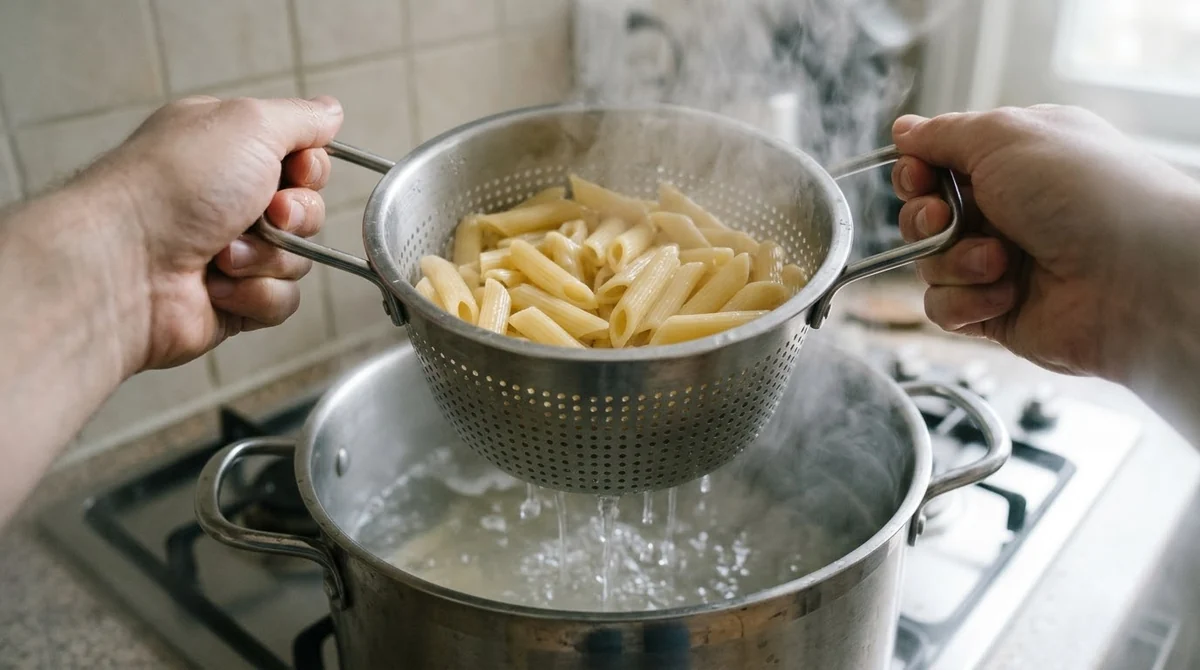

The right colander for pasta has many tiny perforations, a base at least 1 inch tall and a bowl at least 4 inches deep. A colander is a perforated bowl that drains boiled pasta while the water runs out. Base height and bowl depth matter as much as the holes, and the criteria below come from America’s Test Kitchen’s 2025 colander review.
What makes a good colander for pasta?
A good colander for pasta drains quickly, sits steady over the sink and has a bowl tall enough to keep the pasta inside.
Three checks cover most of the difference between a useful colander and a frustrating one. America’s Test Kitchen judged its 2025 lineup on hole pattern, base and bowl dimensions, handles and material, using models of 4.5 or 5 quarts. Look for these three points first:
- Many small, well-distributed holes that let water leave quickly.
- A base at least 1 inch tall with a wide ring shape.
- A bowl at least 4 inches deep, so pasta stays inside when you drain a full pot.
The full review is at America’s Test Kitchen’s colander guide, which lists each model’s measurements and the reasons behind its verdict. Reading it before you shop helps you compare any colander for pasta on the same criteria.
Why hole size and perforation pattern matter
Numerous tiny, well-distributed holes drain pasta fastest, while large holes let food slip through to the sink.
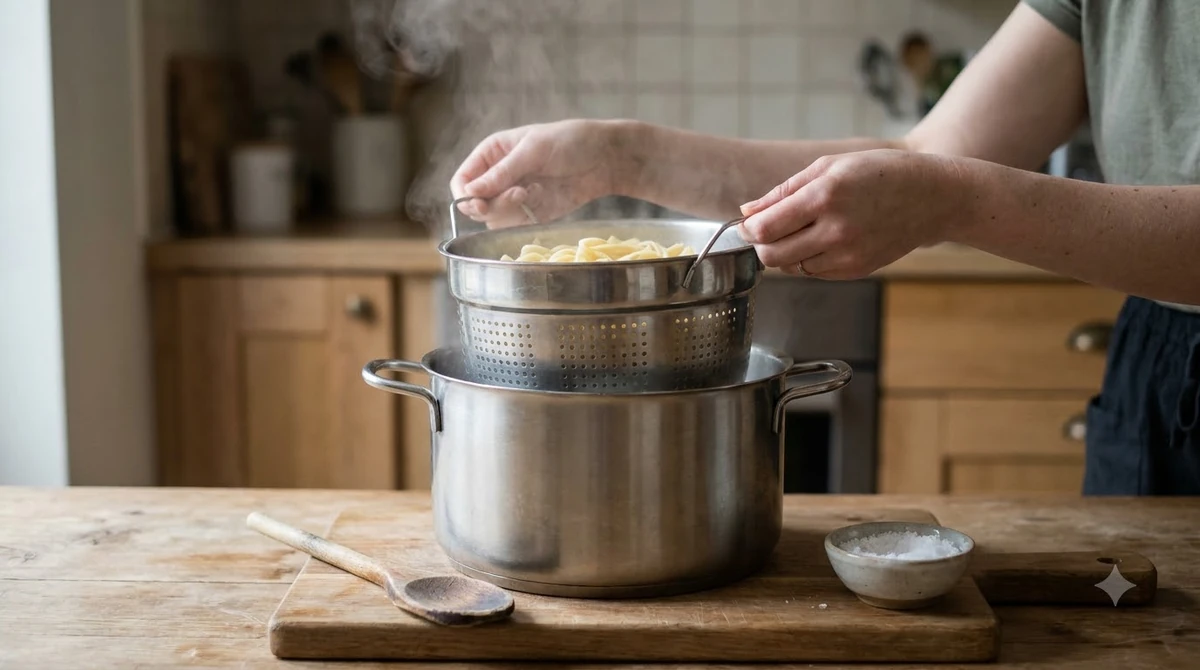
Hole size and number mattered more to the 2025 testers than how the holes were arranged. The review found that the tiniest holes kept angel hair from slipping through, and that drainage improved as the perforations became more numerous.
The same publisher’s 2022 article on draining pasta warns against colanders with a few large clusters of holes set into solid metal. Those solid areas slow the water down. It also says that pasta can keep cooking for a surprisingly long time in a colander that drains poorly, so the pasta can turn soft before you serve it. America’s Test Kitchen’s 2022 draining article describes the problem in more detail.
If you cook thin shapes such as angel hair or orzo, check the hole size of any colander for pasta before you buy. Those shapes slip through openings that are too large, and the loss is easy to miss until the pot is empty.
Base height and stability in the sink
A base at least 1 inch tall keeps the bowl clear of the water it drains, and footed bases sit too low to be stable.
The 2025 review set the minimum base at 1 inch, with a wide ring shape. Shorter or footed bases sat lower in the sink and were less stable. One model with a short base could not lift its bowl clear of the drained water, so the pasta sat in the liquid it had just released.
Before you drain, set your colander for pasta in the sink and check that it does not rock. A stable base lets you lift the pot with both hands and pour without the bowl shifting toward the drain.
Bowl depth and capacity
For a colander for pasta, choose a bowl at least 4 inches deep, because bowls 3.5 inches or shorter let pasta spill over when you empty a stockpot.
Tall walls keep pasta from sloshing over the edge when you pour from a full stockpot. The winning RSVP International model had a 4 1/4 inch bowl, while the two sets with 3 1/2 inch bowls let pasta escape in testing. The 2022 article called the winning colander spacious with tall walls, but it did not give the depth in inches.
Testers used colanders of 4.5 or 5 quarts. Most of the six models in the 2025 test held about 5 quarts, which is the size to compare first when you shop. A smaller colander is easier to store, but it fills faster when you drain a large batch.
Handles and material
Stainless steel is the material the 2025 testers preferred, and wide loop handles are the easiest to grip with oven mitts on.

Stainless steel stayed sturdy in the drop tests, and the thick models did not dent. Silicone and plastic models got dingy over time and were less stable and less durable. Plastic rims also felt less secure in the hand than metal rims.
Handles matter more when the pot is hot. Wide loops gave the testers a firm grip even through oven mitts, which makes a full pot of boiling pasta safer to lift and tip.
A plastic colander for pasta can still do the job for lighter cooking, but expect it to look worn sooner and to feel less steady when full. Check the manufacturer’s care label for the maximum temperature before you drain boiling pasta into one.
Designs to avoid
Skip collapsible, over-the-sink and feature-heavy colanders, which the 2025 testers did not recommend.
The review’s general advice points to a plain, rigid bowl with a ring base. Three styles fall outside that advice:
- Collapsible models, which fold flat for storage but give up the rigid walls and base.
- Over-the-sink designs, which depend on a fixed position rather than a stable base.
- Models with innovative features, which the review did not reward.
If storage space is tight, a plain 5-quart colander for pasta with a ring base still stores well in a cabinet. A collapsible design saves space, but it is harder to keep steady when a full pot of pasta is draining.
Colander, strainer or pot insert: which to choose
A colander is a perforated bowl for draining, a strainer often has finer mesh, and a mated colander pot fits inside a pot.
Wikipedia defines a colander as a kitchen utensil perforated with holes, used to strain foods such as pasta or to rinse vegetables. The same entry notes that a colander is sometimes called a pasta strainer, so the two names overlap in everyday use. A sieve uses much finer mesh and suits fine straining. Wikipedia’s colander entry covers the history of the word and the materials used. For serving single portions of long pasta, a spaghetti spoon is a separate tool.
| Tool | Best for | Key trait |
|---|---|---|
| Colander | Draining pasta and rinsing vegetables | Perforated bowl with a base |
| Pasta strainer | Same job as a colander in everyday use | Often another name for a colander |
| Sieve | Fine straining | Much finer mesh than a colander |
| Mated colander pot | Draining pasta straight from the pot | Fits inside a pot and lifts out |
Tested colanders at a glance
In America’s Test Kitchen’s 2025 test, the RSVP PUNCH-5 won, and the Bellemain matched its base and bowl measurements.
The table lists each colander for pasta in the test with the specifications the review published in October 2025. Models and specifications can change, so check the current listing before you buy.
| Model | Capacity | Base | Bowl depth | Verdict |
|---|---|---|---|---|
| RSVP International Endurance Precision Pierced (PUNCH-5) | 5 qt | Metal ring, 1 1/8 in | 4 1/4 in | Winner |
| Bellemain 5 Quart Stainless Steel (82391) | 5 qt | Metal ring, 1 1/8 in | 4 1/4 in | Highly recommended |
| OXO Good Grips Stainless Steel (11330900) | 5 qt | 3 plastic feet, 1/2 in | 5 1/2 in | Recommended with reservations |
| KitchenAid 5 Quart (KO166OSOBA) | 5 qt | Plastic ring, 1/2 in | 5 1/4 in | Recommended with reservations |
| Hölm 3-Piece Set (X001JBZ2MB) | 4.5 qt | 3 metal feet, 3/8 in | 3 1/2 in | Not recommended |
| P&P Chef Stainless Steel (X001TGGT7D) | 5 qt | 3 wire feet, 3/8 in | 3 1/2 in | Not recommended |
The Bellemain has the same base and bowl as the winner, but its handles are attached with rivets. The review noted that the winner is dishwasher-safe and did not dent when dropped.
For most kitchens, the PUNCH-5 is the reference colander for pasta from this test. The Bellemain is the value option with matching measurements. Check the current listing before you buy, because the table reflects the October 2025 test. More kitchen tools are listed in the Gear & Pantry guides.

Frequently Asked Questions
Which colander for pasta did testing recommend?
America’s Test Kitchen’s 2025 review named the RSVP International Endurance Precision Pierced (PUNCH-5) the winner. It is a 5-quart model with tiny perforations, a metal ring base 1 1/8 inches tall and a bowl 4 1/4 inches deep. Your sink and pot size may change which colander for pasta suits you.
Is a colander the same as a pasta strainer?
In everyday use, the two names often refer to the same kitchen tool, according to Wikipedia. A sieve is different because it uses a much finer mesh and suits fine straining rather than draining pasta.
How big should a colander for pasta be?
Most colanders for pasta in the 2025 test held about 5 quarts. Choose a bowl at least 4 inches deep as well, so pasta does not spill over the edge when you drain a full stockpot.
Can you put a colander for pasta in the dishwasher?
The review says the RSVP PUNCH-5 is dishwasher-safe. For other models, check the manufacturer’s care label before you put them in the dishwasher, because the review did not cover every model.
Are plastic colanders safe for hot pasta?
The review does not address heat ratings. It found that plastic rims felt less secure and that silicone and plastic models were less stable and durable. Check the manufacturer’s maximum temperature before draining boiling pasta into any plastic colander.
A colander for pasta is a simple purchase, but three measurements decide most of the results: hole size, base height and bowl depth. Pick a colander for pasta in stainless steel with tiny perforations, a base at least 1 inch tall and a bowl at least 4 inches deep. Those are the qualities the 2025 testers rewarded most.
 9 min readGear & PantryPasta Rolling Pin: What to Look For Before You BuyUpdated Nov 15, 2026
 8 min readGear & PantryOoni Koda 16 Cover: What to Look For Before You BuyUpdated Nov 8, 2026
 8 min readGear & PantryBest Ooni Karu 16 Cover: What to Look for Before You BuyUpdated Nov 10, 2026
 5 min readGear & PantryTop Rated Panettone: What to Look for Before You BuyUpdated Nov 13, 2026
 9 min readGear & PantryLa Molisana Pasta Review: Bite, Brand and What to Check Before You BuyUpdated Nov 8, 2026
 8 min readGear & PantryBest Aluminum Pizza Peels: What to Look For and What to BuyUpdated Nov 17, 2026