
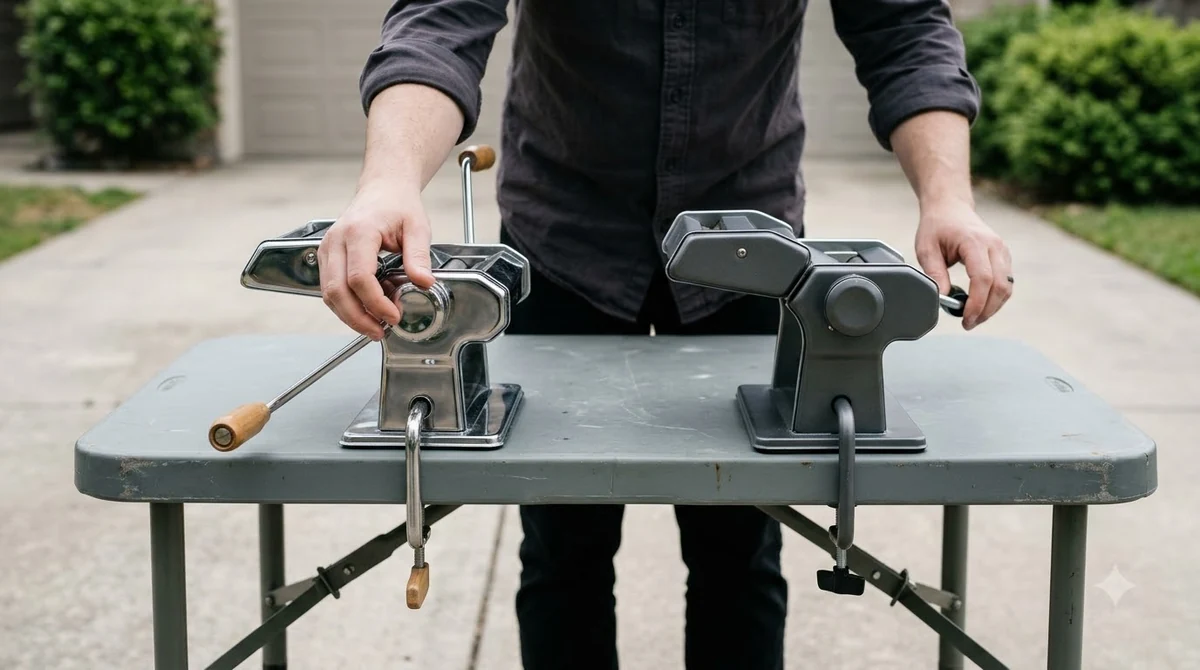

A noodle maker machine is a kitchen tool that rolls dough into thin sheets or cuts it into strands, either by hand with a crank or with a motor. Use one to make fresh noodles and pasta at home without rolling every sheet with a pin.
Manual noodle maker machines suit occasional cooks, while electric ones suit larger batches. Your counter space, your budget and whether you want flat sheets or shapes decide which type fits.
What a Noodle Maker Machine Does
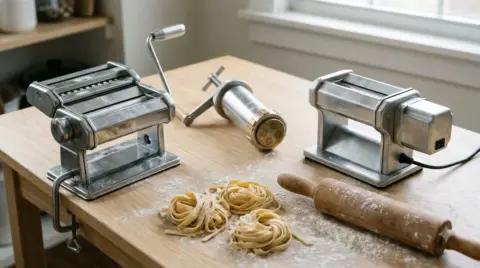
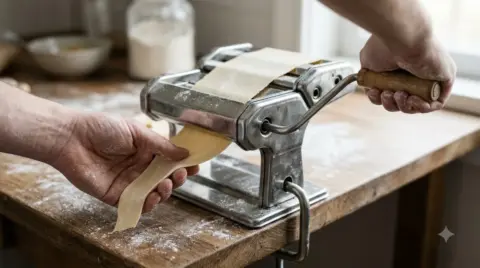
A noodle maker machine feeds dough between rollers, and each pass thins it until it reaches the thickness you set on the dial.
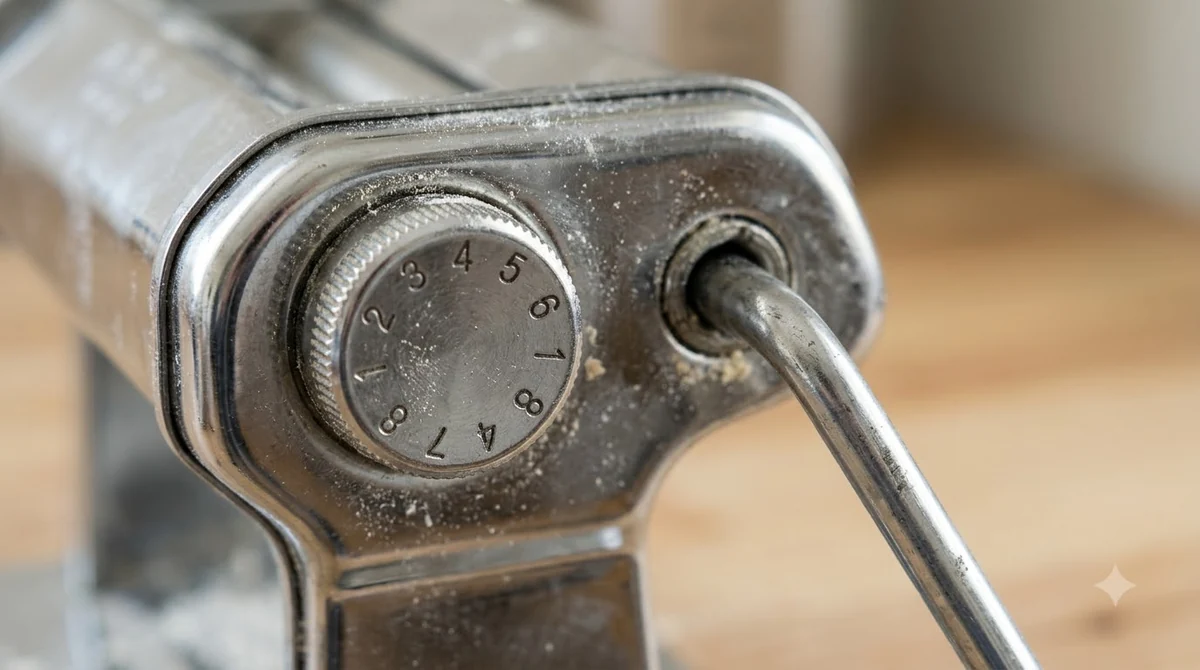
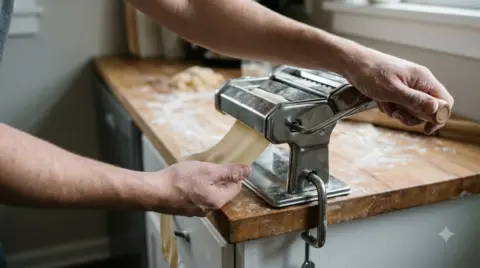
According to Wikipedia’s pasta article, a hand-cranked machine lets the cook feed dough sheets in by hand, and each turn of the crank thins the pasta gradually. On the last pass, the pasta can be pushed through a comb attachment to give it its shape.
The same basic action runs through every noodle maker machine in this guide. Cutter attachments then set the width of the strands, so a noodle maker machine with more cutters gives you more shapes. If you are new to the tool, read how to use a pasta machine first. The differences lie in how the crank or motor turns the rollers, how many thickness settings the dial offers, and which cutters or discs come in the box.
Types of Noodle Maker Machines
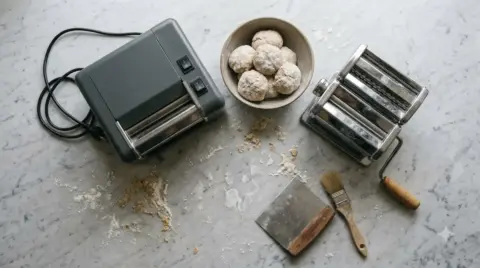
The reviewed models fall into three groups: manual rollers, electric machines and stand-mixer attachments. Each group suits a different kind of cook, and the table below shows the details the review gives for one model in each group.
| Type | Model | What the review says |
|---|---|---|
| Manual roller | Atlas 150 | 9.7 x 3.8 x 2.2 inches, 5.41 pounds, dual-sided attachments |
| Manual roller | Imperia 150 | Two lightweight rollers, 8.05 x 7.2 x 6.2 inches, 7.6 pounds, attachments sold separately |
| Manual with cutters | CucinaPro Deluxe | A wide variety of cutters, 8 x 7.75 x 6 inches, no weight listed |
| Electric | Philips Avance Pasta and Noodle Maker | Eight pasta-shaping discs, 12.4 x 13.5 x 8.5 inches, 21.1 pounds |
| Stand-mixer attachment | KitchenAid 3-Piece Pasta Roller and Cutter Set | Requires a KitchenAid Stand Mixer, 2.86 pounds |
The electric model is the heaviest in the review at 21.1 pounds, and it is the only one listed with a stated number of shaping discs. Manual models weigh between 5.41 and 7.6 pounds where the review gives a weight, which makes them easier to store in a drawer after use.

MARCATO Atlas 150 Machine, Made in Italy, Red
Pros & ConsViewHide
Reasons to buy
- Made in Italy hand-crank pasta machine rolling dough in steps
- Includes a pasta cutter and hand crank
- Fits Marcato attachments and the optional motor
Reasons to avoid
- Only rolls and cuts the sheet; tortellini are still shaped by hand
- Takes more counter and storage space than a hand cutter
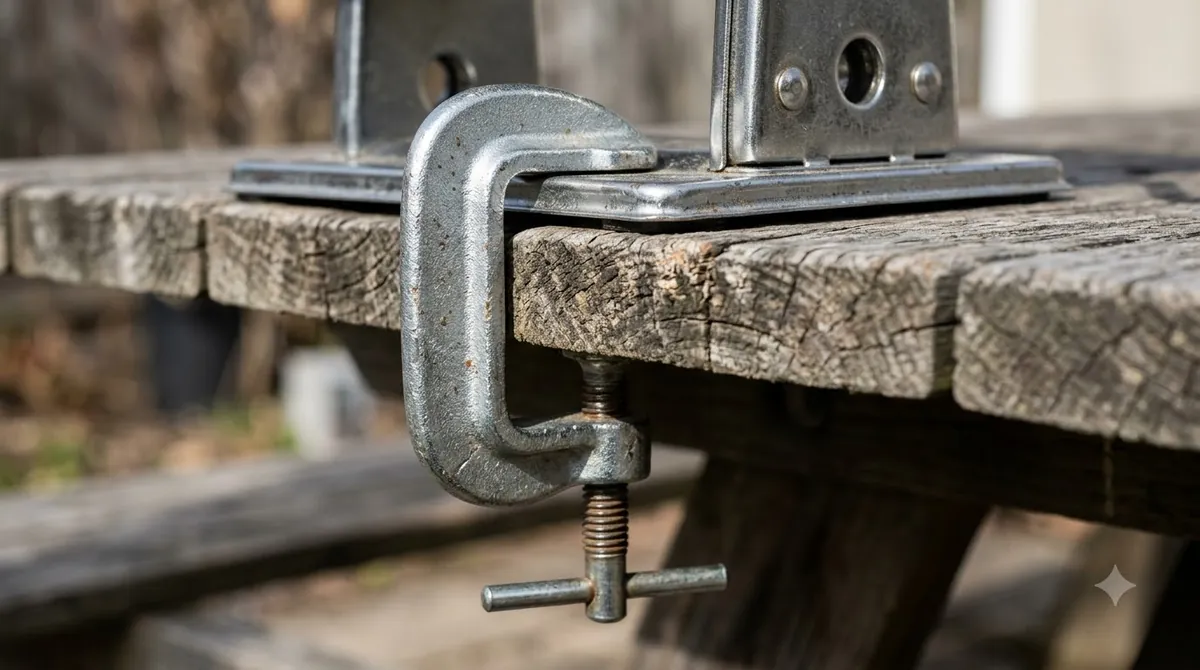
- Fixed to a countertop edge, so check clamp room

Imperia IPasta Classic Pasta Maker
Pros & ConsViewHide
Reasons to buy
- Made in Italy with chromed steel cutting rollers
- Makes 150 mm sheets, 6.5 mm fettuccine and 2 mm tagliolini
- Six roller thickness settings from 0.5 mm to 5 mm
- Clamp slot accepts a separate motor
Reasons to avoid
- Manual crank, so you turn it for every pass
- Only three cut widths in the box
- Motor is a separate purchase

Pasta Maker Deluxe Set- Stainless Steel
Pros & ConsViewHide
Reasons to buy
- Three attachments make five types: lasagnette, fettuccine, angel hair, spaghetti and ravioli
- Hand crank with adjustable thickness
- Chrome-coated steel body
- 67% of 4.6K Amazon ratings are 5-star
Reasons to avoid
- Manual only, no motor
- Clamps to a countertop edge
- 8% of ratings are 1-star

Philips 7000 Series Pasta Maker
Pros & ConsViewHide
Reasons to buy
- Mixes, kneads and extrudes automatically, ready in under 10 minutes per the listing
- Makes up to 8 portions in one go
- Comes with 8 shaping discs
- Parts are listed as dishwasher-safe
Reasons to avoid
- Costs far more than a manual roller
- Needs permanent counter space
- 11% of ratings are 1-star
Best Noodle Maker Machine Picks by Need
For frequent batches, the Philips Avance Pasta and Noodle Maker has the most shapes, while the Atlas 150 suits cooks who want a compact manual noodle maker machine.
These picks come from Jessica Gavin’s August 2026 review, which lists specifications and cons for each model. It is one source, so confirm current specs and availability on the seller’s page before you buy.
Best Electric Option: Philips Avance Pasta and Noodle Maker
The review lists eight pasta-shaping discs, dimensions of 12.4 x 13.5 x 8.5 inches and a weight of 21.1 pounds. As an electric noodle maker machine, it does the turning for you, and that weight and footprint suit a fixed spot on the counter rather than a drawer.
Best Compact Manual Roller: Atlas 150
The review lists dimensions of 9.7 x 3.8 x 2.2 inches and a weight of 5.41 pounds, with dual-sided attachments. It gives no attachment count, so check the listing for the exact set before you buy. As a manual noodle maker machine, it needs you to turn the crank for every pass.
Best Manual Alternative: Imperia 150
This model has two lightweight rollers, measures 8.05 x 7.2 x 6.2 inches and weighs 7.6 pounds. The review’s cons note that attachments are sold separately, so add their cost to your budget, since for a manual noodle maker machine the attachments are the main extra expense.
Best Lower-Priced Manual Option: CucinaPro Deluxe
The review highlights a wide variety of cutters and lists dimensions of 8 x 7.75 x 6 inches, but gives no weight. The review listed it at $49.95 in August 2026, and prices change, so check the current price on the seller’s page.
Best If You Own a Stand Mixer: KitchenAid 3-Piece Set
The review says this set requires a KitchenAid Stand Mixer and weighs 2.86 pounds. Its listed dimensions match the Atlas 150 exactly, which may be a copy error, so confirm them on the product page. For more options in this group, see our KitchenAid pasta roller attachments guide.

How to Choose the Right Machine
Choose by the shapes you cook, your counter space and whether you already own a stand mixer, because those three factors rule out most noodle maker machines. Start with the pasta you make most often, and see how to choose a pasta maker for a longer buyer checklist.
Measure the spot where the machine will sit, including room for the crank handle or motor housing. The review gives overall dimensions, but it does not state how much clearance the handle needs, so leave extra space around the machine when you plan the spot.
If you already own a stand mixer, the attachment route saves a second appliance on the counter. A noodle maker machine built on your mixer is only as useful as the mixer’s motor and bowl allow, so confirm compatibility on the seller’s page before you buy.
Flat sheets need rollers, while short shapes need cutters or discs. Check these points before you add a model to your cart:
- Shapes: confirm the model includes the cutters or discs you need.
- Space: the electric model weighs 21.1 pounds, while the manual rollers in the review weigh 5.41 to 7.6 pounds.
- Mixer: the KitchenAid set does nothing without a stand mixer.
- Attachments: confirm whether cutters are included or sold separately.
- Capacity: the review does not state batch capacity, so check the manufacturer’s manual.
A manual roller gives you control over every pass, but you turn the crank yourself for each sheet. An electric model handles the turning, but it takes more counter space, and the review lists a much higher price for it.
Think about how often you will cook. A noodle maker machine used once a month can be a manual model kept in a drawer, while one used every week can justify the extra counter space of an electric model. This is a judgment rather than a rule, and the review does not test usage patterns. Whichever you pick, a reliable fresh pasta dough recipe matters as much as the machine.
These points apply to home cooks making fresh pasta. The review does not test durability or cleaning, so judge those from each manufacturer’s instructions, and read how to clean a pasta machine before you start.
Common Mistakes When Buying a Noodle Maker Machine
The most common mistake is buying a noodle maker machine without checking whether the cutters you want are included or sold separately. Four other errors show up in the review details.
- Assuming the stand-mixer set works alone, when the review says it needs a KitchenAid Stand Mixer.
- Ignoring weight, when the electric model in the review is 21.1 pounds.
- Trusting identical dimensions across listings, as the KitchenAid set and Atlas 150 do in the review.
- Relying on an old price, since the prices in the review date from August 2026.
Each of these mistakes is easy to avoid by reading the product details on the seller’s page before you order, then comparing the weight and attachment list with the review figures.
Frequently Asked Questions
Is a noodle maker machine the same as a pasta maker?
Shoppers often use both names for the same kind of tool. Search by the features you need, such as rollers, cutters, discs or a motor, because the review covers manual rollers, electric machines and stand-mixer attachments in one guide.
Do manual noodle maker machines need electricity?
No. Manual models are hand-cranked, as the Wikipedia pasta article describes for the sheeting process. The Atlas 150 and Imperia 150 in the review are both listed as manual, and neither needs power.
Does the KitchenAid pasta set work without a stand mixer?
No. The review says the three-piece set requires a KitchenAid Stand Mixer to operate. If you do not own a stand mixer, choose a standalone manual or electric model instead.
How many shapes does the Philips model include?
The review says the Philips Avance Pasta and Noodle Maker comes with eight pasta-shaping discs. It also lists dimensions of 12.4 x 13.5 x 8.5 inches, so measure your counter space before you order.
Which machine should a beginner choose?
The review does not rank models by skill level. Compare the number of parts, the attachment list and the instructions on each seller’s page, then pick the noodle maker machine you can set up and clean without help.
If you cook pasta a few times a month, a manual noodle maker machine with cutters covers most needs. For regular large batches, check the electric model’s weight and attachment list before you commit, and confirm the current price on the seller’s page.
 8 min readBest PicksBest Noodle Makers for Fresh Pasta at HomeUpdated Nov 15, 2026
 8 min readBest PicksThe Best Pasta Machines for Home Cooks in 2026Updated Nov 12, 2026
 8 min readBest PicksItalian Pasta Maker: How to Choose a Good OneUpdated Nov 12, 2026
 8 min readBest PicksBest Cheap Pasta Makers for Home Cooks on a BudgetUpdated Nov 12, 2026
 6 min readBest PicksTop Rated Pasta Maker: Manual, Attachment or ElectricUpdated Nov 13, 2026
 6 min readBest PicksAutomatic Pasta Maker Sale: What to Check Before You BuyUpdated Nov 13, 2026