
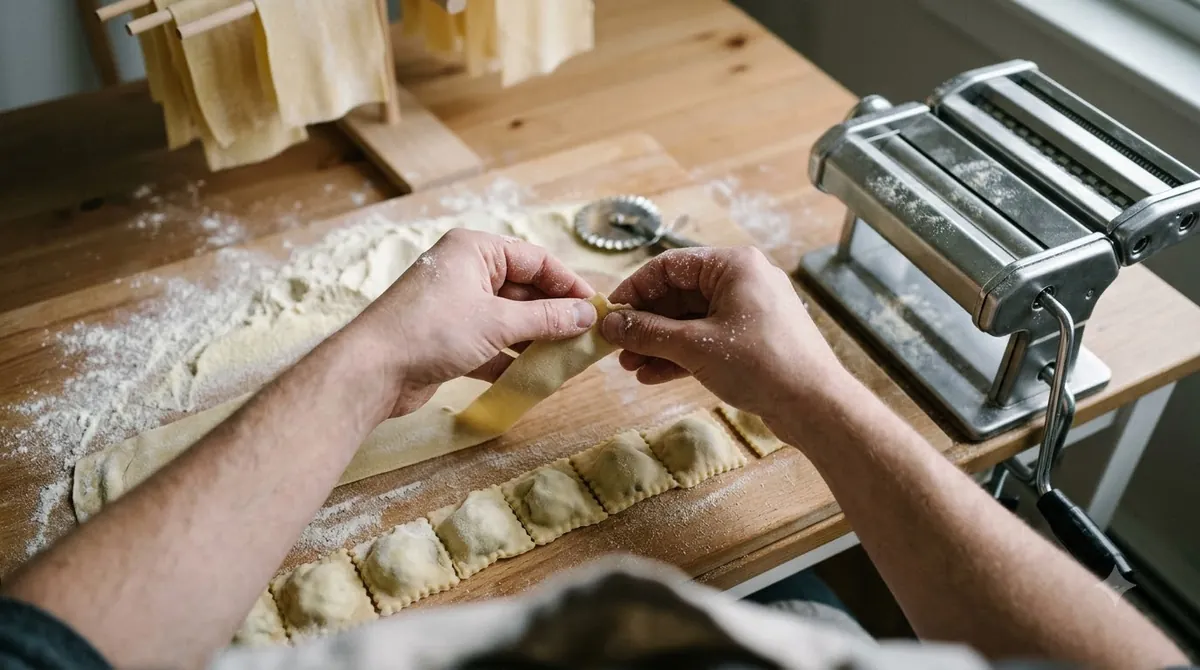

Homemade tortellini are small stuffed pasta rings made from a thin egg dough, cut into squares, filled with a small spoonful of filling, folded into a triangle and wrapped around the index finger so the two corners meet. The shape is simple once you have done a few. The main points are a small amount of filling, edges sealed with no trapped air, and a dough thin enough to cook through but strong enough to hold the fold. This guide covers the shaping steps in order, with the measurements that reputable sources give.
What You Need Before You Shape
Shaping goes faster when the dough and filling are ready before you start. One published recipe uses 400 g of “00” flour and 4 eggs for the dough, then asks you to roll the sheet until it is “fairly thin but not about to tear” (Pasta Evangelists). Keep the sheet covered with a damp towel while you work so it does not dry at the edges.
| Step | Measure given by the sources |
|---|---|
| Square size | About 4 cm (Pasta Evangelists) or 2.5 inches (America’s Test Kitchen) |
| Filling per square | Just under 1 teaspoon (Pasta Evangelists) or about 1/2 teaspoon (America’s Test Kitchen) |
| Cutting tool | A non-serrated pasta cutter, or a pizza wheel or sharp knife |
How to Shape Homemade Tortellini Step by Step
The shaping method is the same for every batch: cut, fill lightly, fold to a triangle, wrap, and seal. Work with a few squares at a time so the rest of the dough stays covered. A similar hat-shaped fold is described in cappelletti folding technique. If you want the background first, our page on tortellini pasta basics explains the shape and its filled variants.
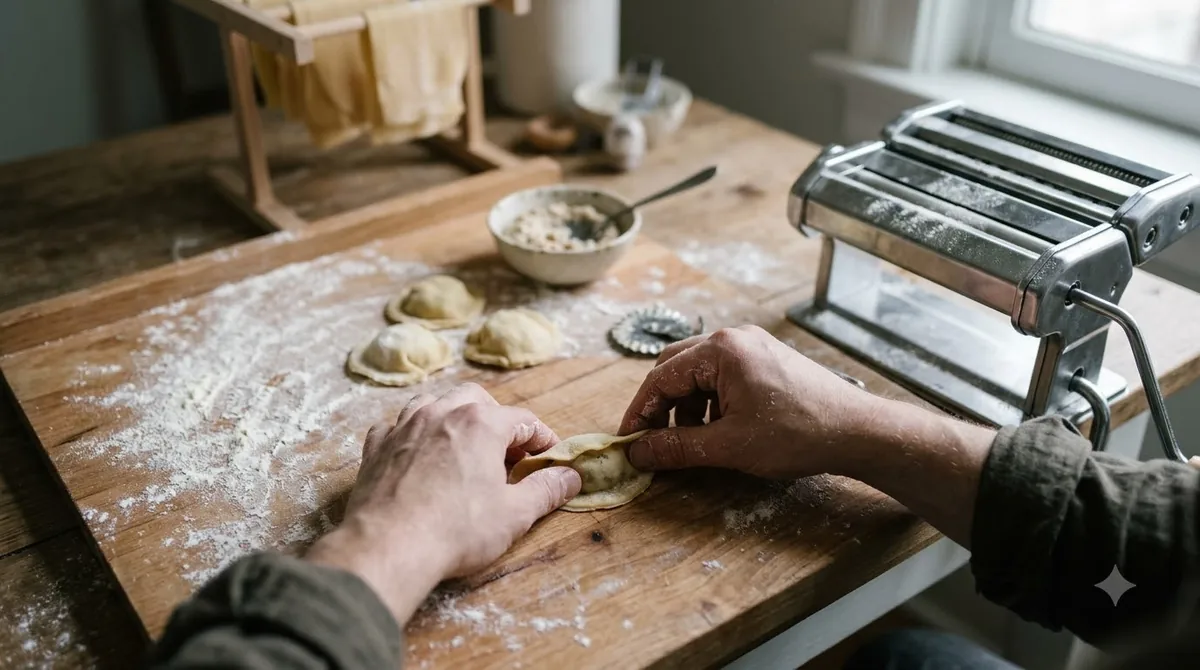
Cut the squares
Cut the rolled sheet into even squares. Keep them the same size so the tortellini cook at the same rate. Lift each square off the counter with a bench scraper or the tip of a knife so it does not stick, and set it on a lightly floured tray.
Add a small amount of filling
Place the filling in the centre of each square. Use a small amount. Overfilling is the most common reason tortellini burst while boiling, because the filling pushes the seal open. A half teaspoon is enough for a 2.5-inch square.
Fold the square into a triangle
Fold one corner over to the opposite corner to make a triangle. Press the edges firmly with your fingertips, squeezing out any trapped air around the filling. Air pockets expand in hot water and tear the dough, so this step matters more than it looks.
Wrap the triangle around your finger
Place the long edge of the triangle against the tip of your index finger, with the filling bulge on the fingertip side. Wrap the two bottom corners around the finger so they meet, then pinch them together. Slide the piece off your finger and set it on the tray. If you prefer a tool, the handle of a wooden spoon can serve as a form.
Seal the edges and rest
If the edges will not stick, dampen them with a little water and press again. Finished tortellini should hold their shape when you lift them. Let the shaped pieces rest uncovered for a short time so the surface dries slightly and seals better when cooked.
Common Shaping Problems and Fixes
Most shaping problems come from three things: a dough that dried out, too much filling, or trapped air. Each has a simple fix that takes seconds. Finished tortellini also work well in tortellini soup, a simple way to serve a batch.
If the dough cracks when you fold it, it is usually too dry or rolled too thin in one spot. Brush a little water along the fold line and try again. If the squares curl up as you work, cover the sheet and the cut pieces with a damp towel. Pasta dough that has rested well is more forgiving, and a longer rest can help the dough relax before rolling.
If a tortellini splits open while you wrap it, the filling is probably too wet or too full. Scoop out a little filling and start over with a smaller spoonful. Filling that is too wet also makes sealing hard, so drain or chill it first if it is soft.
Always work with a clean, lightly floured surface. Too much flour on the tray can stop the edges from sealing, so use only enough to keep the pieces from sticking.
Cooking Tortellini After Shaping
Shaped tortellini cook in gently boiling, well-salted water. They are ready when they float and the dough is tender when you bite one. The exact time depends on the thickness of your dough, so test one piece before cooking the whole batch. Lift them out with a slotted spoon and toss them with your sauce right away so they do not stick together. If the folded shape confuses you, see tortelloni versus tortellini.
If you are not cooking them the same day, keep the shaped pieces in a single layer on a floured tray, uncovered at first until the surface feels dry, then cover them loosely. Check the storage guidance from the USDA before keeping fresh pasta for longer than a day or two.
Frequently Asked Questions
How do you shape tortellini without a special tool?
Your index finger is enough. Fold the square into a triangle, place the long edge on your fingertip, wrap the two corners around the finger, and pinch them together. A wooden spoon handle works the same way if you prefer something firmer to wrap around.
How much filling goes in each tortellini?
Sources differ slightly. One recipe uses just under 1 teaspoon on a 4 cm square, and another uses about 1/2 teaspoon on a 2.5-inch square. Start with the smaller amount and add more only if the shape still seals well.
Why do my tortellini open when they cook?
The usual causes are too much filling, air left inside the fold, or edges that were not pressed firmly. Press out the air, seal the edges well, and use less filling. A dough that is too thick can also fail to seal properly.
Can you shape tortellini ahead of time?
Yes, but keep them on a floured tray in a single layer and cover them loosely so they do not dry out. Cook them within the time your storage guidance allows. Dried edges will not seal, so cover the dough while you work.
Once you have shaped a few batches, the process becomes quick. Keep the filling small, press out every bit of air, and cut the squares evenly. With those three habits your tortellini will hold their shape in the pot and taste the way they should.
 6 min readLearnHomemade Tortelloni: How They Differ and How to Shape ThemUpdated Nov 13, 2026
 8 min readLearnCappelletti vs Tortellini: Shape, Filling and How They Are ServedUpdated Nov 6, 2026
 8 min readLearnTortellini vs Ravioli: Shape, Filling and Cooking ComparedUpdated Nov 12, 2026
 8 min readLearnTortellini Pasta: Shape, Filling and How to Make It at HomeUpdated Nov 6, 2026
 8 min readLearnTortellini Soup Recipe: Ingredients, Steps and Leftover TipsUpdated Nov 11, 2026
 9 min readLearnTortelli Pasta: Shapes, Fillings and How to Serve ThemUpdated Nov 10, 2026