
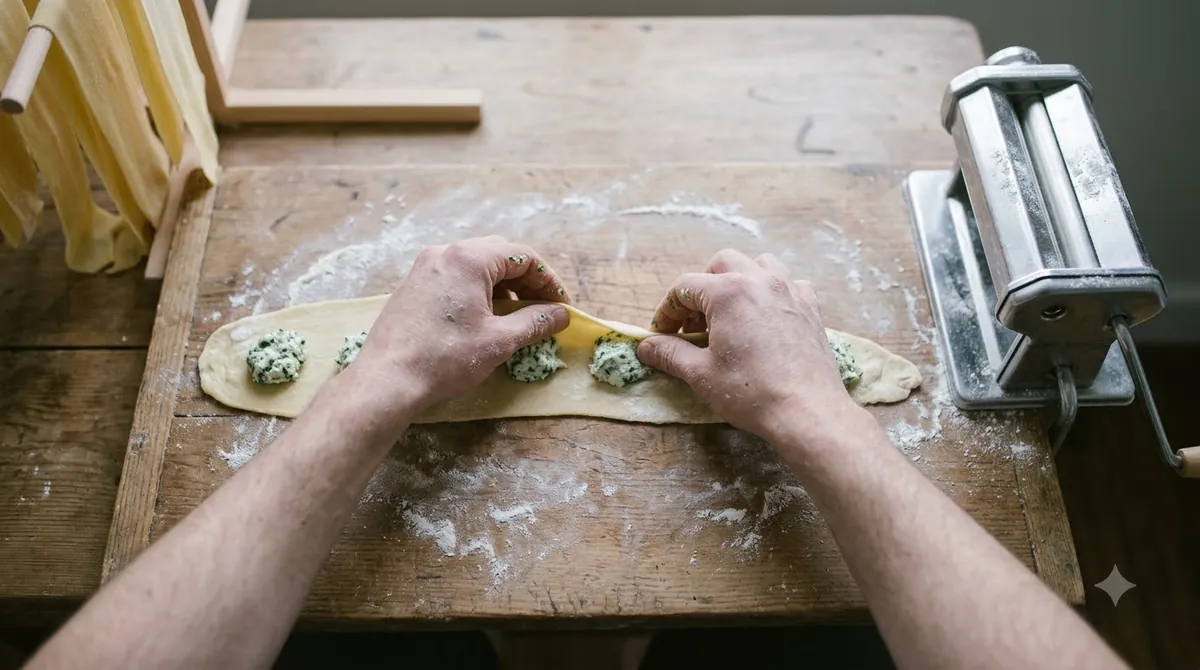

Tortelli pasta is a stuffed fresh pasta from Emilia-Romagna, most often filled with ricotta and spinach and served with butter and sage. The name covers several local shapes, not one single pasta, so the first step is knowing which version you are making. The shape and the filling change from town to town.
What Is Tortelli Pasta?
Tortelli is a family of stuffed pasta made mainly in Emilia-Romagna, with versions also found in Lombardy and Tuscany, according to Wikipedia’s entry on tortelli. Cookbook author Marcella Hazan credits Emilia-Romagna as the birthplace of the pasta. Because the word is used for many local shapes, a recipe for tortelli pasta in one town may look different from a recipe in another.
For a home cook, the useful way to think about tortelli pasta is as a filled sheet of fresh dough. Once you know that, the shape is simply the way you close that sheet around the filling. You roll the dough thin, place a small amount of filling on it, then close the pasta into a shape that is typical of that area. The dough is usually made from flour, eggs, oil and salt, as described in regional sources on tortelli piacentini.
The Three Main Shapes of Tortelli
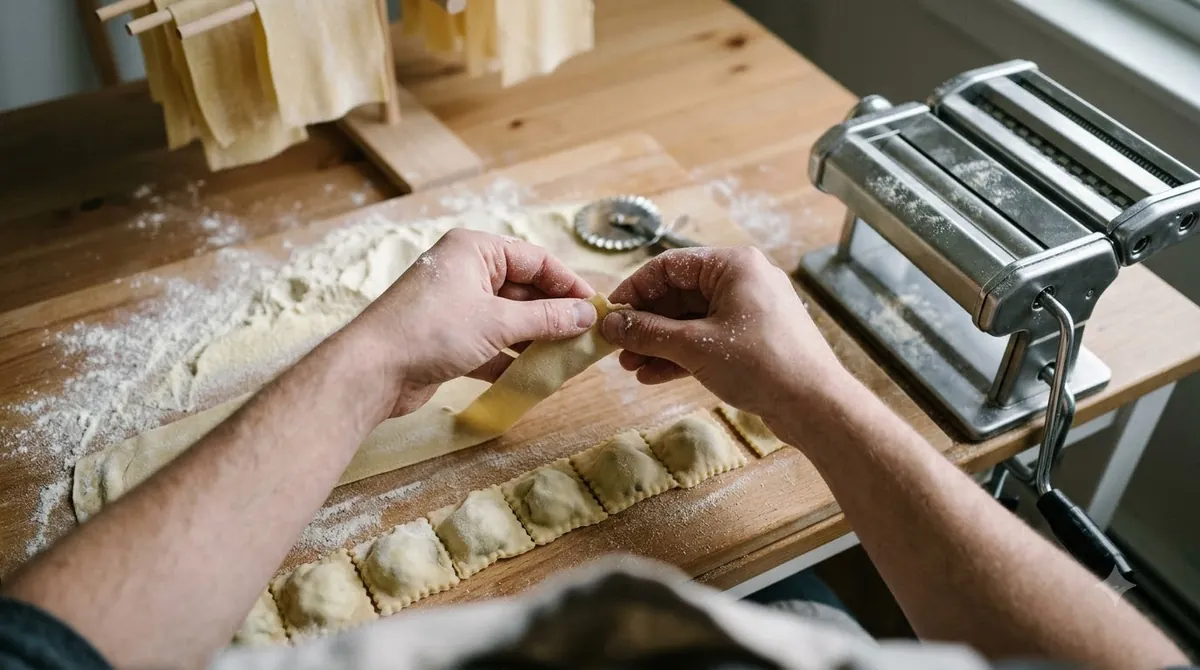
Tortelli pasta comes in three main shapes: square like ravioli, semicircular like agnolini, and twisted into a rounded, hat-like form like cappelletti. Knowing the shape tells you how to fold the pasta and how it will hold the sauce.
The shape also changes how much sauce each piece can carry. A flat square gives a wide surface for butter and sage, while a folded hat shape traps sauce in its curves. When you buy a tortelli pasta cutter or a shaping tool, check which of these three forms it makes before you commit.
| Shape | Looks like | What to know |
|---|---|---|
| Square | Ravioli | Tortelli verdi from Reggio Emilia are typically square. |
| Semicircle | Agnolini | Easy to cut from a round dough circle, then fold over the filling. |
| Hat-shaped | Cappelletti | The dough is twisted so the edges meet, forming a rounded shape. |
Classic Fillings Across Emilia-Romagna
The classic tortelli filling in Emilia-Romagna is ricotta mixed with spinach. Tortelli verdi from Reggio Emilia are known for this green filling, and some family versions add chard, lard, garlic, parsley and nutmeg, according to the regional food guide from Italia.it’s tortello tour.
Filling choices for tortelli pasta vary by town. These are the four main styles that regional sources describe:
- Spinach and ricotta, the most common base for tortelli verdi.
- Ricotta, spinach, nutmeg and Grana Padano, the version used in tortelli piacentini.
- Pumpkin, served with butter and sage. Wikipedia shows this as tortelli di zucca al burro e salvia.
- Herb fillings, or potato fillings that Italia.it calls typical of the Apennines and serves with mushroom sauce or truffles.
Tortelli verdi are traditionally served on Christmas Eve, on St John’s Eve in Parma, and on 24 June, so the filling is often linked to a season or a feast day rather than an everyday meal.
If you want to make a spinach tortelli pasta at home, drain the spinach well before mixing it with ricotta. Excess water loosens the filling and makes the edges harder to seal. The sources read for this article do not give exact amounts, so use the ratio in your own recipe or in our fresh pasta dough recipe and adjust by feel.
Tortelli Piacentini: The 1351 Story
Tortelli piacentini are tail-shaped pasta from the Piacenza area, and the recipe is said to date to 1351, when cooks at Vigolzone castle served them to the poet Petrarch. The host, Bernardo Anguissola, reportedly asked his cooks for something more original than ordinary ravioli.
The pasta is also called “con la coda” or “turtei cu la cua” in local dialect, and some sources call them Petrarca’s tortelli. The tail comes from the braid-like pinch of the edge, which is the part that sets this shape apart from a plain half-moon.
The history is a good reason to learn the local name. When a recipe or menu says tortelli con la coda, it refers to this tail-shaped version rather than to a general tortelli pasta shape.
Because the dish is so tied to one place, it is best to treat the 1351 date as the traditional account, not a fact you can check against a single document in this article. The Pasta Project presents it as the origin story, and that is how it should be read.
How to Shape Tortelli at Home
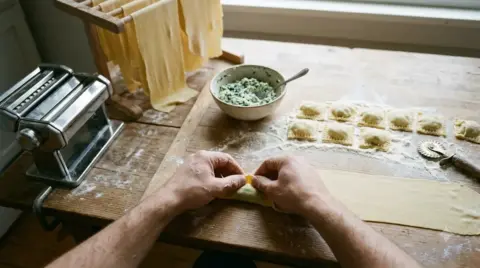
To shape tortelli pasta at home, you cut small dough circles, add a little filling to the center of each, then fold, plait and pleat the edge by hand. The steps below follow the method described for tortelli piacentini.
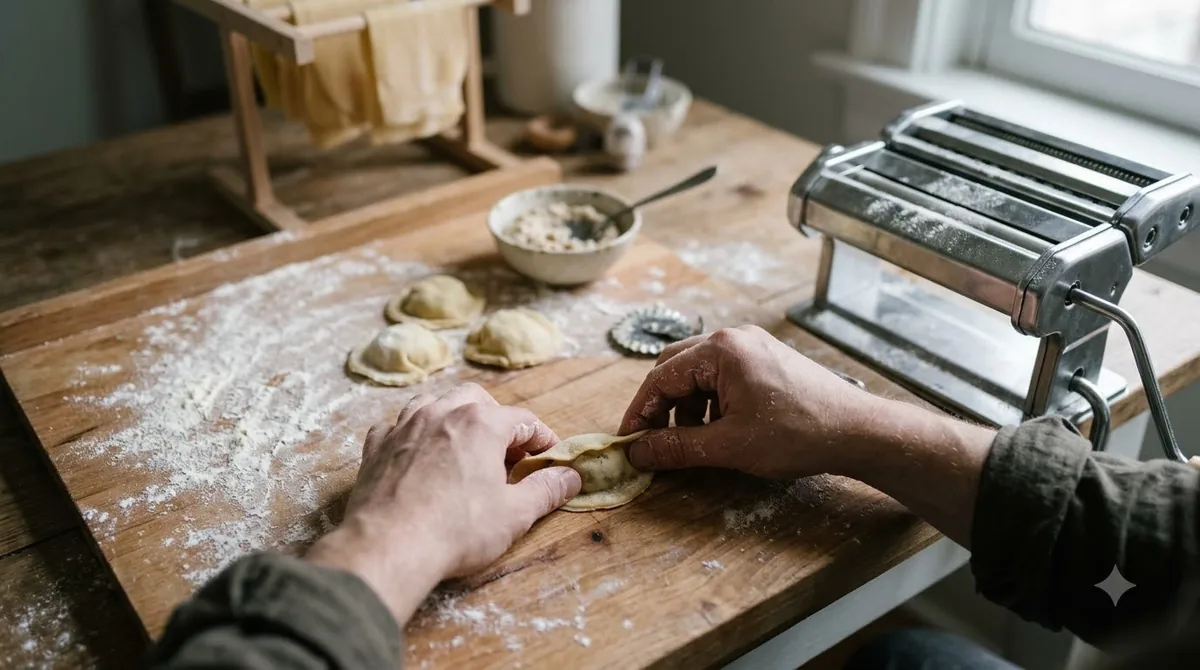
- Roll the dough thin and cut small circles with a cutter.
- Place a small amount of filling in the center of each circle. Too much filling will burst the pasta while it cooks.
- Fold the circle over the filling to make a half-moon.
- Press and pleat the edge, or plait it, so it seals and forms the characteristic tail or ridge.
- Cook in salted water and check the cooking time on your recipe, because regional sources do not give one. Our guide to cooking fresh pasta covers timing and the float test.
A common mistake is rolling the dough too thick. Thick dough makes the seal weak and the bite heavy, so roll the sheet thin enough to fold without tearing.
Sauces That Suit Tortelli
Melted butter and sage, finished with grated Parmesan or grana, is the classic sauce for tortelli pasta, and it is the one most regional sources mention first.
Sage is a flavor the sources link directly to the sauce, so do not swap it out for a heavier cream base if you want the traditional result. The butter should be melted gently and the sage added at the end so it stays fragrant.
- Butter and sage with grated grana or Parmesan, for tortelli piacentini.
- Butter and Parmigiano Reggiano, ideally well aged, for tortelli verdi.
- Broth, cream or a meat sauce, which regional sources name for cappelletti.
- Butter and sage for pumpkin tortelli, the same pairing the Wikipedia caption shows.
Keep the sauce for tortelli pasta light. A delicate filling such as ricotta and spinach is easy to overwhelm with a heavy tomato sauce, which is why the butter-based options are the usual choice.
Tortelli Pasta vs Tortellini and Tortelloni
Tortelli pasta is a broad family name, while tortellini is a specific navel-shaped pasta from Bologna and Modena in Emilia-Romagna. Tortelloni is the larger version of tortellini, as noted in Wikipedia’s entry on tortellini.
Wikipedia gives a typical weight of 5 g for tortelloni against 2 g for tortellini. It adds that tortellini are traditionally stuffed with pork loin, prosciutto, mortadella, Parmesan, egg and nutmeg and served in broth, while tortelloni are filled with ricotta and sometimes parsley or spinach, then cooked in water and served dry with butter and sage. Our guide to tortelloni vs tortellini compares the two in more detail.
| Pasta | Shape | Typical filling |
|---|---|---|
| Tortelli | Square, semicircle or hat-shaped | Ricotta and spinach, or pumpkin |
| Tortellini | Navel-shaped ring | Pork, prosciutto, mortadella and Parmesan |
| Tortelloni | Navel-shaped ring, about 5 g vs 2 g for tortellini | Ricotta, sometimes with parsley or spinach |
The origin of tortellini is disputed between Bologna and Modena, both in Emilia-Romagna. If you are choosing between them, pick tortelli when you want a filled square or half-moon, and tortellini when you want a small stuffed ring for broth.
What the Sources Do Not Confirm
The sources read for this article do not give exact dough quantities, boiling times or how long fresh tortelli pasta keeps. Treat any number you find elsewhere with care, and check the recipe you follow or the package of your pasta.
Recipes online often list a precise flour and egg ratio or a boiling time in seconds. Those figures may be reasonable, but they are not confirmed by the sources used here, so use them only as a starting point and check the result by tasting a test piece.
- Dough ratios: not stated in the sources read.
- Boiling time: not stated, so check the recipe.
- Storage time: not stated, so check the package or your recipe.
Frequently Asked Questions
Are tortelli the same as tortellini?
No. Tortelli pasta is a broad family of stuffed pasta with several shapes, while tortellini is a ring-shaped pasta from Emilia-Romagna. Tortelloni is the larger version of tortellini.
What is tortelli piacentini?
Tortelli piacentini are a tail-shaped tortelli pasta from the Piacenza area, filled with ricotta, spinach and nutmeg in the version described by The Pasta Project. The recipe is said to date to 1351.
What is the traditional sauce for tortelli?
The classic sauce is melted butter and sage, finished with grated Parmesan or grana. Regional guides also recommend well-aged Parmigiano Reggiano for tortelli verdi.
Where do tortelli come from?
Tortelli are mainly made in Emilia-Romagna, with versions also found in Lombardy and Tuscany. Wikipedia names these three regions for the family of shapes.
How long do you cook tortelli?
The sources read for this article do not give a cooking time. Follow the time in your recipe, or the instructions on the package if you bought fresh pasta, and taste a piece to check it.
If you are choosing a first tortelli pasta to make, start with the shape that matches the region you are cooking from. A square tortelli verdi with butter and Parmigiano Reggiano is a simple way to learn the filling, and the tail-shaped piacentini version is a good next step once the dough feels comfortable.
 8 min readLearnCaramelle Pasta: Shape, Fillings and How to Cook ItUpdated Nov 10, 2026
 8 min readLearnCannelloni Pasta: Shapes, Fillings and How to Bake ItUpdated Nov 10, 2026
 8 min readLearnTortellini Pasta: Shape, Filling and How to Make It at HomeUpdated Nov 6, 2026
 8 min readLearnStrozzapreti Pasta: What It Is, How to Shape It and What to Serve With ItUpdated Nov 10, 2026
 6 min readLearnHomemade Tortellini: How to Shape Them Step by StepUpdated Nov 13, 2026
 6 min readLearnHomemade Tortelloni: How They Differ and How to Shape ThemUpdated Nov 13, 2026