
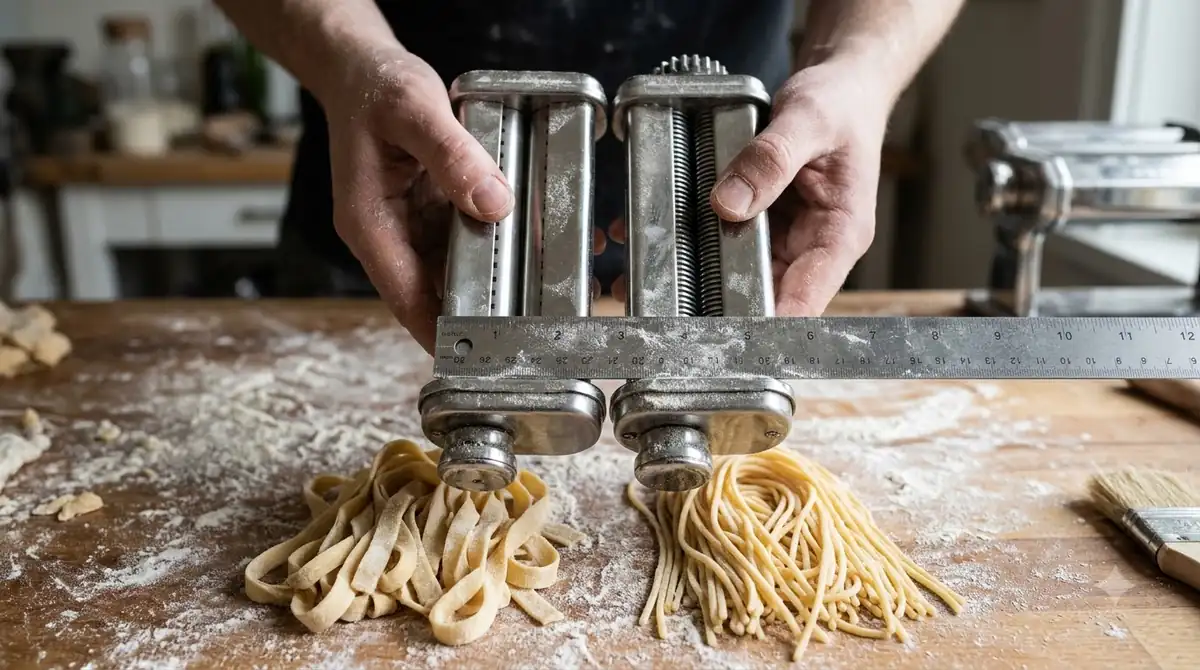

Mafaldine vs pappardelle comes down to edges and width: mafaldine is a narrow ribbon with curled sides, while pappardelle is a wider ribbon with straight or fluted edges. Both are long, flat pastas from Italy, but they differ in origin, dough and the sauces they suit.
Mafaldine’s curls catch seafood, game and white cheese sauces. Pappardelle’s broader ribbon is shown with rich meat ragù. For mafaldine vs pappardelle, choose by the sauce you plan to make.
Mafaldine vs Pappardelle at a Glance
Mafaldine (see our mafaldine pasta guide) is a narrow ribbon with curled edges from the Naples area, while pappardelle is a broad ribbon from Tuscany with straight or fluted edges. The table lists the main differences in mafaldine vs pappardelle.
| Feature | Mafaldine | Pappardelle |
|---|---|---|
| Origin | Naples area, Campania | Tuscany |
| Width | About 1 cm (half an inch) | Fresh types 2 to 3 cm |
| Edges | Wavy on both sides, curled at the ends | Fresh may be fluted, dried egg form has straight sides |
| Dough | Durum semolina and water | Egg pasta in its dried form |
| Name | Honours Princess Mafalda of Savoy | From pappare, to gobble up |
The clearest visual difference in mafaldine vs pappardelle is the edge. Mafaldine is ruffled on both sides, and the figures show pappardelle roughly two to three times as wide. Wikipedia’s pappardelle entry gives the fresh width range.
Wikipedia says mafaldine is prepared similarly to linguine and fettuccine, so cooks treat it as a long ribbon pasta rather than a short shape. That puts it in the same family as pappardelle, even though the two differ in width and edge. If you are also weighing pappardelle against a narrower ribbon, see tagliatelle vs pappardelle.
Where Each Ribbon Comes From
Mafaldine comes from the Naples area of Campania, and its name honours Princess Mafalda of Savoy. Pappardelle comes from Tuscany, and its name comes from the Italian verb pappare, meaning to gobble up.
According to The Pasta Project’s mafaldine page, the pasta is originally from Naples and makers claimed it was created for the princess’s birth. The page adds that the shape may have existed earlier under the name manfredine, and that the name was changed in her honour.
The same source lists mafalda, mafalde and reginette as other names, with reginette meaning “little queens.” In Sicily the pasta is also called margherita, so a menu may use a different name for the same ribbon.
Pappardelle’s origin (our pappardelle pasta guide goes deeper) is a simpler story. Wikipedia places the shape in Tuscany, and the name comes from pappare, the Italian verb for gobbling food up. The page does not say when the name first appeared.
How Wide Each Ribbon Is
The width gap in mafaldine vs pappardelle is clear. Mafaldine is usually about 1 cm wide, while fresh pappardelle runs 2 to 3 cm, so pappardelle is about two to three times as wide. These figures come from Wikipedia’s entries for each shape.
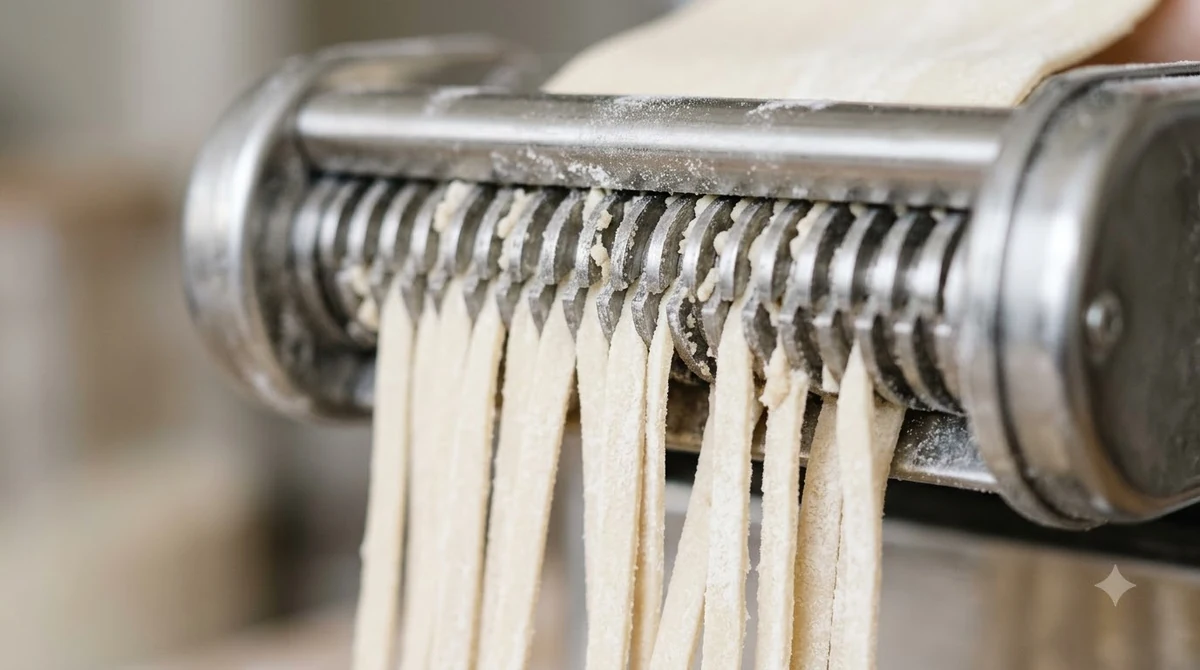
Wikipedia describes mafaldine as flat and wide, usually about 1 cm (half an inch) across. The curl at each end stays well defined even after cooking, so the ruffles are still visible on the plate.
Fresh pappardelle is the wider side of mafaldine vs pappardelle. Wikipedia’s pappardelle entry gives fresh types a width of two to three centimetres, or three-quarters to one inch. Not every source agrees on mafaldine’s width, so check a maker’s packaging if you need an exact measurement.
Tripoline, a related ribbon, is described on the same Wikipedia page as thick and ridged on one side, and it is often found in baked pasta dishes. Its origin is also linked to Campania, the same region as mafaldine. If you see tripoline on a shelf, it is a different shape, not a shortcut for either ribbon.
Edges, Texture and How Each Holds Sauce
According to De Cecco, as quoted by Mashed, mafaldine’s curled sides retain more sauce than its smooth part. Edges also set mafaldine vs pappardelle apart. Pappardelle’s edges depend on the form, with fresh types possibly fluted and dried egg types straight.
Wikipedia’s mafaldine entry describes wavy edges on both sides, with a curl at the ends. That edge shape gives sauce more places to settle than a plain flat ribbon, which is the main reason cooks choose it for a loose sauce.
On texture, Wikipedia says the curl at each end stays well defined even after cooking. The sources give no cooking time, so follow the package directions and taste near the end of the suggested time.
Mashed also cites Bon Appétit, which recommends ribbon pastas like pappardelle for creamy sauces. That makes pappardelle a sensible pick when the sauce is thick and clings to a wide surface.
Dough and Production
Dough is one of the sharpest differences in mafaldine vs pappardelle. Traditional mafaldine is made from durum wheat semolina and water, not eggs, according to The Pasta Project. The same page says it is extruded through traditional bronze dies.
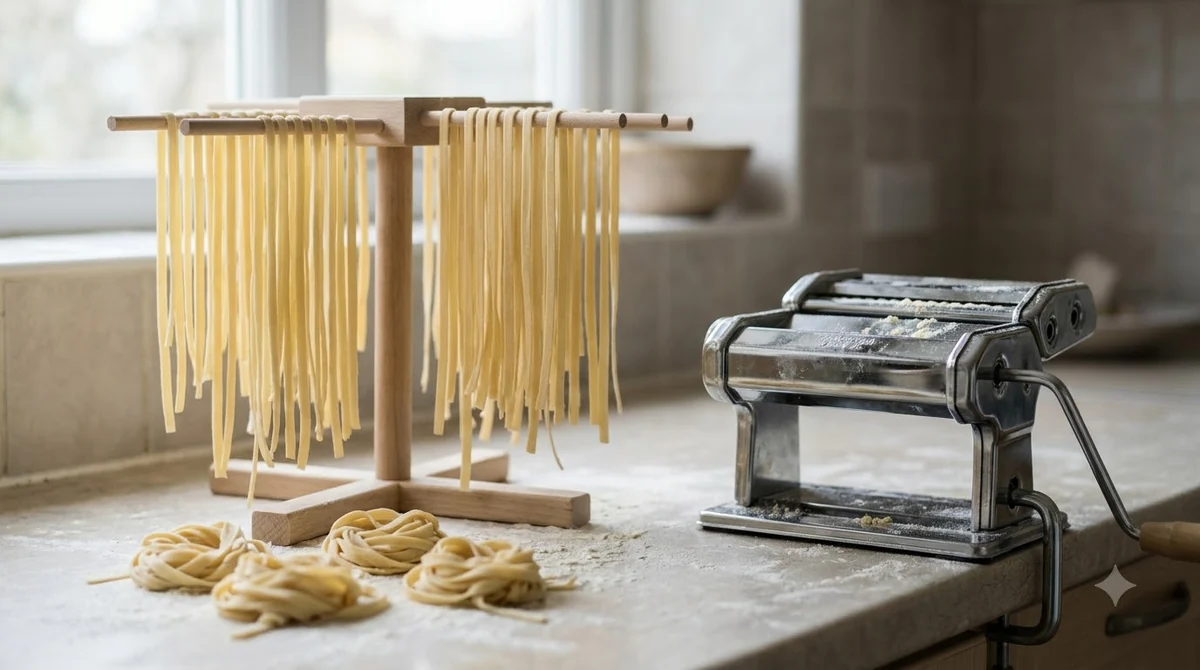
Pappardelle’s dough is described on Wikipedia only in its dried egg form, which has straight sides. The entry does not describe how the dough is mixed, rolled or cut, so this article does not make claims about that process.
The practical point for mafaldine vs pappardelle is the ingredient list. A mafaldine made with semolina and water behaves differently from an egg ribbon of similar width, so check the package before you assume the two are interchangeable. Our explainer on semolina pasta vs egg pasta covers the dough difference.
The Pasta Project links mafaldine to traditional dishes in Sicily and Puglia, and says it is available throughout Italy. The sources read for this article give no cooking time, so the package directions remain the guide for timing.
Sauces That Suit Each Shape
In mafaldine vs pappardelle sauce pairings, mafaldine suits game, seafood and white cheese sauces, according to De Cecco as quoted by Mashed. Pappardelle is shown with rich meat ragù in Wikipedia’s photo captions.
The Pasta Project lists regional pairings for mafaldine:
- Naples: light sauces such as ricotta in bianco made with sheep’s milk ricotta, lardo and pecorino, and a version with chickpeas.
- Sicily: often baked in a timballo, or served with swordfish or with anchovies, tomato paste, pine nuts and raisins.
- Puglia: cooked for St Joseph’s Day in a dish called La barba di San Giuseppe.
Pappardelle’s photo captions on Wikipedia show wild boar ragù, beef cheek ragù, pesto, tomato sauce and porcini mushrooms. Those captions show common pairings, not a single recipe rule.
Mafaldine vs Pappardelle: Which One to Choose
Pick mafaldine when you want curled edges and a narrow ribbon for seafood, game or white cheese sauces. Pick pappardelle when you want a broad ribbon under a thick meat ragù.
- Choose mafaldine for a light or seafood sauce that you want to cling to ruffled edges.
- Choose pappardelle for a thick ragù that needs a wide, flat ribbon.
- Check the package if a recipe depends on an exact width, since sources differ on mafaldine.
For mafaldine vs pappardelle, the sauce matters more than the shape. Both are long flat ribbons, so a swap usually works if the sauce suits the width you are using.
A quick check in the shop helps. Mafaldine’s curled edges are visible in the dried package, so a ruffled ribbon usually means mafaldine. Dried pappardelle in its egg form has straight sides, which is the main visual clue. Fresh pappardelle may be fluted, so compare the edges first and then the width.
The sources reviewed for this article give no sauce-to-pasta ratios, so judge the amount by eye and by the recipe you follow. A ribbon that is too dry for the sauce is a cooking problem, not a shape problem.
Frequently Asked Questions
Is mafaldine the same as pappardelle?
No, mafaldine vs pappardelle is a real comparison of two different shapes. Mafaldine is about 1 cm wide with wavy, curled edges, while fresh pappardelle is 2 to 3 cm wide with fluted or straight edges. Both are long, flat ribbons, which is why people compare them. Their origins and dough also differ.
Can you use pappardelle instead of mafaldine?
Yes, in shape, since both are long ribbons, but pappardelle has no ruffled edges. Its extra width suits a thick sauce better than a delicate one. Match the sauce before you decide on mafaldine vs pappardelle.
What does mafaldine mean?
The name honours Princess Mafalda of Savoy, according to The Pasta Project. The Pasta Project also lists reginette, meaning “little queens,” as another name.
Is mafaldine made with egg?
Traditional mafaldine is made from durum wheat semolina and water, according to The Pasta Project, so it is not usually an egg pasta. Check the ingredient list on the package, because makers can differ.
Where does pappardelle come from?
Pappardelle comes from Tuscany, Italy, according to Wikipedia. Its name comes from the Italian verb pappare, meaning to gobble up. Fresh types are 2 to 3 cm wide, and the dried egg form has straight sides.
Choosing between mafaldine vs pappardelle comes down to sauce first. Mafaldine fits a lighter seafood, game or cheese sauce, and pappardelle fits a thick meat ragù. If a recipe depends on an exact width, check the package, since the sources do not all agree on mafaldine.
 6 min readLearnTrofie vs Fusilli: Shape, Sauce and Cooking DifferencesUpdated Nov 13, 2026
 9 min readLearnTagliolini vs Tagliatelle: Width, Eggs and Sauces ComparedUpdated Nov 6, 2026
 8 min readLearnTagliatelle vs Pappardelle: Which Ribbon Fits Your SauceUpdated Nov 7, 2026
 5 min readLearnWhat Is the Best Sauce for Pappardelle?Updated Nov 13, 2026
 9 min readLearnPaccheri vs Rigatoni: Key Differences and Which Sauce FitsUpdated Nov 6, 2026
 7 min readLearnMafaldine Pasta: What It Is, How to Cook It and What to Use InsteadUpdated Nov 6, 2026