
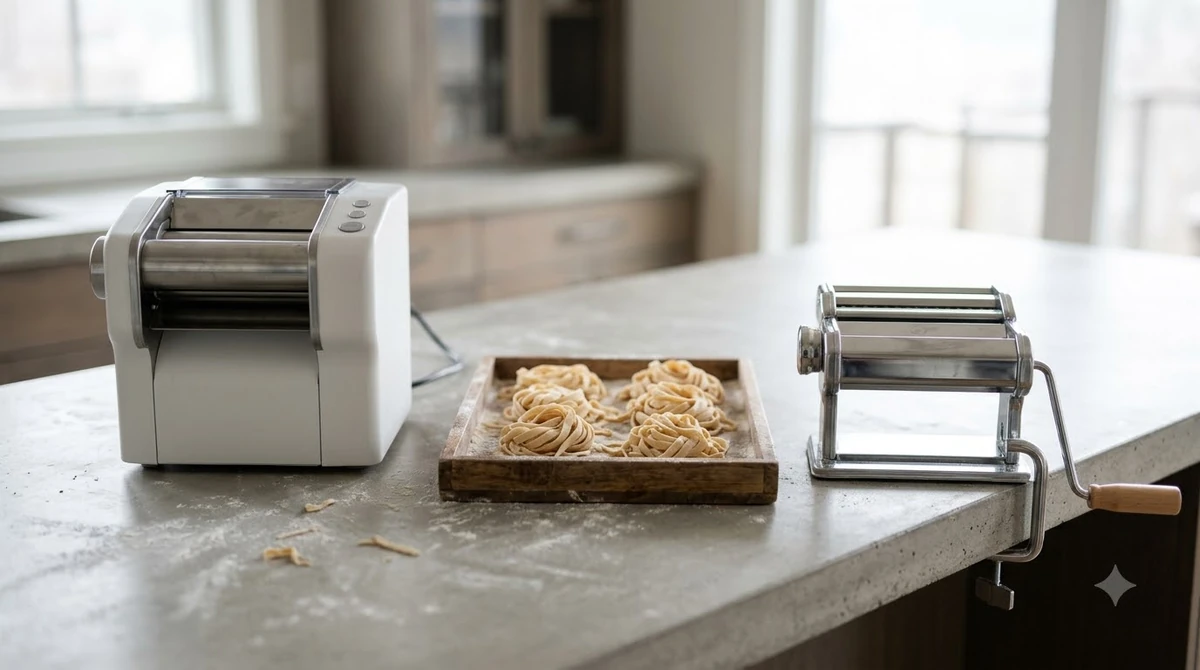

Marcato vs KitchenAid is a choice between a hand-crank pasta machine and a stand mixer attachment. The Marcato Atlas 150 rolls dough through 10 thickness settings without power, while the KitchenAid roller offers 8 settings and needs a compatible mixer. Both cut fettuccine and spaghetti.
Your existing equipment and the number of shapes you want will usually decide this Marcato vs KitchenAid comparison. The sections below cover thickness, cutters, cleaning and warranty, using only figures from the manufacturers’ own pages and manuals.
Marcato vs KitchenAid at a Glance
Choose the Atlas 150 for a standalone hand-crank machine, and choose the KitchenAid set if you already own a compatible stand mixer. Neither option is a direct substitute for the other in this Marcato vs KitchenAid comparison.
| Pick | Best for | Key fact |
|---|---|---|
| Marcato Atlas 150 | Cooks who want a standalone machine | 10 thickness settings and 150 mm sheets |
| KitchenAid pasta roller set | Owners of a compatible stand mixer | 8 settings, 14 cm sheets, 2 cutters |
| Marcato Atlasmotor | Hands-free rolling with a motor | Motor run limited to 15 minutes without a break |
Check the current Amazon listings for the Marcato Atlas 150 and the KitchenAid pasta roller and cutter set in this Marcato vs KitchenAid comparison.

MARCATO Atlas 150 Machine, Made in Italy, Red
Pros & ConsViewHide
Reasons to buy
- Made in Italy hand-crank pasta machine rolling dough in steps
- Includes a pasta cutter and hand crank
- Fits Marcato attachments and the optional motor
Reasons to avoid
- Only rolls and cuts the sheet; tortellini are still shaped by hand
- Takes more counter and storage space than a hand cutter
- Fixed to a countertop edge, so check clamp room

KitchenAid KSMPRA 3-pc Pasta Roller/Cutter Set
Pros & ConsViewHide
Reasons to buy
- Roller and cutter attachments for KitchenAid stand mixers
- Rolls even sheets without hand cranking
- 88% of 9K Amazon ratings are 5-star
Reasons to avoid
- Needs a compatible KitchenAid stand mixer
- Rolls and cuts the dough, but does not fill or fold tortellini
- One of the costlier tools in this guide
A Marcato vs KitchenAid decision starts with the machine you already own, and the two products solve different problems, so this table works best as a guide to setup rather than a ranking. A cook with no mixer has a clear answer, while a mixer owner has to check model compatibility first.
What Each Pasta Maker Is
The Atlas 150 is a standalone manual machine, while the KitchenAid roller is an attachment that needs a stand mixer. Marcato is an Italian maker based in Campodarsego, and its company history goes back to 1930, according to Marcato’s official website.
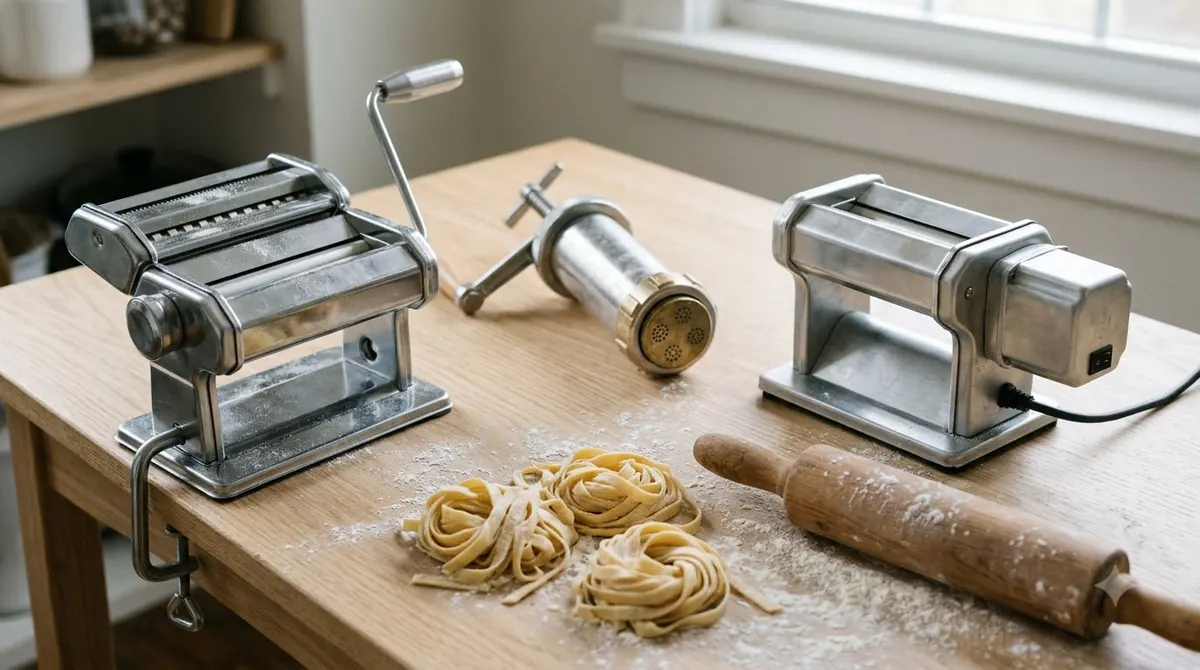
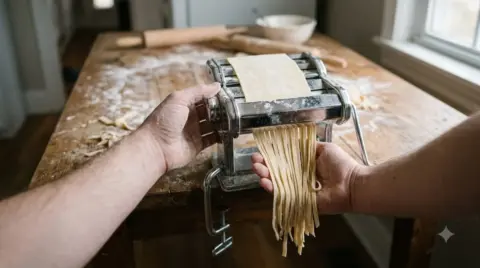
The Atlas 150 is clamped to a work surface through its clamp, then turned by a hand crank. The Marcato manual tells you to fix the machine to the table, insert the crank and turn it clockwise, so it needs no outlet.
In any Marcato vs KitchenAid choice, the mixer is the biggest factor, because the KitchenAid set attaches to a stand mixer rather than running on its own. KitchenAid’s product page refers to stand mixers in general and names tilt-head and bowl-lift types, but it does not list specific models. Check compatibility with your exact mixer before you buy, and browse the best KitchenAid pasta roller attachments for other options.
Thickness and Sheet Width
The Atlas 150 offers 10 thickness settings, from about 4.8 mm down to about 0.5 mm, while the KitchenAid roller offers 8 settings on a 14 cm sheet. The table below shows the Atlas dial values from the Marcato manual.
| Atlas 150 dial | Approximate thickness |
|---|---|
| 0 | about 4.8 mm |
| 1 | about 3.7 mm |
| 2 | about 3.1 mm |
| 3 | about 2.4 mm |
| 4 | about 1.8 mm |
| 5 | about 1.5 mm |
| 6 | about 1.0 mm |
| 7 | about 0.8 mm |
| 8 | about 0.6 mm |
| 9 | about 0.5 mm |
On thickness, Marcato vs KitchenAid is mostly a question of how many settings you need. Sheet width matters for wide shapes. The Atlas 150 rolls 150 mm sheets, while the KitchenAid roller rolls 14 cm sheets, which is slightly narrower. KitchenAid does not publish millimeter values for its settings, so the KitchenAid column only compares setting numbers. Its page describes setting 1 or 2 for kneading and setting 7 or 8 for delicate angel-hair thickness, as shown on KitchenAid’s UK product page.
Shapes and Cutters
Both machines cut fettuccine at 6.5 mm and spaghetti at 2 mm, but the Atlas 150 manual lists 15 cutting options. The KitchenAid set includes only a fettuccine cutter and a spaghetti cutter, so other shapes need separate accessories.
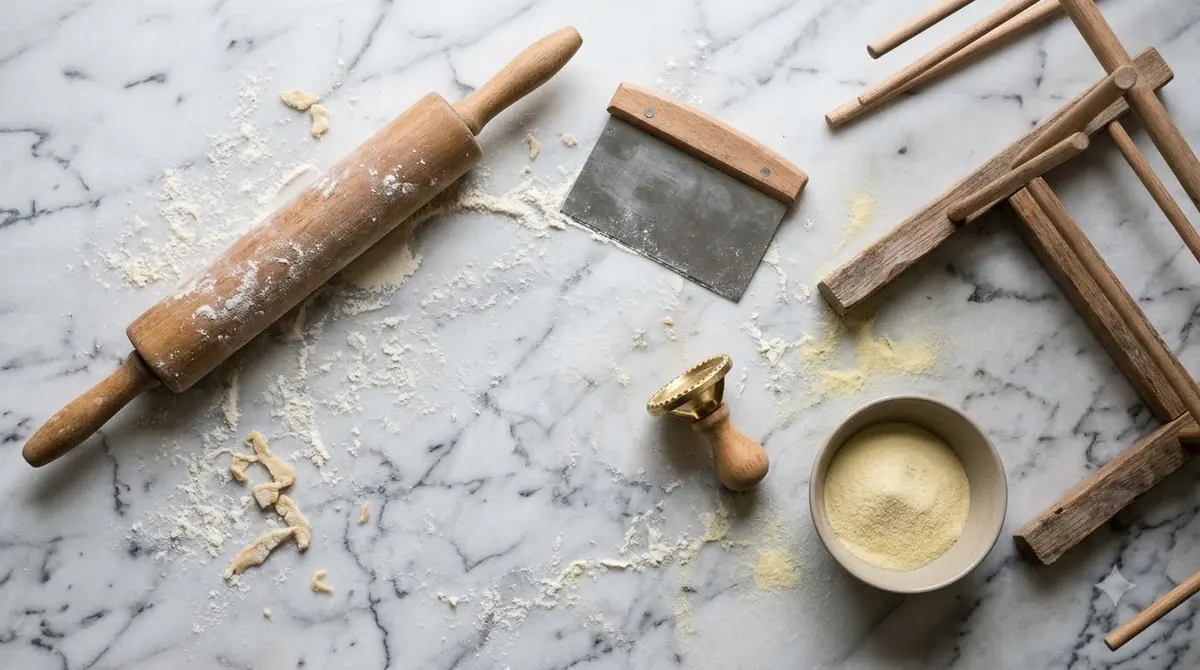
The Atlas 150 cutter list includes the following options from the Marcato manual:
- Tagliolini, 1.5 mm wide, at dial 8 to 9
- Capellini, 1 mm wide, at dial 8 to 9
- Fettuccine, 6.5 mm wide, at dial 6
- Ravioli strips, 45 mm wide, at dial 6
- Lasagna sheets, 150 mm wide, at dial 6 to 9
Shapes are where Marcato vs KitchenAid favors the Atlas 150 most clearly, and our list of Marcato Atlas 150 attachments shows what else fits. The manual marks mafaldine, reginette, pappardelle and ravioli as not usable with the Pastadrive motor. If you plan to use a motor, check that list before buying cutters for the Atlas 150.
Power, Speed and Effort
For power, the Marcato vs KitchenAid difference is effort against an outlet. Hand cranking takes more effort than a stand mixer, but the Atlas 150 needs no outlet. The KitchenAid set is powered by the mixer, and KitchenAid’s guidance sets the roller at speed 2, the fettuccine cutter at speed 5 and the spaghetti cutter at speed 7. Our guide on how to use the KitchenAid pasta roller walks through setup.
Marcato also sells a motorized Atlasmotor version. Its manual limits continuous use to 15 minutes, so plan batches of dough rather than running the motor for a long session.
Cleaning and Care
Neither machine goes in the dishwasher, and both need dough removed with a brush rather than water. Cleaning is much the same in Marcato vs KitchenAid, since both sources say not to immerse the parts in water. For a step-by-step routine, see how to clean the Marcato Atlas 150.
- For the KitchenAid set, let the attachment air dry for one hour after use.
- Brush dried dough off the rollers and cutters with the included cleaning brush, and never use a knife.
- For the Atlas 150, wipe the body with a cloth and brush the rollers and cutters.
- Pull out the removable cogs under the cutters to clean them more thoroughly, then refit them in reverse order.
If the Atlas 150 squeaks, the manual suggests a drop of food-contact-safe petroleum jelly on the roller ends. Avoid oil that is not rated for food contact.
Warranty and Build
Marcato guarantees its Atlas machines for 10 years against manufacturing defects. Motorized Atlasmotor and Ampiamotor units are covered for 2 years from the purchase date, and the warranty excludes damage from use outside the manual.
The KitchenAid warranty for this attachment was not confirmed in the sources checked for this article. Read the terms that come with your mixer or attachment before you buy, since that leaves the warranty an open question in any Marcato vs KitchenAid decision.
Marcato vs KitchenAid: Which Should You Choose
Pick the Atlas 150 for a standalone machine with more shapes, and the KitchenAid set if you already have a compatible stand mixer. The Marcato vs KitchenAid verdict depends on your kitchen, so use these rules to match the choice.
- Choose the Atlas 150 if you have no stand mixer and want 10 thickness settings.
- Choose the Atlas 150 if you want lasagna sheets or ravioli strips.
- Choose the KitchenAid set if you own a compatible stand mixer and want to keep counter space free.
- Choose the KitchenAid set if you only plan to make fettuccine and spaghetti.
Warranty terms also differ in Marcato vs KitchenAid, and the Atlas 150 has the published 10-year coverage. If you want the most shapes, the Atlas 150 covers more ground. Check your mixer model before you commit to the KitchenAid set. If you are weighing another hand-crank brand, read Imperia vs Marcato.

Frequently Asked Questions
Do I need a stand mixer for the KitchenAid roller?
Yes. The KitchenAid roller set is an attachment, so it needs a compatible stand mixer to run. KitchenAid’s page names tilt-head and bowl-lift types but no specific models, so check your mixer model before buying.
Is the Marcato Atlas 150 dishwasher safe?
No. The Marcato manual says not to wash the machine or its accessories in water or a dishwasher. Clean it with a cloth and brush, and pull out the removable cogs under the cutters for a deeper clean.
Which setting makes fettuccine on the Atlas 150?
The Atlas 150 fettuccine cutter is set to dial 6 in the Marcato manual. For spaghetti at 2 mm, the manual recommends dial 4 on the same machine.
Which one is better for beginners?
If you already own a stand mixer, the KitchenAid roller set is the simpler start. For Marcato vs KitchenAid beginners, the answer depends on equipment. Without a mixer, the Atlas 150 is the practical choice. The Marcato manual advises passing the dough through setting 0 several times, then stepping through each number until you reach the thickness you want.
Does the Atlas 150 come with a motor?
Not by default. Marcato sells a motorized Atlasmotor version separately, and its manual limits continuous motor use to 15 minutes. Motorized units carry a 2-year warranty instead of the standard 10-year coverage.
If you already own a compatible stand mixer, the KitchenAid set adds fresh pasta without a second machine. Without a mixer, the Atlas 150 offers more cutter shapes and a published 10-year warranty, so measure your counter space and check the model before ordering. A Marcato vs KitchenAid decision is easiest when you know your mixer model first.
 8 min readReviews & VersusImperia vs Marcato: Which Pasta Machine Should You Buy?Updated Nov 8, 2026
 9 min readReviews & VersusKitchenAid Pasta Roller: Set, Specs and Who Should Buy ItUpdated Nov 15, 2026
 8 min readReviews & VersusHamilton Beach Pasta Maker Review: Who Should Buy OneUpdated Nov 11, 2026
 5 min readReviews & VersusMarcato Pasta Maker Review: Is the Atlas 150 Worth It?Updated Nov 13, 2026
 9 min readReviews & VersusKitchenAid Pasta Maker: What the Attachments Do and How to Use ThemUpdated Nov 15, 2026
 5 min readReviews & VersusKitchenAid Pasta Roller vs Extruder: Which Attachment to BuyUpdated Nov 13, 2026