
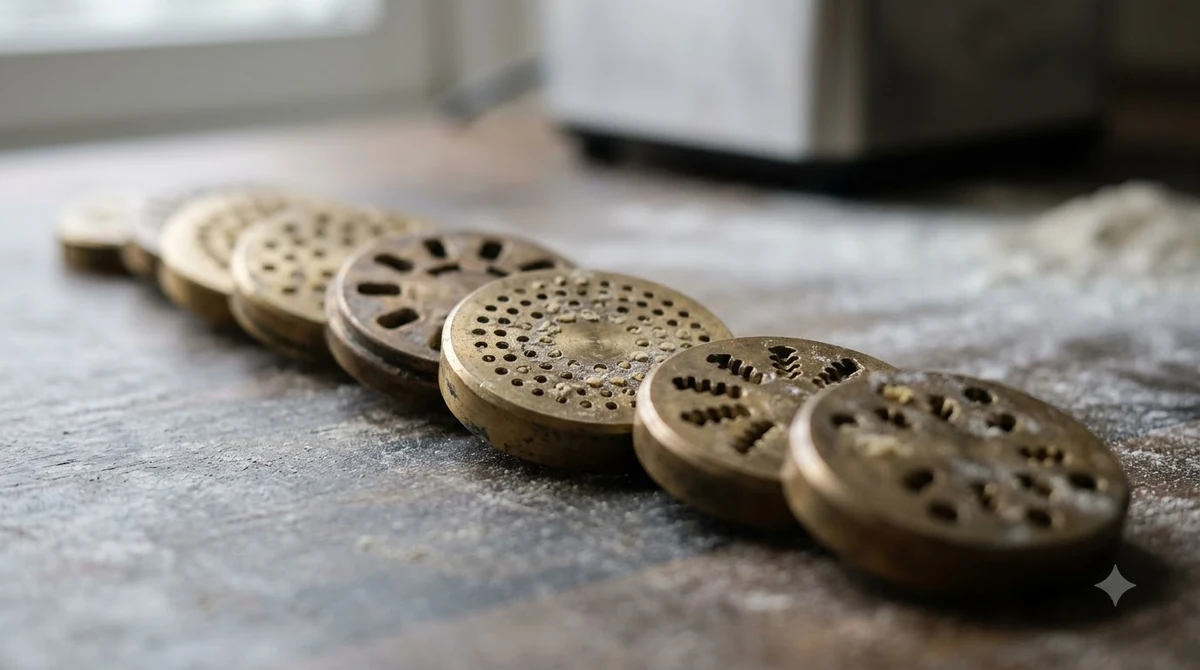

A pasta press is a dough extruder that pushes dough through shaped dies to make tubes and short shapes such as rigatoni, fusilli and bucatini. Most home models attach to a stand mixer, while others run on their own motor or by hand. As of 2026-11-07, the pasta press this guide measures against is the KitchenAid pasta press attachment, model KSMPEXTA.
Choose a pasta press if you want shaped or tubular pasta. If you mostly want flat noodles such as fettuccine or lasagna sheets, a roller is the better tool, and our best pasta rollers guide covers those.
Amazon lists one example of each pasta press type covered here: the KitchenAid KSMPEXTA stand mixer attachment, the Philips 7000 Series electric extruder and the Marcato Regina hand-crank extruder. Details in the boxes below come from the Amazon listings, so confirm them on the page before you buy.

KitchenAid KSMPEXTA Gourmet Pasta Press Attachment
Pros & ConsViewHide
Reasons to buy
- Six quick-change discs: spaghetti, bucatini, rigatoni, fusilli, large and small macaroni
- Built-in wire cutter and a storage case
- Stainless steel cleaning tool included
Reasons to avoid
- Needs a KitchenAid stand mixer, sold separately
- Takes more cleanup than a roller
- Premium-priced attachment

Philips 7000 Series Pasta Maker
Pros & ConsViewHide
Reasons to buy
- Mixes, kneads and extrudes automatically, ready in under 10 minutes per the listing
- Makes up to 8 portions in one go
- Comes with 8 shaping discs
- Parts are listed as dishwasher-safe
Reasons to avoid
- Costs far more than a manual roller
- Needs permanent counter space
- 11% of ratings are 1-star

MARCATO Made in Italy Regina Extruder Pasta
Pros & ConsViewHide
Reasons to buy
- Hand crank, so no power is needed
- Comes with 5 dies for bucatini, fusilli, maccheroni, maccheroncini and rigatoni
- Made and assembled in Italy
Reasons to avoid
- 3.6 average rating, the lowest in this group
- Not dishwasher safe: let residue dry and clean with a dry brush
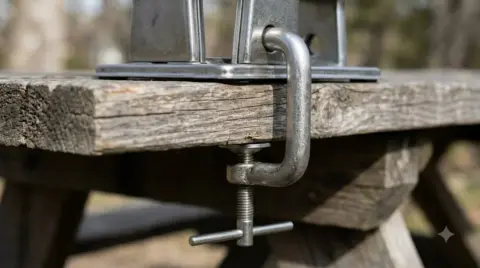
- Needs a table edge to clamp onto
| Pick type | Best for | Key fact |
|---|---|---|
| KitchenAid KSMPEXTA stand mixer press | Stand mixer owners who want several shapes | Six quick-change discs |
| Electric pasta extruder | Cooks who want to press without a mixer | Runs on its own motor |
| Hand-crank pasta press | Small batches and occasional use | No power needed |
What a pasta press makes and how it works
A pasta press forces dough through a die plate, so the shape comes from the disc, not from your hands. Based on Homelization’s KitchenAid comparison, the press makes spaghetti, fusilli, bucatini, rigatoni, and large and small macaroni.
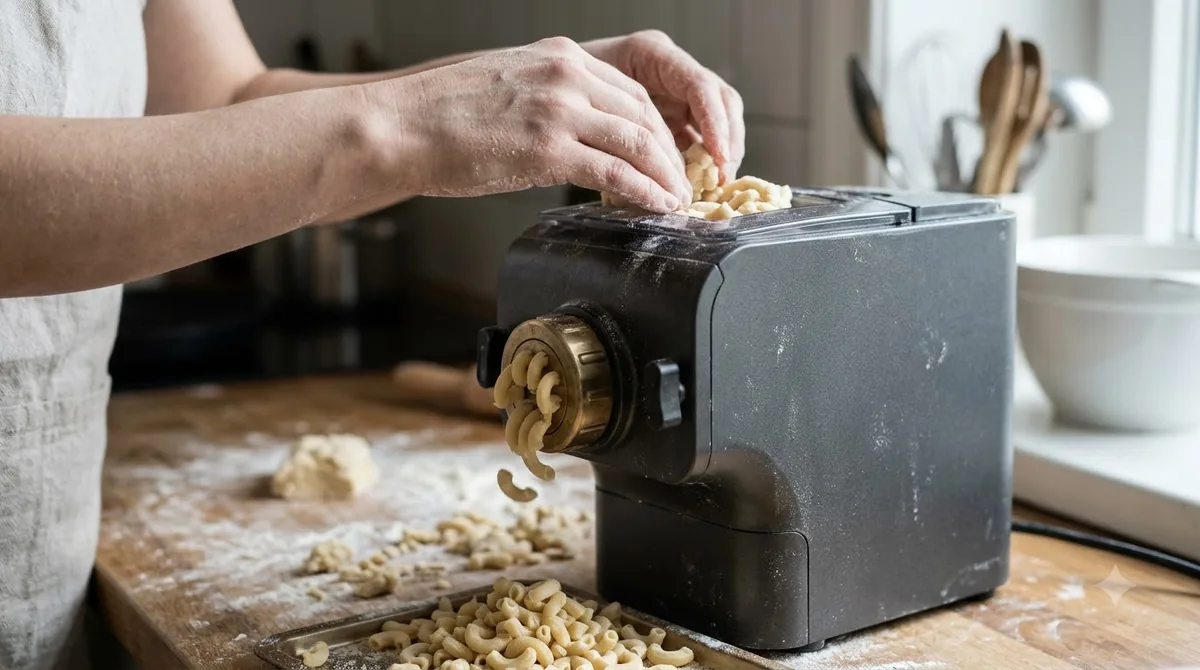
The press is fed in small batches, so you work through the dough in rounds rather than in one pass. The KitchenAid manual says to form dough into walnut-sized balls and to push food with the combo tool, never by hand. It also says the press is designed for pasta dough only, so do not insert anything else.
Before you assemble the press, turn the mixer off and unplug it. Fit the auger into the housing base, cross-tab first, then set the pasta plate in place so its tab sits in the auger base. Screw the pasta ring on until it seats firmly. The manual also asks you to keep long hair gathered and to avoid ties, scarves and loose clothing near the press, and to supervise children around it.
It does not make sheets, so it cannot make lasagna layers.
After extrusion, separate the pasta. The KitchenAid manual says it can be cooked straight away. If you want to dry it, lay long noodles over the KitchenAid drying rack (model 5KPDR), or dry them in a single layer on a towel. Keep the pieces apart while they dry so they do not stick together.

Pasta press versus pasta roller
A press makes shaped and tubular pasta, while a roller makes flat sheets that you cut into noodles. Pick by the shapes you cook most often, not by the price alone.
| Factor | Pasta press | Pasta roller |
|---|---|---|
| Shapes | Spaghetti, fusilli, bucatini, rigatoni, macaroni | Sheets for lasagna, tortillas, pierogi, thin pizza; cut to fettuccine or spaghetti |
| Cleaning | Some parts need hand cleaning, harder when dough sticks | Dry for 30 minutes to an hour, then brush off |
| Effort | Less hand shaping, but more cleanup after cooking | More hands-on rolling and folding |
The KitchenAid roller set in the same comparison has 8 thickness settings and makes 6-inch sheets. It is made in Italy. If you want both shapes and flat noodles, you need two attachments.
Types of pasta press
Pasta presses fall into three groups: stand mixer attachments, electric extruders and hand-crank models. Each one trades power against how much work you do by hand.
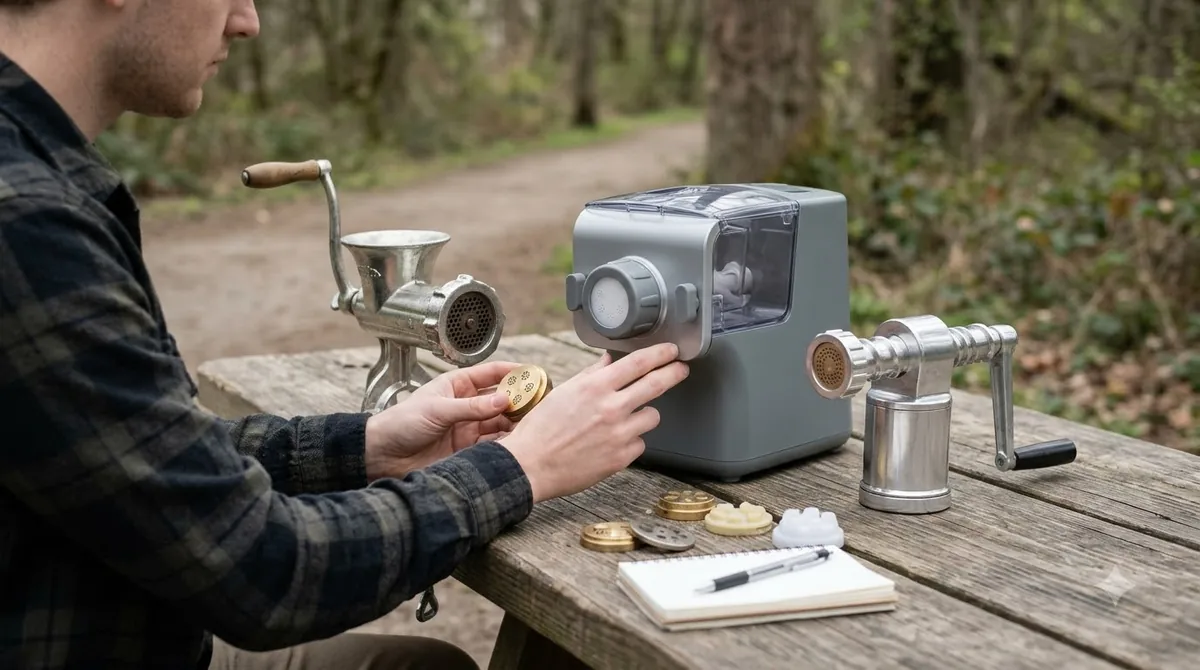
- Stand mixer attachment: uses the power of your mixer, so you need a compatible mixer already. The KitchenAid KSMPEXTA listing adds a storage case for the discs and a stainless steel cleaning tool.
- Electric extruder: has its own motor and does not need a mixer. The Philips 7000 Series listing says it makes up to 8 portions per batch, comes with 8 discs and has dishwasher-safe parts.
- Hand-crank press: needs no power. It suits small batches. The Marcato Regina listing names five dies for bucatini, fusilli, maccheroni, maccheroncini and rigatoni.
Model prices and review scores change often, and the search results for this topic contain many affiliate-led lists that disagree. One KitchenAid quick-start page lists the KSMPEXTA at $249.99, but that figure may be out of date. Check the current price and the disc count on the brand or retailer page before you buy.
How we chose these picks
The picks on this page are sorted by type, not ranked by a hands-on test. The product facts come from a published comparison of KitchenAid pasta attachments. Scores and rankings from other sites were not confirmed, so this page does not give one.
What to look for in a pasta press
Check the number of discs, the body material and how the wire cutter works before you buy, and read how to choose a pasta maker if you are also weighing rollers. These points decide which shapes you can make and how much cleanup follows.
- Disc count: KitchenAid lists six interchangeable pasta discs with the KSMPEXTA, along with the press, a dough pusher and a stainless steel cleaning tool. A storage case is also listed.
- Body material: the KSMPEXTA is made of stainless steel.
- Wire cutter: the KSMPEXTA has a built-in wire cutter.
- Size: KitchenAid’s spec table gives about 6 inches wide, 10.3 inches high and 5.3 inches deep. A third-party comparison lists different figures, so use the brand’s numbers when you measure your counter.
Check the disc set for shapes you actually cook. A set with six discs is only useful if you cook those six shapes.
Mixer Speed and Extrusion Length by Shape
The KitchenAid owner’s manual includes a plate chart that pairs each shape with a recommended mixer speed and an approximate extrusion length. Use it as a starting point, because your dough, room temperature and mixer can change how a batch feeds through.
| Pasta plate | Recommended mixer speed | Extrusion length |
|---|---|---|
| Spaghetti | 10 | About 24.0 cm |
| Bucatini | 10 | About 24.0 cm |
| Rigatoni | 6 | About 4.0 cm |
| Fusilli | 3 | About 4.0 cm |
| Large macaroni | 6 | Up to 5.0 cm |
| Small macaroni | See your manual’s chart | Up to 4.0 cm |
The manual also says to let the mixer cool completely before you put on or take off parts, and before you clean it. Work in small rounds and stop to clear the discharge area if the strands start to stick together.
Who should buy which
A stand mixer owner who wants several shapes fits a press best. A cook who mainly makes fettuccine or lasagna should choose a roller.
- Buy a stand mixer press if you already own a compatible mixer and cook tubes or spirals often; the KitchenAid pasta extruder recipes show what to make first.
- Buy an electric extruder if you want to press without tying up your mixer.
- Buy a hand-crank press if you cook small batches now and then.
- Skip a press if you only want flat noodles or if you dislike cleaning extra parts.
A pasta press earns its place when you cook tubes and spirals often. Run two or three test batches before you judge it, since the first batches show how your dough feeds through the press and how much cleanup follows. If the pasta press sits unused after a few weeks, a roller may suit your cooking better.
Care and cleaning
A press is harder to clean than a roller, so clean it once it has cooled. The KitchenAid manual sorts the parts into two groups. The housing, cutter and pasta plates are hand-wash only: wipe them with a soft damp cloth, dry them thoroughly with a soft dry cloth, and keep them out of water and the dishwasher. The pasta ring, auger and combo tool can be washed by hand in warm sudsy water or on the top rack of a dishwasher.
Remove fully dried dough with the stainless steel cleaning tool. If some remains, use a toothpick. The manual warns against metal objects other than the cleaning tool, and it asks you to clear any dried dough from the auger after you remove it. For the step-by-step routine, see how to clean a KitchenAid pasta extruder.
Frequently Asked Questions
Is a pasta press the same as a pasta extruder?
Usually yes. Both terms describe a machine that pushes dough through shaped dies. Product listings use the names differently, so check that the listing shows dies and not sheet rollers.
Can a pasta press make flat pasta?
No. A press makes shaped and tubular pasta. For flat noodles, use a roller with a fettuccine or spaghetti cutter.
How many discs does the KitchenAid pasta press include?
The KSMPEXTA includes six quick-change discs, according to the Homelization comparison. Confirm the count in the box contents on the brand page, because sets can change.
Is a pasta press hard to clean?
It takes more effort than a roller. Some parts need hand cleaning, and dried dough is harder to remove.
Where can I check the current price?
Check the brand page or the retailer page, since we did not confirm a current price for any model. Prices move often.
Choose the press by the shapes you cook, then check whether your mixer or counter space fits it. If you cook both flat and shaped pasta, plan on a roller and a press rather than trying to make one tool do both, or browse the best noodle makers for all-in-one options.
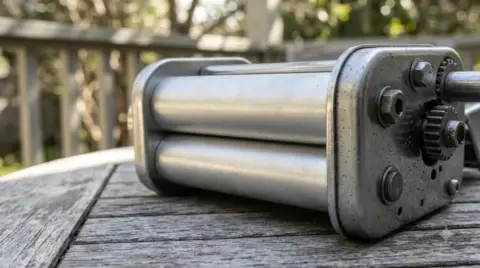 8 min readBest PicksBest KitchenAid Pasta Roller Attachments for Home CooksUpdated Nov 14, 2026
 8 min readBest PicksBest Noodle Makers for Fresh Pasta at HomeUpdated Nov 15, 2026
 8 min readBest PicksBest Noodle Maker Machines for Fresh Pasta at HomeUpdated Nov 14, 2026
 8 min readBest PicksBest Pasta Roller for Home Cooks in 2026Updated Nov 14, 2026
 9 min readBest PicksBest Pasta Sheeter in 2026: Types, Widths and PricesUpdated Nov 12, 2026
 9 min readBest PicksThe Best Pasta Making Kit for Home CooksUpdated Nov 12, 2026