

How long to rest pasta dough? About 30 minutes before you roll it, and up to an hour at room temperature is fine. That short rest lets the flour fully absorb the liquid and lets the gluten relax, so the dough rolls thin without tearing or springing back.
Recipes give the same basic timing with a few variations. The dough can rest on the counter or in the fridge, and the resting time is part of the method rather than an optional extra.
Why Pasta Dough Needs to Rest
Resting gives the flour time to hydrate evenly, so no dry pockets remain in the dough. It also relaxes the gluten that formed while you kneaded, which makes the dough easier to roll.
In a piece for The Takeout, chef Jacob Mendros explains that resting lets the hydration be fully incorporated into the dough and lets it reach room temperature. The article adds that rested dough is pliable enough to hold its shape when rolled and is less likely to turn tough or break. The full article is on The Takeout.
How Long to Rest Pasta Dough at Room Temperature
For most egg pasta doughs, a rest of about 30 minutes at room temperature is enough. The Takeout recommends about 30 minutes and says the dough can rest for up to an hour.
Keep the dough wrapped in plastic wrap or under an upturned bowl while it rests. An exposed surface dries out and forms a crust that cracks when you roll it.
Resting Pasta Dough in the Fridge
Some recipes rest the dough in the fridge instead. The squid ink pasta recipe from Pasta Evangelists wraps the dough and rests it in the fridge for at least 30 minutes after kneading.
If you rest it cold, let the dough come back toward room temperature before you roll it. Cold dough is stiffer and harder to pass through a pasta machine, so a short wait on the counter makes the sheets smoother.
How Long to Rest Pasta Dough for Best Results
The simplest guide to how long to rest pasta dough is to match the time to the method. A counter rest of about 30 minutes suits dough you are rolling the same day. A fridge rest works when you want to prepare the dough ahead of time.
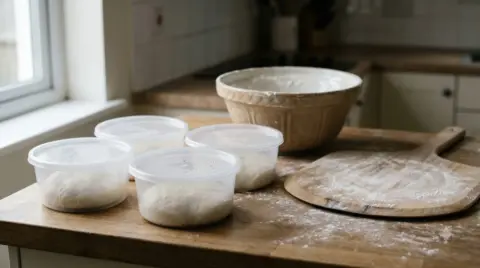
The SBS Food recipe for squid ink linguine divides the dough into four discs, wraps each one in plastic wrap, and refrigerates them for 30 minutes before rolling. That approach keeps the dough cold and easy to handle while you work through a larger batch, one disc at a time.
Whatever method you choose, the goal is the same. The flour should be fully hydrated, the gluten should be relaxed, and the dough should be ready to stretch without snapping back. Skipping the rest is the most common reason a dough feels tough.
Does Flour Change the Resting Time?
The flour and the dough’s hydration affect how the rest feels in practice. A drier dough feels stiffer after a short rest, while a wetter dough relaxes more quickly. Adjust by feel rather than by the clock alone.
Semolina-heavy doughs, such as the one in America’s Test Kitchen’s pici recipe, also rest for about 30 minutes wrapped in a damp towel. The towel keeps the surface from drying while the flour hydrates.
Signs the Dough Has Rested Enough
A rested dough feels smooth and relaxed, and it springs back slowly when you press a finger into it. If it tears or shrinks back hard as you roll, it probably needs a few more minutes.
- Press a finger gently into the dough. It should spring back slowly, not snap back.
- Roll a small piece thin. It should stretch without tearing.
- If the sheet shrinks back as you roll, give the dough another 10 to 15 minutes covered.
Planning Your Pasta Around the Rest
To plan how long to rest pasta dough around a meal, work backward from the time you plan to eat. Mix and knead the dough first, then set the rest time before you start rolling. A dough that rests while you set up the pasta machine, clear the counter and boil the water is ready at the right moment.
If you are making dough the day before, wrap it well and keep it in the fridge. Bring it back toward room temperature before you roll, since cold dough resists the rollers and cracks more easily. A short rest on the counter after the fridge is usually enough to make the sheets smooth again. If the dough still feels tight after that, cover it and give it another 10 to 15 minutes before you try again.
Frequently Asked Questions
Can you rest pasta dough for too long?
Within the usual range of 30 minutes to an hour, a longer rest is rarely a problem, but the dough can dry out if it is left uncovered. Keep it wrapped, and stay close to the time your recipe gives.
Do I need to rest pasta dough if I am using a machine?
A rest still helps. Dough that has rested passes through the rollers more evenly and is less likely to crack at the edges.
Is 30 minutes enough for all pasta dough?
Thirty minutes is the common minimum in these recipes. Use it as your starting point, then check the dough for elasticity before you roll.
Should pasta dough rest in the fridge or on the counter?
Both work. A counter rest of about 30 minutes is the simplest, while a fridge rest is useful when you want to prepare the dough ahead. Bring chilled dough back toward room temperature before rolling.
Give the dough about 30 minutes covered before you roll it, and let it rest longer only if it still feels tight. A relaxed dough is easier to shape and less likely to tear.
 6 min readLearnFix Sticky Pasta Dough: Flour, Rest and RollUpdated Nov 13, 2026
 8 min readLearnHow to Bring Pizza Dough to Room Temperature Before ShapingUpdated Nov 11, 2026
 5 min readLearnHomemade Spaghetti: Dough Ratio, Rest and Cook TimeUpdated Nov 13, 2026
 8 min readLearnAutolyse Pizza Dough: How the Flour and Water Rest WorksUpdated Nov 10, 2026
 6 min readLearnHomemade Linguine: Dough, Rolling and CuttingUpdated Nov 13, 2026
 5 min readLearnHomemade Pappardelle: Dough, Rolling and Cutting by HandUpdated Nov 13, 2026