
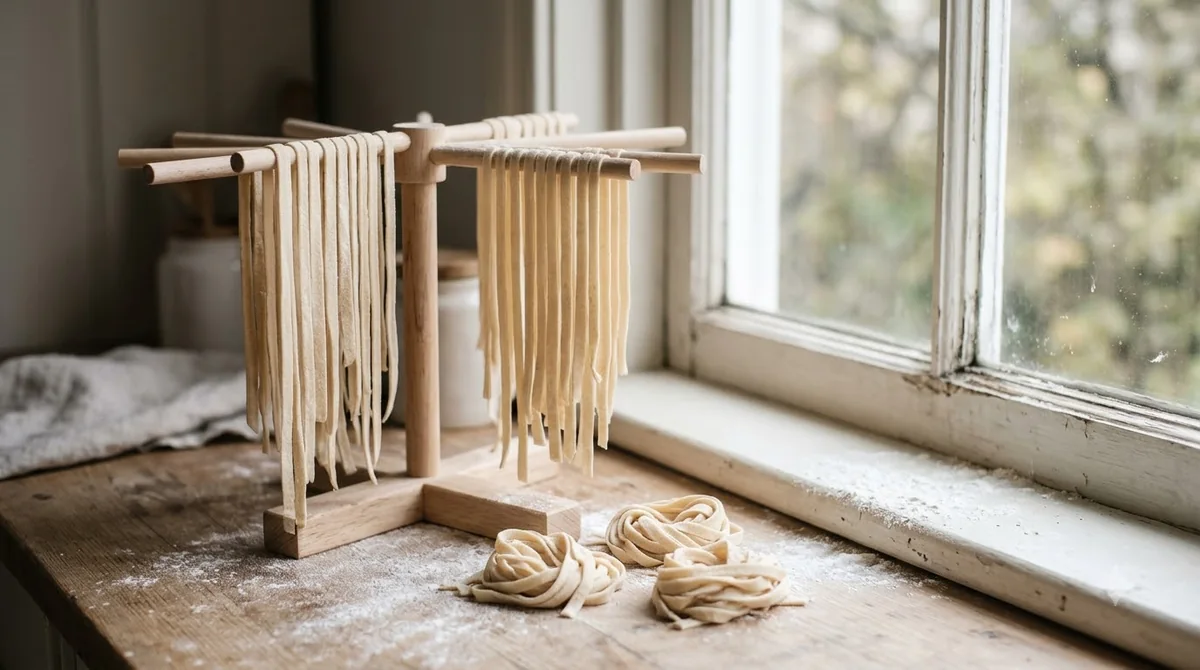

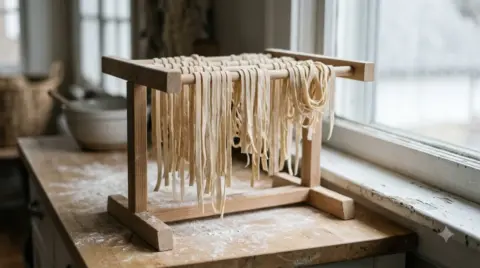
Knowing how to use a pasta drying rack means hanging freshly cut pasta strands over its dowels or arms so they stay separate while they air-dry. Strands that touch while still moist tend to stick together, and spacing them apart lets air reach every side. Once the pasta is fully dry, it moves into an airtight container for storage.
The steps are simple, but drying time and kitchen humidity change the result. This guide covers loading, drying times, shapes that need a tray instead, how to tell when pasta is dry, and storage.
What a Pasta Drying Rack Does
A pasta drying rack holds long pasta in the air so that every surface can dry. King Arthur Baking’s drying guide describes its collapsible rack as keeping strands evenly spaced so they do not stick together. The rack gives you a clear place to put pasta between cutting it and cooking or storing it. If you are still choosing one, read about how to choose a pasta drying rack first.
At home, the rack does three jobs:
- It keeps long strands such as spaghetti and fettuccine from fusing into clumps.
- It lets air reach the whole length of each strand instead of only the bottom.
- It holds freshly cut pasta until it is ready for the pot or a container.
How to Use a Pasta Drying Rack Step by Step
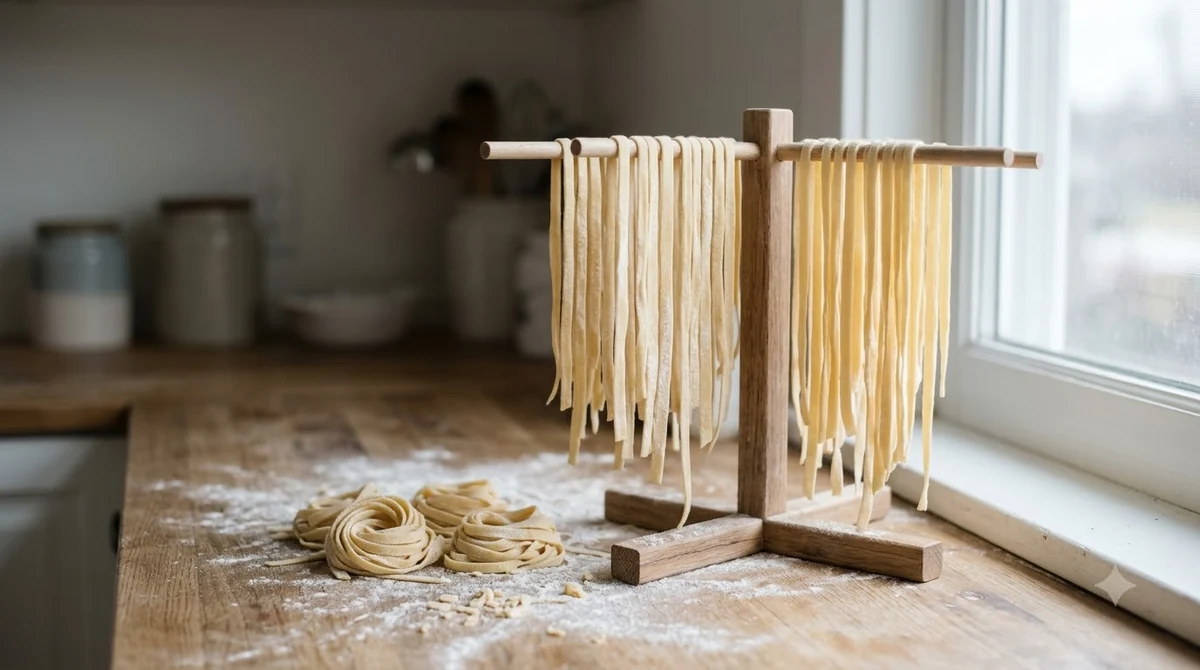
Learning how to use a pasta drying rack comes down to three actions: open it, load it evenly, and leave the strands alone while they dry. Collapsible racks fold flat for storage and open on the counter. Check the manufacturer’s instructions for the exact opening steps on your model.
- Open the rack on a clean, dry counter and make sure it sits flat and stable.
- Cut the pasta, then lift each strand gently so it does not stretch or tear.
- Drape the strands evenly across each dowel or arm of the pasta drying rack, leaving space between neighboring strands.
- Do not pile strands on top of each other, because touching strands are what stick together.
- Leave the pasta drying rack undisturbed while the pasta dries, and keep it in a dry room where the humidity is moderate.
In short, how to use a pasta drying rack well is mostly about spacing: keeping the strands separated from the start is what prevents sticking, and the rack’s dowels or arms do that job while the pasta dries.
How Long to Dry Homemade Pasta
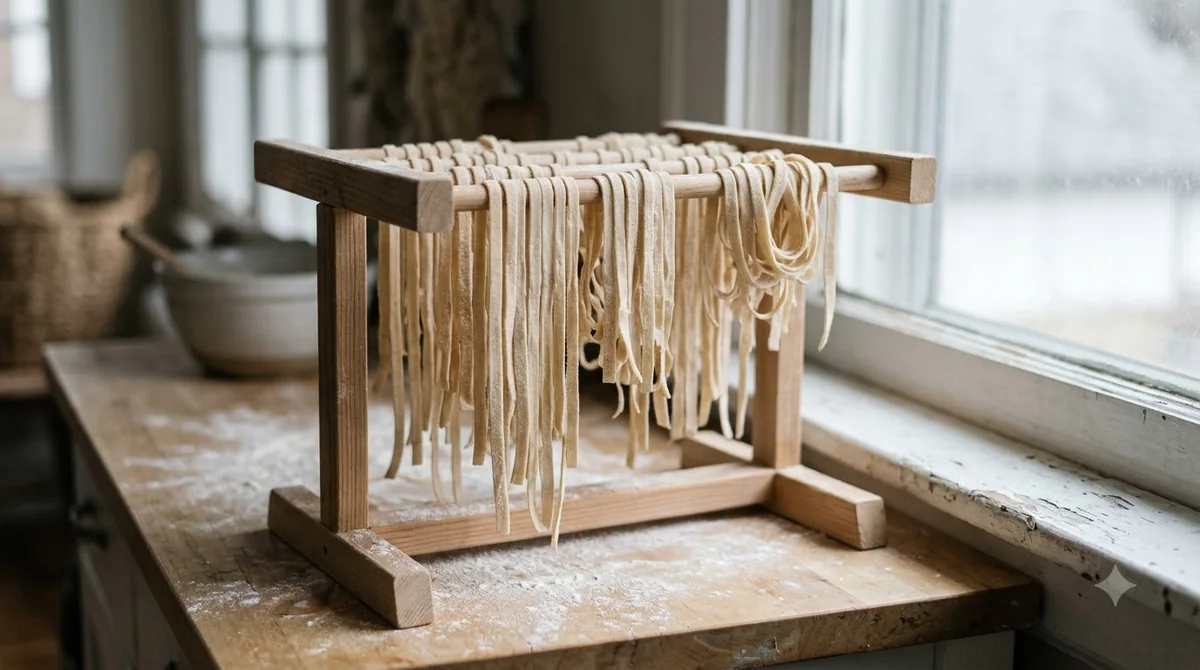
Drying time depends on whether you are cooking the pasta soon or storing it. For cooking the same day, Tasting Table suggests drying noodles for about 10 to 15 minutes, which helps them keep their shape in the water. For storage, King Arthur Baking advises drying overnight or up to 24 hours.
| Goal | Suggested drying time | Source |
|---|---|---|
| Cook the same day | About 10 to 15 minutes | Tasting Table |
| Store at room temperature | Overnight, up to 24 hours | King Arthur Baking |
| Egg-free dough, dry area | 12 to 24 hours | Pasta Evangelists |
The sources do not agree on one exact number, and none gives a separate time for each shape. Pasta Evangelists notes that drying time can vary with the room temperature and the thickness of the dough, so use these windows as a starting point and check the pasta rather than the clock.
Cut-and-cook pasta follows a shorter schedule. Pasta Evangelists advises drying the rolled dough for 15 minutes before cutting, then leaving the cut pasta for a further 15 minutes before boiling. Fresh egg pasta meant for storage needs around 30 minutes of drying before it goes into the refrigerator for up to 24 hours.
Shapes That Cannot Hang on a Rack
Long strands hang well on a rack, but short shapes do not, so knowing how to use a pasta drying rack for each shape matters. King Arthur Baking says shapes such as orecchiette and cavatelli should dry on a pasta drying tray instead, and that trays can be stacked for large batches.
A simple rule covers most cases. Use the pasta drying rack for long strands such as spaghetti, linguine and fettuccine, and use a tray for shapes that cannot be draped over a rod. If you do not own a tray, Tasting Table notes that a floured towel can also work for drying.
Telling When Pasta Is Dry
Fully dried pasta feels hard all the way through and snaps when you break a small piece off. King Arthur Baking describes the same snap test, and Pasta Evangelists says correctly dried pasta is brittle to the touch. For the full routine from rolling to the pot, see our guide to drying fresh pasta at home.
Use these checks before you store the pasta:
- Break a piece from a thick part of a strand. It should snap cleanly.
- If a strand still bends without breaking, it has not dried enough to store.
- Pasta that still feels soft in the center needs more time on the rack.
Tasting Table gives a simple rule for loose noodles: if spaghetti still feels soft, it is not fully dry, and if it is firm enough to snap in half, it is ready to store or eat.
Humidity, Heat and Cracking
Humidity has the biggest effect on whether a pasta drying rack works, more than the rack itself. King Arthur Baking warns that in humid conditions the pasta may not fully dry, and suggests cooking it fresh instead. Pasta Evangelists describes the opposite problem as well: added humidity in the air can make pasta dry too quickly and crack, so it advises avoiding very hot days.
If you want more airflow, Pasta Evangelists suggests placing a fan on a relatively low setting next to the pasta. Pasta dries best in a warm environment, so a mild room that is not humid is the most reliable place for a rack.
Storing Dried Pasta
Store pasta only after it is completely dry, because residual moisture can lead to mold. King Arthur Baking recommends airtight containers at room temperature, which keeps the pasta for one to two months. Tasting Table notes that drying also lowers moisture enough to store the pasta at room temperature instead of refrigerating it.
Pasta Evangelists describes a sequence that suits home cooks:
- Dry the pasta on the rack or tray overnight.
- Keep it in an open container for a couple of days.
- Move it to a sealed container for storage, and use it within about one to two months.
Filled pasta is a different case. Pasta Evangelists says filled pasta can be frozen for up to a month, and King Arthur Baking advises skipping filled pasta for dry storage altogether.
Common Mistakes When Drying Pasta on a Rack
Most problems with a pasta drying rack come from storing pasta before it is dry, or from drying it in conditions that work against it. These are the mistakes that come up most often in the sources:
- Storing pasta while it still feels soft, which can lead to mold.
- Piling strands together instead of spacing them along each dowel.
- Hanging short shapes that should sit on a tray.
- Using a dough that is not suited to dry storage, such as one with eggs or filling.
- Using improvised hangers without sanitizing them first. King Arthur Baking says to sanitize everything properly.
- Cooking homemade dried pasta on time. It usually needs a few extra minutes, so check it every minute after the recommended time.
King Arthur Baking recommends eggless dough made with semolina or durum for pasta you plan to dry, and says to skip filled pasta for dry storage. Choose the dough before you choose the rack.
Frequently Asked Questions
Do you need a pasta drying rack to dry pasta?
No. Tasting Table says a floured towel, clothes hangers or a laundry rack can work. King Arthur Baking says coat hangers or the back of a chair also work, as long as they are sanitized first.
How long should pasta dry on a rack?
For cooking the same day, dry it about 10 to 15 minutes. For storage, King Arthur Baking suggests overnight or up to 24 hours. Check for a snap rather than relying only on the clock.
How do you know when homemade pasta is dry?
Fully dried pasta is hard and snaps when you break a small piece off. If it still bends or feels soft in the center, leave it on the rack for longer before you store it.
Can you dry short shapes on a rack?
King Arthur Baking says shapes such as orecchiette and cavatelli should go on a pasta drying tray rather than a rack. Trays can be stacked when you are making a large batch.
How long does dried pasta last?
King Arthur Baking says properly dried pasta stored in an airtight container at room temperature keeps for one to two months. Make sure it is fully dry first, or it may grow mold.
Homemade dried pasta will not match store-bought dried pasta, which is made under precise temperature control. Use your rack to keep strands apart and dry them safely at home, and cook a small test portion before you commit a full batch. For longer-term keeping, read how to store fresh pasta, and browse more tool guides in the gear and pantry section.
 9 min readGear & PantryPasta Drying Rack: How to Choose and Use One at HomeUpdated Nov 16, 2026
 9 min readGear & PantryPasta Drying Tray: How to Choose and Use OneUpdated Nov 17, 2026
 8 min readGear & PantryBest Garganelli Boards for Homemade PastaUpdated Nov 10, 2026
 9 min readGear & PantryThe Best Marinated Artichoke Hearts: Jarred, Canned, and HomemadeUpdated Nov 13, 2026
 8 min readGear & PantryHow to Use a Pasta Cutter at HomeUpdated Nov 10, 2026
 9 min readGear & PantryHow to Use a Pasta Measuring Tool for Perfect PortionsUpdated Nov 11, 2026