
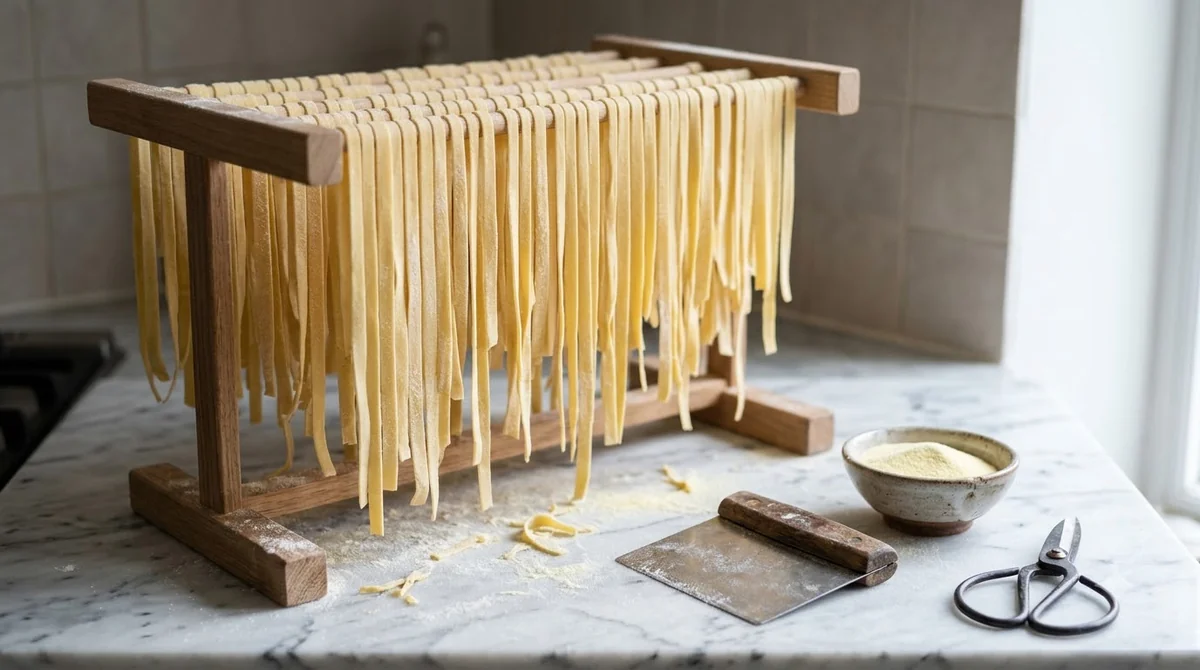

Learning how to dry fresh pasta takes one main step: hang or lay the cut strands in a dry, airy spot for 12 to 24 hours until they are brittle. Drying firms the dough, so the pasta can be stored for weeks instead of cooked the same day.
Knowing how to dry fresh pasta correctly also tells you when to skip drying. Only fully dry pasta should go into storage, a humid kitchen may mean cooking it fresh instead, and filled pasta such as ravioli should not be dried at all.
How to Dry Fresh Pasta Starts With the Dough
Eggless semolina or durum dough made with water dries best, according to King Arthur Baking.
Dough choice matters most when you learn how to dry fresh pasta. King Arthur Baking recommends eggless pasta dough for drying, mainly for food safety reasons. It also says semolina or durum flour mixed with water gives the best results, so start with that kind of recipe if you plan to store the pasta. Our explainer on what is semolina flour covers the basics, and our guide on how to make pasta without a machine shows how to cut the dough by hand.
The same split appears in commercial pasta. According to the pasta article on Wikipedia, dried pasta is typically made from semolina and water and holds about 12% moisture, while fresh pasta is usually made with eggs and flour.
Avoid filled pasta when you dry. Ravioli, tortellini and other stuffed shapes should not be dried, so cook them fresh or freeze them instead.
How to Dry Fresh Pasta on a Rack or Hanger
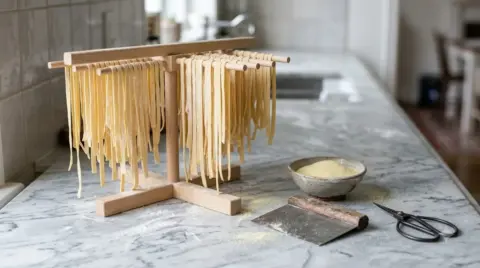
Hang long strands over a laundry rack, a broom handle or a chair back so air reaches every side of the pasta. Every method for how to dry fresh pasta relies on that airflow.
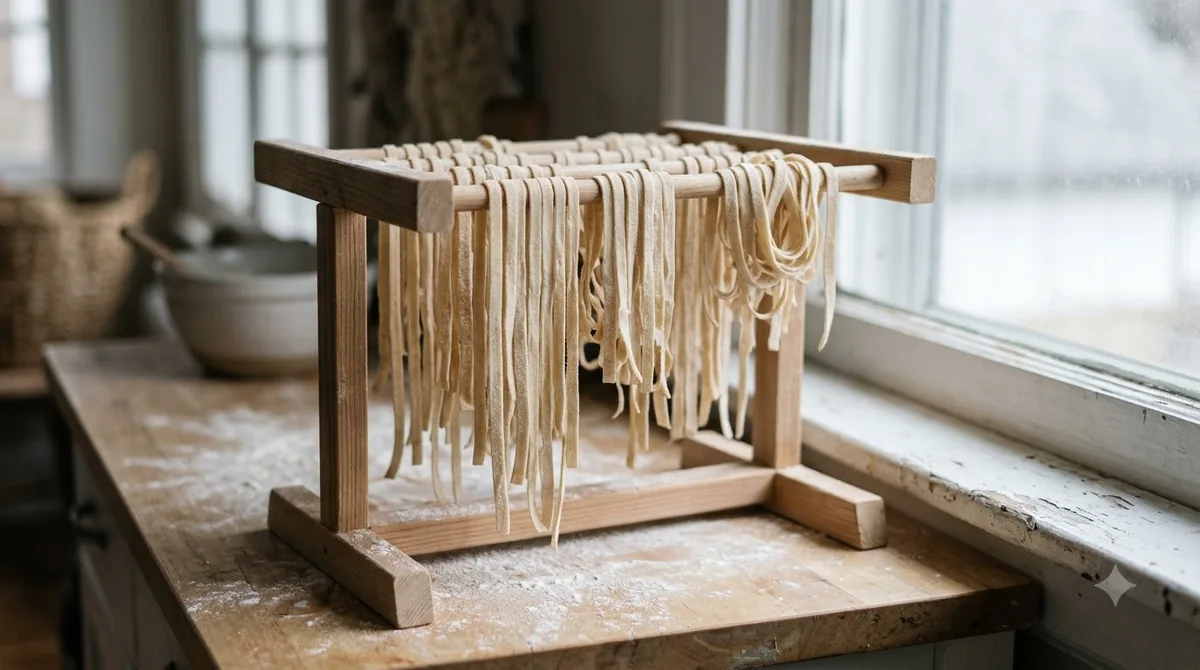
Start by lightly dusting the drying surface with flour, as Pasta Evangelists advises, so the strands do not stick. Keep them separated so air can move between them, since good airflow is what gets the pasta dry evenly.
Several setups work well for how to dry fresh pasta at home:
- A laundry rack, whose narrow spokes leave room for air to circulate, according to Chowhound. A purpose-made drying rack works too, and our roundup of the best pasta drying racks lists options.
- Plastic or wooden hangers with a thick bar across the bottom. Chowhound advises against metal hangers, whose bar is too thin.
- A broom handle laid across two chairs. It takes more effort to set up but gives good airflow.
- The back of a chair, covered with a tea towel lightly dusted with flour.
Long noodles and sheets hang best, according to King Arthur Baking. Shapes that cannot hang, such as orecchiette or cavatelli, go on a floured drying tray instead.
Twisted nests save space, but they may dry less evenly and need checking so the strands do not stick together, according to Pasta Evangelists. A fan set to a low speed and placed near the pasta can also help it dry evenly.
Laying pasta flat on a surface is a last resort. Chowhound notes that one side does not dry, although the flour absorbs some moisture.

How Long Fresh Pasta Takes to Dry
Pasta for storage needs 12 to 24 hours of air-drying, and King Arthur Baking suggests leaving it overnight, for up to 24 hours. According to Chowhound, drying also firms the dough so it does not fall apart in boiling water.
Knowing how to dry fresh pasta for same-day cooking is different from drying it for storage, so your timing depends on which you plan to do. The table below lists the drying times that the sources give for each goal.
| Goal | Drying time | Source |
|---|---|---|
| Cooking soon | About 15 minutes on a floured surface before cutting, then 15 minutes after cutting | Pasta Evangelists |
| Storing for later | Overnight, up to 24 hours | King Arthur Baking |
| Egg-free dough (pasta bianca) | 12 to 24 hours, turned at regular intervals | Pasta Evangelists |
Warm air helps pasta dry. On particularly hot days, though, the humidity can make it dry too quickly and crack, according to Pasta Evangelists.
If your kitchen is humid, the pasta may not dry fully. King Arthur Baking advises cooking it fresh in that case rather than storing it.
How to Tell When Fresh Pasta Is Dry
Dry pasta is brittle, so a small piece broken from the center should snap cleanly rather than bend. This simple test shows whether how to dry fresh pasta has worked.
King Arthur Baking says to break off a small piece to check how brittle it is. Pasta Evangelists adds that you should break a piece to check whether the center is dry, because the middle can stay moist even when the surface feels dry.
Pasta that is not dry all the way through can grow mold once sealed, so wait until every piece is brittle before you store it.
Learning how to dry fresh pasta also means learning how it cooks afterwards. Dried homemade pasta needs a few more minutes in boiling water than the recipe states. King Arthur Baking suggests checking it about every minute after the recommended time, and keeping a note of your drying time and room conditions for next time.
How to Store Dried Fresh Pasta Safely
Store fully dry fresh pasta in an airtight container at room temperature, where it keeps one to two months. Storage is the final step in how to dry fresh pasta at home.
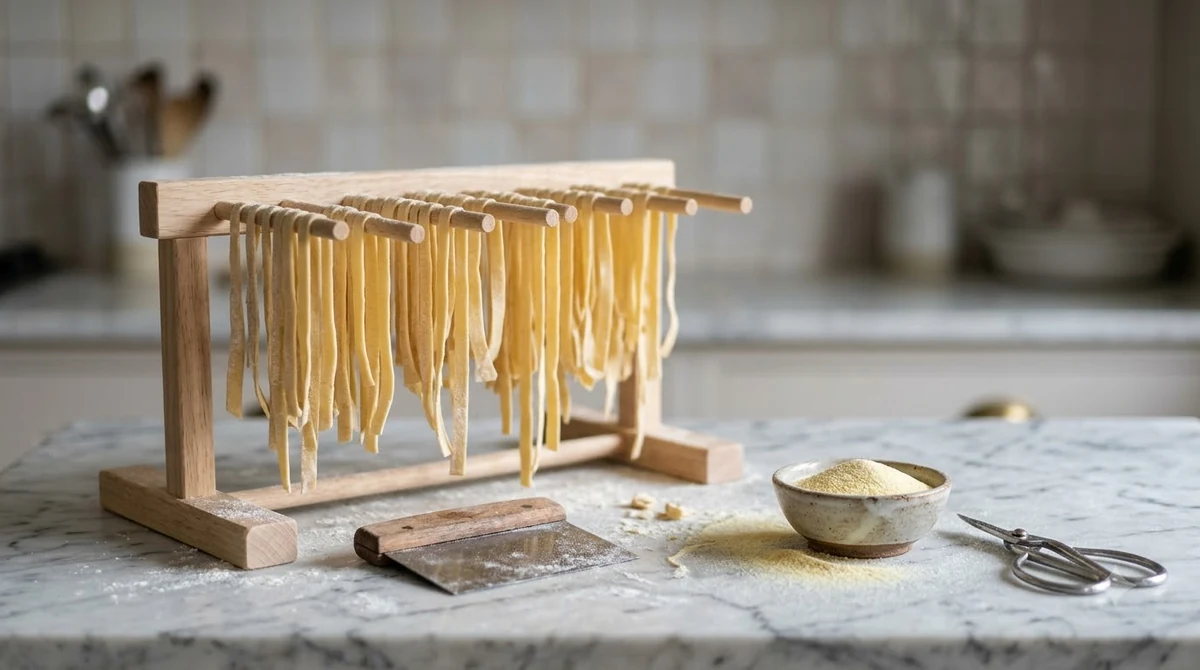
Seal the container only after the pasta is completely dry, using one of the best pasta storage containers if you want a tight seal. Pasta Evangelists warns that residual moisture harms long-term storage, so sealing damp pasta is a common way to lose a batch.
King Arthur Baking gives a shelf life of one to two months for dried pasta kept in airtight containers at room temperature. Keep the container somewhere dry until you cook it.
Freezing is the other option. King Arthur Baking describes freezing fresh pasta as an alternative to drying, and Pasta Evangelists says filled pasta can be frozen for up to a month.
Fresh and Dried Pasta Compared
Prepackaged Italian fresh pasta must be sold within five days of manufacture, while dried pasta is typically about 12% moisture and lasts much longer. Understanding how to dry fresh pasta starts with knowing how it differs from commercial dried pasta.
Knowing the difference explains why home-dried pasta needs its own drying steps. The table below compares the two, using figures from the pasta article on Wikipedia.
| Feature | Fresh pasta | Dried pasta |
|---|---|---|
| Typical ingredients | Eggs with all-purpose or 00 flour | Semolina flour and water, eggs optional |
| Moisture | Italian rules require at least 24% water in prepackaged fresh pasta | Typically about 12% |
| Shelf life | Sold within five days of manufacture for prepackaged Italian fresh pasta | Longer; homemade dried pasta keeps one to two months in an airtight container |
Commercial dried pasta is dried under controlled conditions, according to Wikipedia. Home drying relies on room air instead, so the timing shifts with your kitchen. Without a moisture meter, rely on the brittle and break tests described above to judge how dry your homemade pasta is.
Common Mistakes When Drying Fresh Pasta
Sealing damp pasta, drying in humid weather and drying filled shapes are the three mistakes to avoid.
- Sealing the pasta before it is completely dry, which can lead to mold, according to King Arthur Baking.
- Drying on particularly hot, humid days, when the pasta can dry too fast and crack.
- Letting strands touch on the rack, which keeps air from reaching every side.
- Drying filled pasta, which should be cooked or frozen instead.
Avoiding these errors makes how to dry fresh pasta far more reliable. Most of these problems come from moisture trapped somewhere in the pasta, so better airflow and a check of the center before storing cover most of them.
Frequently Asked Questions
How long does dried fresh pasta last?
Fully dry fresh pasta keeps one to two months in an airtight container at room temperature, according to King Arthur Baking. That window is the reward for doing how to dry fresh pasta fully. Pasta that was not dry all the way through can grow mold, so check it before sealing the container.
Can I dry pasta on a laundry rack?
Yes. Chowhound notes that a laundry rack works well because its narrow spokes leave room for air to circulate. Plastic or wooden hangers with a thick bar also work.
Can I dry ravioli or tortellini?
No. King Arthur Baking says filled pasta should not be dried. Pasta Evangelists suggests eating it as soon as possible, or freezing it for up to a month.
Is humidity a problem when I dry fresh pasta?
Cook the pasta fresh instead of drying it for storage. King Arthur Baking says humid conditions may stop the pasta from drying fully, so cooking it the same day is the safer choice.
Does dried fresh pasta cook differently?
Yes. Knowing how to dry fresh pasta includes planning for cooking, because dried homemade pasta needs a few minutes more than the recipe states. King Arthur Baking suggests checking it about every minute after the recommended time.
Following these steps for how to dry fresh pasta comes down to three checks: a semolina or durum dough, an airy spot on a rack, and a broken strand that is dry in the center. If your kitchen runs humid, cook the pasta the same day instead.
 8 min readLearnCan You Freeze Cooked Pasta? Storage Times and Reheating TipsUpdated Nov 10, 2026
 9 min readLearnFresh Pasta vs Dried Pasta: How They Differ in Cooking, Storage and SauceUpdated Nov 12, 2026
 8 min readLearnHow to Cook Fresh Pasta: Timing, Method and Common MistakesUpdated Nov 10, 2026
 8 min readLearnLasagna Noodles: Types, Cooking Tips and StorageUpdated Nov 10, 2026
 8 min readLearnMinestrone Soup Recipe: Ingredients, Steps and Storage TipsUpdated Nov 12, 2026
 8 min readLearnHow Long to Boil Spaghetti: Timing, Water, and Doneness TipsUpdated Nov 10, 2026