
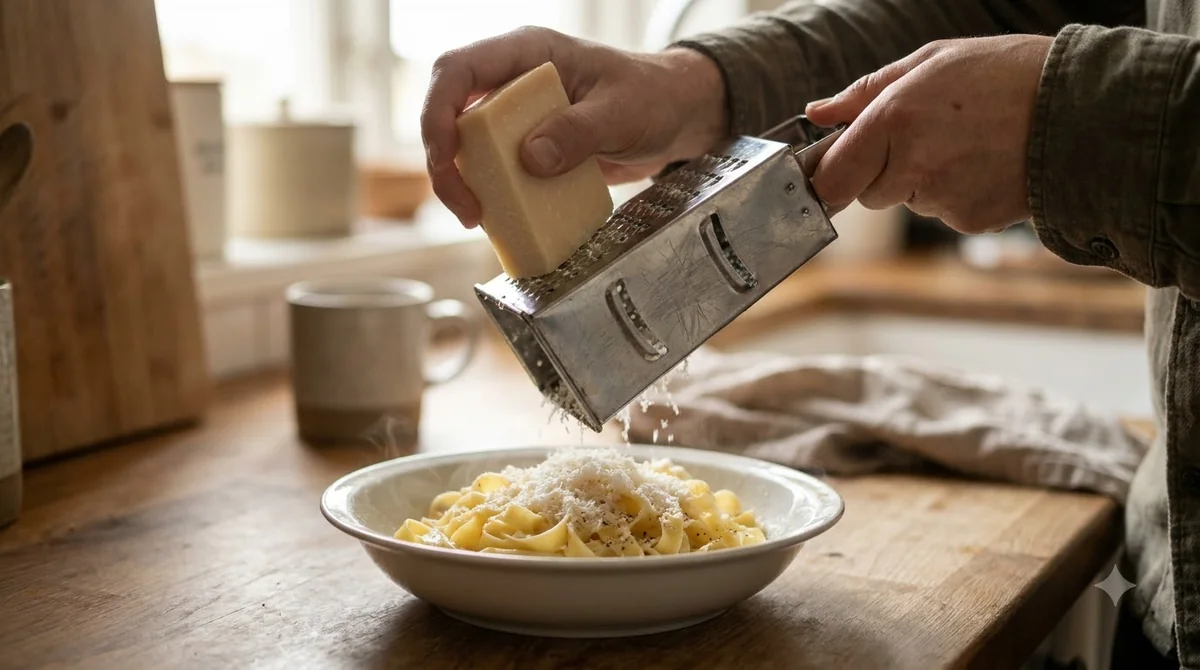

To learn how to use a rotary cheese grater, load a firm piece of hard cheese into the small compartment, set the grater on a flat surface, and turn the crank at a steady pace. The crank turns a drum fitted with grating blades, so the cheese falls onto your plate or pasta in fine shreds. The grater works best with hard cheese and stays easy to clean when you brush it right after use.
Why a rotary grater suits hard cheese
A rotary grater is designed for hard cheeses that you grate directly over pasta and salads. Wisconsin Cheese’s guide to cheese graters describes the rotary design as ideal for this job, and it notes that the tool gives extra protection for your fingers from the sharp edges.
The crank does most of the work, so a rotary grater is quick when you need a small pile of cheese on a plate. It is less practical when you need large amounts of shredded cheese for a lasagna or a pizza, where a box grater or a food processor may save time. Before you learn how to use a rotary cheese grater, decide whether you will grate small amounts often or large amounts once in a while.
The main benefits of a rotary model are simple:
- You can grate at the table, directly over the dish.
- Your fingers stay farther from the blades than they would on a flat grater.
- Cleanup usually means one drum and a small compartment.
How to use a rotary cheese grater, step by step
Learning how to use a rotary cheese grater takes six steps, and the method is the same on most models. Load the cheese, hold the body steady, and turn the handle evenly until only a small piece is left.
- Set the grater on a flat, stable surface, or hold the body firmly with one hand.
- Open the compartment and place a firm piece of hard cheese inside. Do not overfill it.
- Close the compartment so the cheese sits against the drum.
- Turn the crank with steady, even pressure. Let the drum do the cutting rather than pushing hard.
- Stop when a small piece remains, then save it for cooking or grate it separately.
- Tap or brush away any cheese that clings to the outside before you set the grater down.
If you are new to the tool, practice with a small block of hard cheese first. Keep your free hand clear of the drum at all times. The cheese should never need your fingers to push it toward the blades. If the crank feels stiff, stop and check that the cheese is firm and that nothing is blocking the drum. Your model’s manual will show the exact loading and disassembly steps, because compartment sizes and handle designs differ between brands.
Many people also ask whether the cheese should be cold or at room temperature. Neither source reviewed for this guide gives a temperature, so follow the storage guidance on the cheese package and check your model’s manual for any advice on handling.
Which cheeses work and which clog the grater
Hard cheeses such as Parmesan work best in a rotary grater, while soft cheeses like mozzarella or cheddar can clog the fine blades. Wisconsin Cheese notes that fine blades can get clogged when used with soft cheese, so choose a different tool for soft or semi-soft cheese. For a closer look at a classic hard cheese, see what is Pecorino Romano.
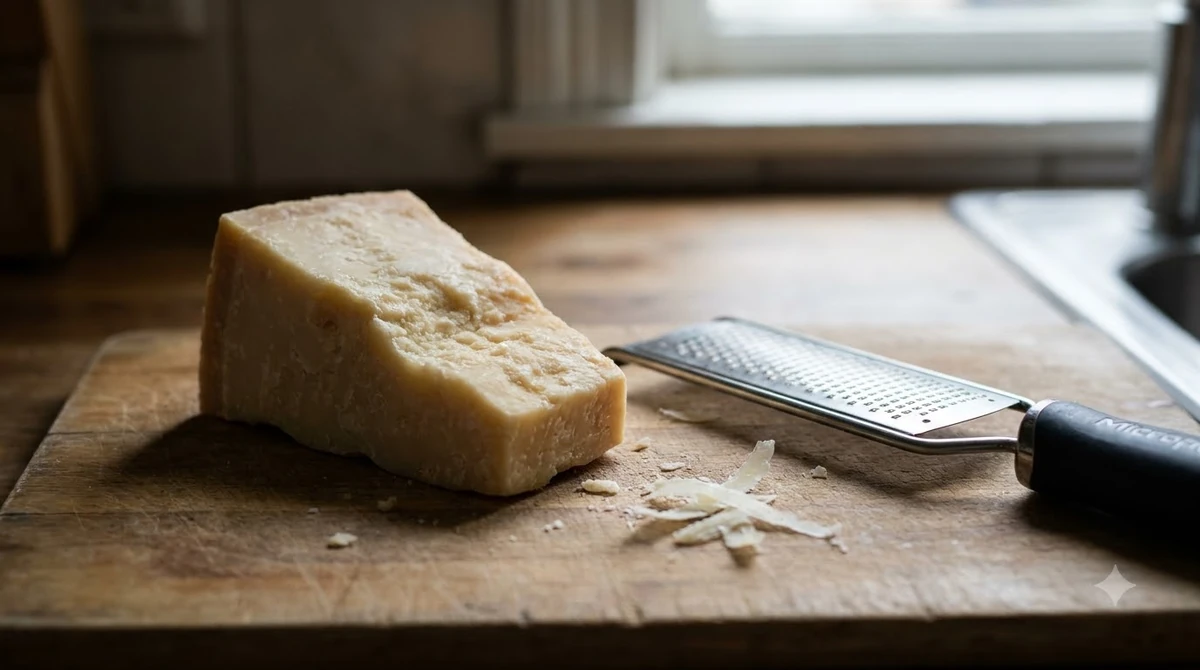
| Cheese type | Fit for a rotary grater | Why |
|---|---|---|
| Parmesan and aged hard cheese | Good | Firm enough to hold its shape in the drum |
| Pecorino | Good, if firm | Hard texture, similar to Parmesan |
| Mozzarella and cheddar (soft or semi-soft) | Poor | Can clog the fine blades |
If you only have a soft cheese on hand, a box grater or a knife is the better choice. Check the label on your grater, because some manufacturers list the cheeses their models handle. A quick look at the product description before you buy will tell you whether the model is meant for hard cheese only.
Rotary grater versus box grater for cheese
A rotary grater is quick for a small amount of hard cheese, while a box grater is steadier and gives you several shred sizes. Wisconsin Cheese describes the box grater as a much more stable tool that lets you apply more force when shredding cheese.
The box grater has four sides with different blades. Its fine holes suit hard cheese such as Parmesan, and its coarse holes handle larger pieces for pizza or salad toppings. If you want to learn how to use a rotary cheese grater for daily table use and still have a second tool for bulk shredding, the two work well together. If you are shopping, our roundups of the best rotary cheese graters and the best Parmesan cheese graters compare models.
| Criteria | Rotary grater | Box grater |
|---|---|---|
| Best for | Hard cheese over pasta or salad | Several cheeses and shred sizes |
| Stability | Needs a steady hand on a flat surface | More stable, allows more force |
| Cleaning | One drum and compartment | Several sides with different blades |
Cleaning your rotary grater after use
Clean the drum right after use, before the cheese hardens on the blades. Wisconsin Cheese advises cleaning immediately after use, because dried cheese sticks to the blades and is harder to remove later.
- Open the compartment and brush out loose cheese bits while the grater is still dry.
- Use a pastry brush to clear stubborn bits in the drum. Tasting Table’s pastry brush tip says the brush can dislodge hard-to-reach bits, and that the method works best when the food and grater are dry.
- Rinse the parts and dry them fully before you put them away.
Wisconsin Cheese also recommends brushing off cheese before any dishwasher cycle, even when the grater is labeled dishwasher safe. Check whether your model’s parts come apart, because removable parts make cleaning easier. Neither source gives a water temperature, so follow the care instructions in your model’s manual before you use hot water or a dishwasher.
Common mistakes and how to avoid them
Most problems with a rotary grater come from the cheese, the loading, or the cleaning routine, and each one is easy to avoid. Watch for these common errors:
- Grating soft cheese, which can clog the fine blades.
- Overfilling the compartment, which can block the drum.
- Leaving cheese on the blades overnight, which makes it harder to remove.
- Pushing the cheese against the blades with your fingers instead of letting the crank do the work.
Frequently Asked Questions
Can you use a rotary cheese grater for soft cheese?
Not well, and this is the most important limit when you learn how to use a rotary cheese grater. Wisconsin Cheese notes that fine blades can get clogged when used with soft cheese such as mozzarella or cheddar. Choose hard cheese for a rotary grater, and use a box grater or a knife for softer cheeses.
Is a rotary cheese grater dishwasher safe?
The answer depends on your model. Brush out the cheese first, because Wisconsin Cheese advises brushing even on dishwasher-safe graters. Check the care instructions that came with your grater.
How do I clean stuck cheese out of the drum?
Use a pastry brush while the grater is dry, because brushing is the simplest first step. Tasting Table describes this method as effective for hard-to-reach bits, and it works best before the residue dries and hardens.
Is a rotary grater safer than a box grater?
Wisconsin Cheese notes that a rotary grater gives extra protection for your fingers from the sharp edges. A box grater is steadier, so the choice depends on the job. Either way, keep a steady hand and never push cheese toward the blades with your fingers.
How much cheese should I load at once?
Load a small amount, enough to fill the compartment without pressing it. Overfilling can block the drum. The exact capacity varies by model, so check your manual for the recommended amount.
Once you understand how to use a rotary cheese grater, it becomes a practical tool for fresh hard cheese at the table. Load firm cheese, turn the crank evenly, and clean the drum as soon as you finish. Keep soft cheese for another tool, and your grater will stay easy to clean. More tool guides are in our Gear & Pantry guides. Read the manual once, and the steps will become second nature.
 7 min readGear & PantryRotary Cheese Grater: How It Works, How to Choose One and Use ItUpdated Nov 16, 2026
 8 min readGear & PantryParmesan Cheese Grater: How to Choose, Use and Store OneUpdated Nov 17, 2026
 10 min readGear & PantryHow to Use a Pizza Screen for Crisp, Even Pizza at HomeUpdated Nov 10, 2026
 8 min readGear & PantryHow to Use an Infrared Thermometer for Accurate Readings at HomeUpdated Nov 10, 2026
 7 min readGear & PantryHow to Use a Pizza Cutter: Step-by-Step Guide for Clean SlicesUpdated Nov 10, 2026
 8 min readGear & PantryHow to Use a Gnocchi Board: Step-by-Step GuideUpdated Nov 10, 2026