
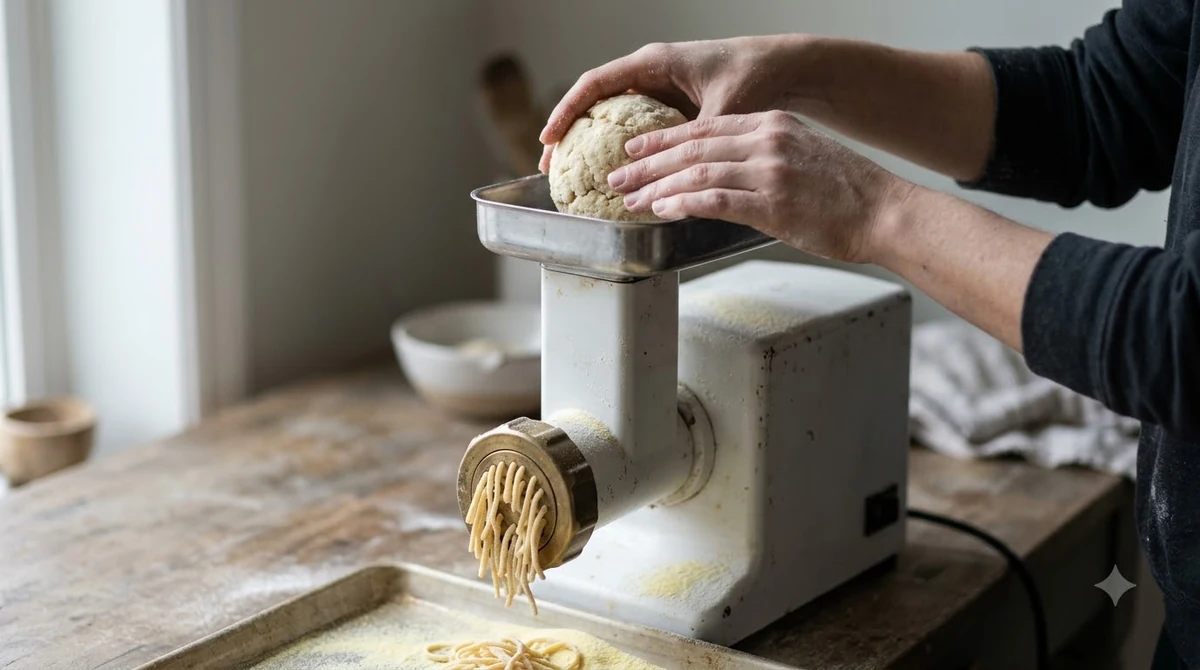

The main KitchenAid Artisan attachments for pasta are the pasta roller and the pasta press, and both connect to the same power hub on the mixer. Once you know how that hub opens, attaching either tool takes only a few steps. The sections below explain the steps, the specs and how to check fit before you buy.
Before you buy any of the KitchenAid Artisan attachments, check how your hub cover opens and confirm your exact model number. KitchenAid’s official pages do not publish a full Artisan-specific list, so the manufacturer wording is the best check available.
How Attachments Connect to an Artisan Mixer
Every KitchenAid Artisan attachment seats in the mixer’s hub, and the hub cover type decides how you open it before you attach anything. Turn the mixer off first, then follow the steps below, which apply to every kitchenaid artisan attachments setup covered in this guide.
- Turn the mixer to speed 0 and unplug it.
- If the hub has a hinged cover, flip it up to open. If it has a removable cover, turn the attachment knob counter-clockwise to remove it.
- Insert the attachment shaft into the hub so the power shaft fits the square socket.
- Line up the pin on the housing with the notch in the hub rim, then tighten the hub knob until the attachment is fully secure.
The KitchenAid UK assembly FAQ gives these steps for the pasta press, and the roller’s product tips describe the same hub insertion check.
The Pasta Roller Attachment
Among kitchenaid artisan attachments, the pasta roller turns dough into sheets 14 cm wide, with eight thickness settings, so you can step down from a thick sheet to a very thin one in small changes.
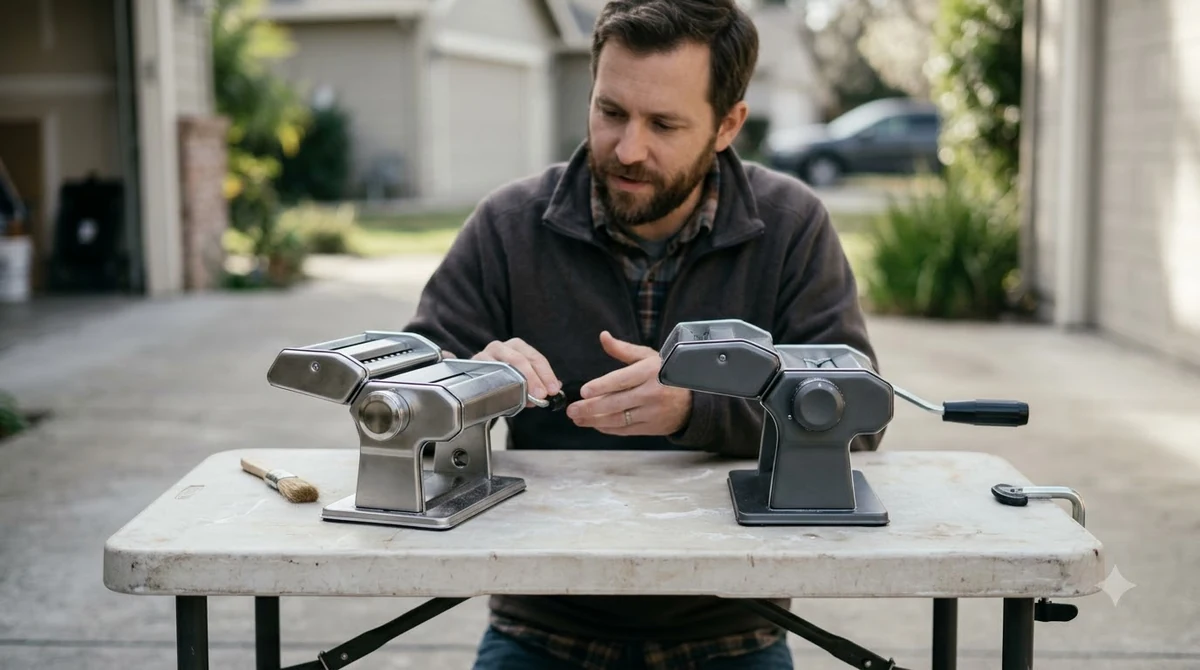
Cutter widths come from the cutter set. Fettuccine strands are 6.5 mm wide, and spaghetti, thin fettuccine or linguine fini strands are 2 mm wide, according to KitchenAid’s pasta cutter and roller tips.
The single pasta roller, listed as KSMPSA, comes with a cleaning brush, and KitchenAid sells the cutters separately. The three-piece set, listed as KSMPRA, is the option that includes the cutters. Among kitchenaid artisan attachments, the single roller covers flat sheets only.
The single pasta roller is labeled as made for all KitchenAid stand mixers, so a KitchenAid Artisan is the expected fit. Confirm this with the model number on your mixer, because the labeling does not name each model.
Since the sheets are 14 cm wide, cut dough into pieces that fit that width before you feed it in. Our best KitchenAid pasta roller attachments roundup compares other roller sets, and our guide to making lasagna with a KitchenAid pasta roller shows a full batch with kitchenaid artisan attachments.
The Pasta Press Attachment
The pasta press is approved for use with all KitchenAid household stand mixers, and it comes with six plates for shapes such as fusilli and rigatoni.
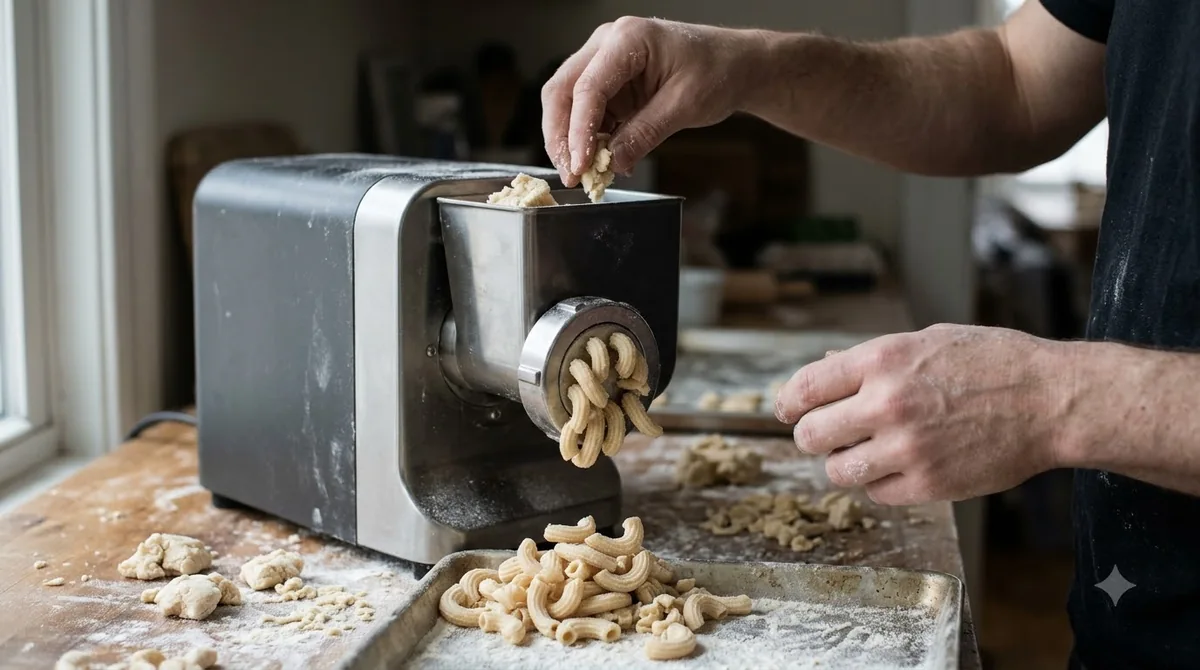
The press box includes a housing, cutter, auger, pasta ring, combo tool, cleaning brush and storage case. Each plate sits over the auger and locks into notches in the housing, so you swap shapes by changing the plate.
- Spaghetti plate
- Bucatini plate
- Rigatoni plate
- Fusilli plate
- Large macaroni plate
- Small macaroni plate
The manual says not to feed dough by hand and to always use the combo tool to push food. It also says to keep fingers out of the feed and discharge openings, and to unplug the mixer before putting on or taking off parts.
The manual has separate sections for changing the pasta plates and for loosening the pasta ring, so read those before your first batch. It also includes recipes such as basic egg noodle pasta, whole wheat pasta and spinach pasta.
KitchenAid lists the press under model 5KSMPEXTA on its UK pages, so match that number when you compare it with your own mixer’s documentation. The manual also has its own Care and Cleaning section and a section on ordering accessories and replacement parts, which are useful if a plate or part goes missing. For care of the press itself, read our guide on how to clean a KitchenAid pasta extruder.
KitchenAid Artisan Attachments at a Glance
The roller makes flat sheets and cut strands, while the press makes shaped pasta, and both follow the same hub steps.
| Attachment | What it makes | Key spec |
|---|---|---|
| Pasta roller (KSMPSA) | Flat sheets | 14 cm sheets, 8 thickness settings |
| Pasta cutter set | Fettuccine and spaghetti strands | Fettuccine 6.5 mm, spaghetti 2 mm |
| Pasta press (KPEXTA) | Shaped pasta from six plates | Six plates, combo tool |

KitchenAid KSMPRA 3-pc Pasta Roller/Cutter Set
Pros & ConsViewHide
Reasons to buy
- Roller and cutter attachments for KitchenAid stand mixers
- Rolls even sheets without hand cranking
- 88% of 9K Amazon ratings are 5-star
Reasons to avoid
- Needs a compatible KitchenAid stand mixer
- Rolls and cuts the dough, but does not fill or fold tortellini
- One of the costlier tools in this guide

KitchenAid KSMPEXTA Gourmet Pasta Press Attachment
Pros & ConsViewHide
Reasons to buy
- Six quick-change discs: spaghetti, bucatini, rigatoni, fusilli, large and small macaroni
- Built-in wire cutter and a storage case
- Stainless steel cleaning tool included
Reasons to avoid
- Needs a KitchenAid stand mixer, sold separately
- Takes more cleanup than a roller
- Premium-priced attachment
Which KitchenAid Artisan Attachments Fit Your Model
KitchenAid’s pasta press manual says it is approved for all KitchenAid household stand mixers, but the official pages checked for this guide do not list each Artisan model.
Find the exact model number on your mixer, then compare it with the manual or product page for that model before you order any kitchenaid artisan attachments. Use these checks to confirm fit:
- Confirm the mixer is a KitchenAid household stand mixer.
- Check whether the hub cover is hinged or removable, since the steps differ.
- Keep your sales receipt, because the manual asks you to keep proof of purchase for in-warranty service.
The roller’s product tips also describe hub steps by mixer type, with separate instructions for tilt-head and bowl-lift mixers. That makes the hub cover check a useful first step, even when a model list is missing.
The press manual also warns that accessories not recommended or sold by KitchenAid may cause fire, electric shock or injury. Stick to KitchenAid-made attachments for the kitchenaid artisan attachments you add, and return the mixer to an authorized service center if it malfunctions or is damaged.
Choosing Between the Roller and the Press
When you compare kitchenaid artisan attachments, choose the pasta roller if you mainly want flat sheets for lasagna, ravioli or cut noodles, and choose the press if you want shaped pasta such as fusilli or rigatoni.
Both attachments use the same hub, so you can swap them on one mixer. The trade-off is that you change attachments for each job, and each one needs its own storage space and cleaning time.
A simple way to decide is to list the shapes you cook most often. If most of your dishes are sheet-based, start with the roller. If you cook shapes such as fusilli, rigatoni or macaroni often, start with the press.
The two kitchenaid artisan attachments for pasta work on different inputs. The roller works on dough sheets, while the press pushes dough through a plate, so each one suits a different kind of dish.
The press is a poor fit for sheet pasta, and the roller does not make extruded shapes. If your menu includes both, plan for two attachments and a clear setup routine before you start.
Cleaning After Pasta Making
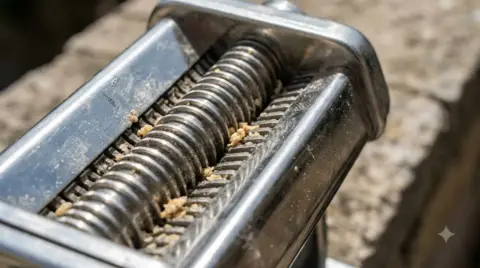
Clean these kitchenaid artisan attachments the same way: let the attachment air dry for about an hour, then brush off dried dough with the included cleaning brush.
- Let the attachment air dry for about an hour.
- Brush off dried dough with the included cleaning brush.
- If dough is stuck, tap the attachment with your hand.
- Polish the roller and cutters with a soft, dry cloth.
KitchenAid says not to immerse the pasta roller in water or wash it in the dishwasher. It also says not to use a knife to remove excess dough, and not to run a dish towel through the rollers. If the roller jams or stops working, our KitchenAid pasta roller not working troubleshooting guide is the next stop for your kitchenaid artisan attachments.
Frequently Asked Questions
Which KitchenAid Artisan attachments are made for pasta?
The pasta roller and the pasta press are the two main pasta attachments. The press manual says it is approved for all KitchenAid household stand mixers, so confirm your model number before you buy.
Does the pasta roller make spaghetti?
The roller makes spaghetti-width strands when you use the cutter set. KitchenAid lists spaghetti, thin fettuccine or linguine fini at 2 mm wide, and fettuccine at 6.5 mm wide.
Can I feed dough into the pasta press by hand?
No. The manual says not to feed dough by hand and to always use the combo tool to push food into the press. It also says to keep fingers out of the feed and discharge openings, so the combo tool is the safer way to guide dough into the press.
Do I need to turn the mixer off before attaching?
Yes. KitchenAid’s UK assembly guidance says to turn the mixer to speed 0 and unplug it before attaching the pasta press, and the same caution applies to the roller.
Can the pasta roller go in the dishwasher?
No. KitchenAid says not to immerse the pasta roller in water or wash it in the dishwasher. Air dry it and brush off the dough instead, and treat the kitchenaid artisan attachments the same way.
If you own a KitchenAid Artisan, start with the hub check and the model number, then pick the pasta roller for flat sheets and cut strands, or the press for shaped pasta. With the right hub check, kitchenaid artisan attachments are simple to set up and clean. Clean each attachment dry, because KitchenAid does not recommend water or the dishwasher. Keep your sales receipt with the manual, since the manual asks for proof of purchase for in-warranty service, and record the model number there as well.
 7 min readBy Use & ModelKitchenAid Bowl Lift Attachments: Which Pasta Tools Fit Your MixerUpdated Nov 7, 2026
 8 min readBy Use & ModelKitchenAid Artisan Mini Attachments: Which Pasta Tools FitUpdated Nov 7, 2026
 8 min readBy Use & ModelKitchenAid Heavy Duty Attachments: Which Ones Fit Your MixerUpdated Nov 15, 2026
 7 min readBy Use & ModelKitchenAid Pro 5 Plus Attachments: Pasta Press Fit, Setup and SpeedsUpdated Nov 8, 2026
 8 min readBy Use & ModelKitchenAid Pro 600 Attachments: What Fits and What to CheckUpdated Nov 8, 2026
 8 min readBy Use & ModelKitchenAid Classic Attachments: Which Ones Fit and What Each DoesUpdated Nov 15, 2026