
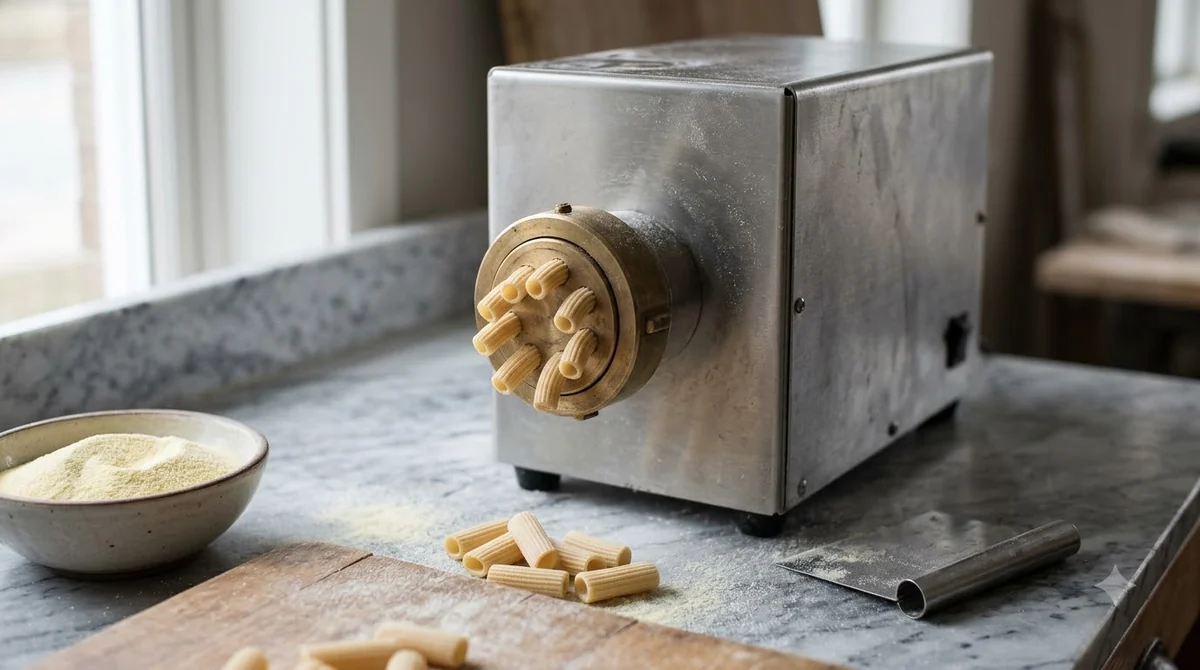

A pasta machine for rigatoni has to be an extruder fitted with a rigatoni die or shaping disc, because rigatoni is a ridged tube that a hand-crank roller cannot form. Look for an extruder that includes a rigatoni plate or sells one as a separate accessory for your model.
Choose by how often you cook, how much cleaning you accept, and whether you already own a stand mixer that can take a pasta attachment. The sections below explain what a pasta machine for rigatoni needs and how to check a model before you buy.

KitchenAid KSMPEXTA Gourmet Pasta Press Attachment
Pros & ConsViewHide
Reasons to buy
- Six quick-change discs: spaghetti, bucatini, rigatoni, fusilli, large and small macaroni
- Built-in wire cutter and a storage case
- Stainless steel cleaning tool included
Reasons to avoid
- Needs a KitchenAid stand mixer, sold separately
- Takes more cleanup than a roller
- Premium-priced attachment

MARCATO Made in Italy Regina Extruder Pasta
Pros & ConsViewHide
Reasons to buy
- Hand crank, so no power is needed
- Comes with 5 dies for bucatini, fusilli, maccheroni, maccheroncini and rigatoni
- Made and assembled in Italy
Reasons to avoid
- 3.6 average rating, the lowest in this group
- Not dishwasher safe: let residue dry and clean with a dry brush
- Needs a table edge to clamp onto
What Rigatoni Needs From a Machine
Rigatoni is a large, straight-cut tube with ridges on the outside and a smooth inside, so the machine must push dough through a shaped opening instead of flattening it into sheets.
CooksInfo describes rigatoni as big tubes that are ridged on the outside and smooth inside, and says the ridges help the pasta grip chunky sauces. The Pasta Project gives the usual length as 4.5 to 6 cm (1.8 to 2.3 inches), and De Cecco’s version measures about 45 mm long.
The ridges also matter for the machine. The Pasta Project notes that ridges became common after industrial pasta production began in the 19th century, and that traditional homemade pasta was usually smooth. The same source confirms that rigatoni dies are sold for domestic pasta machines, so a ridged shape is not limited to factory equipment.
Encyclopedia entries on pasta explain the core rule: the size and shape of the die determine the shape of extruded pasta. For rigatoni, the die or disc is the part that decides whether you get a tube, so it is the first thing to check on any pasta machine for rigatoni. Our rigatoni pasta guide covers the shape itself.
Pasta Machine for Rigatoni: Roller or Extruder
A hand-crank roller cannot make rigatoni, but an extruder with a rigatoni die can, so the real choice is whether the machine has an extrusion stage at all.
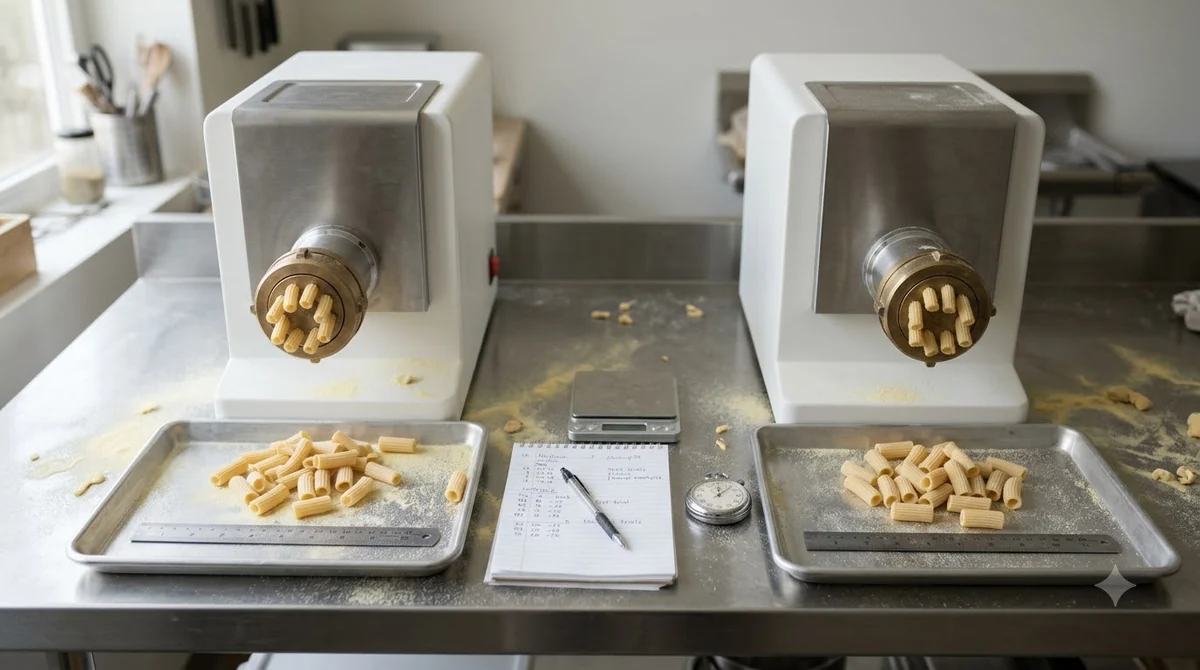
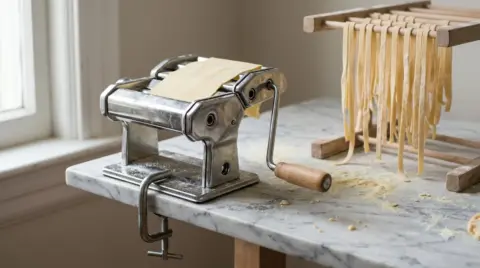
Most manual pasta machines are rollers, so a typical hand-crank pasta machine for rigatoni does not exist. America’s Test Kitchen notes that hand-cranked machines remain the most prevalent and affordable option, and that the most common roller width is 150 mm, about 6 inches. A roller flattens dough into sheets, and its cutter produces ribbons such as spaghetti, tagliatelle and angel hair, as described in University of Maryland pasta notes. Sheets and ribbons suit fettuccine and ravioli, but they are not tubes.
An extruder pushes dough through a die. Electric models and stand-mixer attachments both work this way. The KitchenAid Pasta Press, for example, is a mixer attachment with a set of plates, and its booklet lists a rigatoni plate with a cut length of about 1.5 inches (4 cm).
| Feature | Roller machine | Extruder with rigatoni die |
|---|---|---|
| Can make rigatoni | No | Yes |
| Main output | Sheets and ribbons | Tubes, spirals and short shapes |
| Typical shapes | Fettuccine, tagliatelle, ravioli sheets | Rigatoni, penne, macaroni |
| How dough moves | Rolled between rollers at set thicknesses | Pushed through a die and cut at the exit |
| What to clean | Rollers and cutter, brushed or wiped | Auger, die or plate, pasta ring and cutter |
| Stand mixer needed | No | Only for mixer attachments |
Cut length matters as well in a pasta machine for rigatoni. Check that the cutter gives you a piece near 4 to 6 cm, the usual rigatoni length, and that the length can be adjusted rather than fixed. Penne is another extruded tube, and penne versus rigatoni explains how the two differ.
Disc Sets and Attachments
A pasta machine for rigatoni is only as useful as its discs, so buy a machine that includes a rigatoni plate, or buy the plate separately, and confirm it matches your model number before ordering.
Philips sells an accessory kit, model HR2491/00, with two shaping discs, Macaroni and Rigatoni, for its Avance pasta maker. The Philips accessory sheet also lists detachable parts that make assembly and cleaning easier.
Accessories for a pasta machine for rigatoni are model specific. A disc that fits one maker will not necessarily fit another, so read the compatibility list in the manual before ordering. Retailer listings often name compatible models, but they are not always consistent, so the manufacturer’s manual is the better source.
For stand mixers, the KitchenAid Pasta Press uses a plate that sits under a pasta ring. You change plates by unscrewing the ring, and the plate set includes a rigatoni plate.
Dough That Works in an Extruder
Use a firm dough that holds together when pinched, whichever pasta machine for rigatoni you pick. A wet dough can clog the die, and a crumbly one will not extrude cleanly.
KitchenAid’s pasta dough advice describes a good dough as one that stays together and does not stick to your fingers. If it is too dry, add water one tablespoon at a time; if it is too wet, add flour.
The Pasta Press booklet asks for dough in walnut-size pieces fed into the hopper, so the dough should move through on its own. Use the combo tool only when dough is caught, rather than pushing harder.
Give the mixer a break after heavy use. The booklet advises resting the mixer for at least one hour after extruding two consecutive pasta dough recipes.
Once cut, check the finished pasta. Dried pasta is about 12 percent moisture, while fresh pasta cooks in roughly half the time of dried. For commercial rigatoni, DeLallo lists a cook time of 12 to 13 minutes on its package, which is a useful benchmark when you test a batch of dried homemade pasta.
Safety and Cleaning
Unplug the mixer and set it to speed 0 before attaching or removing the press of a pasta machine for rigatoni, and never put the housing in water. KitchenAid’s UK FAQ gives the same step for attaching the press.
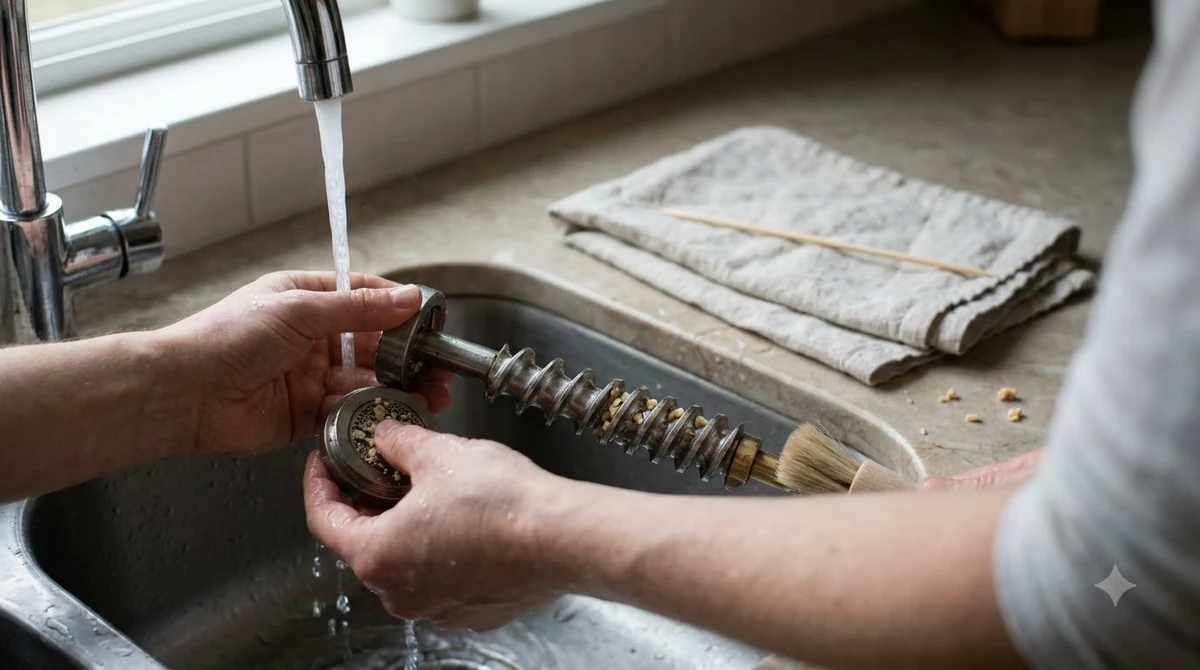
KitchenAid Product Help describes removal: turn off and unplug the mixer, unscrew the pasta ring (use the wrench side of the combo tool if it is tight), lift out the plate, then use the combo tool hook to pull out the auger.
Cleaning follows the same logic, and how to clean a KitchenAid pasta extruder gives a longer routine. The booklet says the housing never goes in the dishwasher or under water. The auger, pasta ring and combo tool are dishwasher safe, while the cutter and plates should be washed by hand. Let dough dry overnight on the plates before separating it, and clean with the brush provided rather than metal objects.
Checklist Before You Buy
Run through these checks before you buy a pasta machine for rigatoni or spend money on accessories.
- Does the pasta machine for rigatoni extrude? If it only rolls, a rigatoni shape is out of reach.
- Is a rigatoni plate or disc included, or sold for your exact model?
- Does the model number match the compatibility list in the manual?
- Can you adjust the cut length to roughly 4 to 6 cm?
- Can you reach and clean the die, auger and cutter without difficulty?
- If you use a stand mixer, does your mixer take the attachment?
If several answers are no, a roller machine for fettuccine and ravioli may suit you better than a rigatoni-focused extruder.

Frequently Asked Questions
Can a hand-crank pasta machine make rigatoni?
No, unless it has an extrusion attachment. A roller flattens dough into sheets and cuts ribbons, while rigatoni needs an extruder with a rigatoni die or disc.
What is the difference between rigatoni and ziti?
Rigatoni is ridged on the outside, while ziti is smooth. Both are hollow tubes, but the shapes are different, so a rigatoni die does not make ziti. See ziti versus rigatoni for the full comparison.
How long should homemade rigatoni be?
Commercial rigatoni is usually 4.5 to 6 cm long, according to The Pasta Project. Choose a machine whose cutter can match that range. Wider tubes such as paccheri need a different die; paccheri versus rigatoni shows the size gap.
Can I use a rigatoni disc on another brand?
Usually not. Discs for a pasta machine for rigatoni are built for specific machines, so check the compatibility list in your manual before buying.
Which dough should I use in a pasta machine for rigatoni?
Start with the dough recipe in your manual and use the pinch test. Adjust with small amounts of water or flour rather than changing the recipe all at once.
Choose a pasta machine for rigatoni by what else you make. If rigatoni is one of many extruded shapes, check how many plates come in the set. If you mainly make sheets for fettuccine and ravioli, a roller machine is the better buy, and rigatoni can wait until you add an extruder.
 9 min readBy Use & ModelPasta Machine for Fresh Pasta: What to Check Before You BuyUpdated Nov 17, 2026
 7 min readBy Use & ModelPasta Machine for Egg Noodles: What to Check Before You BuyUpdated Nov 8, 2026
 8 min readBy Use & ModelPasta Machine for Ramen Noodles: What to Check Before You BuyUpdated Nov 10, 2026
 8 min readBy Use & ModelPasta Machine for Ravioli: What to Look For Before You BuyUpdated Nov 10, 2026
 8 min readBy Use & ModelPizza Oven for Beginners: What to Check Before You BuyUpdated Nov 16, 2026
 8 min readBy Use & ModelPizza Oven for Indoor Use: What to Check Before You BuyUpdated Nov 16, 2026