
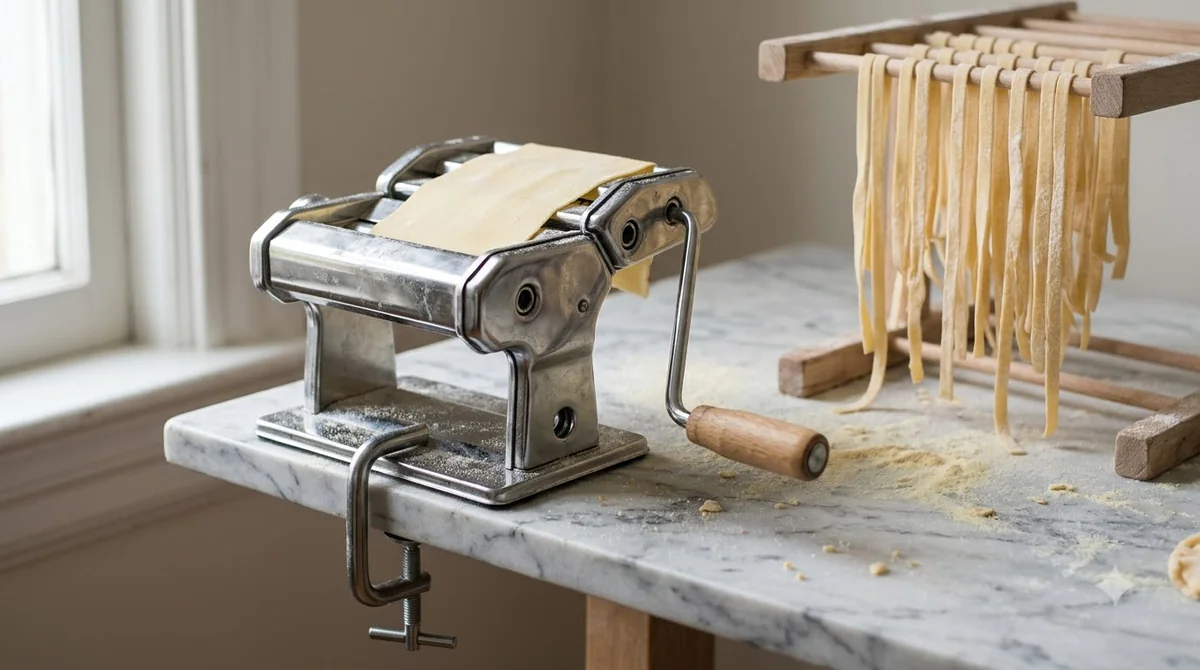

A pasta machine for fresh pasta is a roller that flattens dough into thin sheets, and many models also cut those sheets into noodles. Each machine has two steel rollers with an adjustable gap, so you thin the dough step by step instead of in one pass.
Five points cover most of the decision when you buy a pasta machine for fresh pasta: how the machine is powered, how far the rollers open, how the dough should feel, how good the cutter is, and which mistakes to avoid.

MARCATO Atlas 150 Machine, Made in Italy, Red
Pros & ConsViewHide
Reasons to buy
- Made in Italy hand-crank pasta machine rolling dough in steps
- Includes a pasta cutter and hand crank
- Fits Marcato attachments and the optional motor
Reasons to avoid
- Only rolls and cuts the sheet; tortellini are still shaped by hand
- Takes more counter and storage space than a hand cutter
- Fixed to a countertop edge, so check clamp room

Imperia IPasta Classic Pasta Maker
Pros & ConsViewHide
Reasons to buy
- Made in Italy with chromed steel cutting rollers
- Makes 150 mm sheets, 6.5 mm fettuccine and 2 mm tagliolini
- Six roller thickness settings from 0.5 mm to 5 mm
- Clamp slot accepts a separate motor
Reasons to avoid
- Manual crank, so you turn it for every pass
- Only three cut widths in the box
- Motor is a separate purchase

Philips 7000 Series Pasta Maker
Pros & ConsViewHide
Reasons to buy
- Mixes, kneads and extrudes automatically, ready in under 10 minutes per the listing
- Makes up to 8 portions in one go
- Comes with 8 shaping discs
- Parts are listed as dishwasher-safe
Reasons to avoid
- Costs far more than a manual roller
- Needs permanent counter space
- 11% of ratings are 1-star

KitchenAid KSMPRA 3-pc Pasta Roller/Cutter Set
Pros & ConsViewHide
Reasons to buy
- Roller and cutter attachments for KitchenAid stand mixers
- Rolls even sheets without hand cranking
- 88% of 9K Amazon ratings are 5-star
Reasons to avoid
- Needs a compatible KitchenAid stand mixer
- Rolls and cuts the dough, but does not fill or fold tortellini
- One of the costlier tools in this guide
How a Pasta Machine for Fresh Pasta Works
A pasta machine thins fresh dough by passing it through the rollers at narrower settings, starting at the widest one. Each pass takes the sheet a little thinner until it is ready for the shape you plan to cut. Every pasta machine for fresh pasta works on this same principle, so the real differences lie in the settings and the cutter. If you are still weighing machine types, how to choose a pasta maker covers the main options.
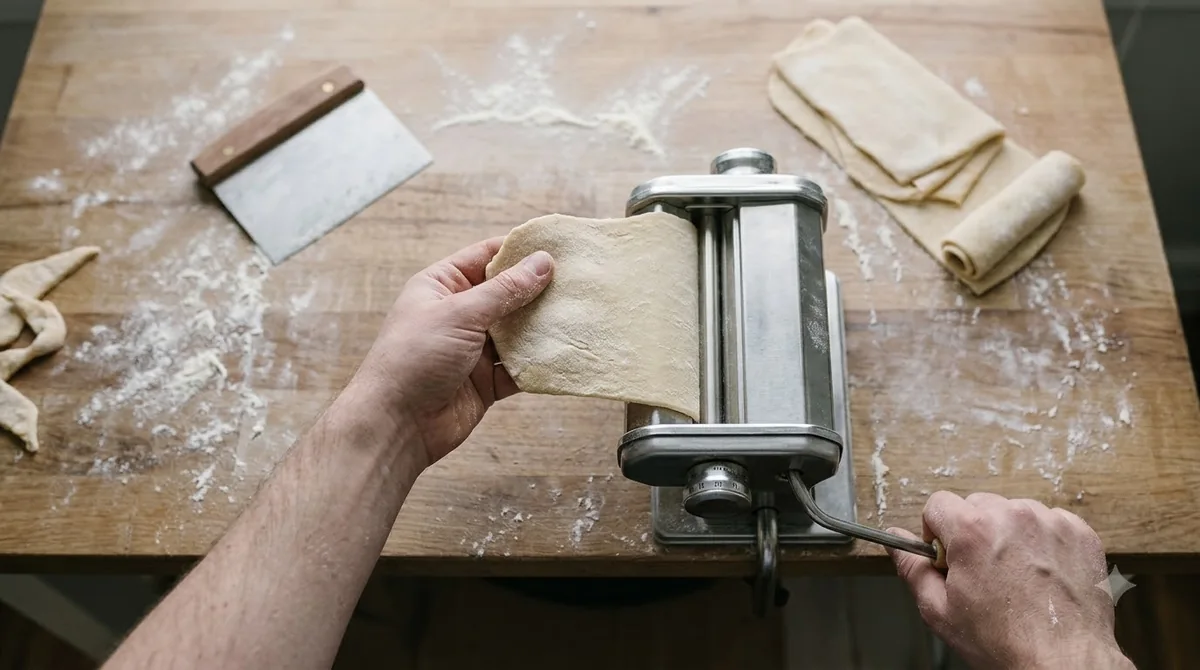
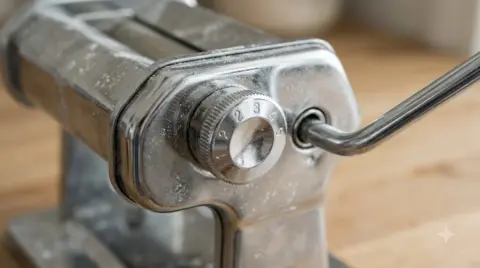
According to the 2022 America’s Test Kitchen review of manual machines, you clamp the base to a table or counter, turn the crank to rotate two rollers, and feed the dough through. A side knob sets the gap between the rollers, and you step down to a narrower setting after each pass. Our guide to using a pasta machine shows the full routine.
Most of the machines in that review had rollers about 150 millimeters (about 6 inches) across, which is the most common sheet width. A wider roller gives you a wider sheet, so each pass handles more dough.
Manual or Electric: Which Suits Fresh Pasta
A hand-cranked machine is the most common and affordable choice for home fresh pasta, according to America’s Test Kitchen. The reviewers said hand-cranked models remain the most prevalent and affordable option, although electric models are becoming more common.
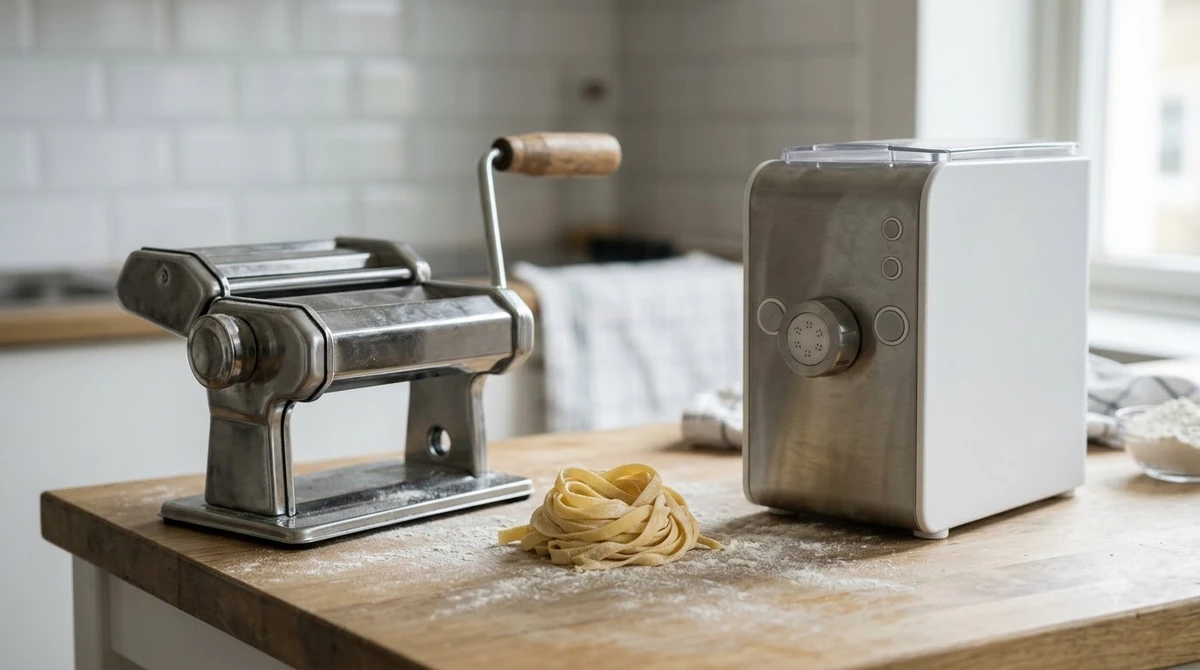
If you only want a pasta machine for fresh pasta now and then, a manual model is simpler to store and clean than an electric one with more parts. A hand crank keeps you in control of every pass. You can feel when the sheet is sticking or uneven and slow down before the dough tears.
Electric machines feed the dough for you, which saves effort if you roll large batches. An electric pasta machine for fresh pasta still needs the same dough and the same rest. The America’s Test Kitchen review covered manual machines only, so for any electric model, check the manufacturer’s specifications for its thickness range and cutter options before you buy.
Roller Width and Thickness Settings
The number of thickness settings mattered less than how far the rollers open and how close they close, according to America’s Test Kitchen. The reviewers said the number of settings “wasn’t critical,” while the range between the widest and narrowest gap mattered more.
The table lists the machines from the 2022 review, with their settings, thinnest setting and the drawbacks the reviewers noted.
| Machine | Settings | Thinnest setting | Drawback noted |
|---|---|---|---|
| Marcato Atlas 150 | 10 | 0.02 in | None noted in the review |
| Imperia by CucinaPro | 6 | 0.03 in | Needs both hands to adjust the thickness knob, and its range is slightly narrower |
| Fox Run | 7 | 0.08 in | Cutter did not always cut through, and the thinnest setting may be too thick for ravioli or wonton skins |
| Weston Traditional Style | 7 | 0.04 in | Rollers do not open as wide, the cutter was inconsistent, and the knob was hard to read |
The thinnest setting is the first number to check on any pasta machine for fresh pasta, because it sets the limit for filled shapes. Look at it before the number of settings. A narrowest gap of 0.08 inch may leave filled pasta too thick, as the reviewers noted for the Fox Run machine. If you plan to make ravioli or wonton skins, a narrower minimum gap matters more than the count of settings on the dial.
Also check how wide the rollers open. For a pasta machine for fresh pasta, the opening range decides whether you can start from a workable sheet or must flatten the dough by hand first. A machine that does not open wide enough can force you to hand-roll a thick sheet first, which the Weston model in the review did not avoid.
Preparing the Dough You Feed Through the Rollers
Fresh egg dough should rest before rolling, and the recipe by Lidia Bastianich calls for at least one hour at room temperature. If you refrigerate it, the same recipe says it can keep for up to one day and should stand about an hour at room temperature before you roll it. If you are weighing fresh against boxed pasta, fresh pasta versus dried pasta explains the difference.
The recipe calls for 3 cups of unbleached all-purpose flour, or as needed, with 4 large eggs, 1 teaspoon of extra virgin olive oil, half a teaspoon of salt and warm water as needed. Mix the eggs, oil and salt, combine them with the flour until a rough dough forms, and knead it by hand or in a food processor.
Knead for 5 to 10 minutes until the dough is smooth, silky and elastic. The PBS recipe notes that the job takes longer if you mix by hand, so plan extra time if you do not have a processor.
KitchenAid UK suggests a shorter rest of 10 to 15 minutes before rolling, which differs from the one-hour rest in the PBS recipe. Use the rest time from the recipe you follow, and cover the dough while it waits so it does not dry out. A separate fresh pasta dough recipe on this site gives a full method.
Cutter Attachments and Cleaning
Each machine in the America’s Test Kitchen review came with a noodle cutter, but blade quality varied. The reviewers found that dull or misaligned blades on some models left noodles stuck together, so they had to be pulled apart by hand.
The cutter is often the part people compare last, but it decides the shape of every batch from a pasta machine for fresh pasta. Before you buy, count the cutter widths that come in the box. A model with only one width limits the shapes you can make without buying extra parts.
When you cut with a pasta machine for fresh pasta, dust the strands lightly with flour and lay them out in loose portions. Separating them as they come off the blades is easier than untangling a stuck mass later. After the session, follow our advice on cleaning a pasta machine so the rollers keep working.
Mistakes to Avoid with Fresh Pasta Dough
Most problems with a pasta machine for fresh pasta show up in the dough first, so check the texture before you blame the rollers.
Good dough is the foundation of any pasta machine for fresh pasta, because the rollers cannot fix dough that is too wet or too dry. KitchenAid UK describes good dough as firm and leathery to the touch but pliable, and it should never stick to your fingers or crumble and fall apart.
A small splash of water or flour usually fixes the texture, and KitchenAid UK notes that consistency depends on humidity, flour brand and egg size, so expect a few batches before it is right. Check the guidance in the KitchenAid UK pasta dough FAQ before you adjust the recipe.
- Dough that is too wet for a pasta machine for fresh pasta: if shapes droop or lose their form, add a little flour.
- Dough that is too dry for a pasta machine for fresh pasta: if it dries out while rolling or extruding, add water a little at a time.
- Starting at a narrow setting: America’s Test Kitchen starts at the widest setting and steps down, so skip the narrow settings at the beginning.
- Skipping the rest: the dough needs its rest time before rolling, so do not shorten it to save a few minutes.
Frequently Asked Questions
Can I use any flour for fresh pasta?
Not every flour behaves the same way. KitchenAid UK says consistency depends on humidity, flour brand and egg size, so the dough may need a small adjustment with water or flour even when you follow the same recipe. A pasta machine for fresh pasta can only roll the dough it receives, so check the texture before the first pass.
How many passes does a pasta machine for fresh pasta need?
There is no fixed number. You start at the widest setting and step down until the sheet is thin enough for the shape you plan to cut, which is the method America’s Test Kitchen describes for manual machines.
Why do my noodles stick together after cutting?
Blade quality affects every batch from a pasta machine for fresh pasta. Dull or misaligned cutter blades can leave noodles stuck together, which the America’s Test Kitchen reviewers saw on some machines. Separate the strands by hand, and check the blades on any machine you consider before buying.
How long should fresh pasta dough rest?
The sources differ. KitchenAid UK suggests 10 to 15 minutes before rolling, while the PBS recipe calls for at least one hour at room temperature. Cover the dough while it rests so it does not dry out, and follow the recipe you use. The rest applies to any pasta machine for fresh pasta, manual or electric.
Do I need an electric machine?
Not necessarily. Hand-cranked models are the most prevalent and affordable option in the America’s Test Kitchen review, while electric models are becoming more common. Choose based on how often you cook and how much dough you roll at a time. A pasta machine for fresh pasta suits either style of routine, so the decision is about your habits rather than a rule.
If you plan to use a pasta machine for fresh pasta often, a manual machine with a clear thinnest setting and a cutter that works is a practical starting point. Check those two features first, then compare the rest of the list. A machine that matches your dough and your shapes will serve you better than one with the most settings on its dial.
 7 min readBy Use & ModelPasta Machine for Egg Noodles: What to Check Before You BuyUpdated Nov 8, 2026
 8 min readBy Use & ModelPasta Machine for Rigatoni: 6 Simple Checks Before You BuyUpdated Nov 16, 2026
 8 min readBy Use & ModelPasta Machine for Ramen Noodles: What to Check Before You BuyUpdated Nov 10, 2026
 8 min readBy Use & ModelPasta Machine for Ravioli: What to Look For Before You BuyUpdated Nov 10, 2026
 8 min readBy Use & ModelPizza Oven for Beginners: What to Check Before You BuyUpdated Nov 16, 2026
 8 min readBy Use & ModelPizza Oven for Indoor Use: What to Check Before You BuyUpdated Nov 16, 2026