
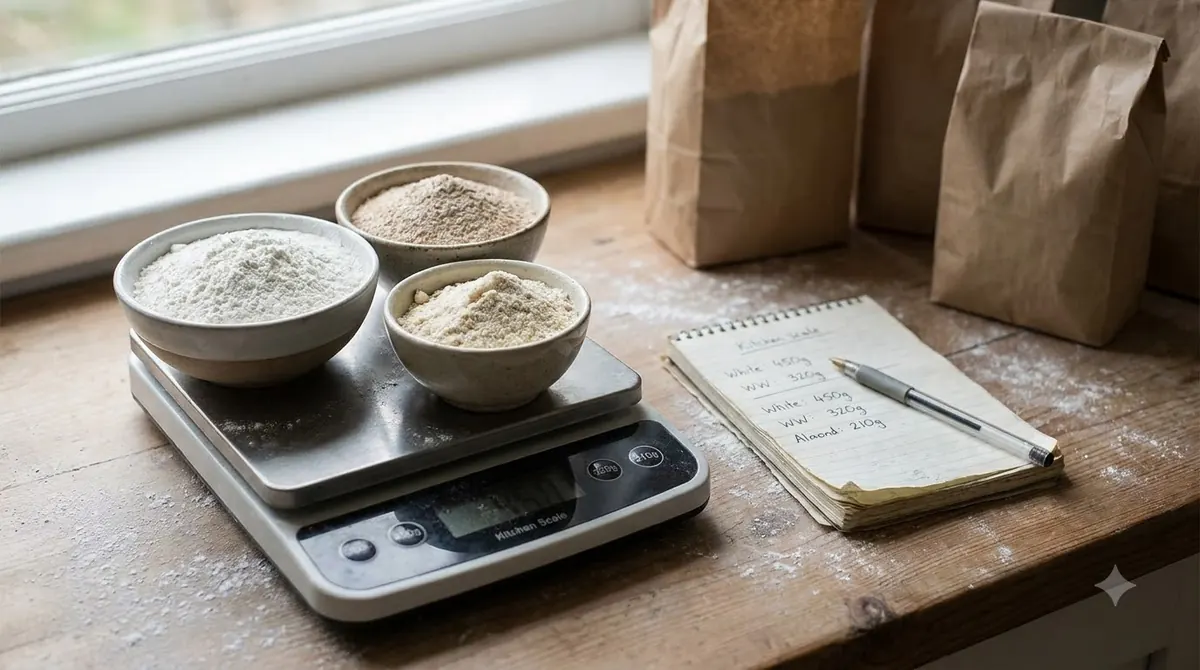

Pizza dough bakers percentages express every ingredient as a share of the flour weight, with flour always set at 100%. This lets you read any dough formula in grams and scale it to any batch size. Once you know the flour weight, every other ingredient follows from a simple percentage.
Pizza dough bakers percentages work for any batch size, from one pizza to a full tray of dough. The method is also the quickest way to check whether a recipe is too wet or too dry before you mix.
What Are Pizza Dough Bakers Percentages?
Baker’s percentages list each ingredient as a percent of the flour weight, and flour is always 100%. Because every other ingredient is measured against flour, the total dough weight is always greater than 100%. Caputo Flour’s guide to the baker’s percentage states that “the flour is the constant and is always set as 100%, so therefore, the total dough is always greater than 100%.”
Take a classic Neapolitan example. It uses 1000 g of flour, 600 g of water, 30 g of salt and 3 g of yeast. In pizza dough bakers percentages, the flour is written as 100%, the water as 60%, the salt as 3% and the yeast as 0.3%. The total of 1633 g is written as 163.3%.
Once you read pizza dough bakers percentages this way, two recipes become easy to compare, even when their batch sizes differ. The NY-style version of the same dough adds 20 g of olive oil. That is 2% of the flour, which brings the total to 1653 g, or 165.3%. The percentages change with the recipe, but the flour base never does.

How to Calculate Each Ingredient’s Percentage
To calculate any ingredient, divide its weight by the flour weight and multiply by 100. King Arthur Baking’s baker’s percentage reference uses 33 pounds of water against 50 pounds of flour, which gives (33 ÷ 50) × 100 = 66%. The same formula works in grams, ounces or pounds, as long as you use one unit throughout.
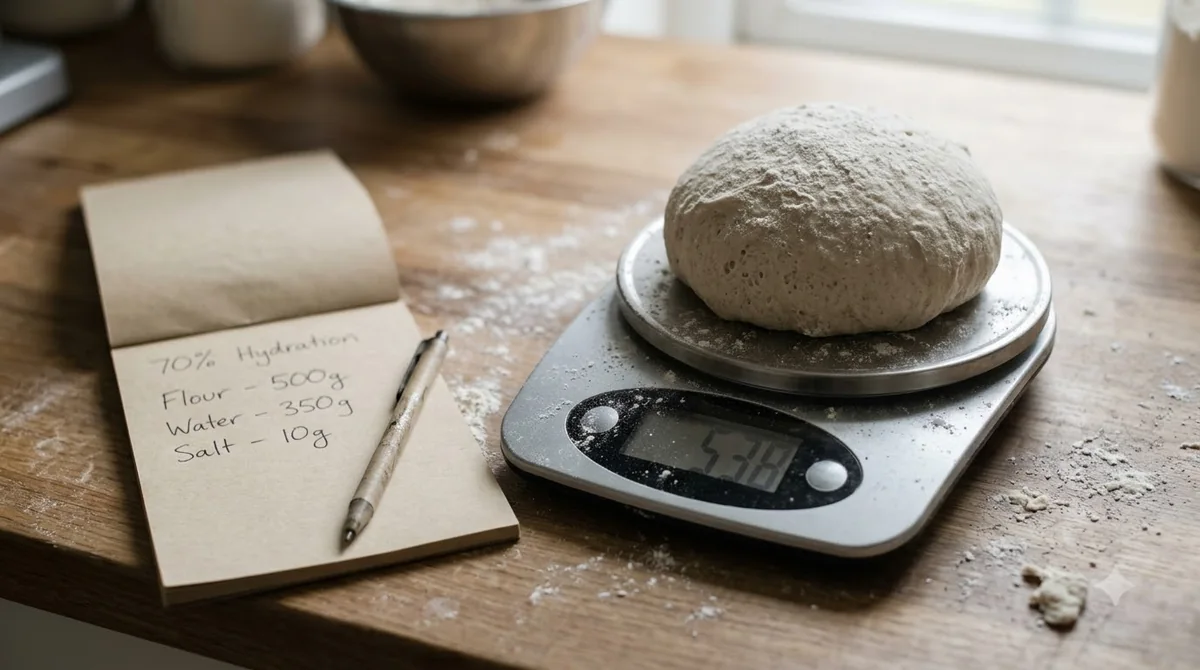
King Arthur also notes that because each ingredient is weighed, one unit of measure keeps the work precise. Weighing is the reason the method is so reliable at home. A cup of flour can vary in weight, while a gram reading does not.
| Ingredient | Weight (g) | Baker’s percentage |
|---|---|---|
| Flour | 1000 | 100% |
| Water | 600 | 60% |
| Salt | 30 | 3% |
| Yeast | 3 | 0.3% |
| Total dough | 1633 | 163.3% |
Water in these pizza dough bakers percentages is also your hydration, and the pizza dough hydration chart shows how common styles compare. A 60% hydration dough has 60 g of water for every 100 g of flour. Check the water line first, because it sets how the dough handles and how open the crumb will be.
Typical Pizza Dough Percentages
Caputo’s generalized figures put most pizza doughs at 58 to 60% water, 2.5 to 3% salt (see how much salt in pizza dough) and about 0.3% yeast (see how much yeast for pizza dough). The same page lists 2% olive oil and a poolish at 20% of the flour weight. The page describes these as very generalized, so treat them as starting points rather than fixed rules. These figures are a useful reference when you read a pizza dough bakers percentages table for the first time, and they make it easier to spot a formula that sits far outside the usual range.
Hydration is the number readers ask about most. Ranges are easier to judge when you see them side by side.
- Around 58 to 60% water: a firm, easy-to-shape dough that suits home ovens and beginners.
- Higher water: a softer dough that is harder to stretch but can produce a more open crumb.
- Very high water: a wet dough that needs careful handling and a strong, well-rested gluten structure.
America’s Test Kitchen links hydration to texture: around 60% gives a denser, closed crumb, while around 80% gives an airy crumb with large, irregular holes. Those are bread examples, so for pizza the useful lesson is that a small change in water shifts handling and crust far more than a small change in salt.
How to Scale a Pizza Dough Recipe
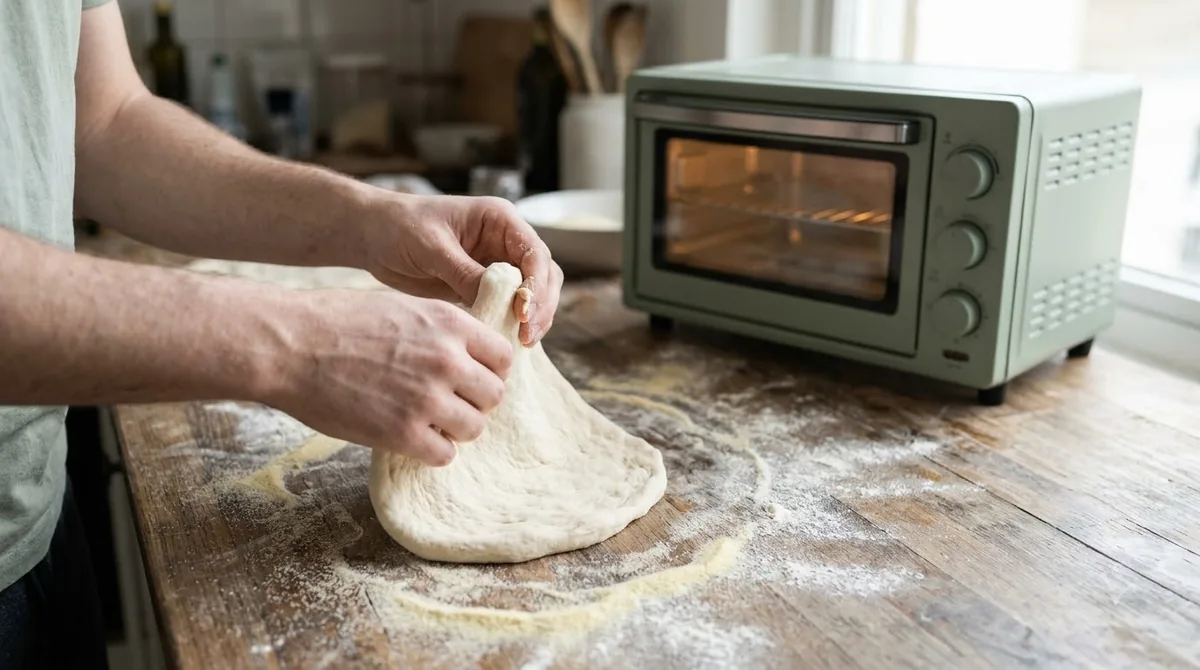
To scale a recipe, divide the new flour weight by the original flour weight, then multiply every other ingredient by that scaling factor. The pizza dough bakers percentages themselves do not change, so the ratio stays the same at any size. A pizza dough calculator can check the math.
King Arthur says that once you start thinking and measuring in grams, scaling a recipe up or down becomes simple. Follow these steps for a batch that is 1.5 times the Neapolitan recipe above.
- Set the new flour weight: 1000 g × 1.5 = 1500 g.
- Confirm the scaling factor: 1500 ÷ 1000 = 1.5.
- Multiply water: 600 g × 1.5 = 900 g.
- Multiply salt: 30 g × 1.5 = 45 g.
- Multiply yeast: 3 g × 1.5 = 4.5 g.
The result keeps 60% hydration and the same salt ratio. Yeast is the one ingredient readers round too early, so weigh it to 0.1 g if your scale allows.
Using Two Flours in One Dough
When a dough uses more than one flour, the flours together must still equal 100%. Each flour is set by its weight within that total, and the other ingredients are calculated from the combined flour weight.
Pizza dough bakers percentages handle this case by treating the whole flour blend as one 100% base. Caputo gives an example of 1500 g of flour split 80/20. That is 1200 g of “00” flour and 300 g of whole wheat, both counted in the 100% base. Scale the water and salt from the 1500 g total, not from either flour alone.
Common Mistakes With Baker’s Math
The most common error is treating the total dough weight as 100%. That shifts every other percentage, and the recipe no longer matches the flour base. Flour is the only 100% line in pizza dough bakers percentages.
- Using the total dough weight as the base instead of the flour weight.
- Mixing cups and grams in one formula, which makes the ratio unreliable.
- Scaling yeast or salt from the water weight instead of the flour weight.
- Assuming a cup of flour weighs the same in every kitchen.
America’s Test Kitchen shows the cup problem with a simple check: 1 1/4 cups of water (10 ounces) and 3 cups of all-purpose flour (15 ounces) give 67% hydration. Converting to weight first gives a more dependable result than scooping by volume.
Working Backwards From a Target Dough Weight
If you know the total dough weight you want, find the flour weight first. Divide the total by 1 plus the sum of the other percentages divided by 100. Then multiply the flour weight by each percentage.
Check the Neapolitan example: the other percentages add up to 63.3%, so 1633 ÷ 1.633 = 1000 g of flour. That matches the original recipe, which confirms the method. Use the same steps with pizza dough bakers percentages at any target size, and round only at the end.
Frequently Asked Questions
Why is flour always 100% in pizza dough bakers percentages?
In pizza dough bakers percentages, flour is the reference weight because every other ingredient is measured against it. Fixing flour at 100% gives every recipe the same base, so two formulas can be compared directly. The total dough weight then becomes a number above 100%.
Is baker’s math the same as hydration?
No. Hydration is one part of pizza dough bakers percentages, the water percentage. Baker’s math covers every ingredient, including salt, yeast and olive oil, and each one is a share of the flour weight.
Do I need a digital scale for this method?
A digital scale makes the method far more accurate, because grams are easier to divide than cups. King Arthur notes that weighing each ingredient keeps the work to one unit of measure. Small amounts like yeast benefit most from a scale that reads to 0.1 g.
Can I use pizza dough bakers percentages for bread?
Yes. King Arthur describes the system for any bread recipe where flour is the main ingredient. For cakes and cookies, bakers often use a different method, so check the recipe’s style before converting it.
Where can I check the percentages in a recipe?
Calculate the pizza dough bakers percentages yourself by dividing each weight by the flour weight, or use a dough calculator to confirm the math. Compare the result with the published ranges, and adjust water gradually if your flour absorbs more or less.
Start with the flour weight every time you work with pizza dough bakers percentages, and keep one unit for the whole recipe. Once the percentages are written down, you can scale any dough in seconds and see at a glance whether a formula is too wet or too dry. Browse more pizza dough guides when you are ready for the next step.
 7 min readLearnPizza Dough Hydration Chart: What Each Percentage MeansUpdated Nov 11, 2026
 8 min readLearnVegan Pizza Recipe: Dough, Cheese and Toppings That WorkUpdated Nov 12, 2026
 9 min readLearnPizza Dough with All Purpose Flour: A Home Recipe That WorksUpdated Nov 11, 2026
 8 min readLearnAutolyse Pizza Dough: How the Flour and Water Rest WorksUpdated Nov 10, 2026
 9 min readLearnPizza Dough Not Rising? Causes and Fixes That WorkUpdated Nov 10, 2026
 9 min readLearnPizza Dough Too Sticky? Causes and Fixes That WorkUpdated Nov 10, 2026