
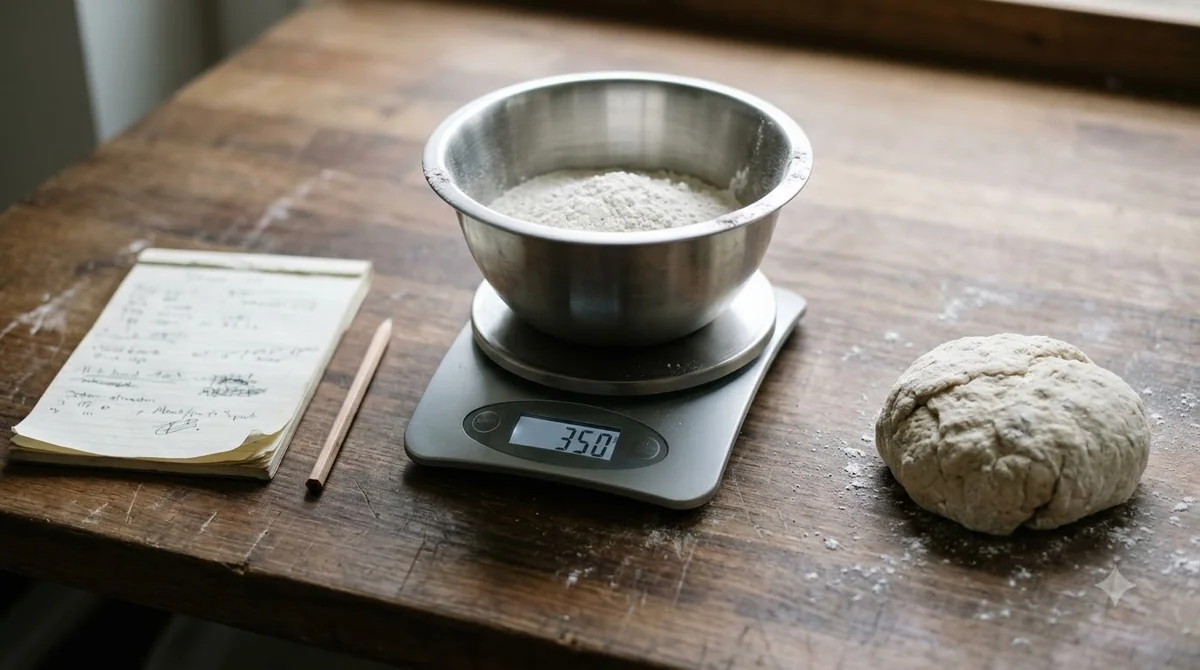

A pizza dough hydration chart lists the water-to-flour percentage for each dough type, from about 50% for firm doughs to 75% and above for very wet ones. Hydration is water weight divided by flour weight, so 600 g of water in 1000 g of flour is 60%.
Use this pizza dough hydration chart to predict how dough will handle, how it will rise and what the crust will look like before you mix. Pick a level that fits your skill and your style, then raise the water in small steps.
How to Read a Pizza Dough Hydration Chart
Each row of a pizza dough hydration chart is a water-to-flour ratio with flour fixed at 100%, so 600 g of water in 1000 g of flour is 60%. Gozney’s hydration explainer describes the same convention: every other ingredient is worked out as a percentage of the flour weight.
The calculation takes three steps, and it works for any batch size because the flour is always the base:
- Weigh the flour in grams.
- Weigh the water in grams.
- Divide the water weight by the flour weight, then multiply by 100.
The same guide gives a smaller example: 500 g of flour with 250 g of water is a 50% dough. Once you know the formula, you can check any row of a pizza dough hydration chart against your own recipe in seconds, or let the pizza dough calculator do the math. For a plain-language explanation of the term itself, see what is pizza hydration.
Caputo, a flour maker, explains the same logic as baker’s percentage in its guide to the baker’s percentage: flour is the constant at 100%, so the total dough always comes out above 100%. Its example uses 1000 g of flour, 600 g of water, 30 g of salt (3%) and 3 g of dry yeast (0.3%), for a total of 163.3%. Because the hydration figure counts only water, the salt and yeast do not change the 60% in that example.
Hydration Levels on the Chart
On a typical pizza dough hydration chart, most home doughs fall between 50% and 75%, and Ooni calls 60% the most common percentage in accessible recipes for beginners.
| Level | Handling | Crust and crumb | Where Ooni places it |
|---|---|---|---|
| 50 to 57% | Firm enough to hold toppings | Denser, moist and chewy | Focaccia, ciabatta, some Sicilian-style |
| 60% | Easier to work, firm and not sticky | Crispier when baked | Sicilian, Chicago deep-dish |
| 65% | Slightly tacky, needs more kneading and stretch time | Tighter crumb, less flavor | Neapolitan, New York, Detroit |
| 70% | Stretchy and sticky, ball up quickly | Light, soft, open crumb | Neo-Neapolitan |
| 75% and up | Challenging for beginners but achievable | Lighter, higher yield | Not tied to a style |
Ooni’s hydration levels guide describes the 50% to 57% rows as slightly denser bread with a moist, chewy crumb, firm enough to hold toppings. It suggests testing 75%, then 80%, then 90% if you want a lighter dough (our high hydration pizza dough guide covers that end of the chart), and notes that the more water you add, the higher the yield and the lighter the resulting dough.
Hydration by Pizza Style
Gozney gives Neapolitan dough 58% to 65% hydration, while Ooni puts it at about 60% to 65%, so the overlap of 60% to 65% is a safe target for that style. A full recipe is in the Neapolitan pizza dough recipe.
| Style | Gozney | Ooni | Note |
|---|---|---|---|
| Neapolitan | 58% to 65% | About 60% to 65% | Both sources agree on the overlap |
| New York | Usually around 65% | Not stated | Longer bake makes it wetter than Neapolitan |
| Detroit | Around 65% | Listed at 65%, but the intro gives 70% to 80% | Sources conflict; check before you copy |
| Sicilian | Not stated | 50% to 57% for some doughs, 60% linked too | Sits at the low end of the chart |
| Roman and pan-style | Not stated | Not stated | No figure given in either guide |
Because the two sources do not agree on Detroit style, treat that row of the pizza dough hydration chart as an open question and test it with a small batch. Neither guide gives a hydration figure for Roman or pan-style dough, so this chart does not cover those styles.
Caputo’s own Neapolitan example uses 1000 g of flour and 600 g of water, the same 60% that sits inside Gozney’s and Ooni’s Neapolitan ranges. Its New York example adds 20 g of olive oil (2%) and keeps the same water, so the hydration on that page stays at 60%.
How Hydration Changes Handling and Crust
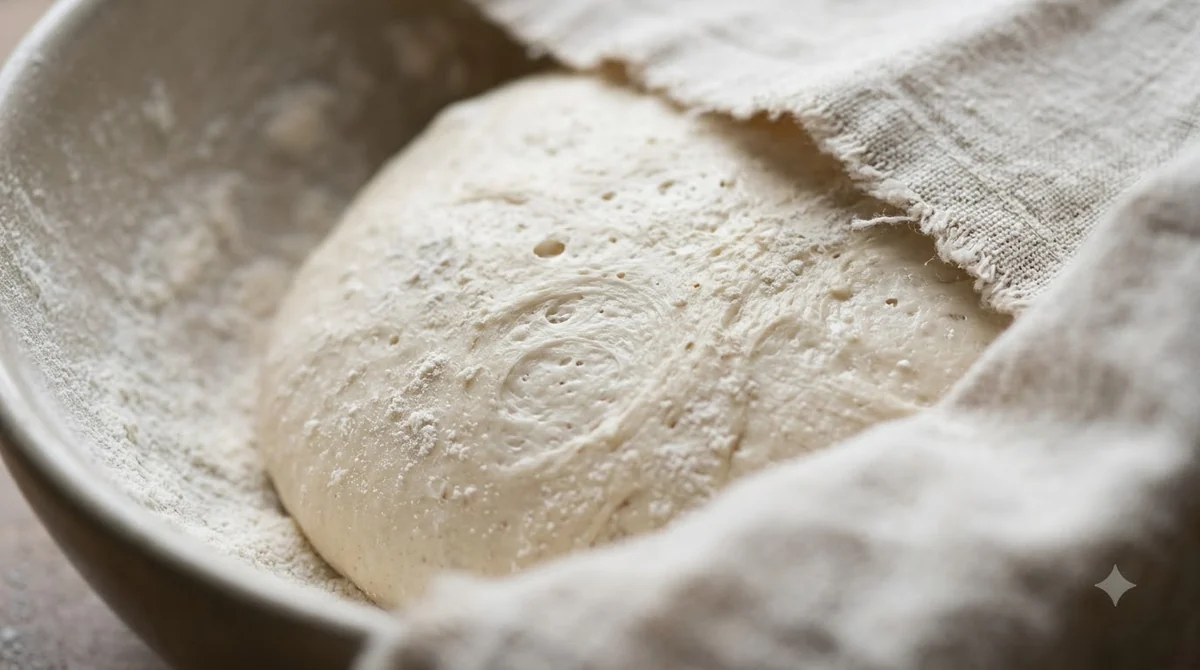
Higher hydration makes dough more elastic and sticky, speeds up the rise and gives a more open, airier crumb, according to Gozney’s guide.
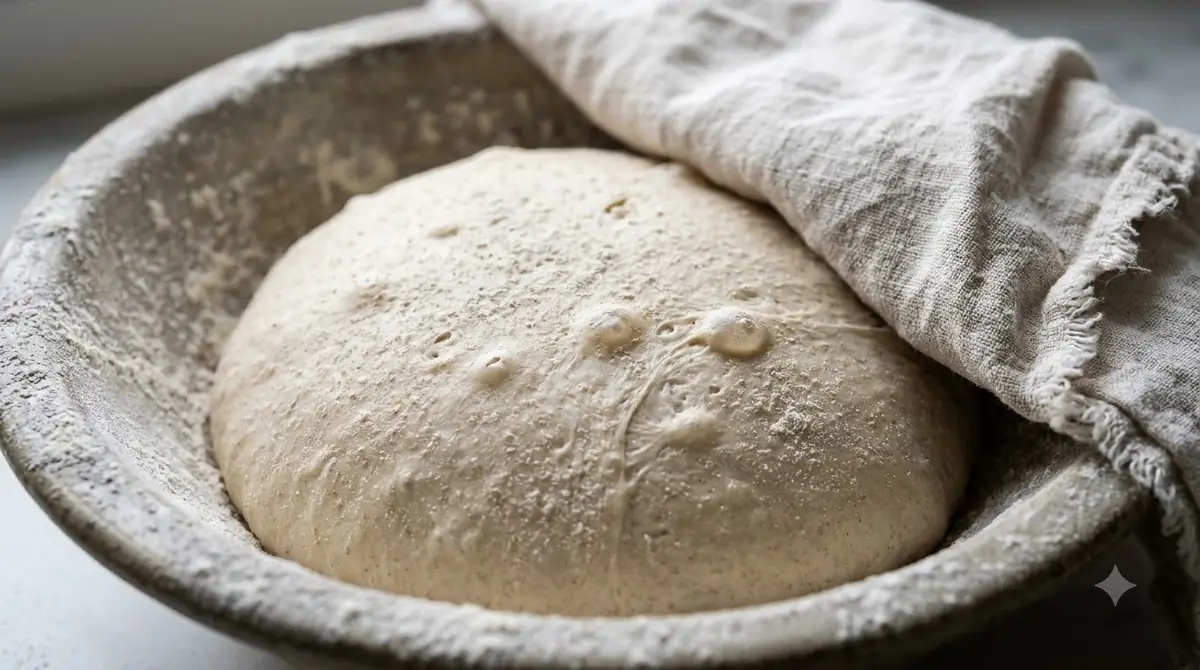
- Elasticity: the dough stretches further but feels softer, which can make it harder to open and form.
- Stickiness: wetter dough clings to hands and the work surface.
- Transfer: high-hydration dough sticks easily to the peel, which makes loading it into the oven harder (see pizza sticking to the peel for fixes).
- Rise: the extra water speeds up yeast activity, so the dough rises faster.
The trade-off is clear. A higher number gives a lighter, more open crust, but you give up ease of handling, and a pizza dough hydration chart is the tool that shows where that balance sits. Ooni describes 60% dough as crispier when baked, so a wetter dough is not the only route to a crisp base.
Choosing a Starting Point on the Chart
Start at 60% on the pizza dough hydration chart if you are new to pizza dough, because Ooni describes that level as easier to work with and firmer than wetter doughs.
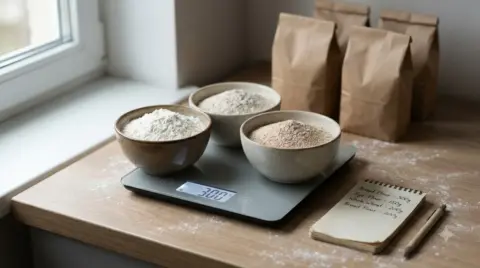
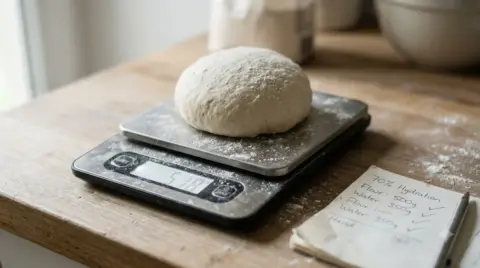
- Make one batch at 60% and weigh every ingredient on a digital scale.
- Move to 65% if the dough feels too firm, and expect more kneading and stretch time at this level.
- Try 75% only after you can handle 65% comfortably, following Ooni’s suggested sequence of 75%, then 80%, then 90%.
- Change one variable at a time, so you can tell which change caused the result.
Common Mistakes When Reading a Hydration Chart
The most common error is measuring flour by volume, since the same cup can hold very different weights depending on how it is filled. A pizza dough hydration chart percentage only means something when both ingredients are weighed in grams.
- Measuring flour by the cup, which changes the ratio you think you have.
- Reading a percentage as a promise of rise or crispness, because flour and oven also change the result.
- Using a pizza dough hydration chart for Roman or pan-style dough, where neither guide gives a figure.
- Counting salt and yeast as water. In Caputo’s example salt is 3% and yeast 0.3% of the flour weight, and neither belongs in the hydration figure.
- Copying the Detroit row without a test, because the Ooni page is inconsistent on it.
Frequently Asked Questions
What hydration is most common for beginners?
Ooni calls 60% the most common percentage on a pizza dough hydration chart for beginners. At that level the dough is easier to work and not sticky, though stretching it takes more effort than a wetter dough.
Is pizza dough hydration the same for Neapolitan and New York style?
Not exactly. Gozney gives Neapolitan 58% to 65% and New York around 65%, and says the longer bake of New York style makes its dough more hydrated. Ooni gives Neapolitan about 60% to 65% and does not state a New York figure.
What does 75% pizza dough feel like?
On a pizza dough hydration chart, Ooni describes 75% and above as challenging for beginners but achievable. Expect stretchy, sticky dough that rises faster and bakes into a lighter, more open crumb, and work up in steps rather than jumping straight there.
Why does high-hydration dough stick to the peel?
Higher hydration makes dough stickier and harder to handle, and Gozney notes that moving it to the peel is challenging because it sticks easily. Dust the peel well before you load the dough and move it quickly.
Can I use a pizza dough hydration chart for Roman dough?
Neither Gozney nor Ooni gives a hydration figure for Roman or pan-style dough, so this chart does not cover them. Use a recipe written for that style, and weigh its flour and water in grams.
Pick the level on this pizza dough hydration chart that matches your skill, then weigh every ingredient so the percentage you plan is the one you bake. Start at 60% if you are new, and move up one step at a time. Test the Detroit row in a small batch before you rely on it.
 8 min readLearnPizza Dough Bakers Percentages: How the Formula WorksUpdated Nov 11, 2026
 8 min readLearnPizza Dough Flour to Water Ratio: How to Set It for Each StyleUpdated Nov 11, 2026
 8 min readLearn70 Hydration Pizza Dough Recipe: What 70% Water Does to Your CrustUpdated Nov 10, 2026
 9 min readLearnRoman Pizza Dough Recipe: Hydration, Flour and MethodUpdated Nov 7, 2026
 8 min readLearnHigh Hydration Pizza Dough: What It Is and How to Handle ItUpdated Nov 10, 2026
 8 min readLearnOlive Oil Smoke Point: What the Numbers Mean for Your CookingUpdated Nov 10, 2026