
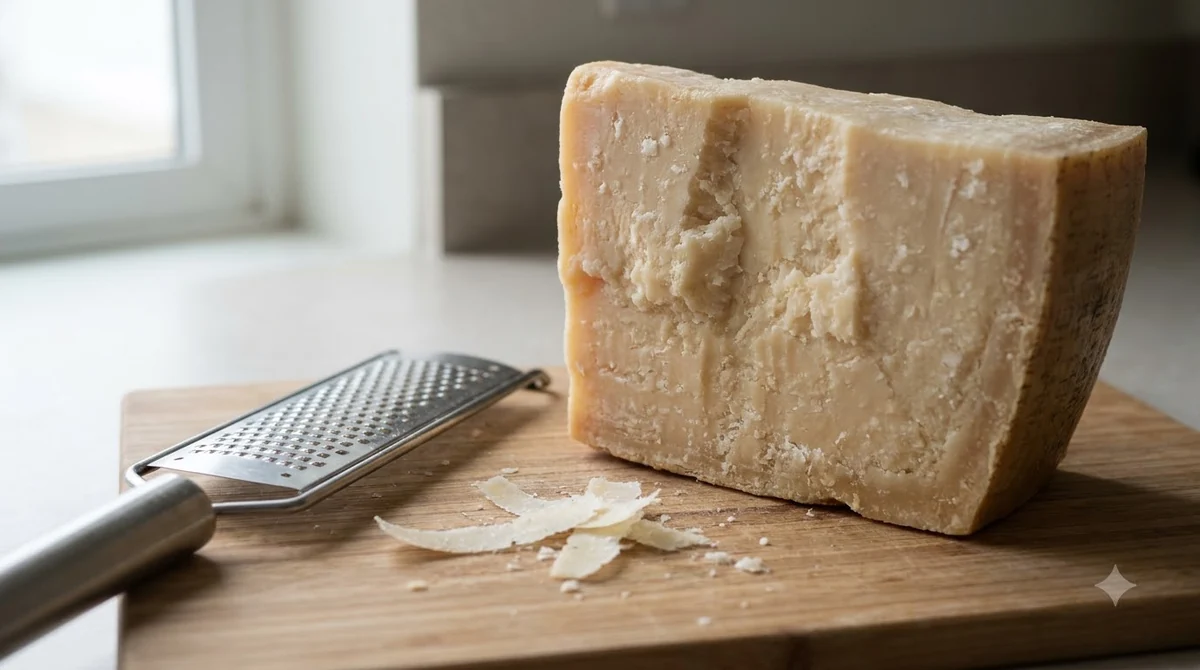

Asking what is Parmigiano Reggiano has a short answer: it is a hard, granular Italian cheese made from unpasteurized cow’s milk in a protected area of northern Italy, aged at least 12 months. The name is legally protected in the European Union, so a generic parmesan is a different product. This guide covers where it is made, how to spot a genuine wheel, how it ages and how to store it.
What Is Parmigiano Reggiano and Where It Is Made
Parmigiano Reggiano is made only in a defined part of northern Italy, under EU protected designation of origin (PDO) rules.
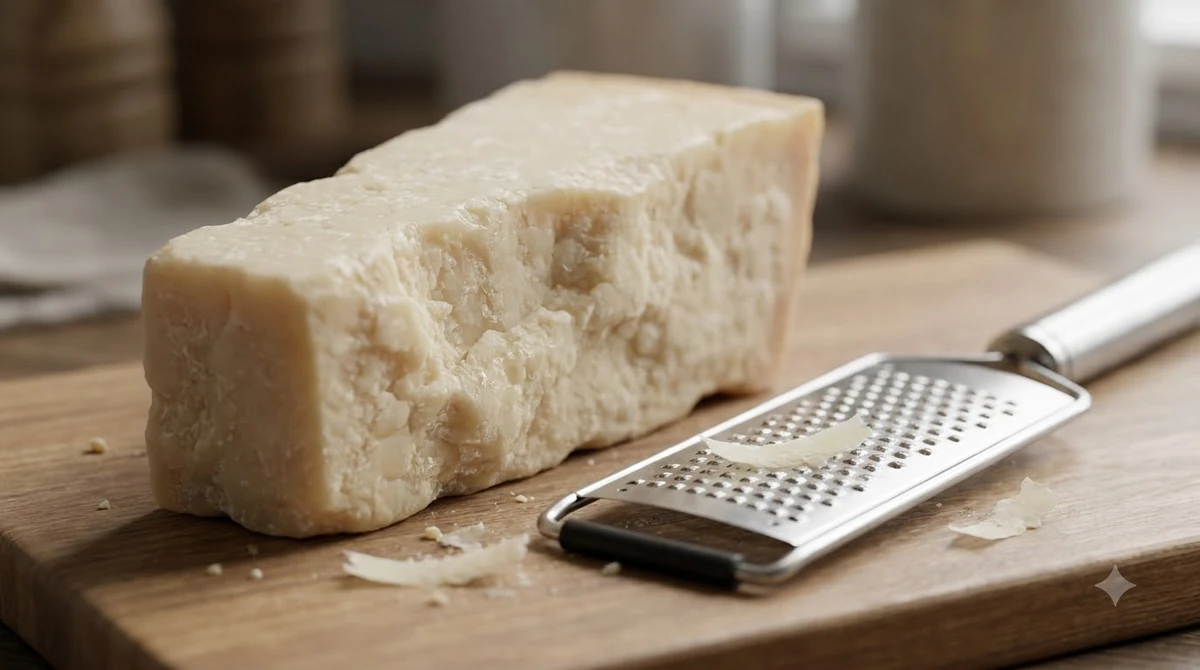
So what is Parmigiano Reggiano in geographic terms? The area covers the provinces of Parma, Reggio Emilia and Modena, the part of Mantua on the right bank of the Po River, and the part of Bologna on the left bank of the Reno River. The name comes from the cities of Parma and Reggio Emilia. Italy granted the cheese protected status in 1955, and the European Union followed with PDO status in 1992.
Written records of the cheese go back to 1254, and the writer Boccaccio praised it in 1348. Production was standardized during the 19th and 20th centuries. Today the Consorzio, the producers’ consortium, promotes the cheese and safeguards the land where it is made.
The milk is unpasteurized, and cows are traditionally fed only grass or hay. Each batch mixes the whole milk from the morning milking with the skimmed milk from the previous evening. Producers use calf rennet and a natural whey culture, and the only additive allowed is salt, which the wheels absorb in brine for about 20 days.
How to Spot Genuine Parmigiano Reggiano
A genuine wheel carries printed marks on its rind, and the grade mark only appears after the wheel passes inspection at 12 months.
According to the Consortium’s seals and marks guide, a wheel can show these identifiers:
- Dotted rind lettering that reads Parmigiano Reggiano.
- A dairy identification number, plus the month and year of production, printed in three positions.
- A plant identification mark for the production plant.
- A casein plate on one flat face, with a traceability code applied in the first hours of life.
- A grade mark added after 12 months: an oval hot-iron mark for first grade, or a hot-iron name mark with parallel grooves for medium grade.
Once you know what is Parmigiano Reggiano on paper, the rind tells you whether the wedge matches. At 12 months, a master grader taps each wheel with a small hammer to listen for cracks and voids. Optional PREMIUM or EXPORT marks can appear from 18 months on first-grade wheels. A grated tub or a piece without rind hides these marks, so buy a piece with the rind whenever you can.
Pre-packed pieces carry a minimum maturation statement, a rule that has applied since April 2018, so the label can confirm the age even when the rind is gone.
Parmigiano Reggiano vs Parmesan
In the European Union, the name Parmesan is tied to Parmigiano Reggiano: according to Wikipedia, a 2008 EU court ruling determined that in Europe the name refers only to Parmigiano Reggiano and cannot be used for imitation Parmesan. Outside Europe the word is often used more loosely, so the full protected name is the safer thing to look for. Our guide to Parmigiano Reggiano vs parmesan goes deeper on the labeling differences.
The key difference is the legal rule. Parmigiano Reggiano must come from the protected area and follow the production rules, including raw cow’s milk and calf rennet. A generic parmesan can be made outside that area, so the protected rules do not apply to it.
Parmigiano Reggiano belongs to the grana family of hard, granular cheeses. Other grana-style cheeses share the texture, but they are not the protected product. For example, Grana Padano is a milder protected cousin made across a wider area of the Po Valley. When you read a label, look for the full name Parmigiano Reggiano and the PDO marks rather than the word parmesan alone.
A simple test at the counter is to read the full label, look for the protected name, and compare the price per gram with other hard grating cheeses. A very low price for a product called parmesan is a signal to check the label closely, because the protected rules apply only to the real Parmigiano Reggiano.
How Long Parmigiano Reggiano Ages
Parmigiano Reggiano ages at least 12 months, and older wheels fall into the Vecchio and Stravecchio groups.
Age changes the texture and the flavor. Older wheels usually taste sharper and crumble more easily than young ones. The table below lists the age ranges that encyclopedia summaries give for each group.
| Group | Typical age |
|---|---|
| Minimum aging | 12 months |
| Vecchio | 18 to 24 months |
| Stravecchio | 24 to 36 months |
These ranges are general references, and the actual age of your piece is the one on its label or marks. Check the label before you pay for an older group.
Age also shapes how you grate it. Older wheels crumble more easily, so they are better for a fine grate over pasta. Younger wheels are softer, so a coarser grate or thin shavings may suit them better. Taste a small piece before you commit to a large quantity.
How to Use Parmigiano Reggiano in the Kitchen
Grate it over pasta, stir it into risotto, or simmer a clean rind in soup for a deeper savory flavor.
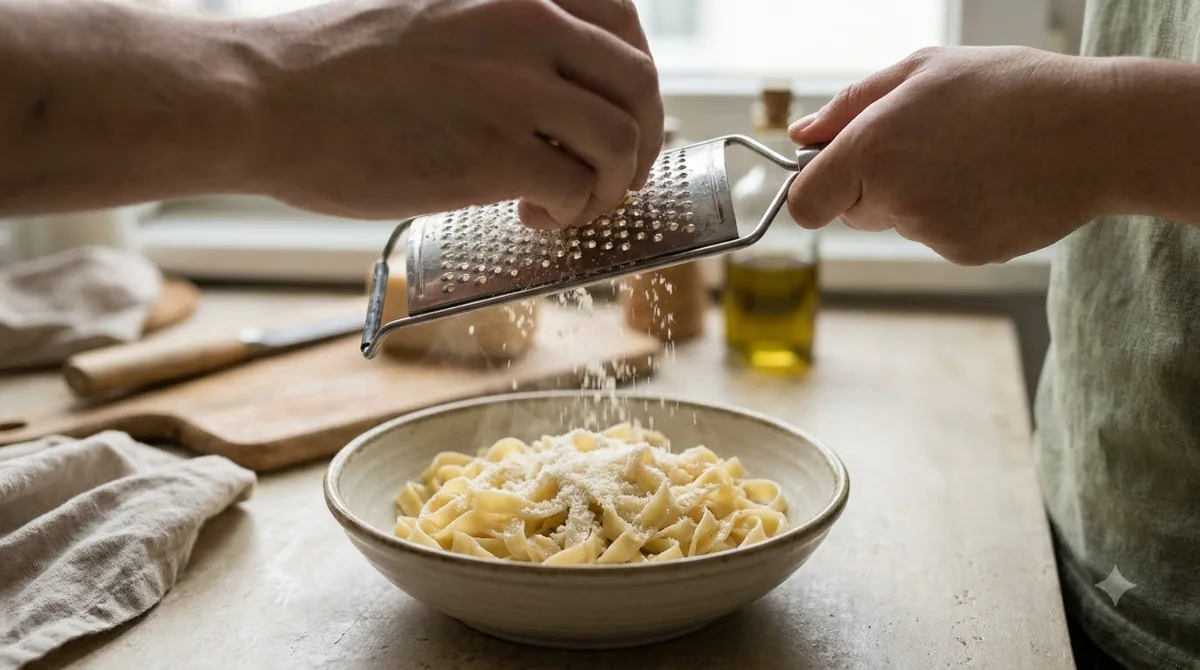
The cheese is rich in glutamate, up to 1.2 g per 100 g according to the Wikipedia summary of the cheese, which gives the savory umami taste cooks value. A small amount goes a long way.
Tasters describe the cheese by its hardness, sharpness, aroma, saltiness and savoriness. Those qualities explain why a finely grated spoonful can season a whole plate of pasta, while a chunk shaved at the table gives a crunchier, more intense bite. If you prefer a sharper, saltier hard cheese, compare it with Pecorino Romano or read our Parmigiano Reggiano vs Pecorino Romano comparison.
- Grate it fresh over pasta just before serving.
- Stir a handful into risotto at the end of cooking.
- Shave it over salads or roasted vegetables.
- Drop a clean rind into a simmering soup or broth, then remove it before serving.
The cheese is made with calf rennet, an animal enzyme, so it is not suitable for vegetarians.
How to Store Parmigiano Reggiano
Keep a cut piece wrapped in the refrigerator at 4 to 8°C, and never freeze it.
The Consortium’s cutting and storage guide says vacuum-packed Parmigiano Reggiano can be stored in the refrigerator for several months. Once opened, keep the cheese away from other foods, because its fat can absorb odors.
- Wrap the cut face in food-grade plastic film, or keep it in a glass or plastic container.
- Check the wrapping from time to time, and keep the cheese at 4 to 8°C.
- A cut piece aged 12 to 18 months keeps about 15 days.
- A cut piece aged 24 months or more keeps about one month.
- If mold forms on the surface, cut it away with a knife and use the rest.
Wrap the piece again after each use, and use glass or plastic containers or food-grade film, as the producer recommends. Grate only what you need, and a good grater makes that easier: see our guide to using a rotary cheese grater or our list of the best Parmesan cheese graters.
Frequently Asked Questions
Is Parmigiano Reggiano the same as parmesan?
Not in the legal sense. Parmigiano Reggiano is the protected cheese from a defined area of northern Italy, while parmesan is a generic name that often refers to imitations made elsewhere.
Is Parmigiano Reggiano vegetarian?
No. It is made with calf rennet, an animal enzyme, so it is not suitable for vegetarians. Look for a cheese labeled vegetarian if that matters for your meals.
How long does Parmigiano Reggiano age?
It ages at least 12 months. Encyclopedia summaries list 18 to 24 months for Vecchio and 24 to 36 months for Stravecchio, so check the label for the age of your wheel.
Can you freeze Parmigiano Reggiano?
The producer’s storage guide says never to freeze it. Keep cut pieces wrapped in the refrigerator at 4 to 8°C and use them within the time the guide gives.
How can you tell if a wedge is real?
Check the rind for the dotted lettering, the dairy number, the month and year, and a grade mark. A grated tub or a piece without rind hides these marks, so buy with the rind when you can.
If you are buying for the first time, pick a wedge with the rind in view and check the marks and the age on the label. Grate it fresh when you cook, and keep the rest wrapped in the refrigerator at 4 to 8°C. For more ingredient explainers, browse our Learn guides.
 9 min readLearnParmigiano Reggiano vs Pecorino Romano: Key DifferencesUpdated Nov 10, 2026
 7 min readLearnOrtolana Pizza Recipe: A Vegetable Pizza Made at HomeUpdated Nov 11, 2026
 8 min readLearnWalnut Sauce for Pasta Recipe: A Creamy Ligurian Sauce Made at HomeUpdated Nov 11, 2026
 7 min readLearnPasta con le Sarde Recipe: Sicilian Sardine Pasta Made SimpleUpdated Nov 11, 2026
 8 min readLearnTajarin Pasta: What It Is, How It Is Made and How to Serve ItUpdated Nov 11, 2026
 8 min readLearnPasta Primavera Recipe: A Simple Vegetable Pasta Made at HomeUpdated Nov 10, 2026