
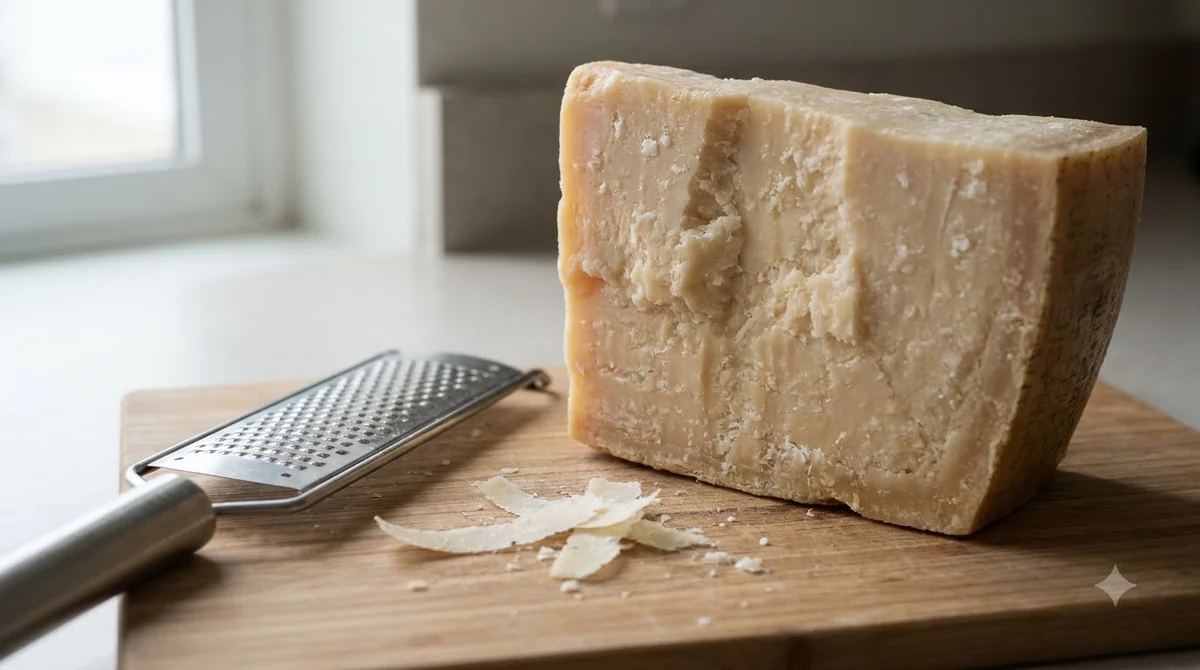

Grana Padano is a hard, slow-ripened Italian cheese from the Po Valley, and that is the short answer to what is grana padano. It must age at least nine months under an EU protected origin label. Its flavor is milder than many people expect from a hard Italian cheese.
It is often compared with Parmigiano Reggiano, which is aged longer and has a sharper finish. Grana Padano suits everyday grating, and the age category on the label tells you how mild or sharp to expect.
What Is Grana Padano and Where It Comes From
Grana Padano is a protected hard cheese made across the Po Valley in northern Italy, and its recipe dates back to monks of Chiaravalle Abbey in the 12th century. According to Wikipedia’s Grana Padano entry, the cheese was developed by those monks, which is why its history is tied to northern Italian abbeys.
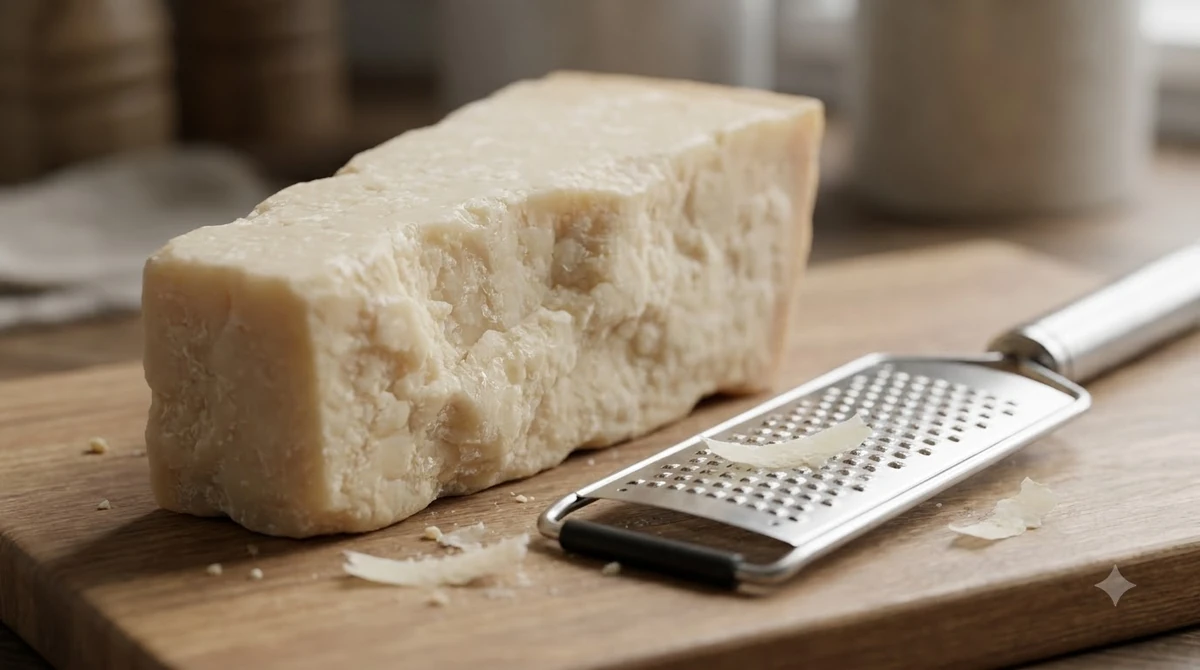
The name has two parts. Grana refers to the grainy texture of the cheese, and Padano points to the Po Valley, the broad plain that runs across northern Italy. The name tells you where the cheese comes from and how it feels to bite.
Traditional production covers Piedmont, Lombardy, Veneto, Trento, parts of Emilia-Romagna and some municipalities in South Tyrol. Sources describe the exact extent of the zone in different ways, so the label on the package is the best guide to where a particular wheel was made.
Italy registered Grana Padano as a DOC product in 1955, and the European Union gave it PDO status in 1996. A PDO label means the cheese must come from its defined area and follow set production rules, which is why the label matters when you shop.
How Grana Padano Is Made
Grana Padano is made from unpasteurized, semi-skimmed cow’s milk, with the curd cut into pieces the size of rice grains and warmed to 53 to 56 °C. The process is simple to describe, but each step affects the final texture and the wheel’s shape.
- Cows are milked twice a day. According to Wikipedia, the evening milk is skimmed to remove the surface layer of cream and mixed with the fresh morning milk.
- The partly skimmed milk goes into copper kettles and coagulates.
- The curd is cut into granules the size of rice grains, which gives the cheese its characteristic texture.
- The curd is warmed to 53 to 56 °C, which is the temperature range given for this step.
- The cheese is set in wheel-shaped molds and soaked in brine for at least two weeks, according to Castello’s cheese guide.
- The wheels age, and after nine months each one is checked and, if it passes, fire-branded with the Grana Padano logo.
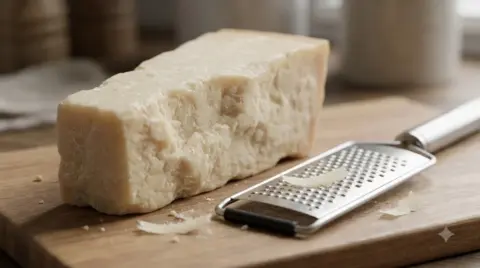
A finished wheel is 35 to 45 cm across, 15 to 18 cm high and weighs 24 to 40 kg. That size explains why shops usually sell Grana Padano as wedges cut from a larger wheel rather than as a whole wheel.
Wikipedia gives two milk figures that are close but not identical: about 14.4 kg of milk for every 1 kg of cheese in its production section, and 1.5 litres for every 100 g in its nutrition section. Treat any exact milk ratio as approximate, and note that about 150 factories in the Po Valley make the cheese, with an estimated 76,724 tons produced each year according to the same Wikipedia entry.
Aging Categories and What the Labels Mean
Grana Padano is aged 9 to 16 months in its base category, over 16 months in the older category, and over 20 months as Riserva. The longer the aging, the more developed the flavor tends to become.
| Category | Aging period | What to expect |
|---|---|---|
| Grana Padano | 9 to 16 months | Milder and less complex; the texture is still creamy and only slightly grainy |
| Grana Padano over 16 months | More than 16 months | A crumblier texture and a more pronounced taste |
| Grana Padano Riserva | More than 20 months | Grainy, crumbly and full-flavored |
Every wheel is checked after nine months of aging, and only wheels that pass the quality tests get the fire-brand.
When you buy a wedge, read the category on the label first. It gives a practical clue to whether you are getting a mild cheese for cooking or an older cheese with a stronger taste.
Grana Padano Compared With Parmigiano Reggiano
Grana Padano is milder and less complex than Parmigiano Reggiano, which is the longer-aged cheese and is made under stricter rules. Both are hard Italian cheeses, so they often sit side by side in shops.
| Attribute | Grana Padano | Parmigiano Reggiano |
|---|---|---|
| Aging | At least 9 months, up to over 20 months as Riserva | Longer-aged cheese; check the label for the exact period |
| Flavor | Milder and less complex when young | Sharper and more complex, since it is aged longer |
| Production rules | Less strict regulations, according to Wikipedia | Stricter rules |
| Origin area | A much wider area across northern Italy | A narrower area around Parma, Reggio Emilia and Modena, plus parts of Mantua and Bologna |
For a sauce, a salad or a simple grated topping, the milder Grana Padano is a practical choice. When the cheese is meant to be the main flavor, such as on a cheese board, the sharper and longer-aged Parmigiano Reggiano is the stronger option.
How to Use Grana Padano in the Kitchen
Grana Padano is most often grated over pasta and salads, and Castello’s cheese guide says it can also be enjoyed on its own. Cut the cheese to suit how you plan to serve it, since a grated topping and a cheese board call for different pieces.
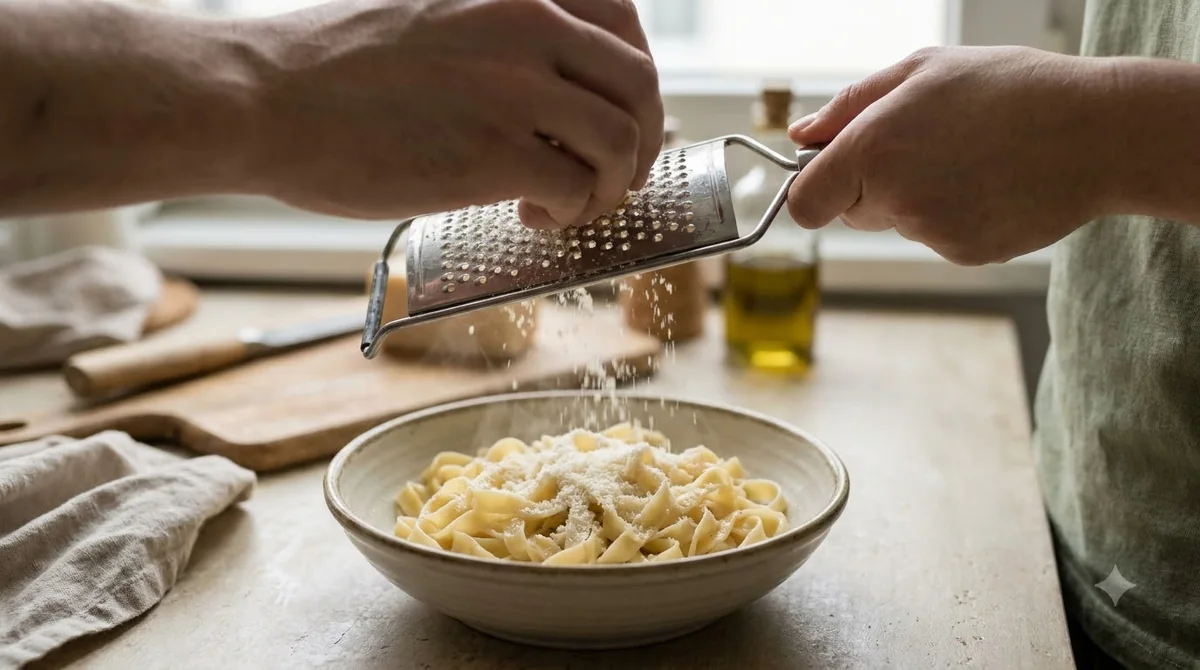
- Grate it over pasta just before serving, so the texture stays fresh on the plate.
- Shave or grate it over a salad as a finishing layer.
- Cut small pieces for a cheese board or to eat on its own, as Castello describes in its cheese guide, which calls the taste savory and nutty with a dense, somewhat flaky texture.
- Choose a younger category for mild dishes and an older category when you want a stronger taste.
A younger wheel is mild enough to blend into many sauces, while an older Riserva brings more punch to the same dish. Taste a small piece before you cook with a new wheel so you know what to expect.
If you are comparing hard cheeses for a recipe, our guides to Pecorino Romano and Parmigiano Reggiano vs parmesan show how the sharper and milder options differ. A good Parmesan cheese grater also helps you grate only what you need.
Nutrition Basics Per 100 g
Per 100 g, Grana Padano has about 398 kcal, 29 g of fat, 33 g of protein and 1.5 g of salt, according to Wikipedia’s nutrition figures. Those numbers help you compare it with other hard cheeses on the same basis.
| Nutrient | Per 100 g |
|---|---|
| Energy | 398 kcal |
| Fat (saturated fat) | 29 g (18.4 g) |
| Protein | 33 g |
| Carbohydrates | Under 1 g |
| Salt | 1.5 g |
| Calcium | 1165 mg |
The source for these figures is an encyclopedia page that notes its nutrition section needs more citations. Check the nutrition panel on the package of the wedge you buy, since values can vary by product.
How to Buy and Store Grana Padano
Buy a wedge with a clear category and producing area on the label, then wrap the cut face tightly once you open it. Sources differ on how long a cut wedge keeps, so judge it by smell, color and mold rather than a single number.
Store the wrapped wedge in the refrigerator, and keep it away from strong-smelling foods. Wrapping in wax paper or aluminum foil helps stop the surface from drying out. Grate only what you need, because grated cheese has far more exposed surface than a wedge.
What Is Not Confirmed and How to Check
Sources describe the milk ratio and the exact extent of the production zone in different ways, and they do not settle whether the cheese suits vegetarians. Those points need checking before you rely on them for a specific product.
- Milk per kilogram: one figure is about 14.4 kg per 1 kg of cheese, and another is 1.5 litres per 100 g, so treat the ratio as approximate.
- Production zone: different sources list different regions, provinces and municipalities.
- Rennet: Castello’s cheese guide says rennet is used in production and makes no vegetarian claim, so check the label if you avoid animal rennet.
For a specific wheel or wedge, read the label and the technical information from the maker. Those sources are more reliable than a general guide, especially for dietary questions.
Frequently Asked Questions
Is Grana Padano the same as Parmesan?
No, but they are close relatives. Grana Padano is a protected cheese from a wider area under less strict production rules, while Parmigiano Reggiano is the longer-aged and sharper benchmark. Read the label to see which cheese you are buying.
How long is Grana Padano aged?
The minimum is nine months. The base category covers 9 to 16 months, the older category is over 16 months, and Riserva is over 20 months. Wheels are checked after nine months and fire-branded if they pass.
Is Grana Padano vegetarian?
The sources do not settle this. Castello’s cheese guide says rennet is used and makes no vegetarian claim, so check the product label or the maker’s information before deciding.
Is Grana Padano lactose-free?
Wikipedia describes the cheese as nearly lactose-free because of its production and long aging. People with lactose intolerance should still check the maker’s information and their own tolerance before eating it.
Can you eat Grana Padano on its own?
Yes. Castello’s cheese guide says it can be enjoyed on its own or as an accompaniment to a dish. Cut small pieces to taste the flavor of the age category you chose.
What is Grana Padano used for?
Grana Padano is mainly grated over pasta and salads, and it can also be eaten in pieces on its own. A younger wheel suits mild dishes, while an older category gives a stronger taste to the same recipe.
What is Grana Padano made from?
Grana Padano is made from unpasteurized, semi-skimmed cow’s milk, with the curd cut to rice-grain size and warmed to 53 to 56 °C. Wikipedia gives slightly different milk ratios per kilogram, so treat the exact amount as approximate.
If you want a mild, everyday hard cheese for grating, Grana Padano is a practical choice. If you want a sharper, longer-aged flavor, look for an older category or choose Parmigiano Reggiano. Always read the label for the age and the producing area, and browse our Learn guides for more cheeses.
 7 min readLearnWhat Is Caciocavallo? A Practical Guide to This Italian CheeseUpdated Nov 11, 2026
 8 min readLearnWhat Is Scamorza? A Guide to This Southern Italian CheeseUpdated Nov 11, 2026
 7 min readLearnWhat Is Provolone? A Practical Guide to This Italian CheeseUpdated Nov 10, 2026
 8 min readLearnTimballo Recipe: How to Bake This Italian Pasta Drum at HomeUpdated Nov 11, 2026
 7 min readLearnWhat Is Stracciatella? A Fresh Italian Cheese ExplainedUpdated Nov 11, 2026
 7 min readLearnWhat Is Durum Wheat? The Hard Wheat Behind Pasta and SemolinaUpdated Nov 10, 2026