
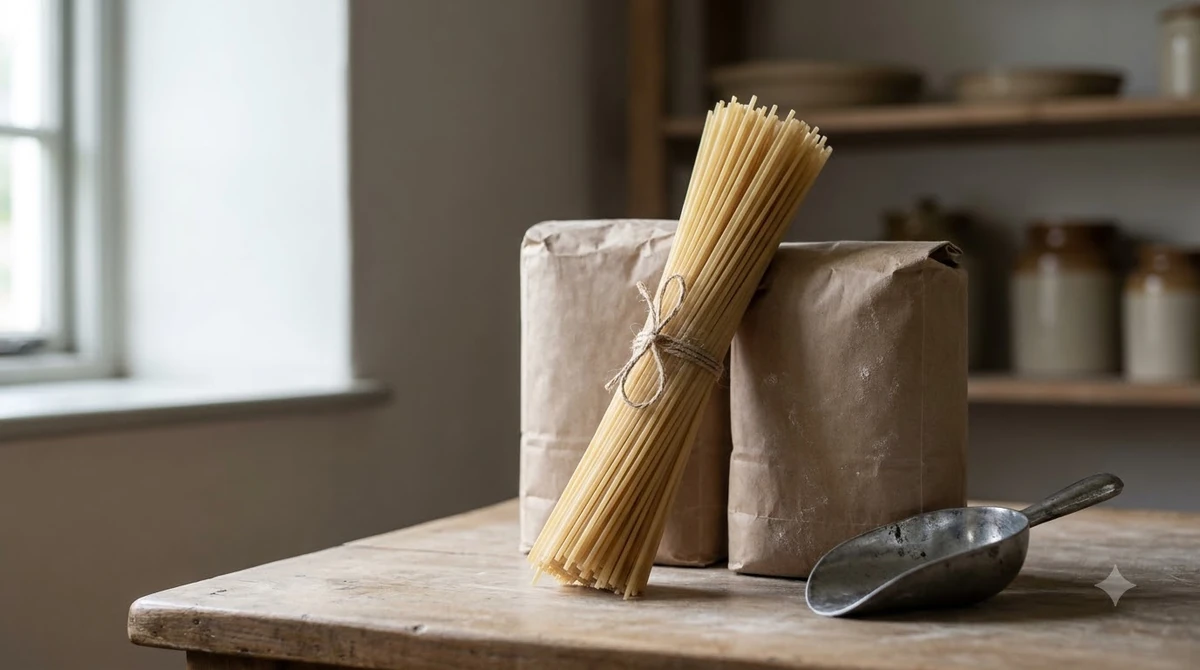

Knowing what is semolina flour starts with the wheat: it is a coarse flour milled from durum, a hard wheat with high protein. That grind makes it grittier than the fine white flour most home kitchens keep on hand. The same protein is why it has long been the standard choice for dried pasta.
What Is Semolina Flour?
Semolina is a coarse flour traditionally made from durum wheat, and the durum version is pale yellow. Common wheat produces a beige semolina that the United States calls farina, and that is the version more often used for desserts. Both names describe the same idea: a larger, sandy particle than standard flour.
The particle size can be measured against a sieve standard. The Codex Alimentarius specifies that for durum semolina, no more than 79% of the grains pass through a 315-micron sieve, which is why the grains feel so different from all-purpose flour. You can read the full summary of the wheat, milling and uses on Wikipedia’s semolina entry.
Anyone asking what is semolina flour should start with the mill: semolina forms during milling. The coarse endosperm particles are sifted out of the wheat, and those particles can then be ground further into different flour grades. That is why semolina and flour come from the same mill process but land in different bags.
Semolina is not one fixed grind. Durum semolina can be milled coarse or fine. German-style durum semolina particles are between 0.25 and 0.75 millimeters in diameter, according to the same Wikipedia entry, so the grind you buy affects the bite of the finished dish.

Semolina vs Other Flours
Semolina flour is coarser and higher in protein than all-purpose flour, and it is more coarsely ground than durum flour, even though both come from the same wheat. The table below sets the main differences side by side so you can see which bag fits which job.
| Flour | Wheat source | Texture | Gluten |
|---|---|---|---|
| Semolina | Durum wheat | Coarse and gritty | 13% or more, per one source |
| Durum flour | Durum wheat | Finer than semolina | High, similar to semolina |
| All-purpose flour | Common wheat | Fine and soft | 8% to 11%, per the same source |
| 00 flour | Common wheat | Very finely ground, refined Italian flour | Varies by brand, check the label |
Semolina is sometimes confused with cornmeal, but they are different products. Cornmeal is ground from corn kernels, while semolina is ground from wheat. Semolina is also not the same as 00 flour (see choosing a 00 flour), which is a fine, refined Italian flour used mainly for soft pizza doughs. If a recipe lists semolina and you only have all-purpose flour, expect a different texture, and use the partial swap rule rather than a full replacement.
A simple way to choose is by the job. For dried pasta, buy semolina flour or a labeled durum flour, because its protein is the reason the pasta keeps its shape. If you are weighing it against an egg dough, semolina pasta vs egg pasta compares the two. For a bread recipe that calls for all-purpose flour, bread flour is the closer swap in protein, according to King Arthur Baking, and semolina works as a partial addition rather than a full replacement.
Why Semolina Works in Pasta and Bread
The high protein in semolina flour forms a strong gluten network when it is mixed with water and worked, and that network gives pasta its firm chew. A nutrition listing cited on Wikipedia gives 12.68 g of protein per 100 g, which helps explain why dried pasta holds its shape in boiling water.
Semolina is also used in pizza crust, and pizza dough made with semolina shows how bakers work it in. Wikipedia notes that its gluten adds texture to the crust, and bakers often pair it with bread or all-purpose flour, since the higher protein supports stronger gluten development. That protein is what helps dough rise and hold its shape.
In bread, the gluten adds firmness and chewiness to the crust. Semolina is not gluten-free, so it is off limits for anyone who needs to avoid gluten. For people who simply want a sturdier loaf, the extra protein is the reason bakers add a small amount of it to plain dough.
How to Use Semolina Flour at Home
Semolina flour works best as a dusting flour for pizza peels and as a partial swap in bread recipes. King Arthur Baking recommends it for dusting so the dough does not stick when you slide it into a hot oven (the choice is covered in semolina vs cornmeal for the peel), and it suggests using semolina for about 25% of the flour by volume in recipes that call for all-purpose flour, as a good rule of thumb.

- Dust the peel or the counter with semolina before you shape the dough, so the base does not tear when you load it.
- For a bread recipe written for all-purpose flour, replace about one quarter of the flour by volume with semolina.
- If you have no semolina for a bread swap, King Arthur suggests bread flour as the closer substitute in protein, although all-purpose flour also works.
- Check the package for the grind before you buy, since the names used on bags vary between brands and countries.
The sources read for this guide do not give a water absorption figure for semolina, so treat any recipe’s liquid amount as the starting point and adjust the dough by feel rather than by a fixed ratio.
Other Dishes Made With Semolina
Semolina flour is used far beyond pasta. In Italy it is the base for gnocchi alla romana, which are baked with cheese and béchamel sauce. The flour also appears in couscous and flatbreads across North Africa.
- Couscous, a staple across North Africa, is made from semolina.
- Gnocchi alla romana, baked with cheese and béchamel.
- Sweet puddings such as Grießbrei, plus halwa and basbousa.
- Savory dishes in South India, such as upma and rava idli.
- Grißknödel, a dumpling made in Central and Eastern Europe.
The word itself comes from the Italian semolino, a diminutive of semola, which descends from the Latin simila, meaning fine flour. The name is first attested in English between 1790 and 1800, which is a useful reminder that the term has been in kitchens for a long time.
Frequently Asked Questions
Is semolina flour the same as regular flour?
No. Semolina is a coarse flour from durum wheat, while regular all-purpose flour is finer and comes from common wheat. Semolina is also higher in protein, which makes it grittier and firmer in dough.
Is semolina gluten-free?
No. Semolina is made from wheat and contains gluten. Anyone who needs a gluten-free diet should look for flours made from other grains or starches.
What is the difference between semolina and durum flour?
Both come from durum wheat. The difference is the grind: semolina is coarser, while durum flour is ground more finely, according to King Arthur Baking.
Can I use semolina flour instead of all-purpose flour?
Often only in part. King Arthur suggests replacing about 25% of the flour by volume as a rule of thumb. Replacing all of it changes the texture, so check the recipe before you swap the whole amount.
What is semolina flour used for?
Mainly pasta, according to Wikipedia’s semolina entry, so what is semolina flour best known for? Pasta, because because its protein and gluten suit dried and fresh pasta. It is also used for couscous, pizza crust, some breads and sweet puddings.
Why does semolina feel gritty?
Because the grain is coarse. Semolina particles are larger than those in all-purpose flour, which is why the powder feels sandy between your fingers and why it can add a slight bite to pasta and bread.
Can semolina be used for pizza dough?
Yes, in two common ways. It works well as a dusting layer on the peel so the dough slides off, and it can be mixed into the dough for a crust with more texture. King Arthur suggests blending it with bread or all-purpose flour rather than using it alone.
Is semolina the same as cornmeal?
No. Cornmeal is ground from corn kernels, while semolina is ground from wheat. They have different flavors and do not replace each other in most recipes.
Now that you know what is semolina flour, the choice is simple. If you are choosing a bag for pasta, pick semolina flour or a labeled durum flour and check the grind on the package. If you are swapping flour in bread, use the 25% rule or bread flour as the closer substitute.
 7 min readLearnWhat Is Durum Wheat? The Hard Wheat Behind Pasta and SemolinaUpdated Nov 10, 2026
 9 min readLearnSemolina Flour vs All Purpose Flour: Which One to Use and WhenUpdated Nov 10, 2026
 5 min readLearnWhy Is Italian Pasta Better? Durum, Bronze Dies and Drying ExplainedUpdated Nov 13, 2026
 9 min readLearnWhole Wheat Pizza Dough: Easy Home Recipe and TipsUpdated Nov 10, 2026
 8 min readLearnSemolina vs Cornmeal for Pizza Peel: Which Works BetterUpdated Nov 10, 2026
 9 min readLearnSemolina Pasta vs Egg Pasta: 5 Simple Differences in 2026Updated Nov 6, 2026