
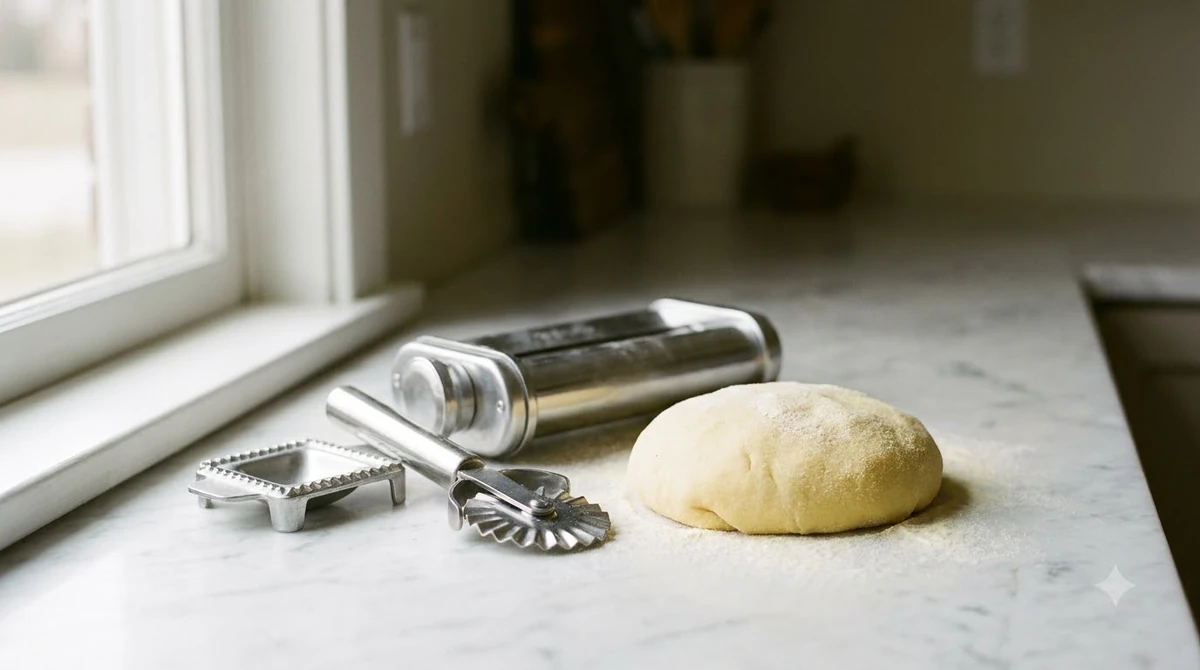

A ravioli maker is a tool that fills thin pasta dough and seals it into individual ravioli. It turns a sheet of dough and a spoonful of filling into shaped pockets without folding each piece by hand. Ravioli makers come in three main forms, and each one needs different equipment at home.
The right choice depends on what you already own. A manual press, a stand mixer attachment and a pasta machine attachment each need different tools, so check the fit before you buy.

Marcato Ravioli 150 Attachment for Atlas 150 Pasta
Pros & ConsViewHide
Reasons to buy
- Adds filled ravioli to an Atlas 150 setup
- Aluminum rollers per the listing
- 73% of ratings are 5-star
Reasons to avoid
- Booklet marks ravioli as hand-crank only, not for the motor
- Higher price than the cutter attachments
What a ravioli maker does
A ravioli maker forms and seals stuffed pasta, which means a filling enclosed in thin dough, usually cut into squares. The tool sets the shape and spacing, so each piece comes out close to the same size.
According to Wikipedia’s ravioli entry, the dough is usually made of water and flour, sometimes with eggs. Fillings vary by region, and the shapes are commonly square, although round and semicircular versions also exist.
Ravioli have long been made at home by hand, and our guide to homemade ravioli shows the basic method. Modern ravioli are also produced by machine. A home ravioli maker brings the forming step into the kitchen, so you can make the same shape again without measuring every piece. For the filling and sealing steps, see our guide on how to use a ravioli maker.
Three types of ravioli makers and what each needs
Ravioli makers come as manual presses, stand mixer attachments and pasta machine attachments. Each type needs different equipment, so match the tool to what is already in your kitchen before you shop.
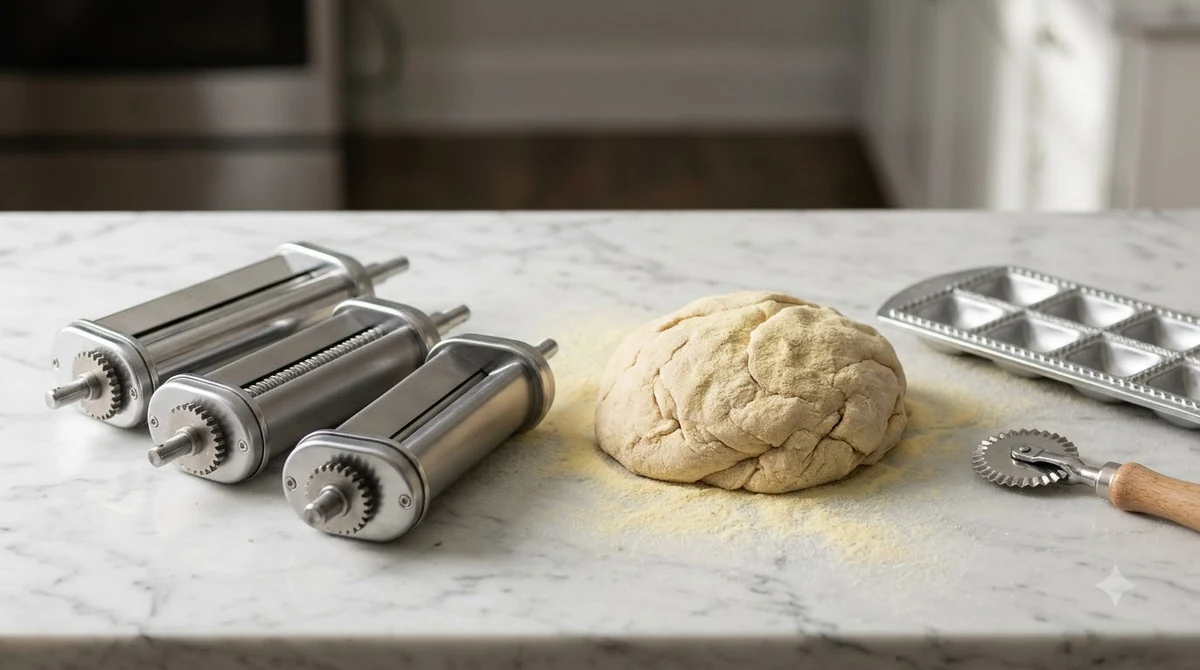
A manual press is a hand tool with fixed cavities that set the size and shape of each piece. It needs no mixer and no motor, but you can only make the sizes the press was built for. Our guide to how a ravioli mold works compares this style.
A stand mixer attachment mounts to the power hub of the mixer. The KitchenAid Ravioli Maker, model KRAV, is one example, and our guide on how to use the KitchenAid ravioli maker covers it in more detail. According to KitchenAid’s spec sheet, it fits all KitchenAid household stand mixers, and its handle is turned by hand while the mixer stays off.
The attachment does not roll sheets. KitchenAid recommends its Pasta Sheet Roller, sold separately, to make the sheets the attachment needs.
A pasta machine attachment fits a hand-crank pasta machine, and our guide on how to use a pasta machine covers the basics. The Marcato Ravioli 150 Attachment shown above, for example, is sold for the Marcato Atlas 150 machine. Wikipedia’s pasta maker entry describes the basic mechanism: a hand crank thins the dough through rollers, and the final pass can go through a shaped comb. A ravioli attachment adds a forming step to a machine you may already use for noodles.
Use these quick checks to narrow the list:
- You own a KitchenAid household stand mixer: the attachment is the simplest path, plus the separate sheet roller.
- You own a hand-crank pasta machine: look for a ravioli attachment that lists your machine model.
- You want no appliance at all: a manual press is the simplest option, but the shape is fixed.
How the main types compare
The KitchenAid attachment makes three wide rows per pass from a 6-inch roller, while a manual press makes one fixed shape per cavity. Compare each type against what you already own before you buy a ravioli maker.
| Tool type | What it needs | Output | Best for |
|---|---|---|---|
| Manual press | Dough sheet, no motor | One fixed shape per cavity | Cooks who want one set size and no appliance |
| KitchenAid Ravioli Maker (KRAV) | KitchenAid household stand mixer and the separate Pasta Sheet Roller | Three wide rows per pass, 6-inch roller | Owners of a compatible KitchenAid mixer |
| Pasta machine attachment | Hand-crank pasta machine that the attachment fits | Depends on the attachment; check the listing | Owners of a matching pasta machine |
Two questions narrow the list fast. Which machine do you already own, and do you want fixed shapes or a flexible sheet you can fill yourself? If you only make one shape, a press can be the simpler choice. If you would rather cut and seal squares from a sheet, see our guide to ravioli cutter types and sizes.
If you already make fresh noodles, an attachment may save you a second tool. Check the width of the sheet your machine makes, because the ravioli roller must match it.
How to use a ravioli maker step by step
Fold the sheet in half, feed it through the rollers, add one or two scoops of filling, and let the strips dry for at least 10 minutes. These steps follow KitchenAid’s help page for the KRAV attachment.
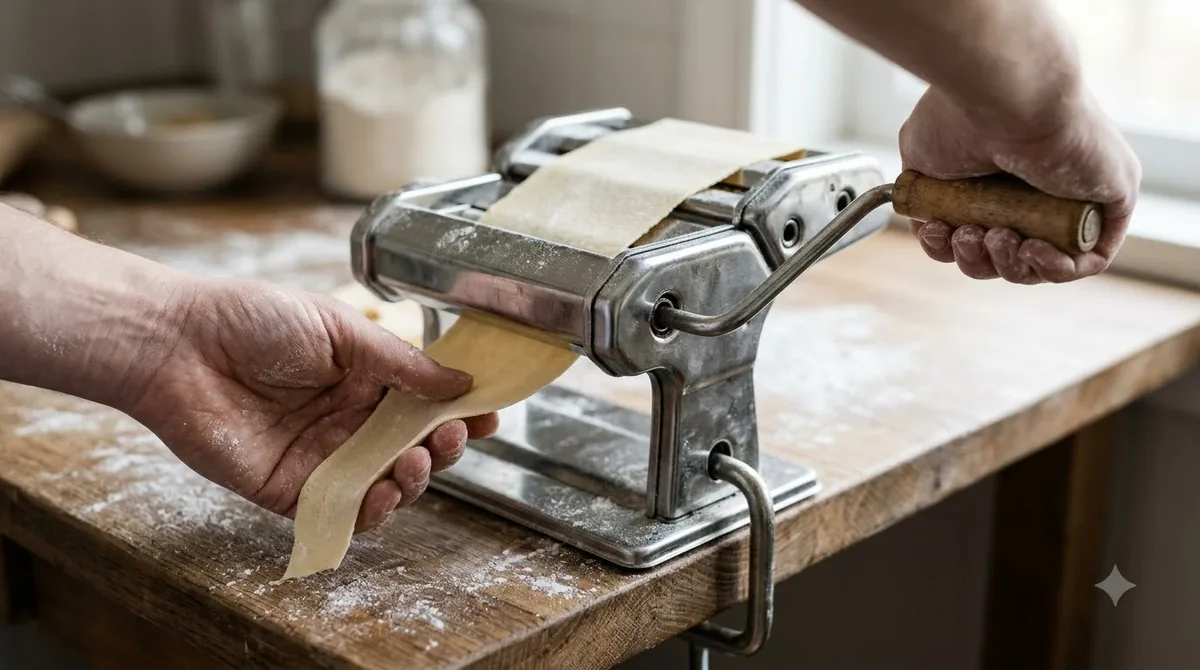
- Pull the hopper straight up from the attachment.
- Fold the pasta sheet in half and insert the folded end between the forming rollers.
- Turn the handle a quarter turn to feed the sheet, then drape both loose ends over the smooth metal rollers.
- Set the hopper on the dough, press until it clicks into place, and spoon in one or two scoops of filling.
- Turn the handle slowly, spread the filling into the corners, and use the scoop to remove extra filling.
- Lay the ravioli strips on a lightly floured surface to dry for at least 10 minutes.
- Clean the attachment with the brush, dust the rollers with flour, and tear the ravioli apart along the perforations.
According to KitchenAid’s help page for the attachment, the sheet should be about 1/16 inch (0.156 cm) thick and about 5 1/2 inches (13.75 cm) wide. The page does not give a dough recipe, so use a dough you already trust.
Run a practice pass with plain dough before you add filling. The help page recommends this for new users, and it shows whether your sheet has the right width before any filling goes in.
Do not overfill. The same help page says to stop feeding before the filling reaches the edge of the sheet, because filling that collects on the rollers can jam the attachment.

Cleaning, warranty and checking availability before you buy
The KitchenAid Ravioli Maker is hand wash only, carries a one-year warranty, and at least one retailer lists it as discontinued. Confirm its status before you plan a recipe around it.
- Clean by hand in warm soapy water. The KitchenAid spec sheet says not to use the dishwasher.
- Brush off dough with the included cleaning brush, and dust the rollers with flour before the next sheet.
- The spec sheet lists a one-year warranty, with free replacement if the unit fails in that first year.
- One retailer page lists the model as discontinued. Check the official product page before you buy.
No current price was verified for this guide. Resale listings vary widely, so compare the live price and the seller, and check the warranty terms before you pay.
Some details were not verified here, including current price, the cavity size of press-style models, and the fit of third-party attachments. Check the product page, the manual and your mixer or pasta machine model before you buy.
Common mistakes to avoid
Overfilling and skipping the drying step are two common errors with a ravioli maker. Both are easy to avoid with a practice pass and a short rest on a floured surface.
- Feeding filling to the edge of the sheet, which can collect on the rollers.
- Skipping the practice pass with plain dough, so the first sheet comes out the wrong width.
- Cooking the strips straight away instead of letting them dry for at least 10 minutes.
Frequently Asked Questions
Is a ravioli maker the same as a pasta machine?
No. A pasta machine thins dough through rollers, while a ravioli maker forms and seals filled shapes. Some pasta machines take a ravioli attachment, so check whether yours does before you buy a separate tool.
Do I need a separate pasta roller for the KitchenAid ravioli maker?
Yes. The KRAV attachment does not make sheets itself. KitchenAid recommends the Pasta Sheet Roller, which is sold separately, to make the sheets that match its 6-inch roller width.
Does the KitchenAid ravioli maker fit my stand mixer?
According to the spec sheet, it fits all KitchenAid household stand mixers through the attachment hub. If you are unsure about your model, check the product page or your mixer manual before you order.
Is a ravioli maker dishwasher safe?
No. The KitchenAid spec sheet says to hand wash the attachment in warm soapy water. Use the included cleaning brush to remove dough, and dust the rollers with flour before you roll the next sheet.
Is the KitchenAid ravioli maker still sold?
One retailer lists the KRAV as discontinued. Stock changes often, so check the official KitchenAid site or a current listing before you buy. No current price was verified for this guide.
What dough should I use in a ravioli maker?
The KitchenAid help page does not give a dough recipe. Use a dough you already know, and practice with plain dough first to confirm the sheet width and thickness before you add filling.
Start with the equipment you already own. If you have a KitchenAid stand mixer, the attachment is the simplest path, but confirm its status first. Otherwise, a manual press or a pasta machine attachment can cover the same task once you confirm the fit with your machine.
 9 min readGear & PantryHow to Use a Ravioli Maker: Step-by-Step for Dough and FillingUpdated Nov 10, 2026
 8 min readGear & PantryPizza Dough Roller: Types, Uses and What to Check Before You BuyUpdated Nov 8, 2026
 8 min readGear & PantryPizza Dough Docker: What It Does and What to Check Before You BuyUpdated Nov 17, 2026
 9 min readGear & PantryBest Pistachio Cream: What to Check Before You BuyUpdated Nov 8, 2026
 9 min readGear & PantryGozney Dome Stand: What to Check Before You Buy a TableUpdated Nov 17, 2026
 9 min readGear & PantryGozney Arc XL Stand: What to Check Before You BuyUpdated Nov 8, 2026