
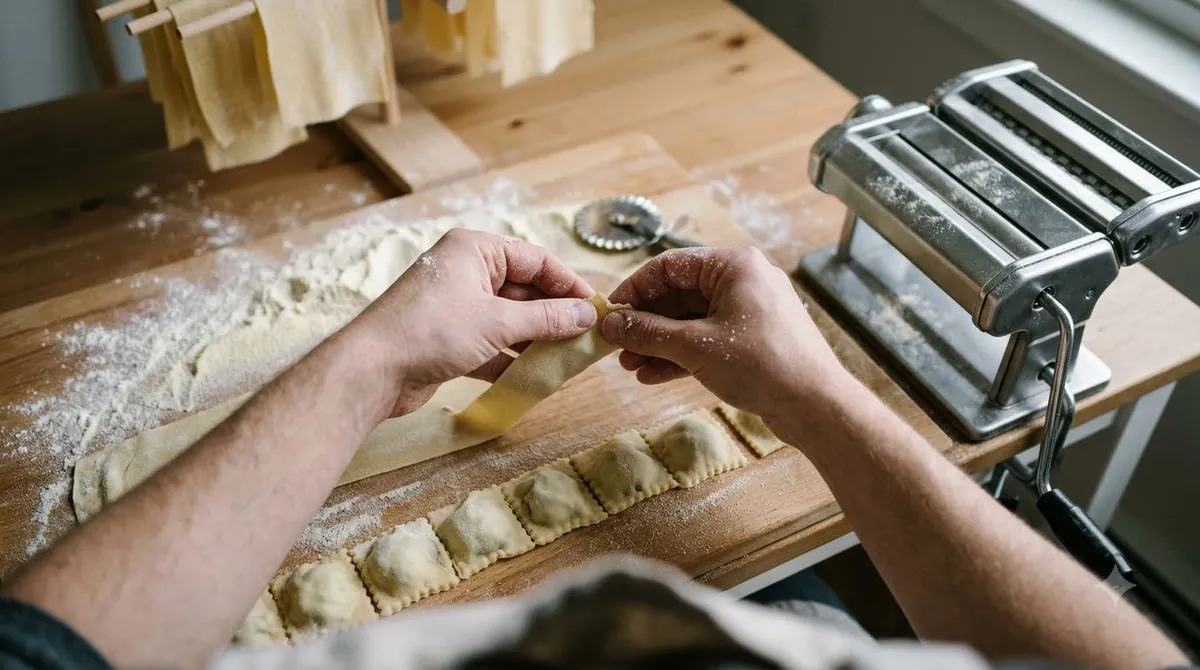

Here is how to shape ravioli: place a tablespoon of filling in mounds on one sheet of pasta, brush the dough with cool water, fold the top sheet over, press out the air and seal the edges before you cut. Standard ravioli are square, about 2 1/4 inches (5.7 cm) per side, and a fluted pastry wheel or knife does the cutting. The steps below follow a King Arthur Baking recipe and the Wikipedia overview of ravioli shapes.
What Shapes Can Ravioli Take?
Ravioli are most commonly square, though Wikipedia notes that circular and semi-circular shapes, called mezzelune, are also used.
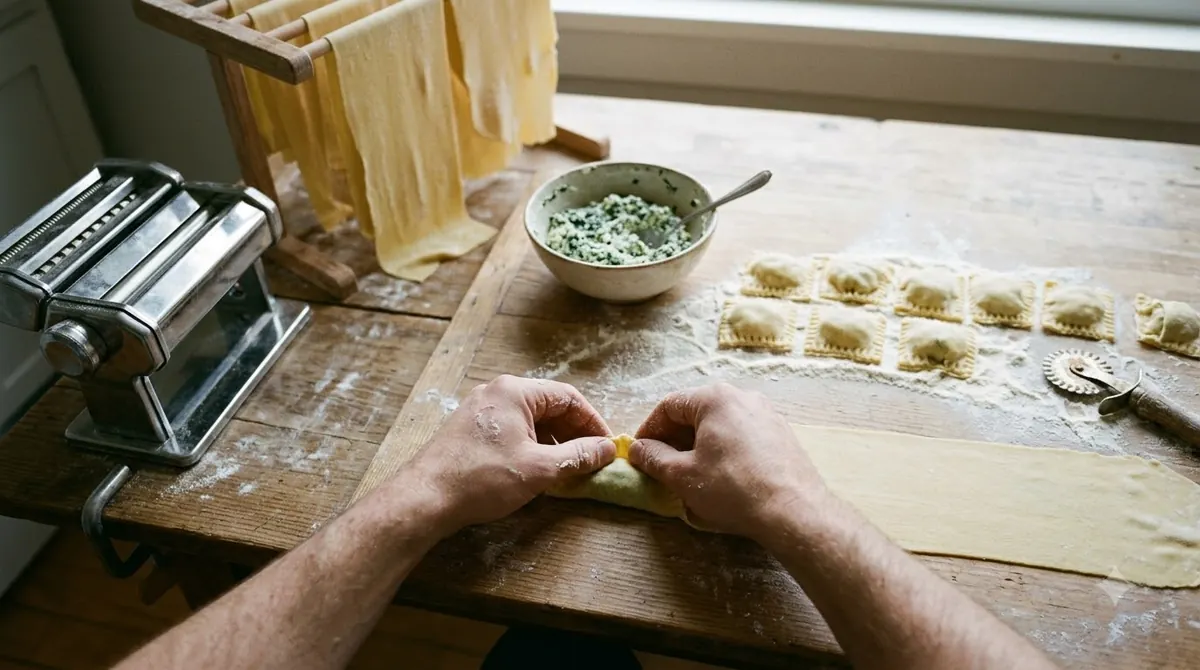
The King Arthur cheese ravioli recipe makes square ravioli measuring 2 1/4 by 2 1/4 inches. The sheet is trimmed to 4 3/4 inches wide, which leaves room for the filling and the seal. Round shapes are not given dimensions in that recipe, so check any round cutter’s size against your sheet before you start.
Shape choice affects how the seal works. A square piece has four straight edges to press together, while a round or half-moon piece has a curved edge that needs to be pressed evenly all the way around.
How to Place the Filling on the Sheet
Set one tablespoon of filling about half an inch from the left and bottom edges, then space the mounds one inch apart. If you also like folded shapes, see tortellini compared with ravioli.
The King Arthur method gives about 14 to 15 mounds per sheet and leaves at least half an inch of bare pasta at the far end. That margin is what the top sheet folds over, so keep it clear of filling.
Keep the mounds in a straight row and check the spacing before you fold. Crowded mounds leave too little dough between them, and the seals can tear when you cut.
How to Seal Each Ravioli
Brush cool water along the bottom edge and around each mound, fold the top sheet over, press out the air from the centre outward, and seal lightly. A simple cutting tool is explained in using a ravioli stamp. A smaller pinched pocket is described in pinched agnolotti pockets.
Pressing from the centre outward pushes trapped air to the edges instead of leaving it under the filling. Seal lightly, so that the pasta encases the filling without squeezing it out.
- Brush cool water along the bottom edge and around each mound.
- Fold the top sheet over to match the bottom edge.
- Press out the air from the centre outward.
- Seal lightly so the pasta encases the filling.
How to Shape Ravioli: Cutting the Pieces
A fluted pastry wheel or a knife trims the bottom edge and the ends, then slices between the mounds to separate the ravioli. The standard method does not need a dedicated cutter. If you want uniform squares, see ravioli molds for even shapes.
For heart shapes, the same recipe uses a heart ravioli stamp dipped in flour. It marks 8 to 10 hearts per sheet, the second sheet goes over the filled hearts, and the stamp cuts the shapes. The recipe does not state the spacing between hearts beyond the alternating pattern, so keep the pattern even by eye.
Let the shaped ravioli rest before you cook them. The recipe calls for a dough rest of at least 30 minutes at room temperature, or up to overnight in the fridge.
Yield and Timing
The King Arthur recipe uses two dough pieces of about 190 g each and yields 28 to 30 ravioli. The hands-on time is about 40 minutes, and the total time is 1 hour 10 minutes including the rest and the cooking. The dough and filling steps are in our ravioli dough and filling guide.
Make the filling first so it can chill while the dough rests. Keep the sheets covered while you work so they do not dry out before you fill the mounds.
Each sheet holds 14 to 15 mounds in the standard method, so two sheets give roughly 28 to 30 pieces, which matches the recipe’s yield.
Common Mistakes When Shaping Ravioli
Most problems come from placing the filling too close to the edge, trapping air, or cutting before the seal is pressed. Each one can make the ravioli open in the water.
Filling set too close to the edge leaves no dough to fold over, so the seal fails. Keep the half-inch margin the recipe gives, and the bottom edge will close cleanly.
Trapped air swells and pushes the seal apart while the ravioli boil. Press from the centre outward before you trim, and check each edge with a fingertip.
Storing and Cooking Shaped Ravioli
The King Arthur recipe lists frozen storage for up to 2 weeks, and notes that frozen ravioli may need a couple of extra minutes of cooking.
Cooked leftovers keep for up to 2 days in the refrigerator when stored with sauce, according to the same recipe.
For cooking, boil the ravioli for 6 to 8 minutes, flipping them every couple of minutes so they cook evenly.
Trim the sheet to the recipe’s 4 3/4 inch width before you start placing filling. A consistent width keeps the ravioli the same size, so they cook at the same rate and the seals line up when you cut them apart.
Use a fluted pastry wheel or a sharp knife for the final cut, and cut straight down between the mounds rather than dragging the blade, so the seal is not pulled open at the edge.
Frequently Asked Questions
What shape is standard ravioli?
Square is the most common shape. The King Arthur recipe makes squares of 2 1/4 by 2 1/4 inches, and Wikipedia notes that round and half-moon shapes are also used.
Do I need a cutter to shape ravioli?
No. The standard method uses a fluted pastry wheel or a knife to trim and separate the pieces. A stamp or cutter is only needed for a specific shape, such as the heart stamp in the recipe.
How long should I boil shaped ravioli?
The King Arthur recipe says to boil for 6 to 8 minutes, flipping them every couple of minutes. Frozen ravioli may need a couple of extra minutes.
How long should the dough rest before shaping?
At least 30 minutes at room temperature, or up to overnight in the refrigerator, according to the King Arthur recipe.
Neat ravioli come from a few habits: even mounds, a light seal, and air pressed out before you cut. Practise with one sheet first, and the rest of the batch will follow the same pattern.
 8 min readLearnTortellini vs Ravioli: Shape, Filling and Cooking ComparedUpdated Nov 12, 2026
 8 min readLearnChicago Tavern Style Pizza Recipe: Thin, Crisp and Cut in SquaresUpdated Nov 11, 2026
 7 min readLearnQuadrucci Pasta: The Small Square Egg Pasta for SoupUpdated Nov 11, 2026
 8 min readLearnWhat Is Spaghetti alla Chitarra? The Square Egg Pasta of AbruzzoUpdated Nov 6, 2026
 8 min readLearnWhat Is Tavern Style Pizza? A Thin, Square-Cut Chicago ClassicUpdated Nov 6, 2026
 5 min readLearnBest Sauce for Ravioli: Brown Butter, Walnut and Cream OptionsUpdated Nov 13, 2026