
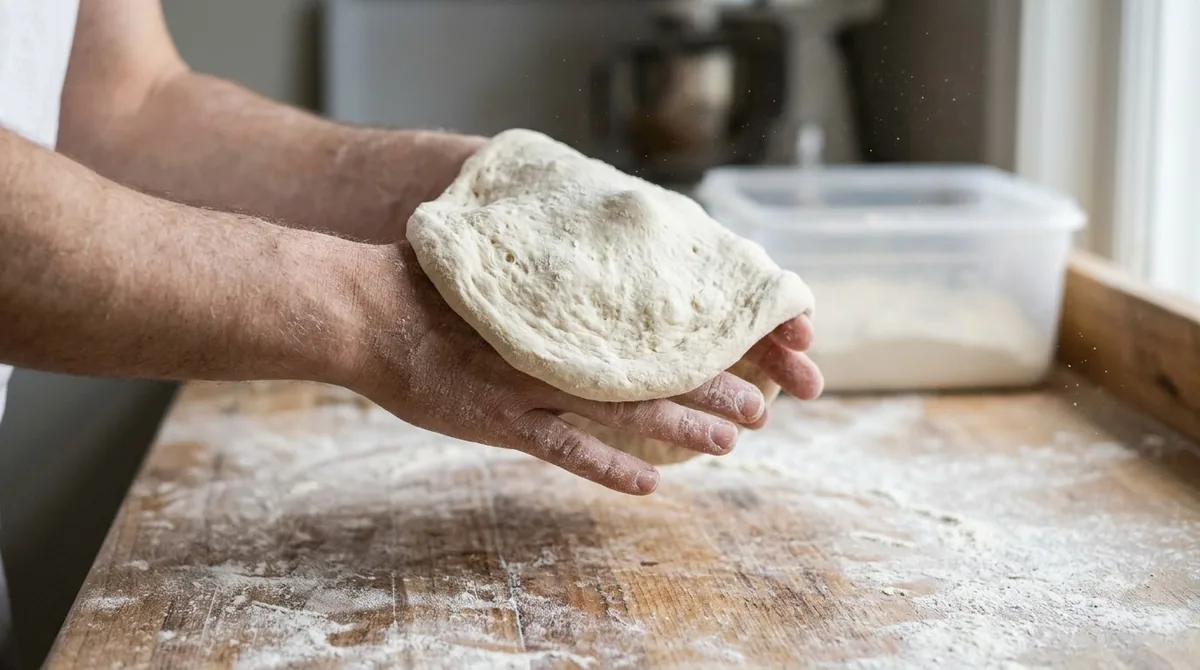

A pinsa romana recipe makes an oval Roman-style flatbread from a blend of wheat, rice and soy flour, with a long cold rise and a very hot grill. The dough is wetter and rests longer than most pizza doughs, so timing matters as much as technique. Follow the weights and steps below to bake six flatbreads at home.
What Is Pinsa Romana and Where Did It Come From?
Pinsa romana is a trademarked name for an oval flatbread that is pressed by hand rather than spun, and it is usually light, with an airy interior and a crisp outside. For another Roman flatbread, see this Roman olive oil flatbread method.
According to Wikipedia’s article on pinsa bread, Italian entrepreneur Corrado Di Marco registered the trademark in 2001, although his company had added the tray-baked dough to its range as early as 1981. The article also says the link to ancient Rome is disputed, because Di Marco later admitted he had invented that history to promote the product. The name draws on the Latin verb pinsere, which means to pound or crush.
The dough mixes wheat, soy and rice flours with yeast, salt, oil and cold water. Wikipedia notes that some versions also use sourdough. The home pinsa romana recipe below uses active dry yeast only, because that is the version the recipe source describes, so you do not need a starter to follow it.
Pinsa Romana Recipe Ingredients and Exact Weights
This pinsa romana recipe makes six flatbreads and uses the weights from the Fine Dining Lovers pinsa romana home recipe, which also serves six.
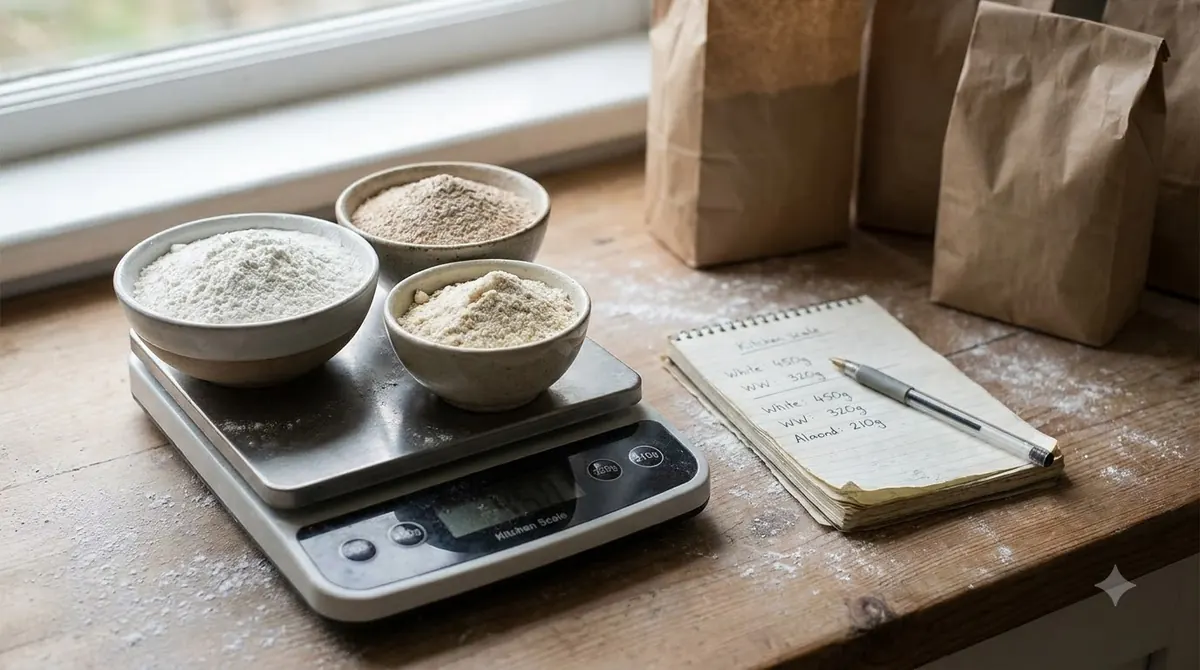
- 500 g bread flour, plus extra for dusting
- 50 g white rice flour
- 30 g soy flour
- 3.5 g active dry yeast
- 400 g cold filtered water, at refrigerator temperature
- 14 g fine sea salt
- 10 g extra-virgin olive oil, plus more for brushing
- Vegetable oil or nonstick spray for the bowl and baking sheet
The pinsa romana recipe uses 580 g of flour and 400 g of water. Those weights work out to roughly 69 percent water to flour, a figure calculated from the recipe because the source does not state it. If percentages are new to you, read how hydration percentages work. Expect a soft, slightly sticky dough at first, and avoid adding extra flour during kneading unless the dough becomes impossible to handle.
Weigh every ingredient for your pinsa romana recipe with a kitchen scale. Volume measures for flour vary widely, and a 20 g difference in flour changes how wet the dough feels.
Mixing the Dough and the 24-Hour Cold Rise
Knead the dough for this pinsa romana recipe in stages over about 15 minutes, then refrigerate it for a full 24 hours in a lightly oiled bowl.
- Combine the bread, rice and soy flours with the yeast in a stand mixer fitted with a dough hook.
- Add 1 and 1/2 cups of the water and knead on low for about 3 minutes, until no dry flour remains.
- Add the salt and olive oil, knead on medium, and add the remaining 1/4 cup of water gradually.
- After 2 to 3 minutes, raise the speed to medium-high and knead for about 10 minutes, until the dough is smooth and elastic.
- Cover the bowl tightly and refrigerate the dough for 24 hours.
The pinsa romana recipe calls for a full 24 hours in the refrigerator, and the source gives no shorter option. A wet dough like this one benefits from the slow rest, much like a slow cold fermentation timeline, so do not shorten it to save time. If you knead by hand instead of using a mixer, the source gives no hand-kneading times, so judge the dough by feel: it should look smooth and feel elastic before it goes into the fridge.
Keep the bowl covered so the surface does not dry out during the cold rest of your pinsa romana recipe. Take the dough out of the refrigerator on the day you plan to bake, because the next step begins with room-temperature proofing.

Shaping Each Pinsa Without Flattening the Dough
Divide the chilled pinsa romana recipe dough into six pieces of about 165 g (5.8 oz) each, then shape them into balls and let them proof until doubled, which takes 2 to 3 hours at room temperature.
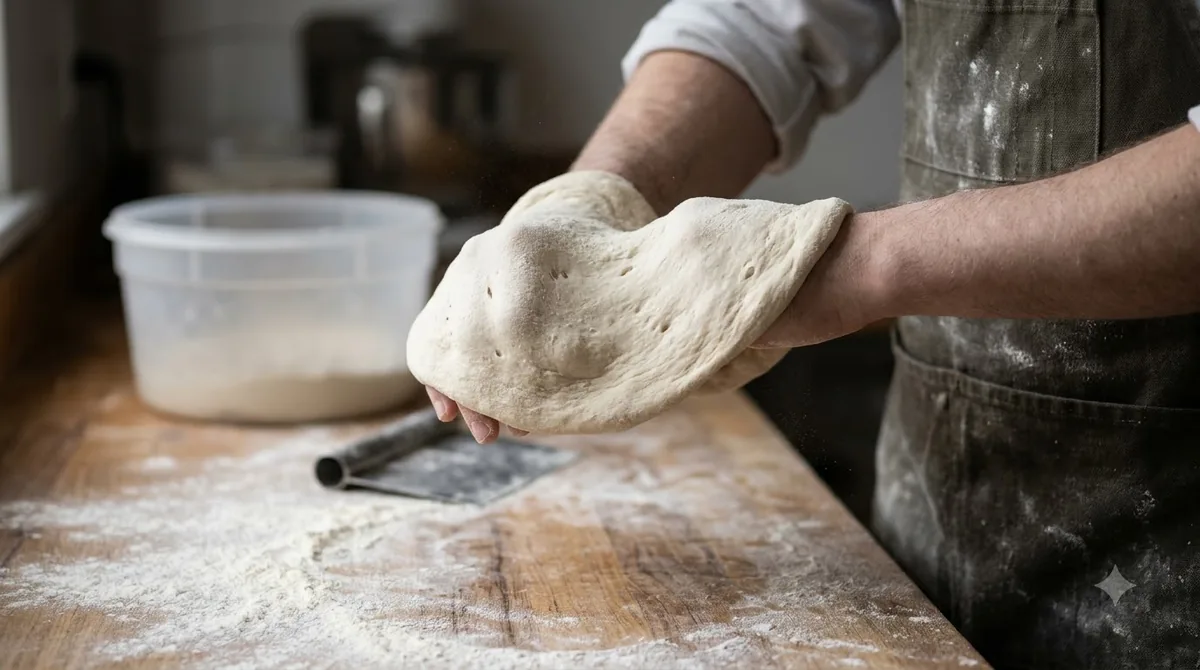
- Divide the dough into six pieces of about 165 g each.
- Fold the corners of each piece into the center without flattening it.
- Space the balls on a greased baking sheet, dust them lightly with bread flour, cover, and let them rise at room temperature for 2 to 3 hours, until doubled.
- While the dough rises, heat the grill to 660 F (350 C) well ahead of baking.
- On a floured surface, press each ball from the center outward into an oval about 6 by 10 inches.
Press from the center outward rather than from the edges, because the source describes pinsa as pressed into shape, not spun. Brush one side with olive oil, lift the dough without tearing it, and shake off the excess flour before it goes onto the grill.
If a ball deflates while you handle it, the most likely cause is that it was flattened during folding. Fold the corners in and leave the air inside the ball until you press it out at the last moment.
Cooking Pinsa on a Hot Grill
For this pinsa romana recipe, the source bakes each piece on a grill preheated to 660 F (350 C), and the whole cook takes about 3 minutes.
- Place the oiled side of the dough down on the grill and bake for 30 seconds with the lid closed.
- Brush the other side with oil, flip the pinsa, and bake for another 30 seconds with the lid closed.
- Keep flipping every 20 to 30 seconds until both sides are golden, about 3 minutes in total.
- Serve with the hottest side facing up, topped as you like.
Keep the lid closed between flips in this pinsa romana recipe so the heat stays inside the grill. The source gives no oven temperature or bake time, so if you use a home oven or a pizza oven, check the manufacturer’s manual for that appliance before you start.
Topping a pinsa is simple. The source lists tomato sauce, mozzarella and basil, and describes the base as fully customizable. Add toppings after the first side is cooked and the second side is in the flip, so they stay warm without sliding off.
Common Mistakes and How to Fix Them
Most problems with a pinsa romana recipe come from skipping a rest, handling the dough too roughly, or misjudging the heat, and each one has a simple fix.
| Problem | Likely cause | Fix |
|---|---|---|
| Dough is hard to handle | The dough is wet by design, at 400 g water to 580 g flour | Keep to the three-stage kneading and the cold rest, and dust the surface rather than the dough |
| Balls deflate when shaped | The dough was flattened during the fold step | Fold the corners to the center and press out only after the rise |
| Pieces do not double | The room is cold or the rise was cut short | Allow the full 2 to 3 hours until doubled |
| Crust burns before the center cooks | The grill is too hot or the flips are too slow | Preheat fully to 660 F and flip every 20 to 30 seconds |
| Dense, tight texture | The dough was under-kneaded or rested less than 24 hours | Knead the full 10 minutes on medium-high and keep the 24-hour cold rise |
If the dough tastes flat, the cause is usually timing rather than flour, so check the cold rise before changing the recipe. Change one variable at a time, and write down the grill temperature and the bake time for each batch. For more dough basics, browse the pizza and pasta learning guides.
Frequently Asked Questions
Can I make pinsa dough the same day?
The pinsa romana recipe is built around a 24-hour cold rise, and the source does not describe a same-day method. Plan at least 24 hours of resting before you shape the dough, then add 2 to 3 hours of room-temperature proofing.
Is pinsa the same as pizza?
No. The pinsa romana recipe above makes an oval flatbread from a blend of wheat, soy and rice flours, and it is pressed by hand rather than spun. Wikipedia notes that it is often marketed as an oval-shaped alternative to pizza.
Does pinsa contain gluten?
Yes, because the recipe uses wheat flour. The publisher describes pinsa as lower in gluten because of the flour mix, but that is a marketing claim. People with celiac disease should check with a doctor before eating it.
Can I use all-purpose flour instead of bread flour?
The source specifies bread flour and does not discuss substitutes. Changing the flour can change how much water the dough absorbs, so watch the texture closely on your first batch.
Do I need a grill to make it?
The source bakes pinsa on a hot grill at 660 F (350 C) and gives no oven settings. If you use an oven, follow your appliance manual, because the grill timing in this recipe may not transfer directly.
How many pinsa does a pinsa romana recipe like this make?
The recipe makes six pieces of about 165 g each, which shape into six oval flatbreads. Each one bakes in about 3 minutes, so you can cook them one at a time as guests arrive.
The 24-hour cold rise is the step most people try to shorten, and it is also the one that matters most for this dough. Make this pinsa romana recipe a day ahead, check your grill temperature before you shape, and keep your first batch as a test for timing. Your results will show whether your grill runs hotter or cooler than the source’s settings.
 7 min readLearnWhat Is Pinsa? The Oval Roman Flatbread ExplainedUpdated Nov 6, 2026
 8 min readLearnHow to Bring Pizza Dough to Room Temperature Before ShapingUpdated Nov 11, 2026
 5 min readLearnHomemade Rigatoni: Dough, Shaping and TipsUpdated Nov 13, 2026
 5 min readLearnHomemade Fusilli: Dough, Shaping and Press SettingUpdated Nov 13, 2026
 6 min readLearnHow to Make Tortellini by Hand: Dough, Filling and ShapingUpdated Nov 13, 2026
 5 min readLearnHomemade Macaroni: Dough, Shaping, Drying and Cooking TipsUpdated Nov 13, 2026