
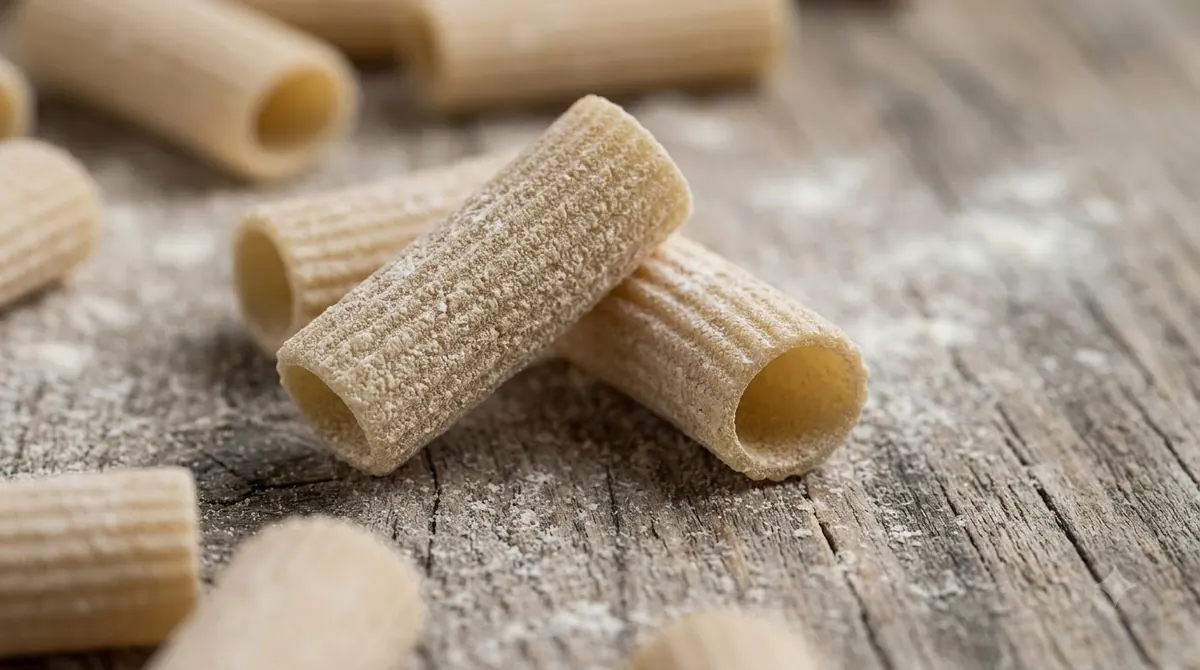

Pipe rigate pasta is a small, ridged, curved pasta shape whose name means grooved pipes. Wikipedia’s list of pasta describes it as very similar to lumaconi but smaller, with lines running the length of each piece. Shapes and sizes vary by brand, so the package is the best guide.
It is easy to confuse with penne rigate, a straight tube with grooves. The cooking advice below comes from sources about related ridged shapes, so confirm the time on your own box.
What Pipe Rigate Pasta Looks Like
Pipe rigate pasta is a small, grooved dried pasta, described by Wikipedia as very similar to lumaconi but smaller, with ridges that run along its length, and those grooves give sauce more places to cling than a smooth shape offers.
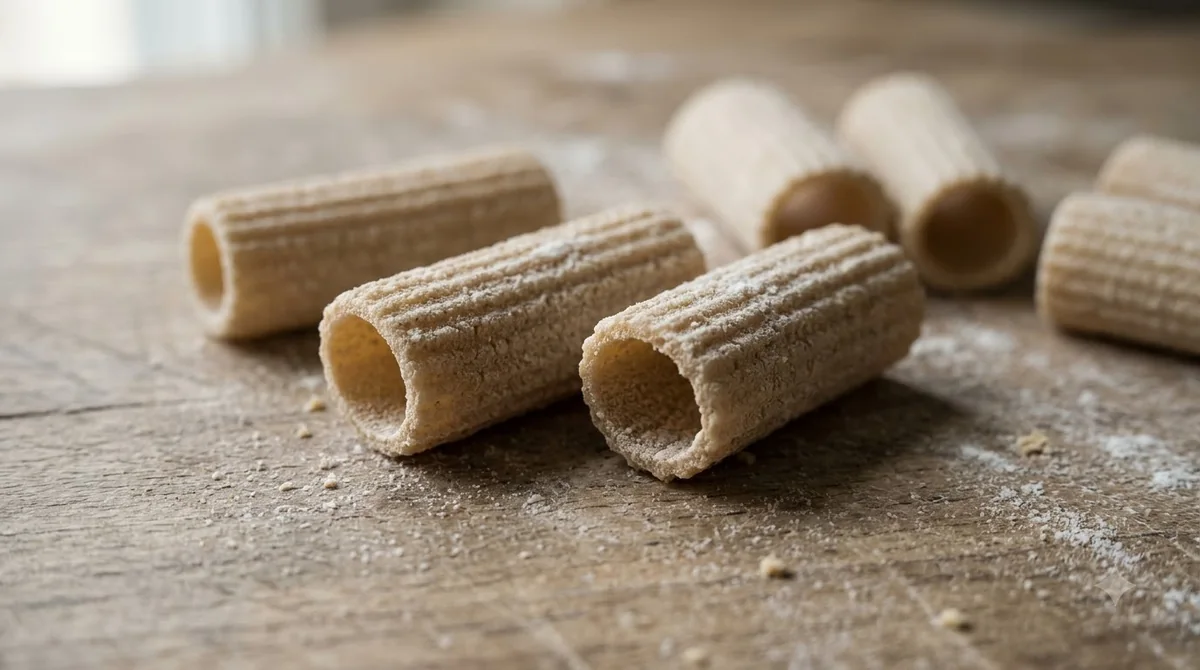
Wikipedia’s list of pasta translates the name as grooved pipes, and its entry for lumache describes snail-shell pieces that are larger than pipe. CooksInfo describes lumache, the smaller cousin of lumaconi, as hollow shells open at one end, closing in on itself at the other, and used with chunky sauces. Pipe rigate pasta works on the same principle: the ridged outside grips thick sauce, and the hollow centre holds small pieces of meat or vegetables.
Brands name their ridged shapes differently, so the name on the front of the box does not settle the shape. DeLallo’s penne guide says the grooves on penne rigate are “perfect for capturing sauces,” a useful comparison because penne rigate is a straight ridged tube, not the curved shape of pipe rigate. Check the photo on the box or the brand page before you buy pipe rigate pasta on name alone.
When you follow a recipe, compare its shape with the one you bought. A recipe written around a different shape may still work if the size is similar, but a recipe that depends on a specific cut or length should be followed with the shape the author used. Small differences in size change how the pasta sits on a fork and how much sauce it carries.
Where the Name and Shape Come From
The origin of pipe rigate pasta is not confirmed by the pages reviewed, and the related penne shape has its own disputed history between Genoa and Southern Italy.
The sources reviewed give no origin for pipe rigate itself. For penne, DeLallo notes that some say it comes from Genoa in Liguria, while others claim it is a product of Southern Italy, and Wikipedia’s penne entry credits Genoese maker Giovanni Battista Capurro with patenting a diagonal cutting machine in 1865.
That 1865 date belongs to the angled penne cut. It says nothing about when pipe rigate pasta first appeared, so read it as penne history, not as the history of pipe rigate pasta.
Because pipe rigate and penne rigate sound alike and are both ridged, they are easy to mix up. When a page describes penne, read it as a neighbour of pipe rigate pasta rather than a direct description of it. Where a detail matters for your pot, such as a cooking time or a water amount, use the figure from the package you are actually cooking.
Which Sauces Suit Pipe Rigate
Thick, chunky sauces suit pipe rigate pasta best, because the grooves and hollow centre hold small pieces that a thin sauce leaves in the bottom of the bowl.
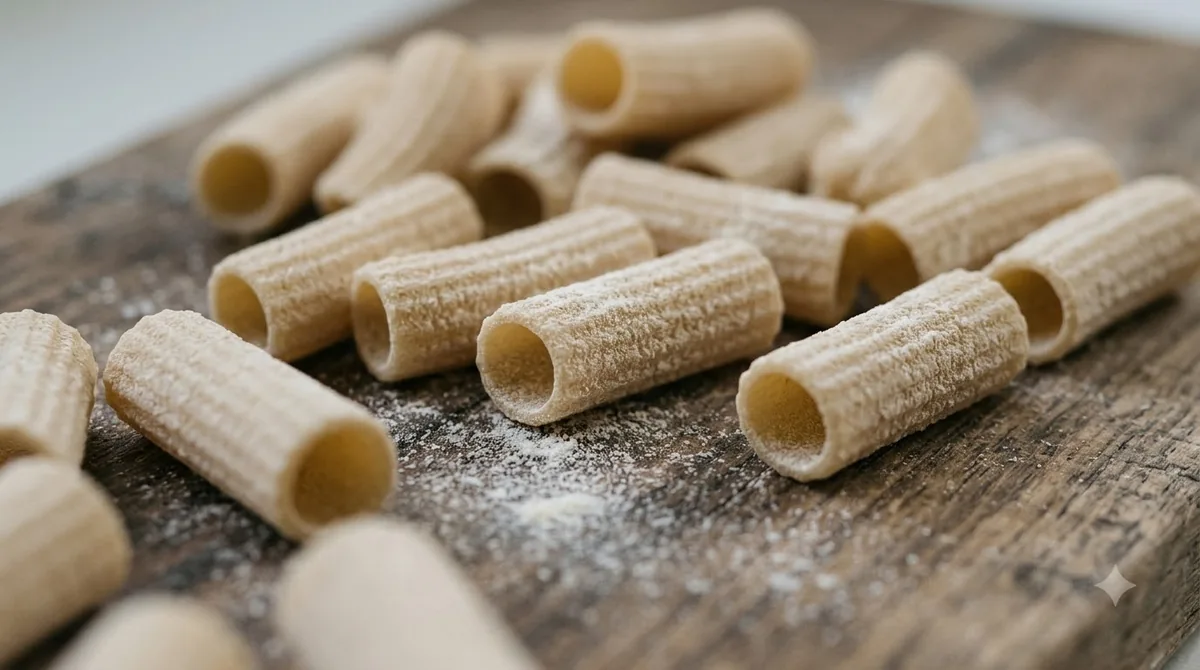
DeLallo names heavier meat ragù and chunkier tomato sauces as the traditional pairings for its penne rigate. Wikipedia’s penne entry also lists pesto, marinara and arrabbiata. Seafood and light cream sauces are not typical in Italy, though DeLallo says they are not out of the question.
| Sauce | Why it works | Source note |
|---|---|---|
| Meat ragù | Thick sauce clings to the grooves and holds small pieces of meat | DeLallo lists it as traditional |
| Chunky tomato sauce | Chunks settle into the hollow centre | DeLallo lists it as traditional |
| Pesto | Oily sauce coats the surface evenly | Wikipedia’s penne entry lists it |
| Arrabbiata | Spicy tomato sauce coats the grooves | Wikipedia’s penne entry lists it |
| Seafood or light cream | Thin sauce pools at the bottom of the bowl | Not typical in Italy, per DeLallo |
Pick the sauce first, then the shape. A pipe rigate pasta dish works best when the sauce is thick enough to coat each piece without pooling on the plate.
Match the sauce to the ingredients inside it. Chunky sauces with small pieces of meat or vegetables suit a ridged shape with a hollow centre, because those pieces can settle inside. A smooth, thin sauce has nothing to hold, so more of it stays in the bowl. Spoon a little sauce onto the cooked pasta first, toss, and add more only if the tubes look dry.
How to Cook Pipe Rigate Pasta
Cook pipe rigate pasta in a large pot of salted water, and start checking for doneness at the early end of the package time, which is usually 9 to 12 minutes for dried pasta.
For pipe rigate pasta, the closest guide is DeLallo’s penne rigate advice: about 5 quarts of water for each pound of pasta, salt added as much as you like, and a cooking time of 10 to 12 minutes. Wikibooks’ pasta cookbook gives about 4 liters of water for every 200 grams of dried pasta. Confirm the time on your own package, and see our guide on how long to boil penne for a related ridged shape.
- Fill a large pot with water and bring it to a rolling boil.
- Salt the water to taste. DeLallo says the amount is up to you.
- Add the pasta and stir during the first minute so the pieces do not clump.
- Taste a piece at the early end of the package time, and keep checking until it is al dente.
- Drain, then toss the pasta with the sauce in the pan so it coats the grooves.
Tossing in the pan is the step that puts sauce into the grooves rather than on top of them. Serve the pasta straight away, since pasta left to sit can soak up sauce and firm up as it cools.
Pipe Rigate in Baked Dishes
Ridged tubes like rigatoni are often used in baked dishes, but none of the pages reviewed gave a baking time for pipe rigate pasta.
Wikibooks’ pasta cookbook describes rigatoni as inch-long ridged tubes, often used in baked dishes. The same grooves that hold sauce on the stovetop can hold cheese and sauce in an oven bake. The page reviewed does not give a bake time, so the recipe or package is the reference.
Cook the pasta to the package time before it goes into the dish. That way the bake only needs to melt, heat and combine, not finish the cooking of the pasta itself.
Common Mistakes to Avoid
DeLallo says never to add oil to the cooking water, and that is the first mistake to avoid with pipe rigate pasta.
- Adding oil to the water, which DeLallo says never to do.
- Cooking to a time copied from a different shape or brand instead of the package.
- Choosing a thin, watery sauce that will slide off the grooves.
- Judging the shape by its name alone, since brands label ridged shapes differently.
- Skipping the early taste test, which DeLallo recommends for its penne rigate.
Most of these mistakes come from treating the shape as a generic dried pasta. Read the package, taste early, and keep the oil out of the water, and pipe rigate pasta behaves the way the sauce needs it to. Check the sources linked above when a specific time or water amount matters for your pot.
Frequently Asked Questions
What is the difference between pipe rigate and penne rigate?
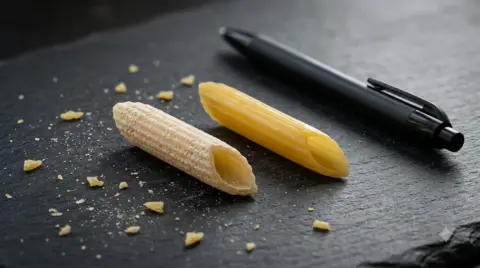
Both are ridged dried pasta, but they are different shapes. Wikipedia describes penne as a tube with ends cut at an angle, while its list of pasta describes pipe rigate as very similar to lumaconi but smaller, with lines running the length of it. Read the package and the photo before you buy.
What can I use instead of pipe rigate pasta?
A small ridged shell such as lumache or a small lumaconi-style shell is the closest match in shape, and penne rigate or rigatoni work as ridged stand-ins for chunky sauces, since Wikibooks describes rigatoni as an inch-long ridged tube. Pick a shape of similar size and follow its own package time.
How long should you cook pipe rigate pasta?
Cook it for the time on the package. DeLallo gives 10 to 12 minutes for its penne rigate, and Wikibooks gives 9 to 12 minutes for dried pasta. Start tasting near the early end, and drain once it is al dente.
Should you add oil to the pasta water?
No. DeLallo says never to add oil to the water when cooking its penne rigate. Salt the water to taste and use a large pot so the pasta has room to move.
Where does pipe rigate pasta come from?
Its origin is not confirmed by the pages reviewed. Sources give different accounts for the related penne, including Genoa in Liguria and Southern Italy, but no page reviewed gives a place or date for pipe rigate, so treat its origin as unsettled.
Pipe rigate pasta is the right pick when the sauce is thick, chunky or meaty and needs something to cling to. A thin, light sauce is better matched to a smooth shape, so the choice of shape should follow the sauce. Cook it in salted water for the time on the box, check it early, and skip the oil. If the box shows a different cut or time, follow the box. More shape guides are in our Learn section.
 9 min readLearnPenne Rigate vs Penne Lisce: Does the Ridged Surface Matter?Updated Nov 11, 2026
 8 min readLearnWhat Is Fileja Pasta? A Calabrian Shape ExplainedUpdated Nov 11, 2026
 8 min readLearnChifferi Pasta: Shape, Cooking and 1 Simple RecipeUpdated Nov 10, 2026
 8 min readLearnFarfalline Pasta: The Miniature Bow-Tie ExplainedUpdated Nov 10, 2026
 8 min readLearnTajarin Pasta: What It Is, How It Is Made and How to Serve ItUpdated Nov 11, 2026
 7 min readLearnRicciolini Pasta: What the Little Curls Are and How to Cook ThemUpdated Nov 11, 2026