
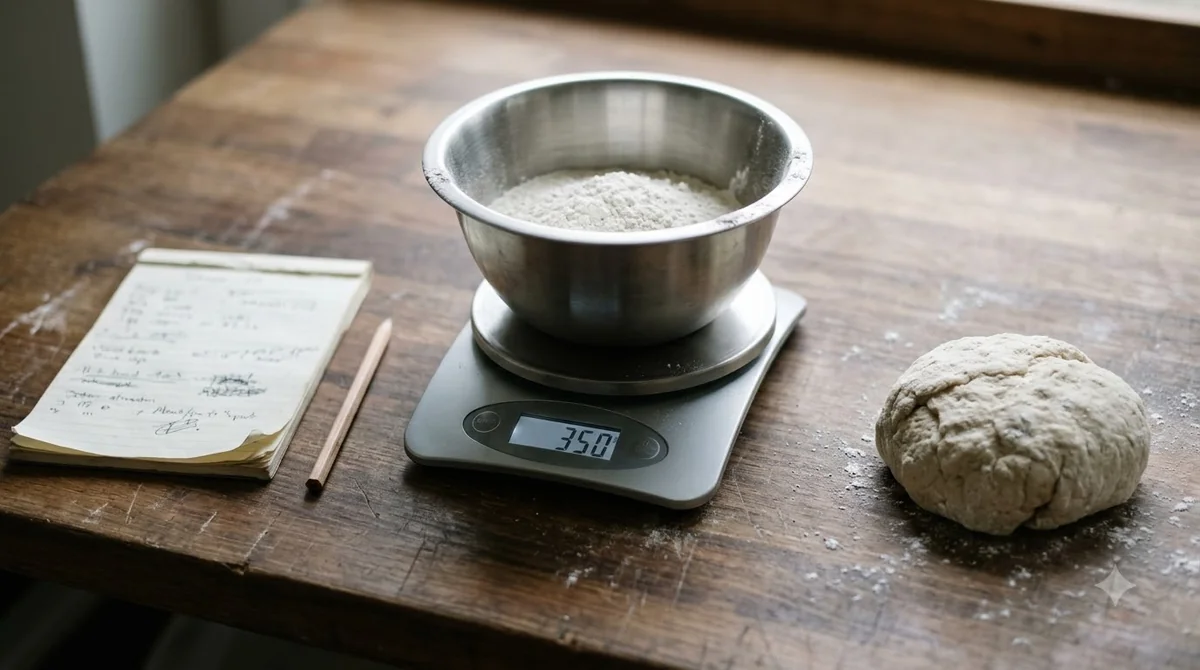

Pizza dough without yeast uses baking powder as its leavening agent, so the dough needs no rise time. The recipe below makes one 12-inch crust and bakes for 12 minutes at 480°F. Baking powder releases gas when it meets liquid, and that gas lifts the dough.
Pizza dough without yeast is quick to mix and has no rise, so it differs from yeasted dough in both texture and timing. Choose it when you have no yeast on hand and plan to bake the same evening.
The recipe for pizza dough without yeast
One 12-inch crust uses 1 1/3 cups of bread flour, 2 teaspoons of baking powder, 3/4 teaspoon of salt, 3/4 teaspoon of sugar, 2 teaspoons of olive oil and 1/2 cup of cold tap water. The amounts for pizza dough without yeast come from RecipeTin Eats’ no-yeast recipe, which yields one 30 cm (12 inch) pizza.
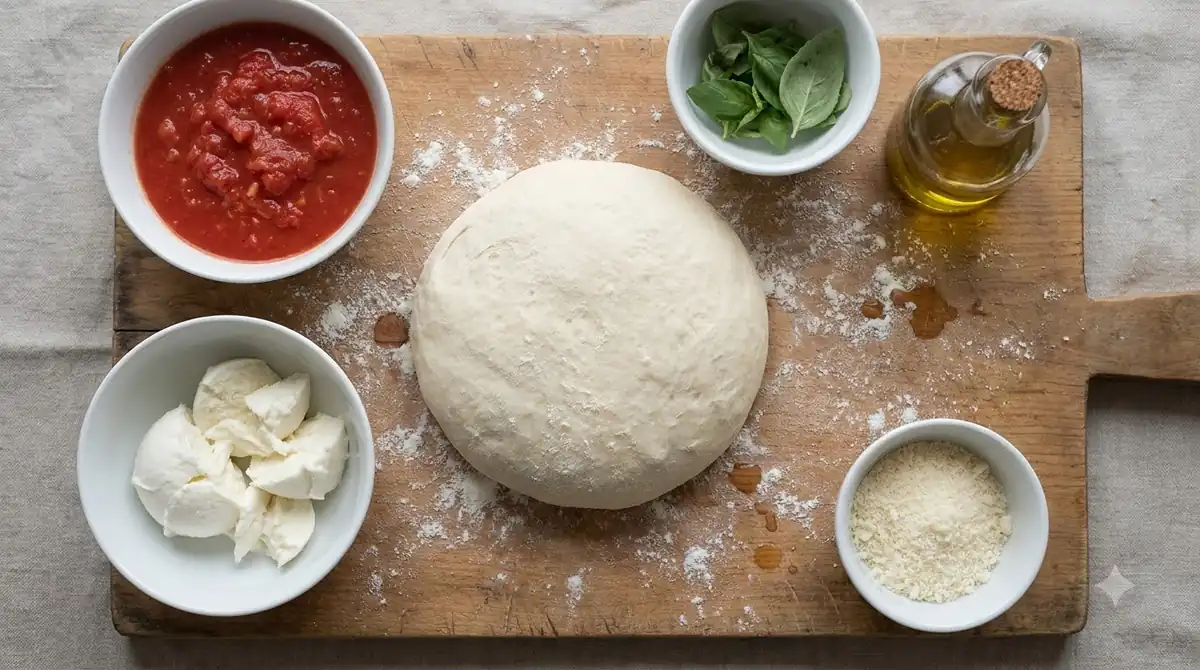
- 1 1/3 cups bread flour (plain or all-purpose flour also works)
- 2 teaspoons baking powder
- 3/4 teaspoon salt and 3/4 teaspoon sugar
- 2 teaspoons olive oil, or another oil
- 1/2 cup cold tap water
- 1 tablespoon extra flour for dusting, and optionally 2 teaspoons vegetable oil for brushing the crust
Before you start, lightly oil a pizza pan or baking tray. The recipe asks you to prepare the sauce and toppings first, because the dough should go into the oven soon after it is mixed.

Why baking powder can replace yeast
In pizza dough without yeast, baking powder replaces yeast by releasing carbon dioxide into the dough, and the gas bubbles expand to lighten the texture. Baking powder is a dry leavening agent, and Wikipedia’s baking powder entry describes how it is built.
Most baking powders contain a base, usually sodium bicarbonate, plus one or more acid salts. A starch such as cornstarch keeps the base and acid apart until the powder is used, which also helps it flow and measure accurately.
Single-acting and double-acting powders
Single-acting baking powder releases all of its gas as soon as it is dampened. Double-acting powder has a fast-acting acid that reacts in a cool, wet mixture and a slow-acting acid that reacts only when heated, which gives a second lift in the oven.
Rumford is a double-acting exception with a single acid. About two-thirds of its gas is released within about two minutes at room temperature, and more needs heat above 140°F (60°C).
How much baking powder the recipe uses
For pizza dough without yeast, the recipe uses 2 teaspoons for 1 1/3 cups of flour, which is about 1.5 teaspoons per cup. The general guideline in the same Wikipedia entry is 1 teaspoon (5 g) for 1 cup (120 g) of flour, so this recipe uses more. The table compares the figures.
| Basis | Baking powder | Flour | Ratio |
|---|---|---|---|
| This pizza recipe | 2 tsp | 1 1/3 cups | About 1.5 tsp per cup |
| General guideline (Wikipedia) | 1 tsp (5 g) | 1 cup (120 g) | 1 tsp per cup |
| Packaging example (Dr. Oetker) | 15 g | 500 g | 15 g per 500 g flour |
The recipe page does not explain the difference. If you change the flour quantity, check the label on your own baking powder, because brands use different acid salts and the amount on the package is the safest starting point.
Mixing the dough by food processor or by hand
You can mix this dough in a food processor with about 40 seconds of blitzing, or knead it by hand for 3 to 4 minutes. Both methods for pizza dough without yeast start with the same dry ingredients and finish with a soft ball.
- Food processor: pulse the dry ingredients twice.
- Add the water and oil, then blitz on low for about 40 seconds until the mix forms a shaggy ball.
- By hand: mix the dry ingredients in a bowl, add the water and oil, then knead on a floured surface for 3 to 4 minutes.
- Shape the dough into a ball, then roll it out to about 30 cm (12 inches).
The dough should feel soft and elastic, and it should not stick to your hands. Transfer the round to the pan, then pull the dough outward from the center with your fingers to fill the pan. Do not pinch the edges while you stretch the dough.
Baking steps and oven temperature
Preheat the oven to 480°F (250°C), with the rack in the top quarter, then bake the topped pizza for 12 minutes, which is the bake time for pizza dough without yeast in this recipe, until the edges are crispy and golden. The recipe gives a 230°C setting for a fan oven.
Spread about 1/4 cup of sauce over the base, add your toppings, and brush the exposed edge with oil before it goes in. Add the cheese and toppings just before baking, so the base stays crisp rather than soggy.
If your oven cannot reach 480°F, the recipe says a lower temperature can work, but the bake will need about a minute or so longer. Check the crust at the 12-minute mark and keep baking until the edges are golden. This guide to oven temperatures for baking pizza at home shows how oven heat affects the crust.
What to expect from dough without yeast
Pizza dough without yeast cannot rest or rise, so use it within about 30 minutes of combining the wet and dry ingredients. A yeasted dough works the other way, as in this slow overnight dough timeline. The finished crust has a good chew but no puffy, bubbly edges.
| Feature | What the recipe says |
|---|---|
| Rest or rise | None. The dough cannot rest or rise. |
| Time before shaping | Use within about 30 minutes of combining |
| Dough feel | Soft and elastic, and does not stick to your hands |
| Surface | Not completely smooth, as yeast dough is |
| Crust chew | Good chew, not thin or dry like a cracker |
| Edges | No puffy, bubbly edges like yeast pizza gets |
| Yield | One 30 cm (12 inch) pizza |
Pizza dough without yeast suits a single evening’s pizza, not a batch to keep for later. When you do have yeast, this guide to choosing yeast for pizza dough helps. The recipe page does not say whether the dough can be frozen, and a commenter’s question about freezing received no answer on the page.
Making several pizzas in one session
Pizza dough without yeast scales to three pizzas at a time, and you can roll the extra bases while the first one bakes. Keep the rolled bases ready so the dough is not left waiting.
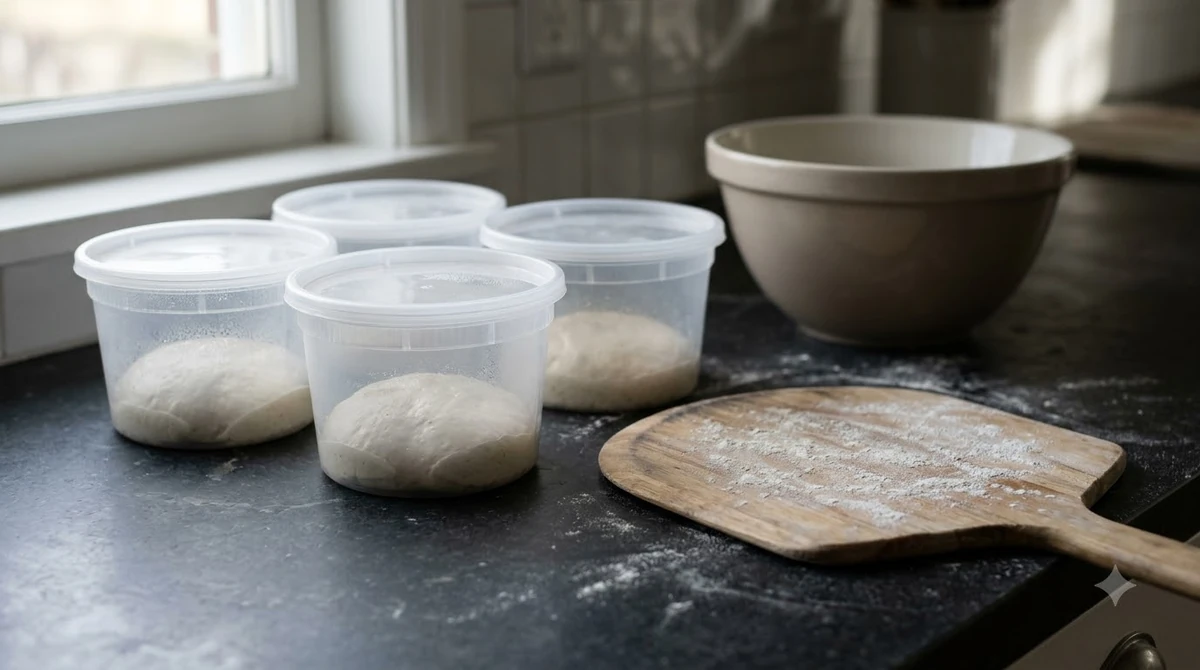
- Roll each base on baking paper and cover the extra bases with a damp tea towel.
- Roll out the next base while the first pizza is in the oven.
- Add toppings just before each pizza goes in, so the dough does not go soggy.
- Mix a fresh batch for later rounds, because the dough cannot be held for long.
Adjusting the recipe for flour and acidic ingredients
All-purpose flour can stand in for bread flour in pizza dough without yeast, using the same 1 1/3 cups and the same method. For a closer look, see how bread flour and all-purpose flour behave in pizza dough. The recipe lists plain or all-purpose flour as a working option.
An acidic liquid needs a different leavening mix. Wikipedia gives an example for a different recipe: 1 cup of flour, 1 egg and 1 cup of buttermilk uses 1/2 teaspoon of baking powder plus 1/4 teaspoon of baking soda. That mix is not a swap for this recipe, which uses water and no acidic ingredient, so keep the amounts above unless you test a changed version.
Common mistakes and what the recipe does not cover
The main risk with pizza dough without yeast is waiting too long after mixing, because it cannot rest or rise. Other slips are easy to avoid if you know them in advance.
- Letting the dough sit: use it within about 30 minutes of combining.
- Pinching the edges while shaping: pull the dough outward from the center instead.
- Adding toppings too early: add them just before baking.
- Assuming the dough freezes well: the recipe page gives no freezing guidance.
Baking powder formulas use one or more acid salts, so brands can differ in how quickly they react. Read the label on your own tin before you adjust the amount.
Frequently Asked Questions
Can you make pizza dough without yeast?
Yes. Baking powder leavens the dough, so the recipe needs no rise time. It uses 2 teaspoons of baking powder for 1 1/3 cups of flour, mixes in a food processor or by hand, and bakes at 480°F for 12 minutes.
How much baking powder do you use for pizza dough without yeast?
The recipe uses 2 teaspoons for 1 1/3 cups of bread flour, which is about 1.5 teaspoons per cup. The general guideline is 1 teaspoon per cup, so the recipe uses more. Check the label on your brand, since formulas vary.
Does pizza dough without yeast rise?
No. This dough cannot rest or rise, so shape and bake it soon after mixing. Use it within about 30 minutes of combining the wet and dry ingredients.
Can you freeze pizza dough without yeast?
The recipe page gives no freezing guidance, and a commenter’s question on the page received no answer. Make a fresh batch of pizza dough without yeast for each bake, and do not assume the texture will survive freezing.
Can you use all-purpose flour instead of bread flour?
Yes. The recipe lists plain or all-purpose flour as a working option at the same 1 1/3 cups. Keep the other amounts and the same mixing method.
Is pizza dough without yeast chewy?
It has a good chew but is not thin or dry like a cracker. It will not form the puffy, bubbly edges that yeast pizza gets.
Can you make several pizzas with the same dough?
Yes, pizza dough without yeast scales to three pizzas at a time. Roll the extra bases on baking paper under a damp tea towel while the first pizza bakes, and add toppings just before each one goes in.
Use pizza dough without yeast when you have no yeast or want a crust in one evening. Choose a yeasted dough when you have time for it to rise, since this recipe cannot rest. Measure the baking powder carefully and check the oven setting before you start.
 8 min readLearnHow Much Dough for a 12 Inch Pizza by Crust StyleUpdated Nov 10, 2026
 6 min readLearnDough Ball Weight for 14 Inch Pizza by Crust ThicknessUpdated Nov 13, 2026
 9 min readLearnCauliflower Pizza Crust Recipe: Ingredients, Steps and Baking TipsUpdated Nov 12, 2026
 7 min readLearnDiastatic Malt Powder in Pizza Dough: What It Does and How Much to UseUpdated Nov 11, 2026
 8 min readLearnPizza Pockets Recipe: Homemade Dough, Filling and Baking TimesUpdated Nov 11, 2026
 8 min readLearnCapricciosa Pizza Recipe: Ingredients, Dough and Baking StepsUpdated Nov 10, 2026