
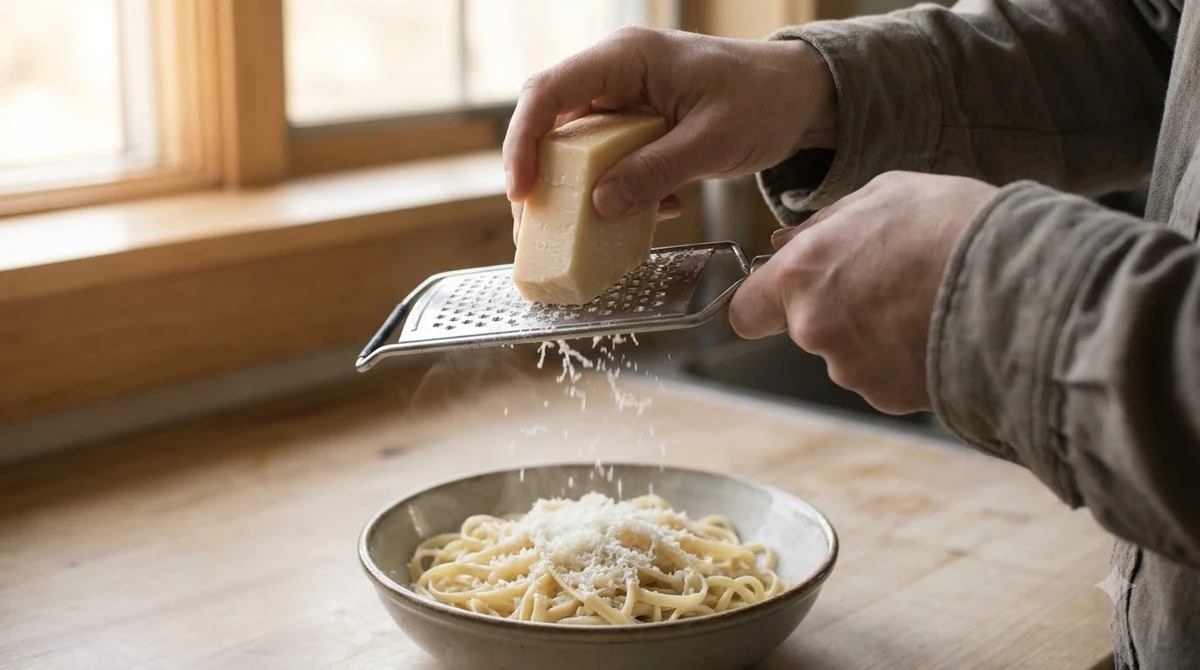

The short answer to what is bottarga is a salt-cured fish roe pouch, usually made from grey mullet or bluefin tuna. It is firm, dry and intensely savory, and Italians grate or shave it over pasta, bread and salads. The product is most closely associated with the islands of Sicily and Sardinia.
Knowing what is bottarga helps you decide where it fits. Bottarga is a finishing ingredient, not a main ingredient. A small amount adds a salty, briny depth to a dish, so a little goes a long way.
What is bottarga made from
Bottarga is the roe sac of a fish, salted, cured and dried into a hard slab. According to Wikipedia’s entry on bottarga, the product is typically made from grey mullet or from bluefin tuna. The two versions differ in color, strength and texture, so it helps to know which one you are buying.
The name is generally traced to the Arabic word battarikh. Fishermen in the Mediterranean first made bottarga so that no part of the catch was wasted. Today it is treated as a delicacy, and it was for a long time rare outside the islands where it is made. Great Italian Chefs calls it “Mediterranean caviar” and the “truffle of the sea” because it is grated over dishes the way truffle is, and says it was hard to find far from where it was produced until the 1950s and was often given as a valuable gift.
The idea is very old. Wikipedia says bottarga production is first documented in the Nile Delta in the 10th century BCE, and that the Italian word is thought to come through Arabic from Byzantine Greek. Wikipedia also notes that its culinary properties can be compared to those of dried anchovies, although it is much more expensive. TASTE offers a handy comparison for cooks: bottarga is like a sausage in how intensely seasoned it is, so a little shaving on pasta or a salad goes a long way.
Grey mullet bottarga is the version most often sold as the traditional product. Tuna bottarga is also made in Sicily and in Carloforte on the island of Sardinia. Grey mullet bottarga is produced around the salt lakes of Cabras in Sardinia and in the lagoon near Orbetello in Tuscany.
According to Great Italian Chefs, the grey mullet version is the most refined and expensive, and its golden or amber color earns it the nickname “Sardinia’s gold.” It is usually made in September. The same article says Sardinia consumes about 150 tonnes of bottarga a year, which takes about 2,300 tonnes of grey mullet, so some of the fish are shipped in from other parts of Italy.
Tuna bottarga follows a different calendar and a longer process. It is usually made once the tuna season ends in May, and it can take up to thirty days with several washings and salt baths to remove any blood. Because the slabs are dried under heavy presses, tuna bottarga ends up with a solid texture, an even dark red color and a squared-off shape, while the mullet version has a looser, more natural shape.
How bottarga is made
Bottarga is made by curing the whole roe pouch, not loose eggs, which is the main difference from caviar. Producers extract the pouch gently from the fish’s belly so the membrane around the roe is not damaged, then wash it in iced water, several times in the case of tuna, and massage it by hand to remove air pockets. The pouch is then cured in sea salt in overlapping layers for a few weeks, though the exact time depends on the climate and the producer. If the membrane does tear, many producers use the roe to make ground bottarga, which is popular for its convenience.
After curing, the slabs are washed again and pressed to remove brine. They are then aged in a ventilated room for up to several months and turned from time to time. Some producers coat the finished slabs in beeswax or paraffin to keep them soft. The result is a dry slab that can be grated or thinly sliced.
- Remove the roe pouch from the fish and wash it.
- Massage the pouch by hand to remove air pockets.
- Cure it in sea salt for a few weeks.
- Press out the brine, then age it in a ventilated room for up to several months.
What is bottarga: grey mullet vs tuna
Grey mullet bottarga is the milder and more widely recognized of the two, while tuna bottarga has a bolder profile. The table below compares the two based on the producers’ descriptions.
| Feature | Grey mullet bottarga | Tuna bottarga |
|---|---|---|
| Color | Golden or amber | Darker |
| Flavor | Intense, elegant, with a pleasantly bitter aftertaste | Stronger and more pronounced |
| Texture | Slightly chewy | Solid |
| Main production areas named in sources | Cabras (Sardinia) and Orbetello (Tuscany) | Sicily and Carloforte (Sardinia) |
If you are new to bottarga, grey mullet is the easier starting point because its flavor is less assertive. Choose tuna bottarga when you want the stronger, darker profile that the producers describe.
How to use bottarga
Anyone asking what is bottarga used for will find that it is usually grated or shaved over a finished dish rather than cooked for long. Sources describe it grated over steaming pasta, shaved over warm bruschetta, and used in olive oil. Italians also serve it as a simple appetizer with olive oil or lemon juice on bread or crostini. Great Italian Chefs adds that it works with salad (it goes well with raw artichokes), risotto and even meat.

- Add it at the end, after the pasta is cooked al dente and finished in its sauce, off the heat.
- Use a fine grater or a sharp knife, and shave a small amount at a time.
- Pair it with a good finishing olive oil, lemon, garlic, chili or simple tomato sauces.
- Start small, because the salt and intensity build quickly.
What to check when buying and storing
Check the label for the fish species and the place of production before you buy. The sources checked for this article describe the curing process and flavor, but they did not give reliable home storage times, so follow the storage instructions on the producer’s label. Some producers wrap the finished slabs in wax to protect them. Other cured Italian products also have their own storage rules, as you can see in our guide on how to store prosciutto.
Do not rely on a fixed shelf life from general articles. Storage advice varies by producer, and the packaging is the most reliable guide.
Frequently Asked Questions
Is bottarga the same as caviar?
No. Caviar is made from loose eggs, while bottarga is the whole roe pouch that has been salted and dried into a firm slab. The two have different textures and are used in different ways.
Is bottarga very salty?
It is salty because it is cured in sea salt. Sources describe it as briny, so use a small amount and taste before adding more salt to the dish.
Where does bottarga come from?
The sources name Sicily and Sardinia as the main regions. Grey mullet bottarga is also made in the lagoon near Orbetello in Tuscany, and tuna bottarga is made in Carloforte. Wikipedia adds that similar products exist elsewhere, including Greek avgotaracho, which has a protected designation of origin for the Messolonghi lagoons, and Tunisian and Turkish versions made from mullet roe.
Which is better, grey mullet or tuna bottarga?
Neither is better in every case. Grey mullet is milder and golden, while tuna is darker and stronger. Pick the one that fits the dish and your taste.
How long does bottarga keep?
The sources checked for this article did not give a reliable shelf life or refrigeration time. Check the storage instructions on the producer’s label, since that is the most reliable answer for a specific product.
Bottarga is worth buying if you cook pasta and want a concentrated, salty finish with a distinct Mediterranean character. Start with a small piece, use it sparingly, and decide after one or two dishes whether you want to keep it on hand.
 8 min readLearnWhat Is Ciliegine Mozzarella? 5 Easy Facts to KnowUpdated Nov 11, 2026
 7 min readLearnFarfalloni Pasta: 5 Simple Facts and the Best SaucesUpdated Nov 11, 2026
 8 min readLearnWhat Is Mortadella? Simple Facts and 5 Ways to Serve ItUpdated Nov 11, 2026
 8 min readLearnHow to Tell If Olive Oil Is Real: Label, Grade, and Taste ChecksUpdated Nov 11, 2026
 9 min readLearnWhy Pizza Dough Smells Like Alcohol and What to Do About ItUpdated Nov 11, 2026
 9 min readLearnOne Pot Pasta Recipe: Easy Dinner in About 25 MinutesUpdated Nov 12, 2026