
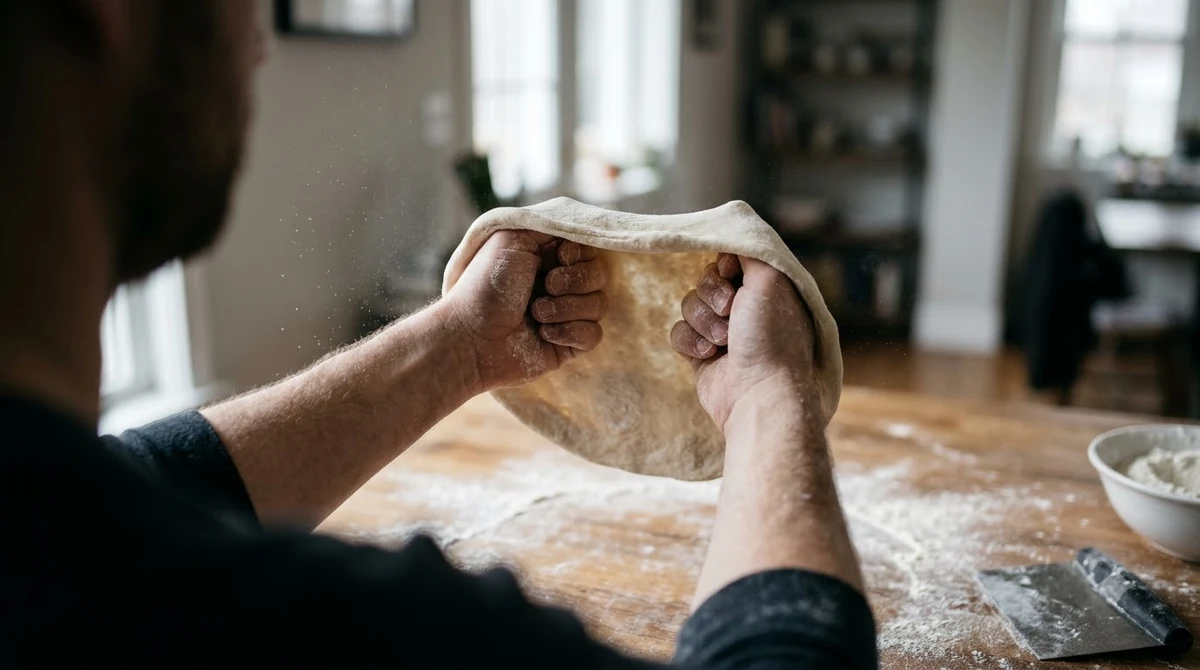

The windowpane test for pizza dough is a hand check that shows whether gluten has developed enough to stretch the dough thin. Pinch off a small piece, stretch it between your fingers, and hold it up to the light. If it thins without tearing, the dough is ready to shape.
The windowpane test for pizza dough matters most for short rises, because kneading builds most of the gluten in quick doughs. Long-fermented dough builds its gluten during the rise, so check it during bulk fermentation instead.
What the Windowpane Test Checks
The windowpane test checks how far gluten has formed in pizza dough. Gluten is a protein network built mainly from gliadin and glutenin when flour meets water.
Glutenin molecules link together through sulfur bonds, and the network traps the gas bubbles that yeast produces. Wikipedia’s gluten entry describes this network as the source of the dough’s elasticity and extensibility.
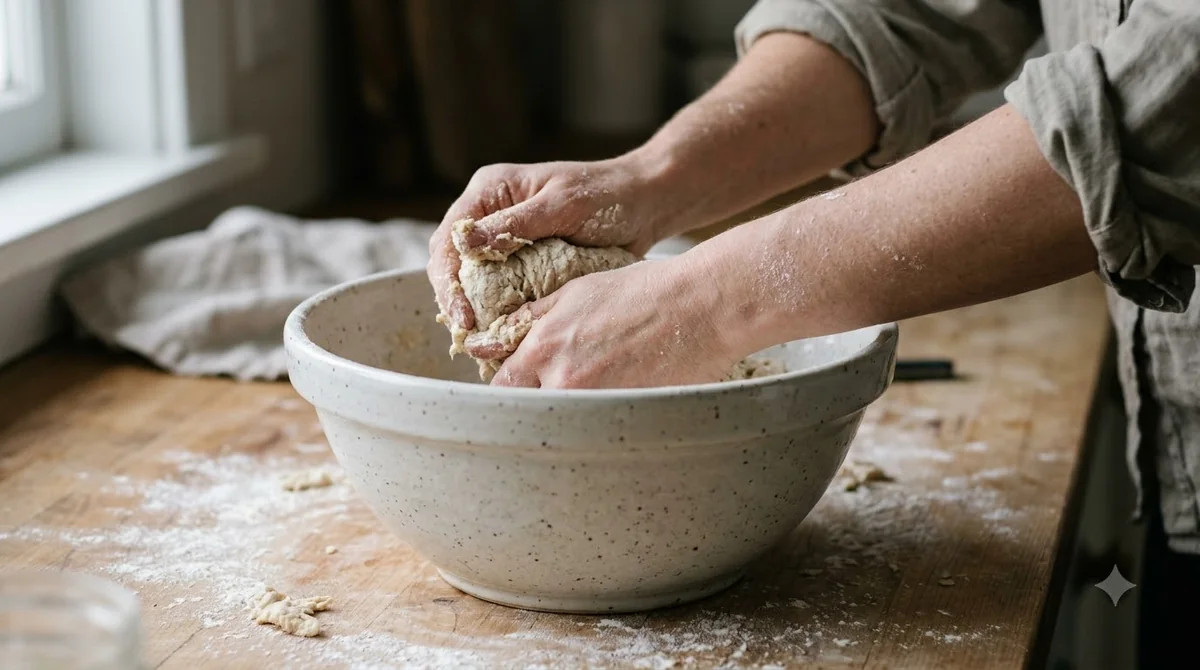
Kneading builds those strands. As you knead, the gluten forms more cross-links, which is why the windowpane test for pizza dough is a useful check during kneading. Higher moisture also helps the network develop.
The windowpane test for pizza dough gives you a quick read on that network without special tools. You need only your hands and a light source. Because the test checks the structure itself, it tells you more than the dough’s color or how long it has been mixed.
How to Do the Windowpane Test for Pizza Dough
To do the windowpane test, let the dough rest about one minute, pull off a small piece, and stretch it gently between your fingers. The piece should be small enough to hold in one hand.
- Let the dough rest for about one minute.
- Pull off a small piece of dough.
- Pinch one side of the piece in each hand.
- Stretch gently, then hold the piece up to the light and compare it with the five stages below.
Stretch slowly. Pulling hard tears the dough before you can read the result. Keep your hands moving so the stretch spreads evenly and no thin spot forms in one place.
Hold the piece near a window or a lamp, then turn it slowly. A dough at stage 5 lets light pass through as a thin, see-through membrane. A dough at stage 4 still looks opaque, but it stretches to a wide, even sheet without holes.
Running the windowpane test for pizza dough this way takes only a few seconds, and each test uses a small piece, so you can repeat it without wasting dough.
Common Mistakes When Stretching the Piece
Three habits make the result hard to read: yanking the piece, skipping the short rest, and judging the piece in dim light. A lamp or a window helps, because light has to pass through the dough for the result to show.
A useful habit is to test the same batch twice: once after the short rest, and again after a few more minutes of kneading. If the two results agree with the stage you see, you can trust the reading and move on to shaping.
The Five Stages of Gluten Development
The windowpane test for pizza dough grades gluten in five stages, and the goal is stage 5, where light passes through the dough. The percentages are a guide, since the test judges the stretch by eye.
Read the windowpane test for pizza dough as a sequence rather than a simple pass or fail. Each stage shows how much gluten has built up, and the stretch length tells you how far the dough can go before it tears.
| Stage | Gluten development | Stretch before tearing | What you see |
|---|---|---|---|
| Stage 1 | 25% | Breaks when lightly stretched | Tears almost at once |
| Stage 2 | 50% | About 1 to 2 cm | Tears after a short stretch |
| Stage 3 | 75% | About 2 to 3 cm | Stretches further, then tears |
| Stage 4 | 90% | About 5 to 8 cm | Stays thin and opaque without tearing |
| Stage 5 | 100% | Stretches thin enough for light to pass through | Translucent membrane |
According to the windowpane guide at Busby’s Bakery, each round of kneading moves the dough up one stage. That means you can test as you go, rather than guessing when the dough is ready.
Stage 4 stretches well without tearing, while stage 5 is the target for a dough that will be stretched very thin. For a pizza base you press out by hand, stage 4 or 5 gives you the most room before the dough tears.
Many cooks stop at the first stage that stretches to a wide, even sheet. Running the windowpane test for pizza dough at that point saves time, since further kneading past the target only adds work.
Why Pizza Dough Tears When You Stretch It
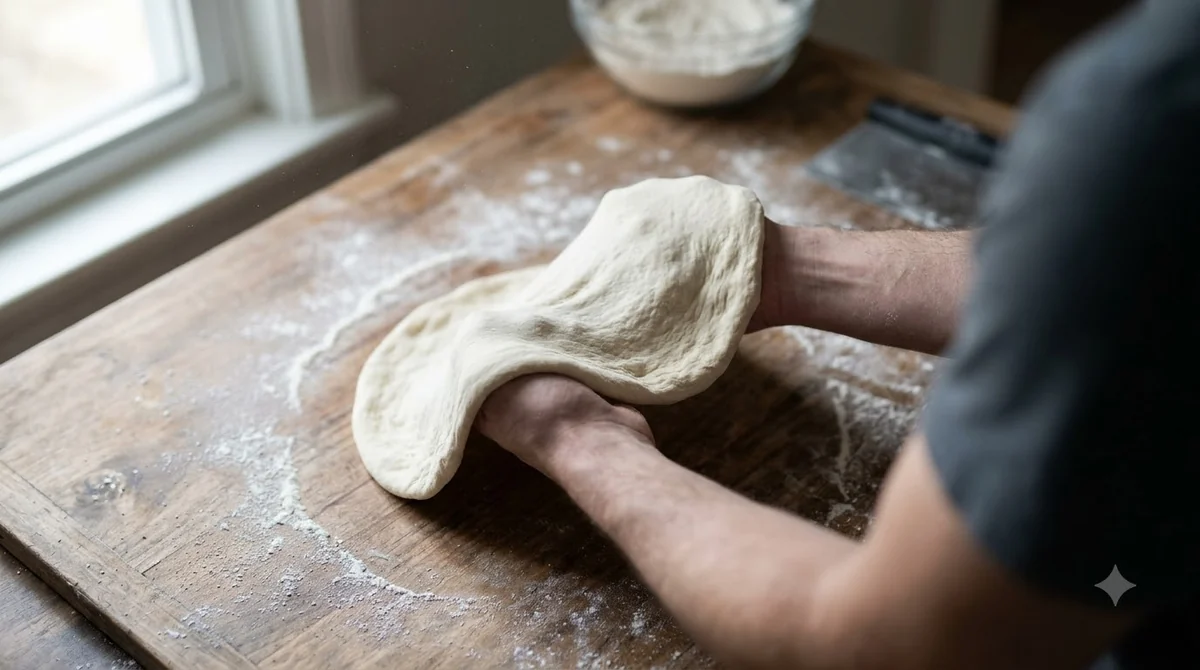
Pizza dough tears when its gluten is under-developed, and the usual fix is to knead a few more minutes and test again. The failure signs below help you tell the problem apart from other causes, and the guide to pizza dough tearing covers the other fixes.
- The piece tears easily and looks rough rather than smooth.
- The finished crust has a dense crumb.
- The dough bursts at the sides or base in the oven.
- The dough takes a long time to rise.
Over-kneaded dough is a different problem. It feels sticky, warm and weak, and the windowpane test shows it as a soft, slack sample rather than a clean tear. This is uncommon when you knead by hand, but it can happen in a mixer.
If an under-kneaded dough fails, shape it back into a ball, knead for a few more minutes, and test again. Repeat until a small piece stretches thin without tearing.
Each attempt also shows you how the dough responds to pressure. A dough that tears at the edge but holds in the middle may need a little more kneading, or a longer rest before you pull the piece. Use the same test each time, so the comparison stays fair.
A tear on the first pull usually points to a dough that needs more kneading, not to a dough with the wrong flour. Running the windowpane test for pizza dough before you shape the base helps you confirm that.
When the Windowpane Test Matters Most
The test matters most for short rises, while long-fermented dough builds its gluten during bulk fermentation and should be checked then. The timing depends on how the dough was made.
| Dough type | When to test | Why |
|---|---|---|
| Quick dough with a short rise | After each round of kneading | Kneading does most of the gluten work |
| Long-fermented dough | During bulk fermentation | Gluten should reach stage 5 about when the dough doubles |
For long-fermented doughs such as cold ferment pizza dough, Busby’s Bakery recommends light kneading, because heavy kneading and long resting can add oxygen that damages flavor and gas retention. Test during the rise instead, and watch for the dough to reach stage 5 as it doubles.
Hydration changes how the dough feels, so judge the result against the stages rather than a fixed water percentage.
Plan the windowpane test for pizza dough into your schedule. For a quick dough, check it before you divide and shape. For a slow dough, check it partway through the rise, when the dough is visibly larger and easier to read. Writing down the stage you reached each time makes it simple to repeat the windowpane test for pizza dough and compare results from one batch to the next. Over several bakes, that record shows how your flour and kneading habits behave.
Frequently Asked Questions
Can you do the windowpane test with bread flour?
Yes, the windowpane test for pizza dough works the same way with bread flour. It checks the gluten network that wheat flour forms when it is mixed with water, so you read the stages the same way.
How long should dough rest before the test?
Let the dough rest for about one minute before you pull off the piece. The short rest lets the dough relax, so the piece stretches more evenly when you test it.
What if the dough tears at stage 2?
Knead the dough for a few more minutes, then test again. Stage 2 means the gluten stretches only about 1 to 2 cm before tearing, and each round of kneading can move the dough up a stage.
How often should you do the windowpane test?
Run the windowpane test after each round of kneading, and stop once a small piece stretches thin without tearing. That result is stage 4 or 5, which is enough for most hand-stretched bases.
Does the windowpane test work for gluten-free dough?
Not in the same way. The windowpane test for pizza dough relies on a stretchy gluten network, which gluten-free flours do not form. Judge gluten-free pizza dough by its texture and handling, and follow the recipe for timing.
If the dough passes the windowpane test for pizza dough, move on to shaping. If it fails, knead for a few more minutes and test again, because a dough that tears will also tear or burst in the oven. A quick windowpane test for pizza dough now saves a ruined base later.
 8 min readLearnGluten Free Pizza Dough: A Simple Home RecipeUpdated Nov 6, 2026
 8 min readLearnGluten Free Pasta Dough Recipe: Ingredients, Method and FixesUpdated Nov 12, 2026
 6 min readLearnPizza Oven Not Getting Hot Enough? Checks by Oven TypeUpdated Nov 13, 2026
 8 min readLearnHow Long to Knead Pizza Dough (By Hand and in a Mixer)Updated Nov 10, 2026
 8 min readLearnHow to Knead Pizza Dough by Hand: A Simple Method for Home CooksUpdated Nov 11, 2026
 8 min readLearnHow to Stretch Pizza Dough by Hand: Step-by-Step GuideUpdated Nov 10, 2026