
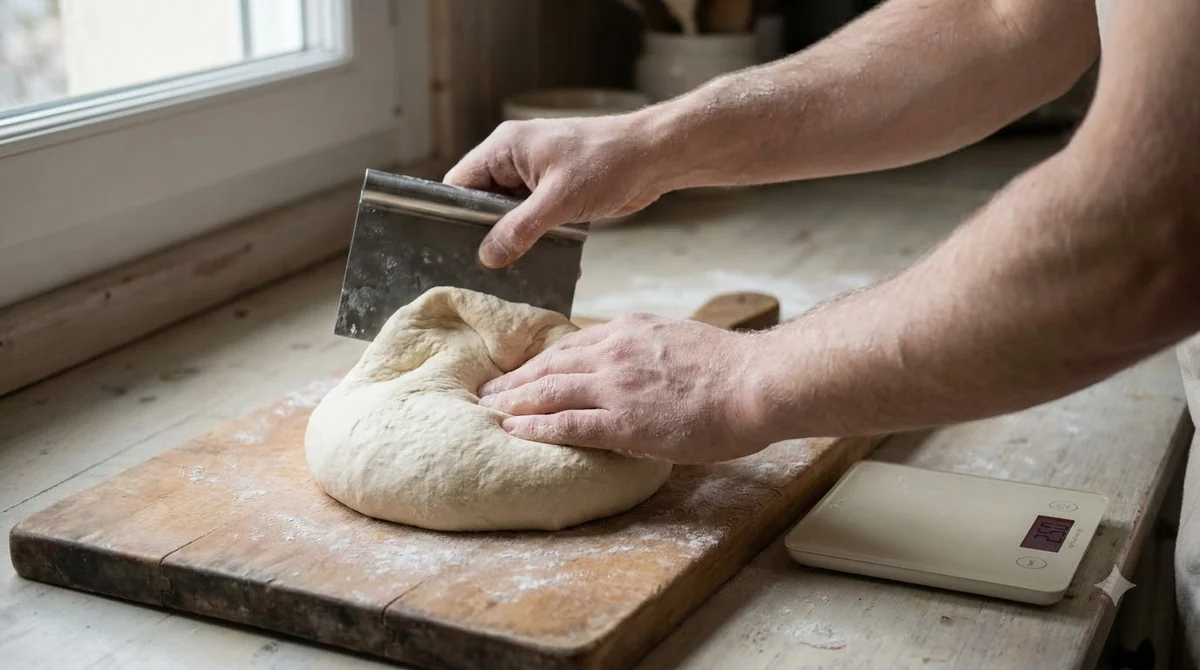

Knowing how to knead pizza dough by hand lets you make a good crust without a mixer. Work the dough on a lightly floured surface for 7 to 8 minutes until it is smooth and elastic. The method suits a single batch made from about 4 cups of bread flour.
Learning how to knead pizza dough by hand takes steady pressing and folding, but the texture tells you when the dough is ready. If the dough is very sticky, add flour in small pinches and check the texture again before adding more.
Why kneading matters for pizza dough
Kneading builds gluten, the protein network that lets pizza dough stretch and hold the gas that yeast produces.
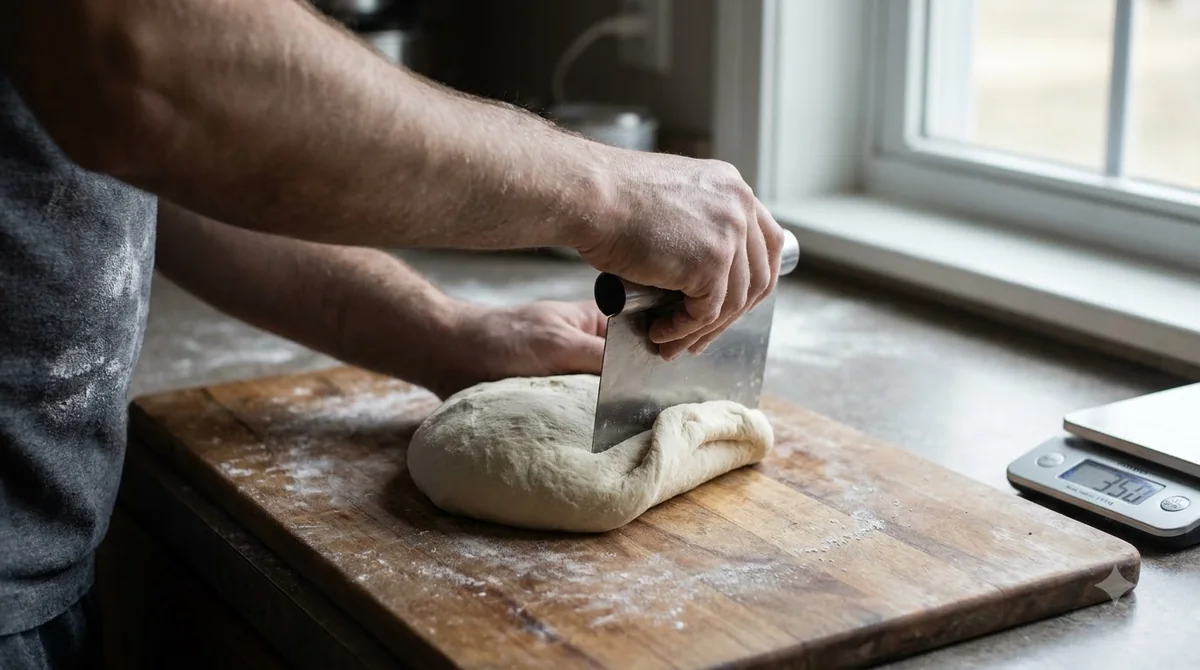
Gluten forms when hydrated proteins link into a network, and kneading strengthens that network. Wikipedia’s gluten article explains that glutenin molecules cross-link through disulfide bonds and attach to gliadin, which adds viscosity and extensibility to the dough.
The same article says chewiness increases the longer dough is kneaded. That is why a well-kneaded crust tends to be chewier than a dough that was barely worked, and it is one reason the kneading time matters when you learn how to knead pizza dough by hand.
Hydration also affects how fast gluten develops. Higher moisture enhances gluten development, so a wetter dough builds structure with less effort. Very wet doughs that rise for a long time can need little or no kneading at all.
Ingredients and mixing order
A batch made with 4 cups of bread flour needs 1 1/2 teaspoons of salt, one envelope of rapid-rise yeast and two portions of water, mixed in a set order.
The America’s Test Kitchen pizza dough recipe uses the amounts below, and its warm water is kept at 105 to 115°F so the yeast can dissolve and swell.
| Ingredient | Amount |
|---|---|
| Warm water (105 to 115°F) | 1/2 cup |
| Rapid-rise yeast | 1 envelope (2 1/4 teaspoons) |
| Room-temperature water | 1 1/4 cups |
| Extra virgin olive oil | 2 tablespoons |
| Bread flour | 4 cups (20 oz / 567 g), plus extra for dusting |
| Salt | 1 1/2 teaspoons |
The recipe makes enough dough for 3 medium pizzas, and America’s Test Kitchen says unbleached all-purpose flour can be used in a pinch, though the crust will be less crisp. Mix the dough in this order so the yeast is active before the flour and salt go in. Once it is mixed, the next step is learning how to knead pizza dough by hand.
- Pour the warm water into a measuring cup, sprinkle in the yeast and let it stand about 5 minutes until it dissolves and swells.
- Stir in the room-temperature water and the olive oil.
- Combine the salt and half the flour in a deep bowl, add the liquid and mix with a wooden spoon.
- Add the remaining flour until a cohesive mass forms.
How to knead pizza dough by hand, step by step
To learn how to knead pizza dough by hand, turn the dough onto a lightly floured surface and knead it for 7 to 8 minutes, until it is smooth and elastic, using as little extra flour as possible.
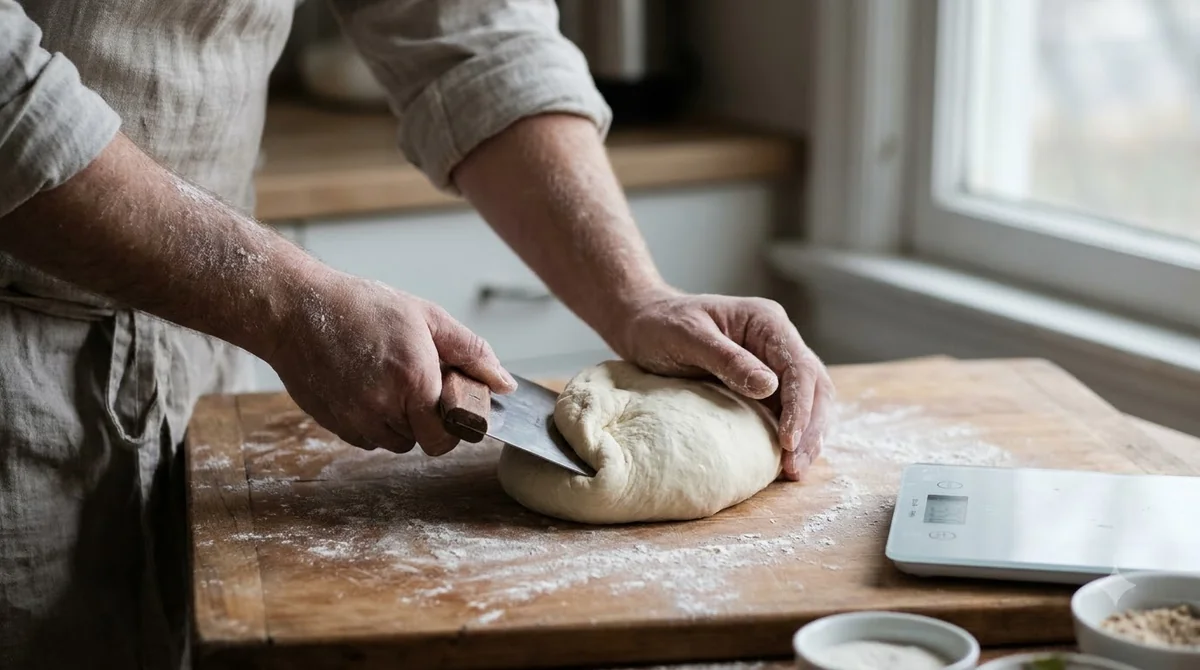
Keep a steady rhythm and use the same motion each time so the dough develops evenly. Wikipedia’s kneading article describes hand kneading as pressing and stretching the dough with the heel of the hand, folding it over and rotating it through 90 degrees, repeated until the dough turns elastic and smooth. Here is how to knead pizza dough by hand for a standard batch, in five steps.
- Turn the mixed dough onto a lightly floured work surface.
- Push the dough away from you with the heel of your hand, then fold the far edge back over itself.
- Give the dough a quarter turn and repeat the push and fold.
- Keep going for 7 to 8 minutes, adding only as much dusting flour as you need to stop sticking.
- Shape the dough into a ball, place it in a deep oiled bowl and cover it with plastic wrap.
After kneading, let the dough rise until it doubles, which takes 1 1/2 to 2 hours in the America’s Test Kitchen recipe.
Knowing how to knead pizza dough by hand is slower than using a stand mixer, but it lets you feel the dough change under your hands. Stop as soon as the dough is smooth, so you do not overwork it.
How to tell when the dough is kneaded enough
Kneaded pizza dough should feel smooth and elastic, with no dry, shaggy patches of flour left on the surface.
When you learn how to knead pizza dough by hand, the clock is a guide, not a rule. Hydration changes how quickly gluten develops, so the texture is a better signal than the timer alone. Check these three signs, and see our guide to the windowpane test for pizza dough if you want a firmer test:
- The surface looks smooth, with no dry patches of flour.
- The dough springs back slowly when you press it with a fingertip.
- The dough feels elastic rather than tight, and it does not tear when you stretch a small piece.
The dough article on Wikipedia describes kneading as working dough to produce a smooth, elastic dough by developing gluten, so those two textures are the target you are aiming for.
Common mistakes when kneading by hand
The most common mistakes in how to knead pizza dough by hand are adding too much dusting flour, using water at the wrong temperature and rising the dough somewhere too hot or too cold.
- Adding too much dusting flour. The America’s Test Kitchen method asks for as little dusting flour as possible, because extra flour stiffens the dough.
- Using water that is too hot or too cold. The recipe specifies 105 to 115°F for the warm water used to dissolve the yeast.
- Rising the dough in a place that is too hot or too cold. The dough article on Wikipedia notes that such temperatures stop the yeast from developing.
- Cutting the rise short. The recipe lets the dough rise until it doubles, which takes 1 1/2 to 2 hours.
If the dough is still sticky after you learn how to knead pizza dough by hand, add flour in small pinches rather than all at once. A large amount of flour added at once changes the balance of water and flour, and that is hard to undo.
When hand kneading is not the right method
Very wet, high-hydration doughs can be folded instead of kneaded, and not every yeast dough needs kneading at all. If you want a recipe that skips the work entirely, see no knead pizza dough.
High-hydration doughs like ciabatta and focaccia may be folded to develop gluten or not kneaded at all, according to Wikipedia’s dough article.
An autolyse, which is a rest of flour and water before the final mixing, can reduce mixing time and increase extensibility, according to the same article.
For a large batch, or a dough you make every week, a stand mixer can save time, though knowing how to knead pizza dough by hand still helps. Hand kneading still teaches you how the dough should feel, and that skill carries over to any method.
Frequently Asked Questions
How long should I knead pizza dough by hand?
When you learn how to knead pizza dough by hand, knead for 7 to 8 minutes, until it is smooth and elastic, according to America’s Test Kitchen’s hand-kneaded recipe. Stop when the surface looks even and springs back under a fingertip. Use only as much dusting flour as you need to keep the dough from sticking.
Can I knead pizza dough by hand without a mixer?
Yes. Learning how to knead pizza dough by hand takes only a deep bowl, a wooden spoon, a lightly floured work surface and, if you have one, a dough scraper. Mix the flour, water, yeast, oil and salt into a shaggy dough, then knead it on the counter for 7 to 8 minutes. Hand kneading takes some practice, but the texture tells you when it is ready.
Why is my pizza dough too sticky to knead?
Sticky dough is common when you learn how to knead pizza dough by hand, and it usually means the water and flour are out of balance (our guide to pizza dough that is too sticky covers more causes). Add flour in small pinches rather than all at once. Extra flour changes the dough’s balance and makes it stiffer, so use as little dusting flour as you can.
How long should pizza dough rise after kneading?
The America’s Test Kitchen recipe lets the dough rise until doubled, which takes about 1 1/2 to 2 hours, covered in an oiled bowl. Keep the dough somewhere that is neither too hot nor too cold, since extreme temperatures stop yeast from developing, according to Wikipedia’s dough article.
Does kneading make pizza crust chewier?
Yes. Wikipedia’s gluten article says chewiness increases the longer dough is kneaded, because gluten strands and cross-links form. Knead for the time your recipe gives, and check the texture rather than kneading far beyond it.
Knowing how to knead pizza dough by hand suits a single batch, and the method is simple once you have done it a few times. Trust the texture more than the clock when you practice how to knead pizza dough by hand, and adjust water or flour in small steps. If you make large batches often, a stand mixer is a practical alternative for the same job, and our guide to making pizza dough in a stand mixer shows the steps.
 8 min readLearnHow Long to Knead Pizza Dough (By Hand and in a Mixer)Updated Nov 10, 2026
 9 min readLearnNo Knead Pizza Dough: Flour, Water and Time Do the WorkUpdated Nov 10, 2026
 8 min readLearnWindowpane Test for Pizza Dough: How to Check Gluten by HandUpdated Nov 10, 2026
 8 min readLearnHow to Stretch Pizza Dough by Hand: Step-by-Step GuideUpdated Nov 10, 2026
 6 min readLearnHomemade Paccheri: Hand-Rolled and Extruder MethodsUpdated Nov 13, 2026
 6 min readLearnHow to Make Agnolotti by Hand: Pinch-and-Fill MethodUpdated Nov 13, 2026