
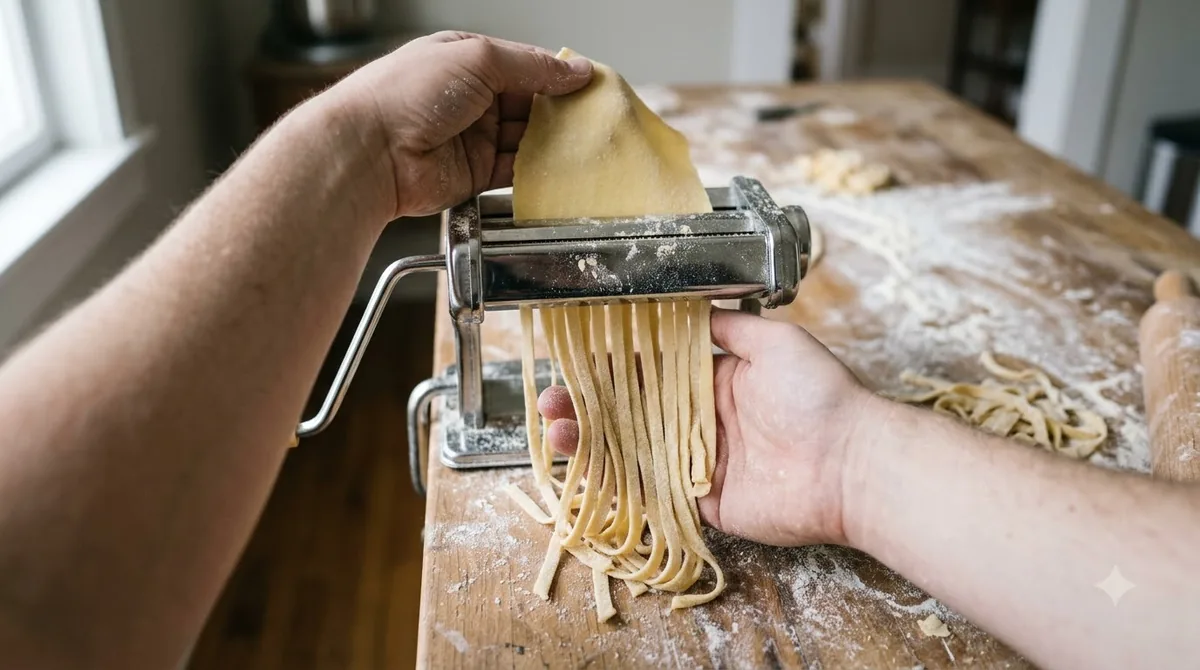

Homemade fettuccine by hand means rolling an egg pasta dough into a thin sheet with a rolling pin, then cutting it into flat ribbons with a knife. No pasta machine is needed. The key is a dough that has rested, a sheet rolled thin enough to see light through without tearing, and a sharp knife for even strips. King Arthur suggests fettuccine is about 1/4 inch wide, and this guide explains each step so you can judge the sheet by feel as well as by the numbers.
What You Need for Hand-Rolled Fettuccine
You need a fresh egg pasta dough, a long wooden rolling pin, a clean counter, a sharp knife, and plenty of flour or semolina for dusting. A pastry board or a large lightly floured counter gives you room to roll the sheet out long. Use a dough recipe you trust and keep the flour and egg ratio from that recipe, because hand rolling works best with a dough that is firm but not stiff.
Hand-rolled fettuccine is more work than a machine, but the texture can be very good. The rolling takes practice, and the first sheets are usually uneven. Expect to refine your technique over a few batches rather than getting the perfect ribbon on the first try.
Rest the Dough Before Rolling
Resting relaxes the gluten so the dough rolls out without springing back. Food Republic advises letting the dough rest about 15 minutes, covered in a bowl with a damp cloth or wrapped in plastic wrap, and notes that this softens it so it cracks less. King Arthur recommends a rest of about half an hour after the initial kneading. If the dough snaps back as you roll, cover it and let it rest 5 to 10 minutes more. If you cannot decide on a width, see fettuccine compared with tagliatelle.
Why a longer rest helps
A rested dough stretches evenly. If you skip the rest, the centre of the sheet will be thick while the edges tear. Keep the dough wrapped whenever you are not rolling it, since a dry surface cracks at the edges.
Roll a Thin Sheet With a Rolling Pin
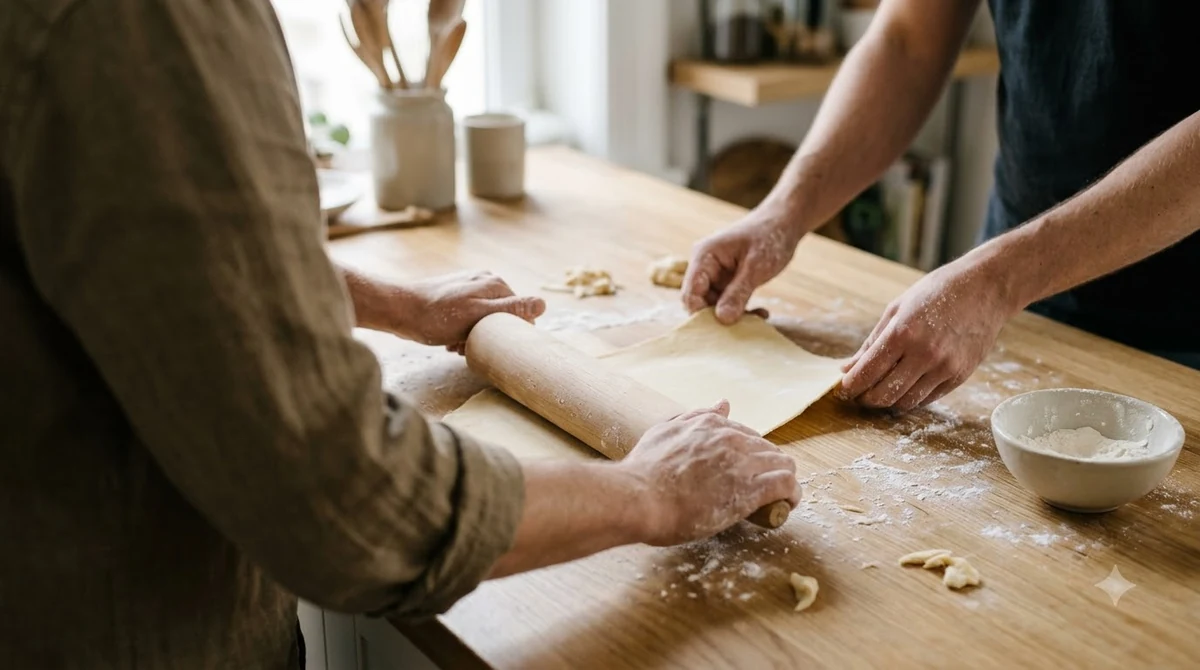
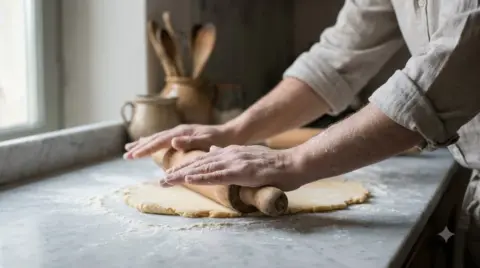
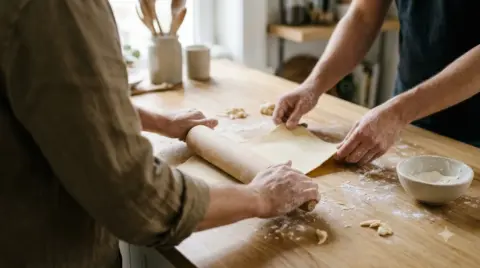
Divide the dough into small portions so each piece is easy to control. Flatten one piece into a disc or a rough rectangle, then roll it out in a steady, even motion. The goal is a sheet that is as thin as you can make it without tearing. Another common mix-up is explained in linguine and fettuccine differences. For a much thinner cut from similar dough, try thin tagliolini ribbons.
Roll in a pattern
King Arthur describes rolling from the middle outward: begin in the middle, roll away from you, return to the middle, then roll toward you, and keep going to the edge so the sheet stays evenly thick. Turn the dough a quarter turn every few passes so it stretches in all directions. Dust with flour as needed so it does not stick to the counter or the pin.
Check the thickness
King Arthur aims for a sheet roughly 1 mm thick. Hold it up to the light: you should be able to see the shape of your hand through it without tearing. A simple test is to lay the sheet over the edge of the table and blow gently on it. It should ruffle without lying flat or flying away.
Cut the Sheet Into Fettuccine Ribbons
Cutting by hand is easiest when the sheet is dry enough to handle but still flexible. Let it rest for a few minutes if it feels sticky, and dust the surface with semolina or flour before cutting. The same rolling method works for hand-cut tagliatelle.
Roll and slice
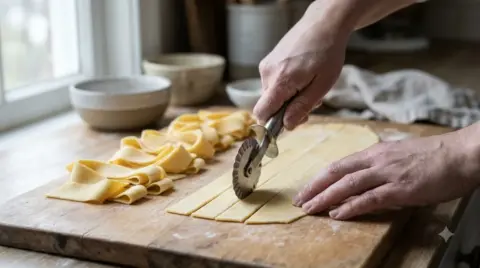
King Arthur’s method is to cut the dough into long strips, dust each strip, roll it up loosely like a scroll, and slice across the roll with a sharp chef’s knife. Cutting across the roll gives you ribbons that keep their shape, and the loose roll stops the layers from sticking together.
Set the width
For fettuccine, King Arthur specifies a width of 1/4 inch. Keep the slices as even as you can, and separate the ribbons with your fingers as soon as they are cut. Unroll the cut noodles onto a flour- or semolina-dusted tray and toss them lightly so they do not clump.
Common Problems When Rolling by Hand
Most hand-rolling problems come from dough that is too wet, too dry, or not rested. Each one shows up in a specific way, so you can fix it before the whole batch is affected.
If the sheet tears, the dough probably needs more rest or the sheet has become too thin in one spot. Patch small tears by pressing the dough back together with a little water. If the sheet keeps shrinking back, give it a short rest before rolling again.
If the ribbons stick together, the dough was not dusted enough before rolling up. Add more semolina between the layers, and do not let cut ribbons sit in a pile. If the sheet is uneven, roll more in the thin areas and avoid pressing down hard at the edges, which can make them thinner than the centre.
Cooking and Serving Fresh Fettuccine
Cook fresh fettuccine in a large pot of well-salted boiling water. Fresh pasta cooks quickly, so start tasting a strand early and drain it while it is still just tender. Toss it in a warm pan with a little of the cooking water and your sauce so the strands stay coated.
Hand-cut fettuccine dries best when it is laid out in loose nests on a floured tray. Hang or lay the ribbons out to dry if you are not cooking them right away, and keep them away from damp air.
Frequently Asked Questions
Can you make fettuccine without a pasta machine?
Yes. A rolling pin and a sharp knife are enough. Roll the dough as thin as you can without tearing, roll it up loosely, and slice it into ribbons about 1/4 inch wide.
How long should pasta dough rest before rolling?
Food Republic suggests about 15 minutes covered, and King Arthur suggests about half an hour after the initial kneading. If the dough springs back while rolling, rest it another 5 to 10 minutes.
How thin should hand-rolled pasta be?
King Arthur aims for roughly 1 mm. You should be able to see light through the sheet without tearing it. A thicker sheet makes a chewier fettuccine.
Why does my homemade fettuccine stick together?
The ribbons need enough dusting before you roll them up, and they should be separated as soon as they are cut. Toss them with semolina or flour on a tray, and do not leave them in a pile.
Hand-rolled fettuccine rewards patience. Rest the dough, roll the sheet thin in a steady pattern, and cut even ribbons with a sharp knife. Your first batch may look rustic, and that is fine. The more batches you roll, the easier it becomes to judge the sheet by eye.
 5 min readLearnHomemade Pappardelle: Dough, Rolling and Cutting by HandUpdated Nov 13, 2026
 6 min readLearnHomemade Linguine: Dough, Rolling and CuttingUpdated Nov 13, 2026
 6 min readLearnHow to Make Pappardelle by Hand Without a Pasta MachineUpdated Nov 13, 2026
 5 min readLearnHow to Make Pasta by Hand Without a MachineUpdated Nov 13, 2026
 6 min readLearnHow to Make Tagliatelle: Egg Ratio, Rolling and CuttingUpdated Nov 13, 2026
 9 min readLearnHow to Make Pasta Without a MachineUpdated Nov 10, 2026