
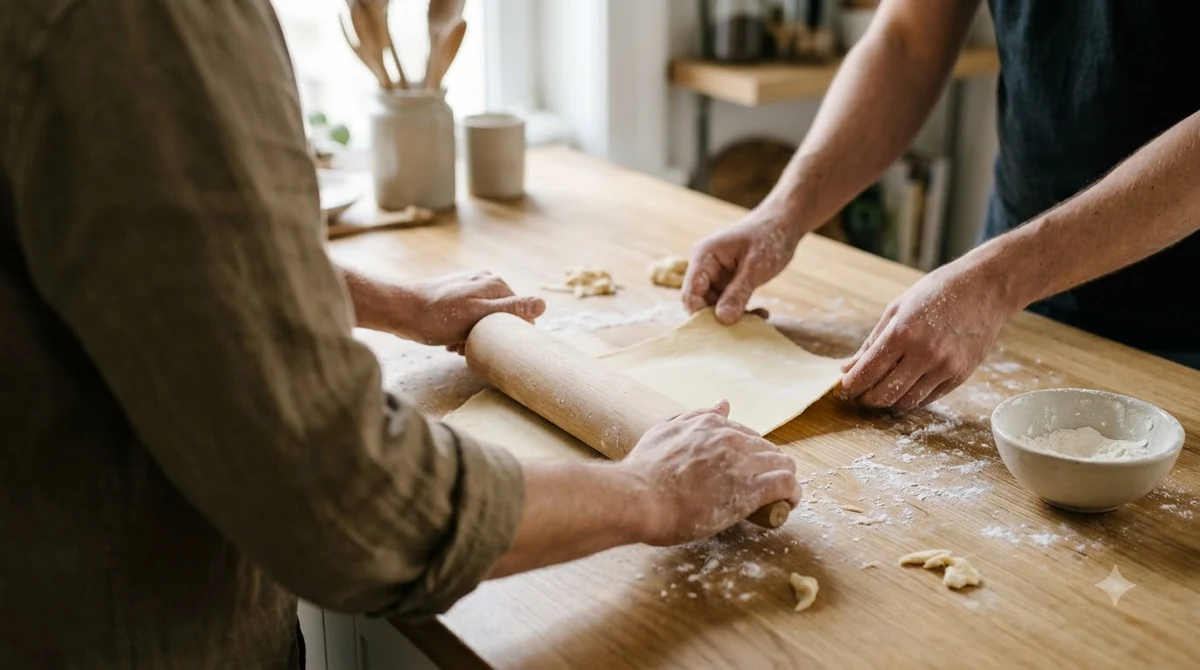

Learning how to make pasta without a machine takes only flour, eggs, a rolling pin and a knife. You knead a firm dough by hand, let it rest, roll it into thin sheets, and cut those sheets into ribbons or simple shapes. Hand-made pasta is the traditional method, and it suits home cooks who want fresh noodles without buying equipment.
The method asks for more effort than a machine, but it gives you full control over the dough. It is a good choice for a few ribbons or shapes, and a machine makes more sense if you cook pasta often.
How to Make Pasta Without a Machine: What You Need
Hand-made fresh pasta usually uses eggs with all-purpose or “00” flour, while dried pasta is made from semolina and water. The Wikipedia pasta article notes that fresh pasta is usually made with eggs and all-purpose or “00” low-gluten flour, and that it is traditionally produced by hand, sometimes with simple machines.
You do not need special equipment to start. For how to make pasta without a machine at home, prepare a clean, flat work surface, a large bowl, a rolling pin and a sharp knife or pizza cutter.
- Flour: all-purpose or “00” for an egg dough, or semolina for a firmer eggless dough.
- Eggs: used at room temperature so they blend into the flour evenly.
- A rolling pin with a smooth surface that you can dust with flour; a good pasta rolling pin makes the long rolling easier.
- A sharp knife or pizza cutter for cutting the sheets.
- A bench or large counter, lightly dusted with flour.

Ingredient Ratios for Hand-Made Dough
When you learn how to make pasta without a machine, you will find that dough recipes do not agree on exact amounts, so pick one source and keep its ratio. Domino uses four eggs with 3 1/2 cups of all-purpose flour for four people, while The Spice Girl Kitchen uses two eggs with 2 cups of flour. Neither page gives a gram weight, so treat the volumes as a starting point and adjust by feel.
| Source | Eggs | Flour | Notes |
|---|---|---|---|
| Domino | 4 | 3 1/2 cups all-purpose | Large pinch of salt; add a small bit of water if dry |
| The Spice Girl Kitchen | 2 large | 2 cups 00, all-purpose or semolina | Add water one teaspoon at a time if dry |
| Milk Street (eggless) | None | Half semolina, half all-purpose | Knead at least 10 minutes |
Use the same ratio each time you cook, so you can judge the dough by its feel. If the dough is dry, add water slowly rather than adding more flour.
Making an Eggless Dough
If you have no eggs, or you want a firmer dough for shapes like pici, Milk Street describes a dough made with half semolina and half all-purpose flour. It needs at least 10 minutes of kneading and is ready when it feels smooth and soft and springs back when poked.
How Long to Knead and Rest the Dough
Knead the dough by hand for about 8 to 10 minutes, then rest it before rolling, because a smooth, elastic dough is the base of how to make pasta without a machine. Domino describes about 8 minutes of kneading, and The Spice Girl Kitchen says 8 to 10 minutes until the dough is smooth and elastic.
- Mix the flour and eggs until a shaggy dough forms, then turn it onto a floured surface.
- Knead until the dough is smooth and elastic, about 8 to 10 minutes.
- Wrap the ball in plastic wrap and rest it at least 30 minutes at room temperature.
Milk Street gives a wider range for its eggless dough: 20 to 60 minutes at room temperature, or wrapped in the fridge for up to two days. A rested dough is easier to roll because it is less springy.
How to Tell the Dough Is Ready
The dough is ready when a tight ball springs back slightly after you press it lightly with a finger. If it cracks or crumbles while you knead, it is too dry, so add water a teaspoon at a time until it holds together.
Rolling Pasta Dough With a Rolling Pin
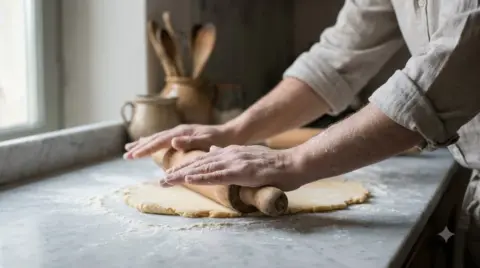
Rolling by hand is the step that takes the most effort in how to make pasta without a machine. Cut the rested dough into quarters and roll one piece at a time, keeping the others covered so they do not dry out. The Spice Girl Kitchen recommends rolling each piece as thin as possible, and Domino aims for a long rectangle.
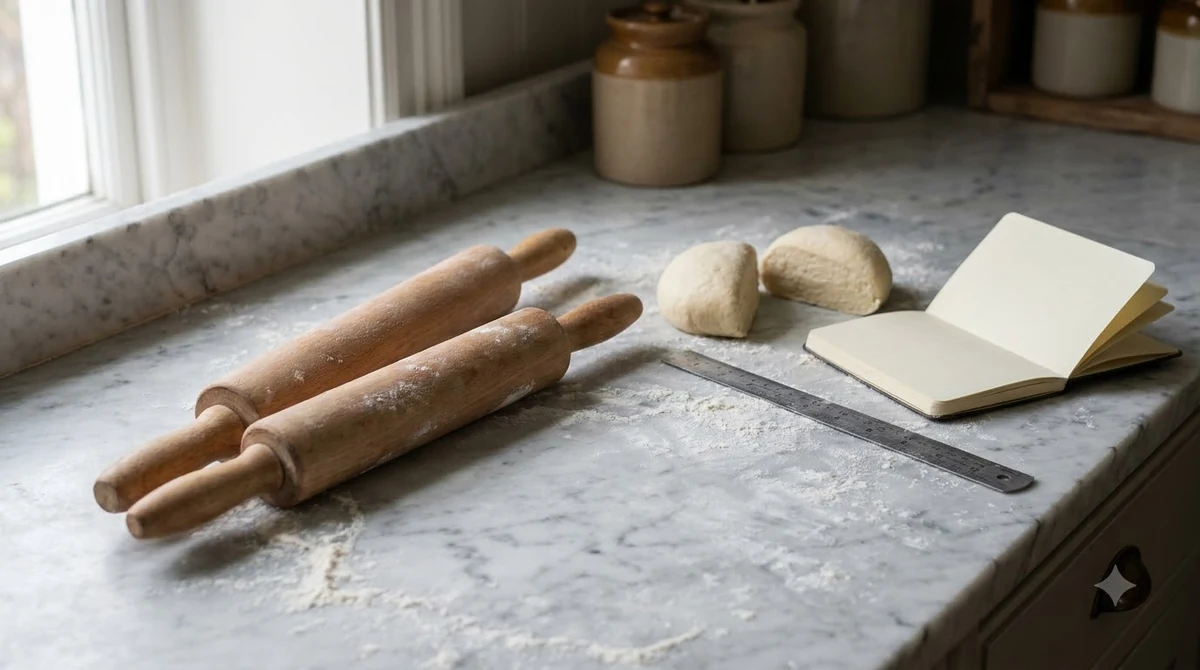
Dust the rolling pin and the surface lightly with flour, a habit that helps how to make pasta without a machine go smoothly, so the dough does not stick. Roll from the center outward, turn the sheet a quarter turn often, and lift it gently to check that it moves freely across the bench.
Keeping the Thickness Even
Even thickness is the goal in how to make pasta without a machine, and it helps the pasta cook evenly. Work slowly, check how thin to roll pasta for your shape, and if the sheet springs back, let it rest for a few minutes before you roll it again. For pici, Milk Street starts from a slab about a quarter inch thick, which is a practical target if you are new to rolling by hand.
How to Cut Hand-Made Pasta Into Shapes
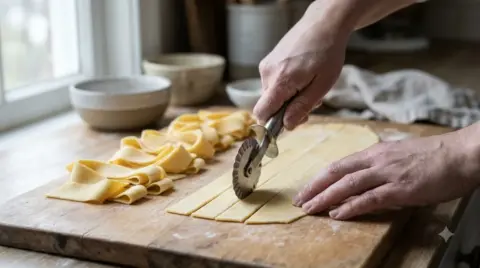
A sharp knife or pizza cutter is enough to turn a rolled sheet into ribbons, the final step of how to make pasta without a machine. Domino’s guide cuts strips about 3/4 inch wide for pappardelle, which is a good width for a sauce that clings to the pasta.
- Pappardelle: wide strips, about 3/4 inch, cut lengthwise from the sheet.
- Fettuccine: a narrower cut from the same sheet.
- Tagliatelle: a ribbon cut with the same knife, a little narrower again.
Dust the strips with a little flour and lay them in loose nests so they do not stick together while you cook the next batch.
Shapes That Need No Tools
Shapes are where how to make pasta without a machine gets creative: pici, orecchiette and cavatelli can be shaped by hand with only the dough and a counter. Milk Street’s noodle guide describes all three methods in detail.
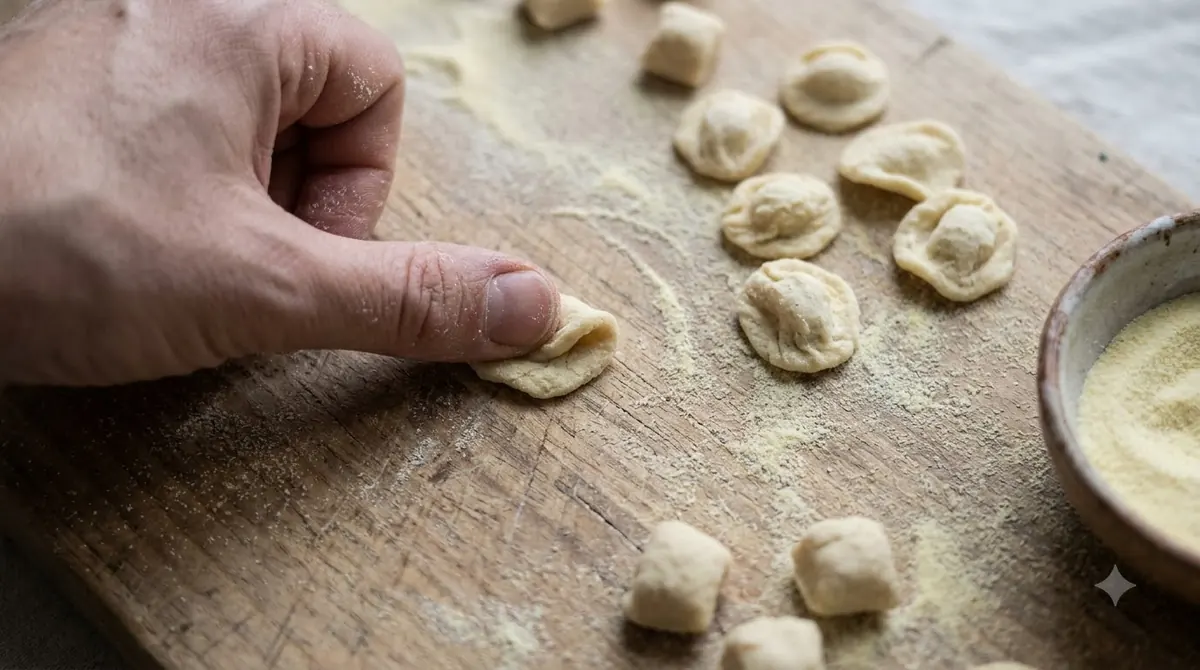
- Pici: roll a quarter-inch slab, cut quarter-inch strips, then roll each one against the counter into a long noodle.
- Orecchiette: roll ropes, cut quarter-inch pieces, then drag each one with your thumb to form a small ear.
- Cavatelli: use the same dragging motion along the tines of a fork or a gnocchi board.
Pici pasta is the simplest place to start for how to make pasta without a machine, because it needs only a knife and a counter. Orecchiette and cavatelli take more practice to shape evenly, so make a small batch first.
How Long to Cook Hand-Cut Pasta
Once you have mastered how to make pasta without a machine, timing becomes the next question. Hand-cut fresh pasta cooks in about half the time of dried pasta, according to the Wikipedia pasta article, so do not follow a dried-pasta timer (see how to cook fresh pasta for timing). Check the package for dried pasta, and taste fresh pasta early because the thickness and shape change the time.
For portions, the same article says about 0.7 kg (1.5 lb) of fresh pasta serves four generously, while about 0.5 kg (1 lb) of dried pasta serves up to four people. Use these figures as a starting point and adjust for appetite.
Common Mistakes When Rolling Pasta by Hand
Most problems with how to make pasta without a machine come from dry dough, a skipped rest or a sticking surface. Avoid these four mistakes to get a smoother sheet.
- Adding too much flour, which makes the dough dry and crumbly.
- Skipping the rest, so the sheet springs back as you roll.
- Rolling on a dry surface or with a dry pin, so the dough sticks and tears.
- Kneading for too short a time, when Milk Street sets at least 10 minutes for its eggless dough.
If the dough cracks, add water a teaspoon at a time. The Spice Girl Kitchen recommends adding water in small amounts only.
Hand-Made Pasta vs Machine Pasta
For how to make pasta without a machine you need only a pin and a knife, but the method is slower and gives less even thickness than a machine. The table compares the two methods on the criteria home cooks weigh most.
| Criteria | Made by hand | With a machine |
|---|---|---|
| Equipment | Rolling pin, knife, bench | Pasta machine, often with attachments |
| Effort | More rolling and kneading | Less rolling, more set-up |
| Thickness control | Depends on your technique | Set by the machine |
| Shape range | Ribbons and simple shapes | Depends on the attachments |
Hand-made pasta suits you if you want a few shapes and no extra equipment. If you plan to make pasta often, a machine is faster and more even, and how to choose a pasta maker explains the options.
Frequently Asked Questions
Can I make pasta without eggs?
Yes. Learning how to make pasta without a machine works with an eggless dough too, as Milk Street describes: an eggless dough made from half semolina and half all-purpose flour, kneaded for at least 10 minutes and rested for 20 to 60 minutes at room temperature.
How long should I knead pasta dough by hand?
For how to make pasta without a machine, plan for about 8 to 10 minutes, until the dough is smooth and springs back. Domino and The Spice Girl Kitchen both describe that range for egg dough.
Can I make the dough ahead of time?
The dough can wait, since Milk Street says its eggless dough can rest wrapped in the fridge for up to two days. Bring it back to room temperature before you roll it.
How thin should hand-rolled pasta be?
For how to make pasta without a machine, roll it as thin as you can manage on a floured surface, until the sheet forms a long rectangle. Milk Street uses a quarter-inch slab as the starting point for pici.
What sauce goes with hand-made noodles?
Choose a light sauce that clings to ribbons, such as olive oil with garlic or a simple tomato sauce. Keep it simple at first, so you can judge the texture of the pasta.
If you want to try how to make pasta without a machine, start with one batch and a simple ribbon shape. Once the dough feels right to you, try pici or orecchiette for a change.
 5 min readLearnHow to Make Pasta by Hand Without a MachineUpdated Nov 13, 2026
 6 min readLearnHow to Make Pappardelle by Hand Without a Pasta MachineUpdated Nov 13, 2026
 6 min readLearnHomemade Fettuccine by Hand: Rolling and Cutting Without a MachineUpdated Nov 13, 2026
 8 min readLearnHow Thin to Roll Pasta by Shape and Machine SettingUpdated Nov 7, 2026
 9 min readLearnHow to Use a Pasta Machine: A Simple Step-by-Step GuideUpdated Nov 7, 2026
 8 min readLearnHow to Make Pizza Without a Peel: Parchment and Sheet Pan MethodsUpdated Nov 11, 2026