
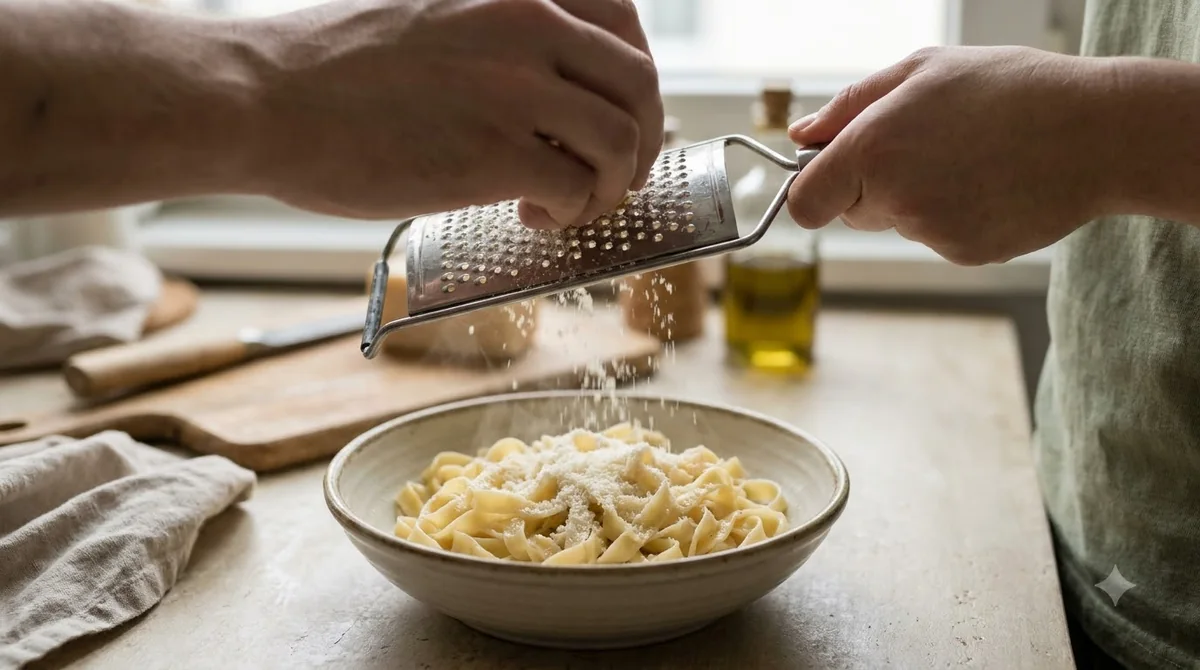

What is Asiago? Asiago is a cow’s milk cheese from the Asiago plateau in northeastern Italy, sold either fresh or aged. It holds EU protected designation of origin (PDO) status, which limits the name to cheese made in its origin area under official rules.
The age on the label decides most of the taste and texture, from soft and buttery to hard, grainy and sharp. Check the age before you buy.
What Is Asiago Cheese and Where It Comes From
Asiago is a cow’s milk cheese, classed as a Swiss-type or Alpine cheese, first made on the Asiago plateau, which spans the Veneto and Trentino-Alto Adige regions of northeastern Italy. Today the PDO milk and production area covers the whole province of Vicenza and Trento, plus parts of the provinces of Padua and Treviso.
The PDO status dates to 1996, according to the Asiago cheese entry on Wikipedia. Under EU law, the name is authentic only when the cheese is made in that area under the official production rules. Outside the EU those rules do not apply, and Asiago-style cheese is made in the United States and Australia.
The history explains the name’s reach. Between the 10th and 15th centuries, sheep raising dominated the plateau, and the early cheese was called Pegorin. Production spread to surrounding areas in the 1700s. Aged Asiago d’Allevo was made in the 18th and 19th centuries, and the shorter-aged pressato appeared in the early 1900s.
Outside Europe the name is not protected. The US Patent and Trademark Office ruled that “asiago” is generic, and in 2019 the Consorzio Tutela Formaggio Asiago abandoned its US trademark effort. Australia’s IP office struck down similar trademark efforts in 2018. So when you ask what is Asiago in an American shop, a label alone does not show that the cheese came from the PDO area.

Fresh Asiago and Aged Asiago Compared
Fresh Asiago, called pressato, ripens for only 20 to 40 days and stays soft. Aged Asiago, called d’Allevo, must rest at least 60 days in its origin area and turns firm and sharp.
| Feature | Fresh (pressato) | Aged (d’Allevo) |
|---|---|---|
| Milk | Fresh whole milk | Mix of whole and skimmed milk |
| Aging time | 20 to 40 days | At least 60 days |
| Paste | Soft, buttery, white or slightly yellowish | Firm and becomes crumbly with age |
| Typical use | Sliced for panini and sandwiches, melted over dishes | Grated over salads, soups, pasta and sauces |
So what is Asiago in practice? Think of it as one cheese family with two faces: a soft, fresh cheese for slicing and melting, and a firm, aged cheese for grating. The same name covers both, which is why the age matters so much.
The making process differs too. Fresh Asiago uses whole milk heated to about 35 °C, then to about 45 °C, and the curd is pressed for roughly four hours. Aged Asiago uses curd broken to rice-grain size, which is then drained and turned several times.
A fresh wheel measures about 30 to 40 cm across, is about 15 cm tall, and weighs 11 to 15 kg. Its rind is thin and elastic, and the paste is soft from the start.
How Long Asiago Is Aged: Mezzano, Vecchio and Stravecchio
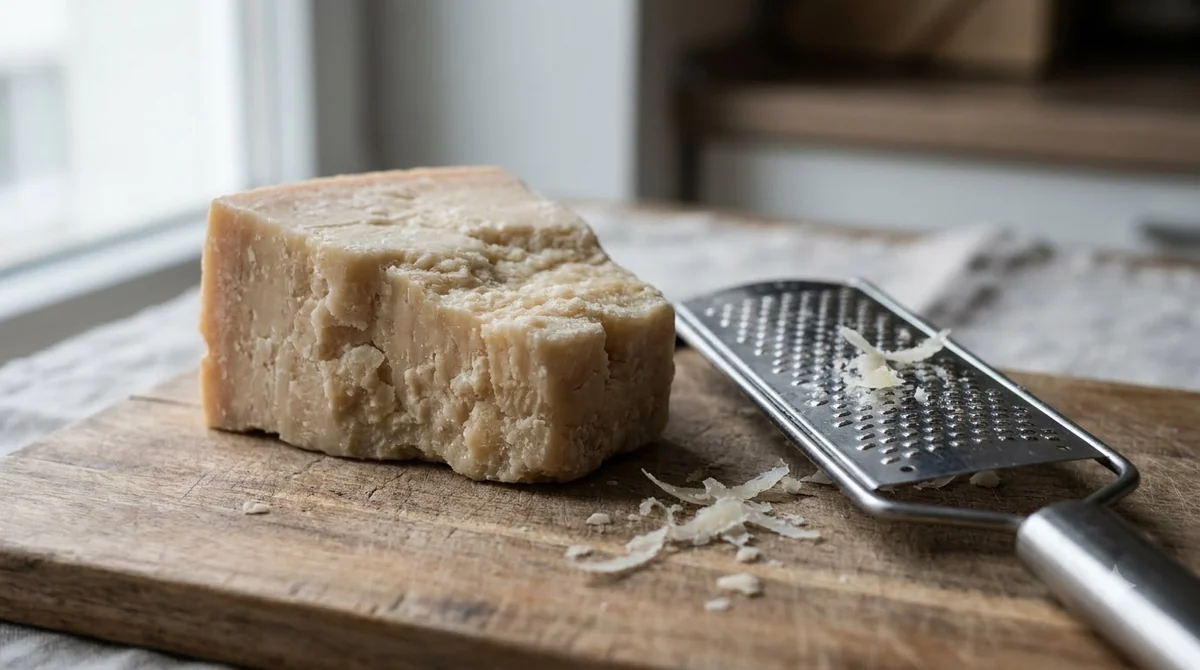
Aged Asiago comes in three grades, and the grade follows the aging time. Mezzano rests 4 to 6 months, Vecchio 10 to 16 months, and Stravecchio more than 15 months.
- Mezzano: 4 to 6 months, with a compact, straw-colored paste and a sweetish taste.
- Vecchio: 10 to 16 months, with a hard, straw-colored paste and a bitter note.
- Stravecchio: over 15 months, with a very hard, grainy paste that is amber-colored and tastes bitter and spicy.
The Asiago PDO consortium describes Stravecchio as produced in very limited quantities, with intense aromas that range from cut grass to nuts. Some secondary sources give different month ranges for Mezzano and Vecchio, so check the producer’s label or the consortium’s rules if you need exact figures.
The consortium’s Stravecchio sheet describes the wheel as cylindrical with straight sides and flat faces. It lists a height of 9 to 12 cm, a diameter of 30 to 36 cm, and a weight of 8 to 12 kg. Its paste is compact and crumbly, with an intense ochre color.
How to Recognize Real PDO Asiago
Genuine PDO Asiago carries the word ASIAGO lettered on the crust, the PDO logo, and a dairy number with an identification code on the casein label.
- The word ASIAGO lettered on the crust
- The PDO logo
- The number of the dairy where the cheese was made
- An individual identification code on the casein label
The consortium’s Stravecchio sheet presents these marks as the traceability guarantee that only PDO can offer. If you are unsure what is Asiago and what is only Asiago-style cheese, the marks settle it. When you buy a wedge, look for them on the crust and the label before you assume the cheese is Asiago.
If a wedge has no PDO markings, ask the seller which grade it is and where it was made. The answer should match what is printed on the label.
How to Use Asiago in Cooking
Aged Asiago is grated over salads, soups, pasta and sauces, while fresh Asiago is sliced for panini and sandwiches and melted over dishes.
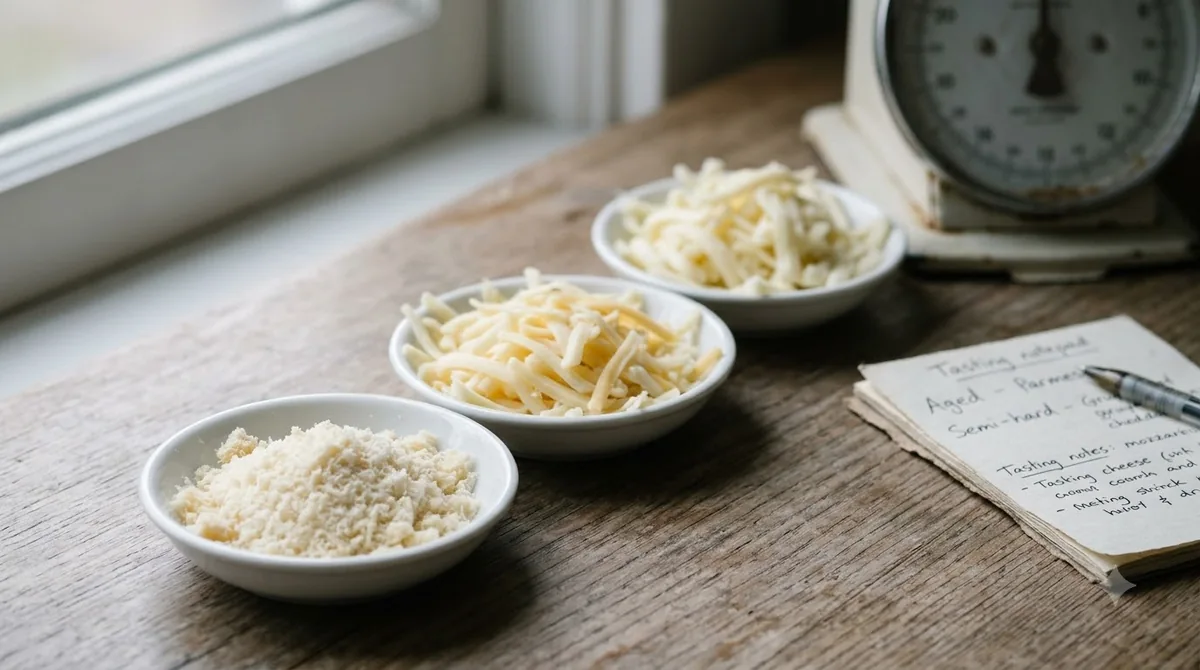
Asiago is a different cheese from Parmigiano Reggiano, so a recipe written for Parmigiano may taste different when you use Asiago. If you are comparing it with other Italian hard cheeses, our guides to Grana Padano and Pecorino Romano cover how those differ. Start with a small amount and adjust once you know the grade you have.
- Choose fresh Asiago when you want to slice it or melt it.
- Choose Mezzano or Vecchio for everyday grating over pasta or salads, ideally with a good rotary cheese grater.
- Choose Stravecchio when you want a grainy, stronger bite.
The most common mistake is grating fresh Asiago. Its paste is soft and buttery, so it will not give the fine, dry crumbs that aged cheese makes. Also do not assume every Asiago is aged, because the label tells you which grade you are buying.
Asiago Nutrition per 100 Grams
Because aged grades are rich and dense, a small grated portion goes a long way. Per 100 grams, the consortium lists 390 kcal, 31% lipids and over 28% protein for Stravecchio, so Asiago is a rich, high-fat cheese.
The same sheet gives 2.4% salt, 86 mg of cholesterol, and 990 mg of calcium per 100 grams. These figures come from the Stravecchio sheet only, so check the package for the type you buy, since fresh Asiago will differ.
Frequently Asked Questions
Is Asiago a hard cheese?
Asiago ranges from soft and buttery when fresh to very hard and grainy when aged. The age on the label tells you where a particular wedge falls on that range.
How long is Asiago aged?
Fresh Asiago is aged 20 to 40 days. Aged Asiago must rest at least 60 days, and its grades run from Mezzano at 4 to 6 months, to Vecchio at 10 to 16 months, to Stravecchio at more than 15 months.
Can I substitute Asiago for Parmesan?
Aged Asiago can stand in for a grated hard cheese in many dishes, but it tastes different from Parmigiano Reggiano. Taste a small portion first, then decide whether to use it in a full recipe.
Is Asiago made outside Italy?
Yes. Asiago-style cheese is made in the United States and Australia. Only cheese made in the PDO area under the official rules can carry the protected name in the EU.
Which Asiago is the strongest?
Stravecchio is the most mature grade, with a very hard, grainy paste and intense aromas that range from cut grass to nuts, according to the consortium.
Is Asiago high in fat?
Yes, for the Stravecchio sheet the consortium lists 31% lipids per 100 grams. Fat content varies by type, so read the label of the cheese you buy.
Now that you know what is Asiago, check before you buy whether the cheese is fresh or aged and look for the PDO markings on the crust. Match the age to the dish: fresh for slicing and melting, aged for grating over pasta and salads.
 9 min readLearnHow to Store Parmesan Cheese So It Stays FreshUpdated Nov 11, 2026
 7 min readLearnWhat Is Stracciatella? A Fresh Italian Cheese ExplainedUpdated Nov 11, 2026
 8 min readLearnWhat Is Bocconcini? Small Fresh Mozzarella Balls ExplainedUpdated Nov 11, 2026
 9 min readLearnHow to Store Dried Pasta So It Stays Fresh and Pest-FreeUpdated Nov 11, 2026
 8 min readLearnHow to Store Prosciutto So It Stays FreshUpdated Nov 11, 2026
 9 min readLearnHow to Store Olive Oil So It Stays FreshUpdated Nov 11, 2026