
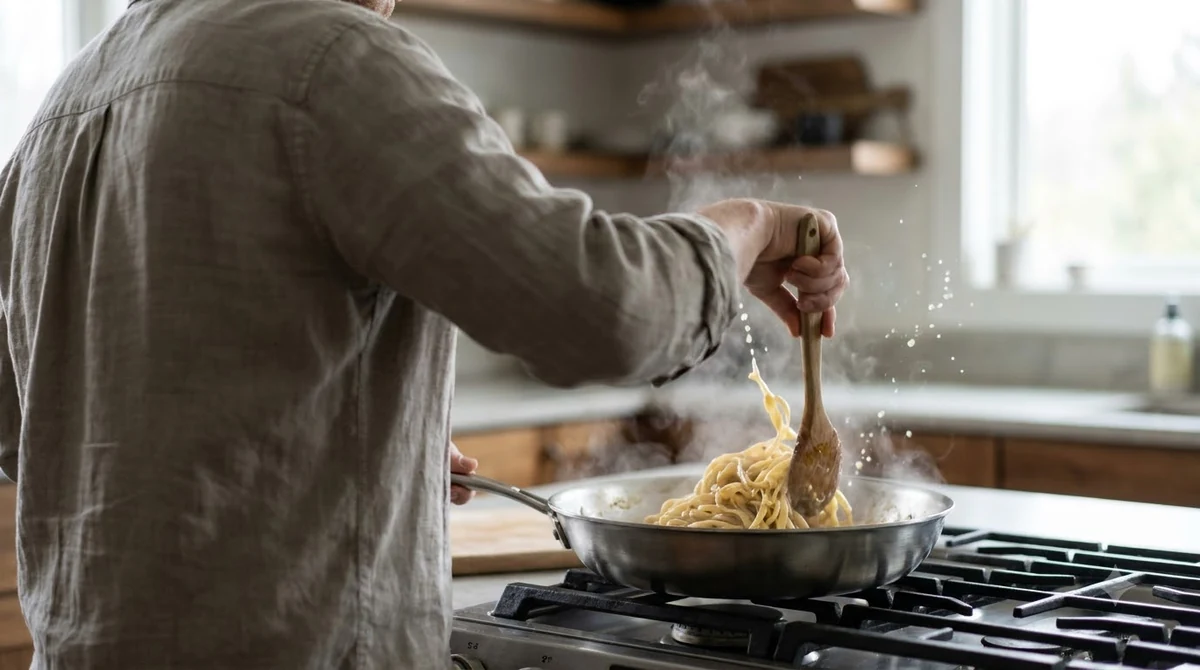

Knowing how to thicken pasta sauce comes down to reducing the liquid or adding starch. Most thin sauces hold more liquid than starch and solids, so a short, controlled fix works better than one large addition. The methods below suit homemade and jarred sauces alike.
Choose by flavor and time. Each option answers a different question about how to thicken pasta sauce: simmering keeps the taste intact, a roux or cornstarch adds body with little flavor, and cheese or pasta water adds richness along with thickness.
Why Pasta Sauce Turns Thin
A sauce thickens when its starch swells in hot liquid and holds water, a process called gelatinization.
Starch granules swell as they heat. According to Wikipedia’s entry on starch gelatinization, some native starches begin swelling at 55 °C (131 °F) and others at 85 °C (185 °F). The exact point depends on the plant source, the amount of water, the pH, and the salt, sugar, fat and protein in the recipe. A sauce that is still barely simmering may therefore feel thin even when starch is present.
Thin sauce usually has more liquid than starch and solids. Broth, cream, water and the juice from canned tomatoes each add liquid. Reducing that liquid, or adding a small amount of starch, gives you more control than dumping in a large thickener all at once.
How to Thicken Pasta Sauce by Simmering
Simmering uncovered over low heat is the simplest way to thicken pasta sauce, because it reduces the liquid without adding anything.
CookThink’s guide recommends simmering over low heat, uncovered, and stirring regularly. The page gives no set reduction time and says only that the process can take a while. Judge the sauce by how it coats the back of a spoon rather than by the clock.
- Use a wide pan, because more surface area lets water evaporate faster.
- Keep the heat low and the lid off.
- Stir regularly so the bottom does not scorch.
- Lift a spoonful and check whether the sauce coats it evenly.
Simmering concentrates salt and sugar as well as tomato flavor. Taste again near the end, and add water in small splashes if the sauce becomes too tight. If you are building a sauce from scratch, our how to make marinara sauce guide covers the base.
Thicken With a Roux
A roux is a mix of flour and fat cooked together, and it goes into the sauce before the sauce is fully thickened.
Wikipedia’s article on roux defines it as a mixture of flour and fat cooked together and used to thicken sauces. It is typically made from equal parts of flour and fat by weight. The article names three color stages, white, blond and brown. Longer browning gives a nuttier flavor but less thickening power, and a very dark chocolate roux has about one-fourth the thickening power of a white roux by weight.
For a quick version, CookThink suggests 1/4 cup butter and 1/4 cup all-purpose flour. Melt the butter, sprinkle in the flour, and cook for about 1 to 2 minutes until a paste forms. Whisk it into warm sauce and simmer until the sauce thickens.
Cook the flour until the raw taste is gone before you add liquid. Girl and the Kitchen says to cook wheat flour a little longer to avoid a raw taste, but it gives no time. Stir the roux in gradually so it does not clump. A roux is also the base of our bechamel sauce recipe.
How to Thicken Pasta Sauce With Cornstarch
A cornstarch slurry of 1 tablespoon cornstarch and 1 tablespoon cold water thickens about 1 cup of liquid once the sauce is simmering.
Girl and the Kitchen gives this ratio and says to stir for 30 to 60 seconds after adding the slurry. The sauce must reach a simmer or a gentle boil, since medium heat may not be enough. The page shows no author or date, so treat the ratio as a starting point and adjust it with a test spoonful.
The sources do not agree on the ratio. CookThink’s text describes a 2 to 1 ratio of water to cornstarch, while its step list uses 1/4 cup water with 2 teaspoons cornstarch, a much weaker mix. Start small, stir, and wait a minute before adding more.
Arrowroot, potato starch and tapioca starch also work. Girl and the Kitchen says to use a slightly smaller amount than cornstarch because they thicken faster, but it gives no measure for them.

Add Starchy Pasta Water and Cheese
Reserved pasta water and grated cheese both add starch and body, so they work best when the sauce is already close to the right texture.
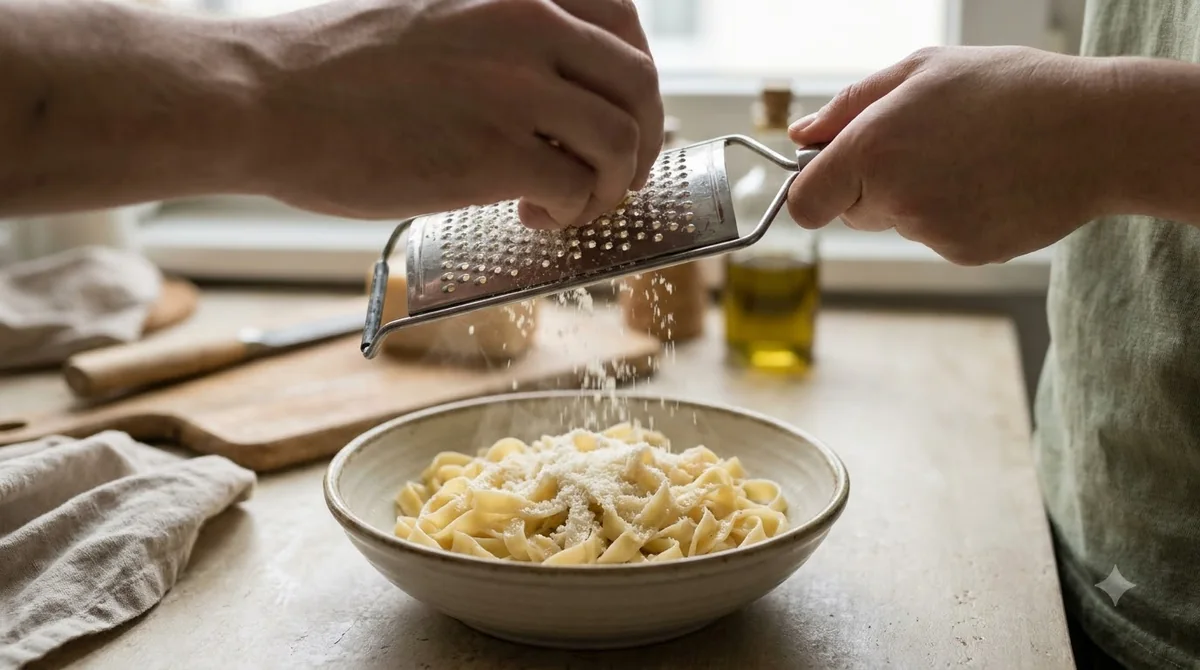
CookThink recommends reserving 1 cup of starchy cooking water before you drain the pasta. Add about 1/4 cup to the sauce, bring it to a gentle boil, reduce the heat, and simmer until it thickens. Add more only if needed. Our guide to starchy pasta water for sauce goes deeper on this method, and how to finish pasta in the sauce uses the same starch.
For cheese, add about 1/4 cup at a time. Simmer and stir until it melts into the sauce, then decide whether to add more. Hard grated cheese adds salt as well as body, so taste before you season.
- Reserve pasta water before draining.
- Add 1/4 cup, bring to a gentle boil, then simmer.
- Add grated cheese in batches of about 1/4 cup.
- Stop when the sauce coats the pasta.
Stir In Tomato Paste, Mashed Potatoes or Egg Yolks
Tomato paste, instant mashed potatoes and egg yolks each thicken a sauce in small amounts, so add them one step at a time.
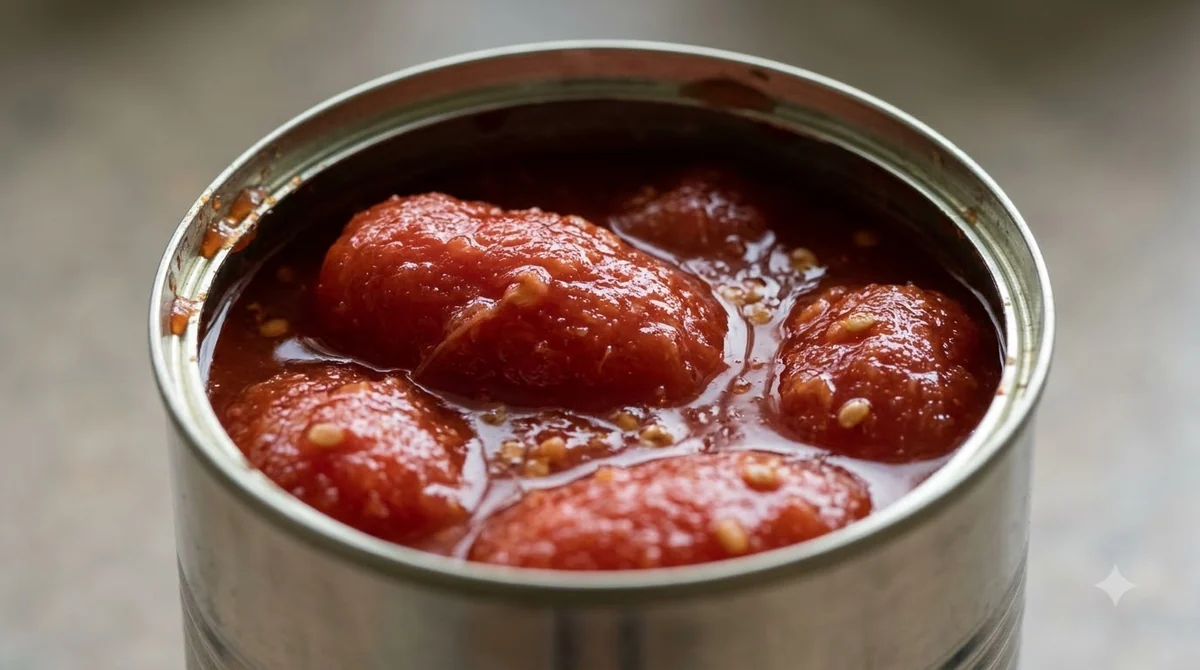
The table below lists the amounts the sources give. Where a source gives no amount, add the ingredient by the spoonful and check the texture after each addition.
| Thickener | Amount in the source | Best for | Note |
|---|---|---|---|
| Instant mashed potatoes | About 1/4, unit not stated | Tomato and cream sauces | Simmer 2 to 3 minutes, then add more if needed |
| Egg yolks | 2 yolks, whisked smooth | Cream-based sauces | Add gradually and keep the heat gentle |
| Tomato paste | No amount given | Tomato sauces | Adds body and concentrates the tomato flavor |
| Milk | Not recommended | None | Use cream, a roux or yolks for a richer sauce |
CookThink says milk is not recommended for thickening, so a cream sauce should rely on cream, a roux or yolks. Our alfredo sauce recipe is one example of a cream-based sauce. Whisk the yolks smooth before stirring them in, and keep the sauce below a hard boil so they do not scramble.
Mistakes That Make Sauce Gummy or Pasty
Too much starch makes a sauce gluey, and a sauce keeps thickening after it leaves the heat, so add thickeners in small steps and check the texture while hot.
Wikipedia’s article on starch gelatinization notes that gelatinized starch can thicken, gel and reorganize as it cools over hours or days, a process called retrogradation. A sauce that looks right on the stove may therefore set once it sits.
- Adding the whole slurry at once instead of half, then tasting.
- Thickening before the sauce reaches a simmer, so the starch never fully works.
- Stirring dry flour straight into hot liquid, which forms lumps.
- Skipping the fix for an over-thick sauce, which is a splash of broth or water.
Girl and the Kitchen suggests stirring in a splash of broth or water to thin a sauce that has gone too thick, but it gives no amount. Add it a teaspoon at a time over low heat.
What the Sources Do Not Settle
The sources read for this guide give no fixed reduction time and no measure for arrowroot, potato starch or tomato paste.
CookThink gives no reduction time for simmering, and Girl and the Kitchen gives none for any method. Their cornstarch ratios also differ, so the figures here are starting points, not guarantees. Check the recipe you are following for exact amounts.
Egg-thickened sauces need careful heat, and no food-safety figure from a government agency was checked for this guide. For those sauces, follow the cooking temperature in your recipe and confirm it with a food thermometer.
Frequently Asked Questions
How to thicken pasta sauce without flour?
Simmer the sauce uncovered to reduce it, or stir in a cornstarch slurry, reserved pasta water or grated cheese. Mix cornstarch with cold water first so it does not clump. None of the sources read gave a fixed reduction time, so check the sauce by how it coats a spoon.
Can I thicken pasta sauce with cornstarch?
Yes. Girl and the Kitchen gives 1 tablespoon cornstarch to 1 tablespoon cold water for about 1 cup of liquid. Stir for 30 to 60 seconds once the sauce is at a simmer or gentle boil, and add more only if the sauce stays thin.
Why did my pasta sauce get gluey?
Too much starch usually causes a gluey texture, especially when the sauce was thickened hard before it simmered. Starch also firms as the sauce cools, so reheat gently and add a splash of broth or water if it sets too firm.
How much pasta water should I add?
CookThink suggests reserving 1 cup of starchy water and adding about 1/4 cup to the sauce. Bring it to a gentle boil, then simmer until it thickens, and add more only if the sauce still looks thin.
Can I thicken a cream sauce with egg yolks?
Yes. CookThink uses 2 yolks, whisked smooth before they go into the sauce. Stir gradually, keep the heat gentle, and avoid a hard boil so the yolks do not scramble.
What thickens tomato sauce fastest?
For a quick answer to how to thicken pasta sauce fast, a cornstarch slurry works once the sauce reaches a simmer, though the sources differ on the ratio. Tomato paste and reduction are slower but add flavor, so pick the method that matches the taste you want.
Learning how to thicken pasta sauce well is mostly about picking the method that fits your flavor. Simmering keeps the taste closest to the original, while starch works quickly but needs careful measuring. Add thickener in small steps, check the texture as it simmers, and remember that a sauce will thicken more as it cools.
 8 min readLearnTruffle Pizza Recipe: Easy Home Method With Real Truffle FlavorUpdated Nov 11, 2026
 8 min readLearn24 Hour Pizza Dough: A Simple Timeline for Better FlavorUpdated Nov 10, 2026
 8 min readLearnPoolish Pizza Dough: How to Make It for Better FlavorUpdated Nov 10, 2026
 5 min readLearnHow to Make Pasta by Hand Without a MachineUpdated Nov 13, 2026
 6 min readLearnHow to Clean a Pasta Cutter Without Damaging ItUpdated Nov 13, 2026
 6 min readLearnHow to Make Pappardelle by Hand Without a Pasta MachineUpdated Nov 13, 2026