

Learning how to use a pasta extruder comes down to three things: dough texture, mixer speed and cutting. The machine pushes dough through a shaped plate, so the same dough can become spaghetti, rigatoni, fusilli or macaroni.
This guide explains how to use a pasta extruder step by step. It follows the KitchenAid Pasta Press manual for speeds and lengths (see our KitchenAid pasta extruder guide for the machine itself), and compares two semolina dough recipes from published sources.
What a Pasta Extruder Does
A pasta extruder is a machine that pushes firm dough through a metal plate, and the plate sets the shape of each piece.
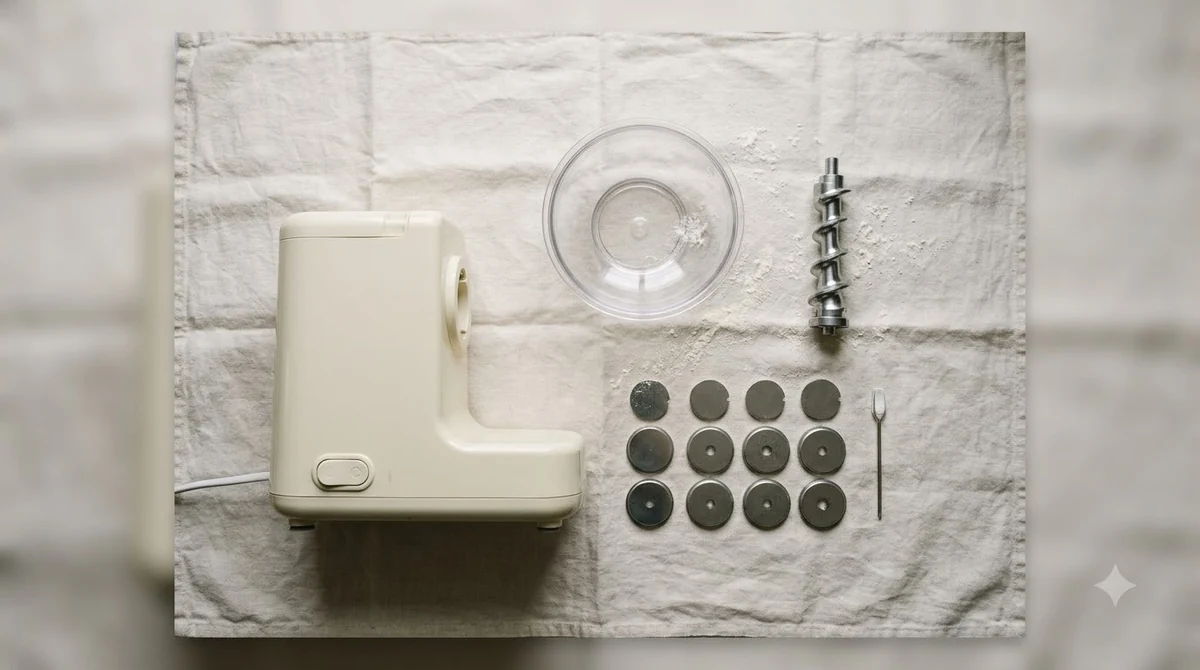
The KitchenAid Pasta Press has a housing, an auger (the screw that moves dough forward), a pasta ring that holds the plate, a swing-arm wire cutter, and a hopper where the dough goes in. It ships with six plates: spaghetti, bucatini, rigatoni, fusilli, large macaroni and small macaroni.
Knowing how to use a pasta extruder starts with knowing these parts. Other brands work on the same principle, though their parts and plate sizes differ. Check which plates your model accepts before you buy extra sets, because a plate that fits one machine may not fit another. Our list of the best pasta extruder dies can help you compare shapes.
Choose the Right Dough
Extruder dough is drier and tougher than rolled pasta dough, so it keeps its shape as it leaves the plate.
Two published recipes give a starting point. The Borough Kitchen guide, which adapts the Marcato Regina manual, uses 250 g of “00” flour, 250 g of semolina and 5 whole eggs for six servings. Caputo’s extruded pasta recipe uses 300 g of semolina and 100 g of water for four servings.
| Recipe | Main ingredients | Yield | Source |
|---|---|---|---|
| Egg and semolina dough | 250 g “00” flour, 250 g semolina, 5 eggs | 6 servings | Borough Kitchen guide |
| Semolina and water dough | 300 g semolina, 100 g water | 4 servings | Caputo Flour recipe |
The texture test matters more than the exact recipe. The dough should feel soft but not elastic, and it should not stick to your fingers. If it is too dry, add a few drops of water. If it is too wet, add more flour, because soft dough changes the shapes and makes cleaning harder. Getting the dough right is the first step in how to use a pasta extruder without jams.
How to Use a Pasta Extruder Step by Step
Assemble the parts in a fixed order, starting with the auger, so the plate seats correctly before you add any dough. These steps show how to use a pasta extruder safely with the KitchenAid model, in the order printed in the manual.
- Place the housing upside down on a counter and insert the auger until its top is flush with the opening.
- Set one plate over the opening, matching its tabs to the notches in the housing.
- Place the pasta ring over the plate and turn it by hand until it is finger tight. Do not over-tighten it.
- Push the cutter into its socket and turn it to the right to lock it in place.
- With the mixer off and unplugged, slide the accessory shaft into the hub and tighten the accessory knob clockwise.

Load and Extrude the Dough
Load the dough in walnut-size pieces, and let the auger pull it into the plate.
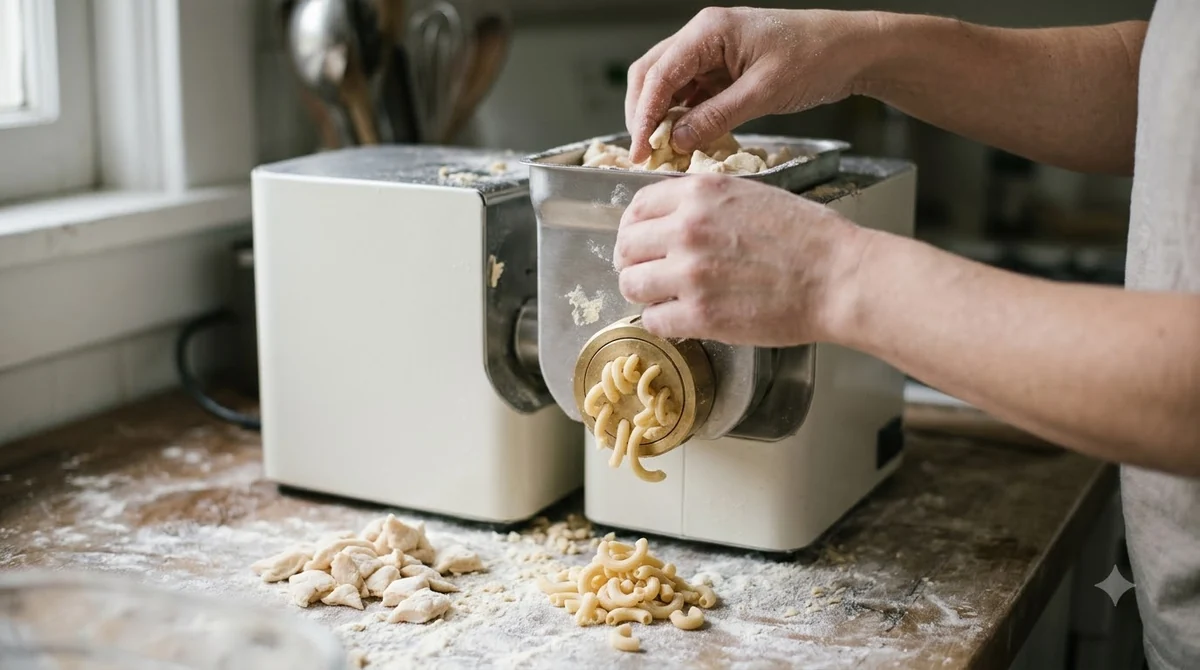
Set the mixer speed between 6 and 10, then drop the dough into the hopper one piece at a time. The dough should self-feed, and the auger should be visible before you add the next piece. Learning how to use a pasta extruder well means watching the feed rate rather than pushing harder.
Use the flat end of the combo tool only when the dough jams in the hopper and stops feeding on its own. The manual says to always use the food pusher and to keep fingers away from the openings while the mixer runs.
Set the Speed and Cut Length
Spaghetti and bucatini run at speed 10, rigatoni and macaroni at speed 6, and fusilli at speed 2 to 4 on the KitchenAid chart.
Speed is the setting that most affects how to use a pasta extruder with different shapes. The manual gives these speeds and cut lengths for each plate. Cut the strands with the swing-arm wire cutter as they leave the plate, so each piece matches the length in the table.
| Plate | Mixer speed | Approximate length |
|---|---|---|
| Spaghetti | 10 | 9.5 in (24.0 cm) |
| Bucatini | 10 | 9.5 in (24.0 cm) |
| Rigatoni | 6 | 1.5 in (4.0 cm) |
| Fusilli | 2 to 4 on the chart, maximum 6 for best results | 9.5 in (24.0 cm) traditional, 1.5 in (4.0 cm) short |
| Large macaroni | 6 | Up to 2 in (5.0 cm) |
| Small macaroni | 6 | Up to 1.5 in (4.0 cm) |
The manual sets the general rule as speed 6 to 10 depending on the shape and your preference. Slower speeds suit very short pasta, while longer shapes such as spaghetti can handle higher speeds.
Dry, Store and Cook the Pasta
Drying and storage are the last part of how to use a pasta extruder, and they decide how long the pasta keeps. Cook extruded pasta straight away, or dry it on a rack or towel before you store it.
Long shapes such as spaghetti dry best on the KitchenAid drying rack or on a towel laid flat, while short shapes should dry on a flat surface. Long noodles can be formed into a nest before drying, but the manual excludes fusilli from this step.
For storage, the manual says to air dry fresh pasta for one hour, then keep it in an airtight bag in the refrigerator for up to five days. The Borough Kitchen guide gives two days in the fridge and two months in the freezer for its recipe, so choose the window that fits your dough.
To cook, Caputo says to boil the pasta at a rolling boil for two to three minutes, then finish it in the sauce. Borough Kitchen recommends generously salted water and cooking until the pasta floats.
The manual also warns against leaving dough with eggs, dairy or meat unrefrigerated for more than one hour, which matters when you work in a warm kitchen.
Common Mistakes to Avoid
Most mistakes in how to use a pasta extruder are easy to avoid once you know them. Most jams come from dough that is too wet or too stiff, or from a pasta ring that is fitted loosely or too tightly.
- Dough that is too soft changes the shape of the pasta and makes cleaning harder.
- Dough that is too hard strains the machine.
- Refrigerated dough that has not come back to room temperature.
- A pasta ring left too loose, so the cutter cannot pass the plate, or tightened so hard that the press is damaged.
- Washing the housing with water or soap, or putting it in the dishwasher.
Protecting the plates is part of how to use a pasta extruder well. The manual also says not to use metal objects on the plates, so a wooden skewer or the cleaning brush is the safer choice.
How to Clean the Extruder
Cleaning is part of how to use a pasta extruder correctly, and the manual gives a clear order for it. Clean the extruder once the dough has dried, which takes at least two hours in one guide and overnight in the manual.
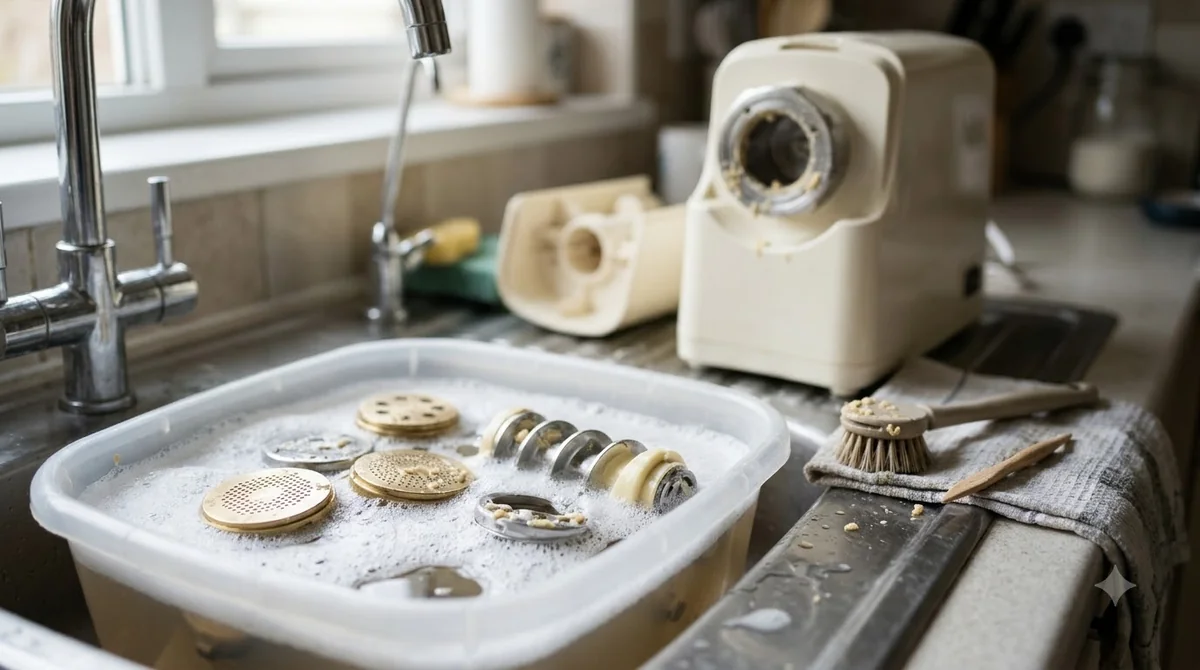
Turn the mixer off, unplug it, and take the press apart. For a deeper walkthrough, see how to clean a KitchenAid pasta extruder. The manual says to let leftover dough dry overnight on the plates before separating it. Use the cleaning brush for dried dough, and a wooden skewer or toothpick for the small holes.
Only some parts go in the dishwasher, so check this first when you learn how to use a pasta extruder at home. The auger, pasta ring, combo tool and storage case are dishwasher safe. The housing must never go in the dishwasher or under water, and the cutter and plates should be washed by hand in warm, sudsy water and dried thoroughly. If any part gets wet, dry it right away before you reassemble it.
Frequently Asked Questions
Can I use any dough in a pasta extruder?
No. The KitchenAid manual says its press is designed for pasta dough only, and inserting anything else can damage the press. Learning how to use a pasta extruder safely starts with the right dough. Use a semolina or flour dough like the recipes above, and check your machine’s manual for the recipe it recommends.
What mixer speed should I use?
Use speed 10 for spaghetti and bucatini, speed 6 for rigatoni and macaroni, and speed 2 to 4 for fusilli, as the KitchenAid chart shows. The chart answers most questions about how to use a pasta extruder at each speed. The manual also says fusilli works best at a maximum of 6.
Why does dough jam in the hopper?
Jams are a frequent problem when people learn how to use a pasta extruder. Dough usually jams when it is too wet or too stiff, or when the pieces are larger than walnut size. Feed the dough slowly, and use the combo tool only when the dough stops self-feeding.
Can I put the press in the dishwasher?
Only some parts. The auger, pasta ring, combo tool and storage case are dishwasher safe, but the housing must never go in the dishwasher or under water, and the cutter and plates should be washed by hand.
Once you know how to use a pasta extruder with one shape, the rest follows the same pattern. Start with one shape, such as rigatoni at speed 6, so you learn the feed rate before you try longer pasta. Keep the dough texture consistent, and check your own model’s manual, because speeds and parts can differ between brands.
 9 min readGear & PantryBest Pasta Extruder Dies for Home Cooks in 2026Updated Nov 17, 2026
 9 min readGear & PantryHow to Use a Pasta Pot with Strainer, Step by StepUpdated Nov 11, 2026
 9 min readGear & PantryHow to Use a Pasta Rolling Pin, Step by StepUpdated Nov 11, 2026
 8 min readGear & PantryHow to Use a Spaghetti Spoon: Step-by-Step GuideUpdated Nov 11, 2026
 9 min readGear & PantryHow to Use a Ravioli Maker: Step-by-Step for Dough and FillingUpdated Nov 10, 2026
 8 min readGear & PantryHow to Use a Wooden Pizza Peel: Step-by-Step GuideUpdated Nov 10, 2026