
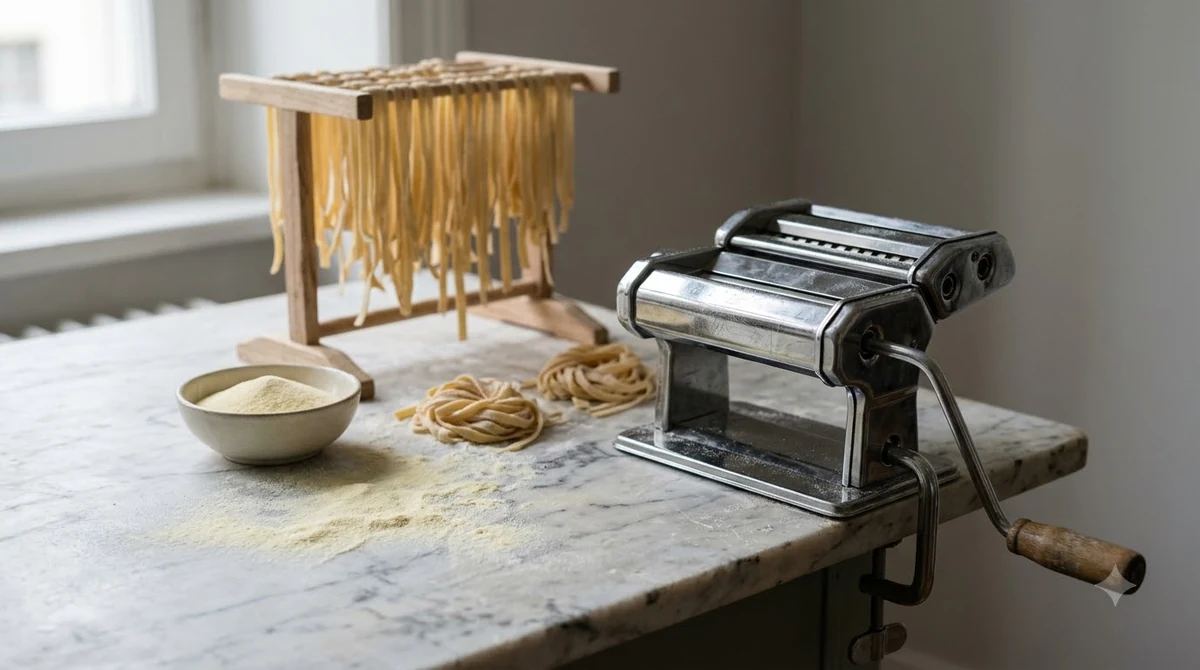

The core pasta making tools are a digital scale, a bench scraper, a wooden board, a rolling pin and a pasta machine, with a cutter and a drying rack added as you make more shapes. You can start with your hands and a knife, but a machine makes long, even sheets much faster. This guide sorts the pasta making tools by job so you know what to buy first.
| Tool | Best for | Key fact |
|---|---|---|
| Digital kitchen scale | Weighing flour and eggs | Should switch between grams and ounces |
| Bench scraper | Mixing, shaping and trimming dough | A metal blade with measurement markings is a bonus |
| Pasta machine | Long ribbons and stuffed pasta | Manual or stand mixer attachment |
| Rolling pin | Hand-rolled sheets and ribbons | An indented version cuts tagliatelle-width ribbons |
| Wheel pasta cutter | Strips, squares and sealed ravioli | The ridged edge helps seal filled shapes |
| Drying rack | Drying short shapes and long strands | Stackable wire racks suit shapes like orecchiette |

Pros & ConsViewHide
Reasons to buy
- Switches between grams and ounces, which suits weighing flour and eggs
- Tare function lets you weigh ingredients one after another in the same bowl
- Rated 4.6 stars across a very large number of Amazon ratings
Reasons to avoid
- 11 lb capacity is plenty for dough but not for big batches in a heavy bowl
- Basic design with no extras such as a built-in timer

Amazon Basics Multi-Purpose Bench Scraper
Pros & ConsViewHide
Reasons to buy
- Stainless-steel blade with 1/4-inch measurement marks, per the listing
- Contoured non-slip handle and dishwasher safe
- Rated 4.8 stars on Amazon
Reasons to avoid
- 6.1 x 4.33-inch blade is compact for large dough batches
- Square edge is not suited to scooping sticky dough from a bowl

MARCATO Atlas 150 Machine, Made in Italy, Red
Pros & ConsViewHide
Reasons to buy
- Made in Italy hand-crank pasta machine rolling dough in steps
- Includes a pasta cutter and hand crank
- Fits Marcato attachments and the optional motor
Reasons to avoid
- Only rolls and cuts the sheet; tortellini are still shaped by hand
- Takes more counter and storage space than a hand cutter
- Fixed to a countertop edge, so check clamp room

KitchenAid KSMPRA 3-pc Pasta Roller/Cutter Set
Pros & ConsViewHide
Reasons to buy
- Roller and cutter attachments for KitchenAid stand mixers
- Rolls even sheets without hand cranking
- 88% of 9K Amazon ratings are 5-star
Reasons to avoid
- Needs a compatible KitchenAid stand mixer
- Rolls and cuts the dough, but does not fill or fold tortellini
- One of the costlier tools in this guide

Fantes Ravioli Maker Stamp Set
Pros & ConsViewHide
Reasons to buy
- Sturdy aluminum frame with a wooden handle and fluted edge
- Cuts and seals 2.75-inch square ravioli in one press
- Compact, easy to store, and low priced
Reasons to avoid
- Stamps one ravioli at a time, slower for big batches
- Hand-wash only, per the listing
How we chose these pasta making tools
Each tool in this list is tied to a specific step in making fresh pasta: measuring, mixing, rolling, cutting, shaping and drying. We kept the list to tools that a King Arthur Baking guide describes as useful for home pasta, and we checked the shaping tools against a separate guide to pasta equipment. The guides do not rank brands, so the advice here sorts these pasta making tools by job rather than by brand. Each entry below says what the tool does and when it is worth buying.
The most useful point from the King Arthur guide is that you may not need much at all. In its words, “quite often you don’t need any tools other than your hands, a knife, and a good measure of patience.” Keep that in mind when you decide how much to spend. Start with the tools that save the most effort and add the rest once you know which shapes you make most often.
The basic pasta making tools you should own first
A digital scale, a bench scraper and a wooden board cover measuring, mixing and kneading. These three pasta making tools are the foundation of every pasta recipe, and most home kitchens can add them for little cost.
- Digital kitchen scale. Flour and eggs are easier to measure by weight than by volume. King Arthur notes that “a good scale doesn’t need to be expensive,” and any model that switches between grams and ounces works. Our digital kitchen scale guide covers what to check.
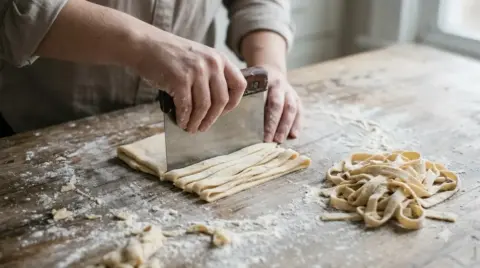
- Bench scraper. A metal bench knife, explained in our bench scraper guide, helps you bring the dough together, lift it off the board and trim the edges. Look for one with measurement markings if you want to portion dough by eye.
- Wooden board. An unvarnished wood surface gives the dough grip. Place a damp dishcloth under the board so it does not slide while you knead.
- Sheet pan. A half or quarter sheet pan lined with parchment, a tightly woven dishcloth or semolina gives finished pasta a place to rest without sticking.

Pasta machine: manual or stand mixer attachment
A pasta machine is optional, but it is the one of the pasta making tools most cooks buy after the basics. King Arthur says “I strongly recommend a pasta machine” for long ribbons and stuffed pasta, and it also states that “you don’t need a pasta machine to make fresh pasta.”
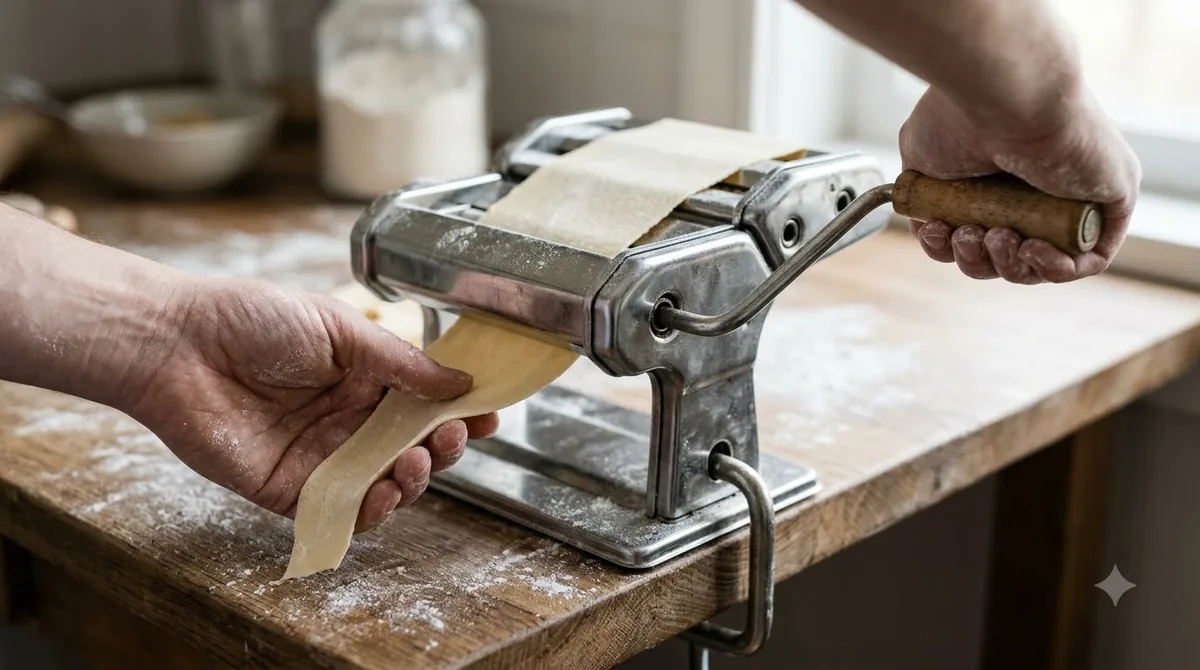
The two main options are a manual machine and an attachment for a stand mixer. A manual machine clamps to the edge of a table and is turned by hand. The Marcato Atlas 150 is a common choice in this group. Most listings describe it with rollers about 150 mm wide and 10 thickness settings, and the thinnest setting produces a sheet a little under 1 mm. Check the setting count on the model you buy, because retailers do not always agree on the exact range.
A stand mixer attachment, such as the KitchenAid pasta roller, uses the motor you already own. It is quicker for a large batch, but you need a compatible mixer and a stand mixer takes up counter space. Choose the manual machine if you have limited space or want full control over each pass of the dough. Choose the attachment if you already own the mixer and cook pasta several times a week.
- Look for a machine with a cutter attachment for fettuccine and spaghetti.
- Confirm the thickness dial has enough settings for the range you need.
- Check that the clamp fits the edge of your table before you buy.
Shaping tools: rolling pin, wheel cutter and pasta stamps
A rolling pin, a straight wheel cutter and pasta stamps cover most hand-shaped pasta. These pasta making tools work with or without a machine, and they are the cheapest route to shapes like tagliatelle and pappardelle.
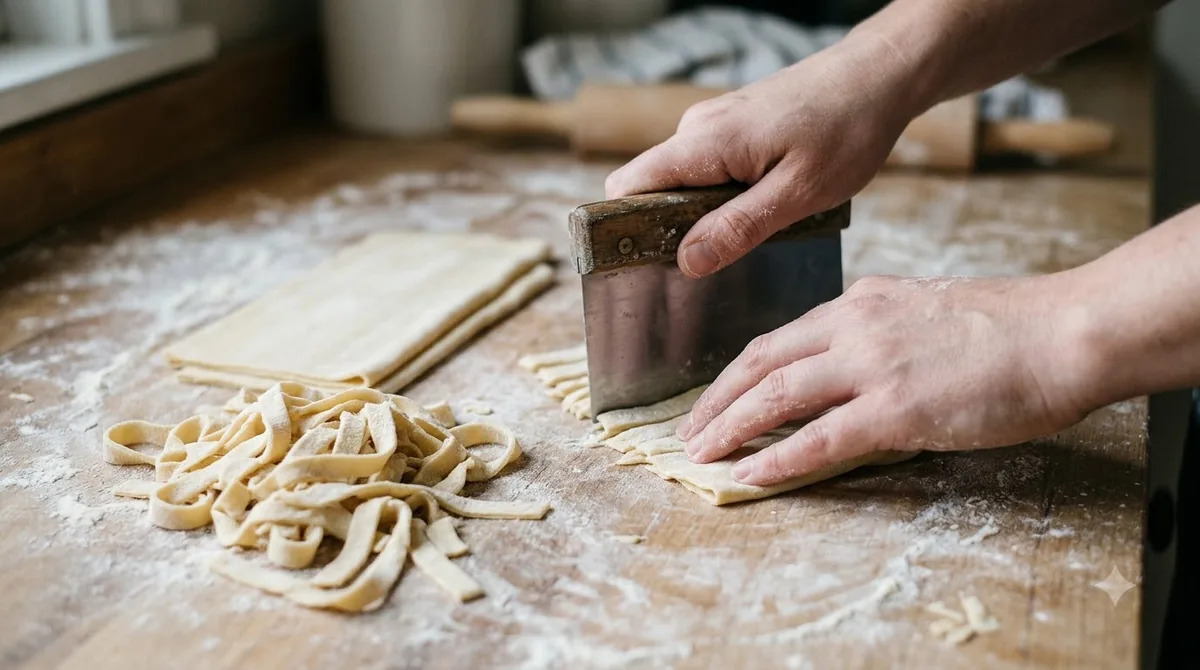
Pasta Evangelists describes an indented rolling pin that gives ribbon widths for tagliatelle or pappardelle. A plain pasta rolling pin flattens dough for sheets, lasagne and filled pasta, so choose the type that matches the shape you plan to make most. The straight wheel cutter slices sheets into strips or squares. Its ridged edge also helps seal filled shapes, which is useful for ravioli and tortelli.
Pasta stamps are round, square or heart-shaped cutters that press two layers of dough together around a filling. They are quick to use once the sheet is rolled, and they make even parcels without a lot of practice.
Filled pasta and gnocchi tools
Nesting cookie cutters and a gnocchi board are the specialty tools for filled pasta and potato dumplings. You can make both by hand, but these pasta making tools keep the shapes consistent from one batch to the next.
King Arthur recommends sturdy nesting cookie cutters for rounded stuffed shapes such as ravioli and cappelletti. Fluted and smooth-edged versions both work, and a set with several sizes gives more flexibility. A gnocchi board is a ridged wooden board. Pasta Evangelists explains that the ridges give rolled potato dumplings grooves that hold sauce. King Arthur describes these boards as generally inexpensive.
Drying and storage tools
A wire pasta drying rack keeps short shapes separate while they dry, and long strands can be hung. Fresh pasta dries best when the pieces do not touch, so give each shape room on the rack or the sheet pan. Every home pasta maker eventually needs a place to dry shapes, so treat the rack as one of the pasta making tools worth planning for.
Pasta Evangelists notes that stackable wire-mesh racks suit shapes such as orecchiette, while long pasta can simply be hung. If you cook pasta only occasionally, a sheet pan lined with parchment or semolina does the same job for a short wait before cooking.
Optional tools and what to skip
A pestle and mortar is optional. Pasta Evangelists says it is “not exactly needed to make the pasta,” although it helps when you grind pine nuts, basil and Parmesan for pesto. A chef’s knife can cut noodles by hand, so you do not need a special noodle knife.
Skip single-purpose pasta making tools that only do one shape you will rarely make, and remember that a kitchen drawer full of gadgets is not the same as a working set. Buy the tools you will use each week first, then add a specialty cutter when a recipe calls for it.
What to buy first
Buy the scale, bench scraper and board first from the pasta making tools above, then add a machine if you make long pasta often. This order of pasta making tools costs the least and covers most recipes.
- Digital scale and bench scraper for every batch.
- Wooden board and a sheet pan for kneading and resting.
- A pasta machine or stand mixer attachment for long ribbons.
- Wheel cutter, drying rack and ravioli cutters as your shapes grow.
Frequently Asked Questions
Do I need a pasta machine to make pasta at home?
No. You can roll and cut dough by hand with a rolling pin and a knife. A machine gives thinner and more even sheets in less time, which matters most for long ribbons and stuffed pasta.
What is the first of the pasta making tools to buy?
A digital kitchen scale. Weighing flour and eggs gives more consistent dough than measuring by cup, and the scale also helps with other baking.
Can I use a stand mixer instead of a manual pasta machine?
Yes, if you have a stand mixer that accepts a pasta roller attachment. Among the pasta making tools, the attachment rolls dough in the same way as a manual machine, but it needs the mixer and takes up counter space.
How do I dry fresh pasta?
Spread short shapes on a wire rack so the pieces do not touch. Hang long strands over a rack or a clean dowel. Fresh pasta should be cooked soon after shaping, so drying is mainly a short wait before cooking or storage.
Is a pestle and mortar necessary?
No. It is optional and only needed for grinding ingredients for pesto or spice mixes.
Start with a scale, a scraper and a board, then add the machine and shaping tools that match the pasta you cook most. A small set of pasta making tools covers most home recipes, and you can add specialty pieces later without buying in bulk.
 7 min readGear & PantryBest Pasta Chitarra for Making Spaghetti at Home in 2026Updated Nov 10, 2026
 8 min readGear & PantryBest Pasta Measuring Tools for Spaghetti PortionsUpdated Nov 17, 2026
 9 min readGear & PantryHow to Use a Pasta Measuring Tool for Perfect PortionsUpdated Nov 11, 2026
 8 min readGear & PantryBest Tortellini Makers: Which Tool Type Fits Your KitchenUpdated Nov 17, 2026
 9 min readGear & PantryBest Pizza Oven Tool Sets: What to Buy and What to SkipUpdated Nov 17, 2026
 8 min readGear & PantryBest Garganelli Boards for Homemade PastaUpdated Nov 10, 2026